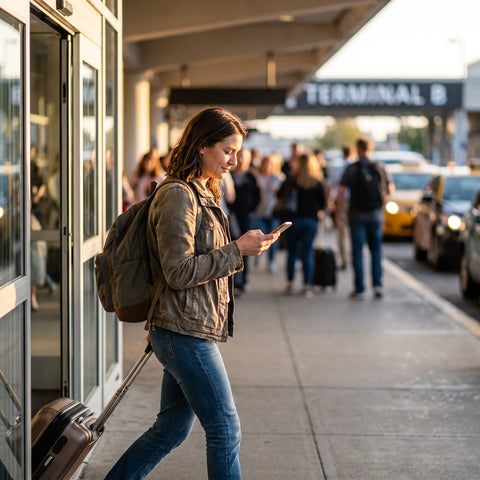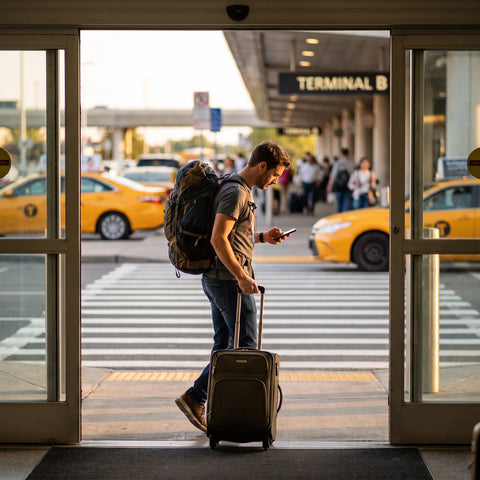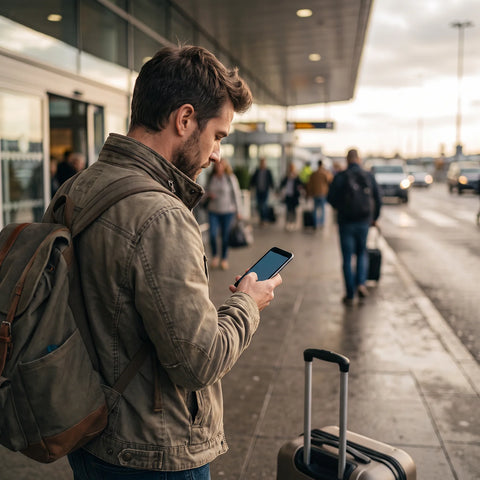
In short: a local SIM is the physical card of the operator in the country you're traveling to, which you buy upon arrival; a travel eSIM is a digital profile you install before you leave, giving you internet from the moment you land. The eSIM wins in convenience and speed; the local SIM might win on price in some destinations in Asia and Latin America, but at the cost of losing time and your active Spanish number.
It's the eternal question right before a trip: do I risk my connection on a shop or a stand upon arrival, or do I get everything ready from my couch at home? Both options work. Both have people who defend them fiercely. But when you compare how they actually work – not in theory, but the moment you step out of the terminal with your suitcase and phone in hand – the differences are much more noticeable than they appear at first glance.
Let's review it without embellishments: what each one is, how it's activated, what happens with the price depending on the destination, what risks each option has, and, above all, when one is convenient and when the other. No "the eSIM always wins" or "the local SIM is always cheaper": it depends on your trip, and here you'll be able to decide with real data, not assumptions.
What each one exactly is
Local SIM: the physical card of the destination operator
A local SIM — or "local sim," as it's also searched for in English — is simply a prepaid card you buy in the country you're traveling to, usually at the airport, at an operator's store, or at a kiosk. They give you a new phone number from that country, you physically insert it into your mobile (removing your Spanish SIM), and you get connected to the local network with the same conditions as a local customer.
It's the "traditional" option: what any backpacker has used for the last twenty years. It works on any mobile with a SIM slot, without exception, and in many countries, it's still cheap if you don't mind the process.
Travel eSIM: the digital profile you have ready
The eSIM is not a physical card, but a digital profile that is installed on the eSIM chip already integrated into most mobile phones from 2018-2019 onwards. You buy it online, install it via a QR code or a direct link before leaving home (or even at the boarding gate), and it's ready to activate as soon as your mobile detects the network of the destination country.
The key is there: you can leave it installed and activate it exactly when you land, without touching anything else. Your physical Spanish SIM stays in place, so you don't lose calls or bank verification SMS while you're away.
How each one works upon arrival at your destination
The most practical difference is not technical, it's about timing and steps. This table summarizes the real process, not the one described in theory:
| Aspect | Travel eSIM | Local SIM |
|---|---|---|
| When you contract it | Before leaving, from home | Upon arrival, at destination |
| Installation | Digital, via QR or app | Physical, by changing the card |
| Time until you have data | Practically immediate | Can take considerably longer, depending on queue and process |
| Your Spanish SIM and number | Remain active in parallel | You remove them from the phone, they are stored separately |
| Risk of losing the original SIM | None | Real, especially if you travel in a hurry |
| Compatible devices | Only mobiles with eSIM | Any mobile with a SIM slot |
| Process language | Spanish, from your own mobile | That of the country (or English, depending on luck) |
If you have never tried an eSIM and are not sure if your mobile is compatible, it is worth checking beforehand the difference between activating a travel eSIM and using your Spanish operator's roaming: they are different things and are easily confused.
How much each option costs
This is where most myths circulate. The truth is that there isn't a single answer: it depends heavily on the destination, and local operator prices change constantly (and vary according to specific promotions), so any exact figure given today may not be the same the week you travel. That said, there are patterns that repeat trip after trip:
- Southeast Asia and much of Latin America: Local operators often have very affordable data packages, designed for a market with lower wages. It's common there for a local SIM to be cheaper than a travel eSIM, especially if you stay for weeks.
- Western Europe, United Kingdom, USA, Canada, or Australia: Prepaid tourist plans from local operators are usually not particularly cheap, and in some cases, the daily price can easily exceed that of a well-chosen travel eSIM. Adding the time lost searching for a store, the comparison leans even more towards the eSIM.
- Destinations with several countries in the same trip: Here, the local SIM clearly loses, because you would need one per country. A single regional eSIM covers the entire itinerary without physically changing anything.
Our honest advice: if price is your number one priority and you're going to a single country where you know local rates are low, compare before deciding. If what matters most to you is not losing a single minute of your first day of travel, the eSIM almost always wins, even if it costs a bit more. And if you want to squeeze every gigabyte to the maximum, there are simple tricks to stretch your eSIM data that often compensate for any price difference.
A real example of this dilemma: travelers to Medellín, Bogotá, or Cartagena will find local operators with quite competitive data rates, so it's worth comparing carefully before deciding between a local SIM and an eSIM.
When each option is convenient
Choose a travel eSIM if...
- Your mobile is compatible (most iPhones since XS and mid-to-high-end Androids since 2020 are).
- You're going to Europe, the USA, Canada, Australia, or any destination where local prepaid is not particularly cheap.
- You arrive at night, on a weekend, or at a small airport with few purchasing options.
- You want to continue receiving calls or verification SMS on your Spanish number while you're away.
- Your trip includes several countries: a single regional eSIM saves you from changing cards at each border.
- You hate waiting in lines and dealing with paperwork in a language you don't master right after getting off the plane.
Consider a local SIM if...
- Your mobile does not have an eSIM and you absolutely need connectivity.
- You are going to a single destination where local data rates are clearly economical.
- Your stay will be long—weeks or months—and you prefer a monthly plan from the country's operator. This is precisely the case for many travelers who spend the low season abroad for extended periods.
- You need a real local phone number, for example, to verify banking or transport apps in the country.
Risks and common problems of each
| Risk | Travel eSIM | Local SIM |
|---|---|---|
| Buying something fake or non-functional | Low, if you buy from a reputable provider | Exists in some destinations, especially outside official stores |
| Losing the original card when changing it | Not applicable, there's nothing to remove from the mobile | Yes, it's one of the most common oversights while traveling |
| Incompatibility with your mobile | Only on mobiles without eSIM or locked | Practically never, works on any unlocked mobile |
| Running out of data in the first few hours | No, if you installed it before leaving | Yes, especially if you land late at night |
| Customer support in your language | Yes, with Spanish-speaking providers | No, in the country's language |
What almost no one tells you
The "listed price" is almost never the final price
Many SIM stands at airports advertise an attractive price that only applies to the most basic plan. When you ask for something with enough data for the entire trip, the price goes up. Always compare it with the full plan, not with the sign at the entrance.
Not all "unlimited" eSIMs are truly unlimited
Some travel eSIMs advertise "unlimited" data but apply a speed reduction (throttling) after exceeding a certain daily consumption. It's not illegal or uncommon, but it's wise to read the fine print before assuming you'll be able to make 4K video calls without limits all month.
Activate the eSIM before leaving, but don't "turn it on" until you land
A very common mistake: people install the eSIM and activate mobile data as soon as they buy it, consuming days of validity while still at home. Installation (applying the QR) and activation (starting to use the plan) are different steps. Install at home at your leisure; activate the data plan only when you are in airplane mode getting off the plane.
Keep your physical SIM in a fixed place, not in your pocket
If you're going to swap your Spanish SIM for a local one, a classic oversight is to put it "for a moment" in your pant pocket or on the security checkpoint tray and forget about it. Have a dedicated compartment in your toiletry bag or phone case just for that, and don't move it from there for the entire trip.
Dual SIM: the option almost no one utilizes
If your mobile supports dual SIM (one physical and one eSIM, or two eSIMs), you don't have to choose just one option. You can keep your Spanish line active for calls and verifications, and use the travel eSIM only for data. It's the combination that offers the most peace of mind, yet very few travelers configure it before leaving, even though it's just a matter of two minutes in the mobile settings.
Coverage is not always identical
A local SIM connects you directly to that operator's network, with the same treatment as a local customer. A travel eSIM usually works through roaming agreements with those same operators, which in practice is almost never noticeable, but in very specific rural areas of some countries, it can make a slight difference. Serious providers work with the operators with the best coverage in each country precisely to minimize this.
Frequently Asked Questions
What is a local SIM and how is it different from an eSIM?
A local SIM is the physical SIM card of an operator in the country you are traveling to, which you buy and activate upon arrival. An eSIM is an equivalent digital profile, but it is installed before the trip and does not require changing any physical card in the mobile.
Is a local SIM cheaper than a travel eSIM?
It depends on the destination. In much of Asia and Latin America, local operators usually have competitive data rates, and it may be worth the process. In Western Europe, the UK, USA, or Australia, local tourist prepaid is not usually cheap, and there, a travel eSIM often pays off, also considering the time you save.
Can I use eSIM and physical SIM simultaneously?
Yes, if your mobile has Dual SIM functionality. You can keep your Spanish SIM active for calls and verification SMS, and use the travel eSIM only for data abroad. This is the most convenient combination for most short trips.
What happens if I lose my Spanish SIM when replacing it with a local one?
It's one of the most frequent oversights while traveling: the physical SIM gets lost in the hotel, in a pocket, or during the swap. With an eSIM, this problem doesn't exist because there's no card to remove or store.
Does the travel eSIM work for calls or only for data?
Most travel eSIMs are designed for data only. For calls, people typically use WhatsApp, Telegram, FaceTime, or similar services via that data. Some premium eSIMs do include local minutes; it's worth checking before purchasing.
Can I buy and install the eSIM just before boarding?
Yes. Installing an eSIM via QR takes a few minutes, and you can do it right at the boarding gate, even using the airport's Wi-Fi at your departure location. This is one of the main advantages compared to having to find a local SIM as soon as you land.
Do I need a local SIM if I'm only staying for a few days?
For short stays, most travelers benefit from a travel eSIM: you don't waste time on the first day looking for a store and avoid the risk of losing your Spanish SIM. A local SIM starts to pay off more when the stay extends to weeks or months, especially if you need a local number for country procedures.
The decision, summarized
If your mobile supports eSIM, for most trips to Europe, the USA, or multi-country itineraries, the travel eSIM wins in convenience, security, and often price too. The local SIM still makes sense in destinations where local prepaid is clearly cheap and you're staying long enough for the process to be worthwhile. There is no universal answer: there is the right answer for your specific trip. And if what you're looking for is to land with internet, without roaming and without stress from the very first minute, that's precisely what Europe and USA eSIMs are designed for: ready before leaving home, active as soon as you land.