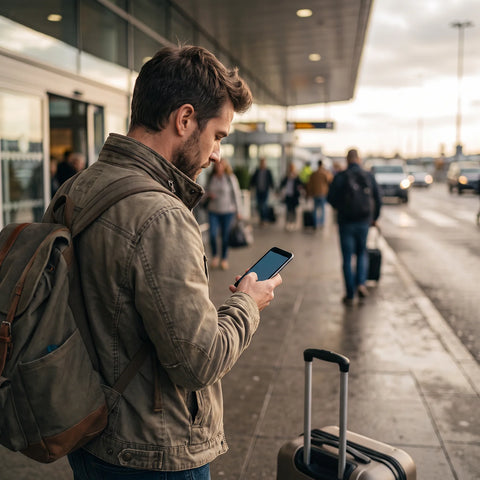
In summary: the most sought-after alternative to Airalo is an eSIM with Spanish support, plans organized by days instead of loose gigabytes, and no small print about reduced speed. PuraSim, Holafly, Saily, Nomad, and Ubigi are the most common options; which one suits you depends on your destination, how many days you'll be away, and whether you need to be able to text someone at three in the morning because the QR code won't scan.
Why so many people are looking for an Airalo alternative
Airalo works, and we're not going to say otherwise: it was one of the first to popularize buying mobile data before traveling without setting foot in a phone store at the airport. But when you really use it, in the middle of a real trip, frictions appear that aren't visible in the plan details.
The first is language. The app and support are designed for an international user, which in practice means English. If something goes wrong—the QR code doesn't scan, the plan doesn't activate, the app doesn't recognize the payment—you have to explain yourself in a language that isn't yours, and it might even be the middle of the night at your destination. The second friction is more subtle: many local plans come with few gigabytes and short validity, so if your trip extends for a couple more days, you run out of data just when you need it most.
- Support: primarily English-language support, via chat, without immediate response guarantee.
- Data: local plans often have limited GB and short validity.
- Compare countries: moving between destinations within the app takes more clicks than it should.
None of these points make Airalo a bad option. They simply explain why, once someone has experienced it, they start looking at what other eSIMs exist before making a repeat purchase without thinking.
What to look for before choosing a travel eSIM
Before only looking at the headline price, there are four things that really make a difference when you're already at the arrival airport with your phone in hand:
- Real coverage at your destination: which local operator the eSIM connects to and whether that operator has good signal in the areas you'll be in, not just the capital.
- Relationship between data and validity: 10 GB is useless if it expires in 7 days and your trip lasts 12. Count your actual days, not the gigabytes that sound good in the advertisement.
- Support language: if something fails, being able to write in Spanish and be understood immediately completely changes the experience.
- Ease of installation: scanning a QR code and getting connected in minutes, without paperwork or having to restart your phone three times.
A step many people skip and then regret: checking that their phone supports eSIM before paying anything. Almost all recent models allow it, but some unlocked phones bought outside Europe or second-hand have the function blocked by the original operator, and you only discover that after you've paid.
Traveler's tip: don't buy by individual gigabytes, buy by "useful gigabytes for your days." A 5 GB plan for 15 days usually performs better than a 10 GB plan that expires in a week, because on most trips you use your phone for maps, messaging, and quick searches, not for watching entire series with mobile data.
Comparison: Airalo vs. the main alternatives
This table summarizes the criteria that really matter when deciding between Airalo and the rest of the market. These are guiding points to show where each brand excels; for the exact price for your destination, always consult the current rate on each website, as it changes frequently depending on the country and demand.
| Criterion | Airalo | PuraSim | Holafly | Saily / Nomad |
|---|---|---|---|---|
| Spanish support | Limited, mainly in English | Yes, 24/7 via email and WhatsApp | Yes | Varies by brand |
| Data model | By GB, adjusted validity | Day-based plans with clear GB | "Unlimited" data with fair use policy | By GB or by days, depending on plan |
| Destination catalog | Extensive | More than 200 destinations | Extensive, focused on popular destinations | Extensive |
| Activation | QR scan | QR, activation in minutes | QR scan | QR scan |
| Price profile | Economical entry, limited data | Adjusted to actual travel days | Flat rate, usually more expensive | Competitive, check "unlimited" fine print |
The quick takeaway is this: Airalo competes well in terms of destination variety and entry price, but it falters in close support and the data-to-validity ratio. If your priority is having someone to write to in Spanish when something goes wrong, there are better-suited options. You can see the detailed head-to-head in PuraSim vs Airalo, or the three-way comparison with Holafly in Holafly vs Airalo vs PuraSim.
PuraSim as a direct alternative
PuraSim is designed for the Spanish-speaking traveler from the initial concept: plans with clear data and days, a catalog of more than 200 destinations, and 24/7 support in all languages via email and WhatsApp. Instead of selling you individual gigabytes that expire in a week, the plans are organized by number of days so that the data accompanies you throughout your entire trip, whether it's a weekend getaway or a whole month.
Activation follows the same simple logic you'd expect from any modern eSIM: you buy the plan for your destination, receive the QR code by email, scan it, and you're connected in minutes, usually even before leaving home using your usual Wi-Fi. There's no need to look for a physical SIM store at the airport or deal with a counter in a language you don't master as soon as you land.
What usually convinces those coming from Airalo is the human touch more than the technical specifications: if the QR code doesn't scan the first time, if the phone doesn't connect to the network upon arrival, or if you have a silly question at two in the morning, you can write in Spanish and they'll help you out via WhatsApp or email. For a trip to Europe, for example, the eSIM Europe plan covers several countries without having to buy a different line at each border; and if you return home and want backup data right here, there's also the eSIM Spain plan.
Holafly, Saily, Nomad and Ubigi: the rest of the map
Holafly
Holafly is the other big name in the sector, and its main draw is "unlimited" data in many destinations, which is convenient if you don't want to worry about gigabytes or calculate how much video you can watch. The downside is that it's usually more expensive than the rest, and it's worth reading the fair use policy, because "unlimited" sometimes means reduced speed after a certain daily consumption. If you want the full details, you can find the comparison in Holafly alternative.
Saily
Saily is a more recent option, with flexible plans by GB or by days depending on the destination. It usually works well for those looking for something simple without too much hassle, although support and plan variety by country change quite a bit from one destination to another. You can read more in Airalo vs Saily.
Nomad and Ubigi
Nomad has a similar approach to Airalo, focusing on an extensive catalog of countries and flexible plans, while Ubigi plays more on network reliability by partnering directly with local operators in various markets. Neither is a bad choice, but both share the same weakness as Airalo: support is not primarily designed for Spanish-speaking users.
The key, beyond which brand "wins" in the abstract, is what fits your destination, your days, and your travel style:
- You're going to a single country and the trip is short: a local plan by days is more than enough and you avoid paying for gigabytes you won't use.
- You're traveling through several countries: look for regional or multi-destination plans so you don't have to change eSIMs at each border.
- You consume a lot of video or make video calls: consider an "unlimited" plan, reading the fine print beforehand, versus a well-calculated GB plan.
How to switch from Airalo without complicating your life
Changing eSIMs doesn't erase your usual line. The travel eSIM coexists with your Spanish SIM thanks to the dual SIM feature that phones have had for several years: you keep your number for calls and SMS, and you use the data from the new eSIM only for browsing abroad. You can have several eSIMs installed on the same phone, although usually only one is active for data at a time.
The process to switch from Airalo to another option is straightforward: you choose the destination, buy the plan, receive the QR code by email, and activate the data line upon landing, or even before leaving home if you want to get everything ready. If you've never installed an eSIM and are a little nervous, the complete step-by-step is in how to install an eSIM, with screenshots of the actual process on a mobile phone.
A detail that many people coming from Airalo miss: you don't need to uninstall the old eSIM for the new one to work. You can leave it saved, inactive, and if you travel to the same country again in the future and still have unused data, you can reactivate it without buying anything new.
Myths and what almost no one tells you about travel eSIMs
Before deciding on one brand or another, it's worth debunking some misunderstandings that cause more than one upset during a trip:
- "Unlimited" doesn't always mean what you think. Almost all plans with "unlimited" data on the market—from any brand, not just one—apply a fair use policy that reduces speed after a certain daily consumption. If you're going to make long video calls or work remotely, check that policy before assuming you have plenty.
- Buying an eSIM on the same day as your flight is riskier than it seems. Not because of the delivery, which is usually immediate by email, but because if you have any mobile compatibility questions, trying to resolve them in a hurry in the boarding queue is the worst time. Install and activate the profile calmly, a few days in advance, even if you don't turn it on until you land.
- Activating an eSIM doesn't always mean you start consuming data immediately. In most cases, you can install the profile from home with Wi-Fi and leave the data line inactive until you land; this prevents the day counter from starting prematurely.
- In rural or inland areas, local operator coverage matters more than the eSIM brand. It doesn't matter if you buy from Airalo, Holafly, or PuraSim: all depend on which local operator they are associated with in that country, and in small towns or mountainous areas, the difference between operators can be significant. If your trip includes rural sections, it's worth checking which operator each eSIM uses in that specific destination.
- A cheaper plan with fewer gigabytes can end up being more expensive if you run short. Buying a tight plan and having to extend it halfway through your trip usually costs more in total than having chosen a plan with some leeway from the beginning. Calculate with some buffer, especially if you're going to use maps and GPS navigation continuously.
Frequently asked questions
Airalo or Holafly, which is better?
It depends on your trip. Airalo offers more variety of local plans by GB and usually has a lower entry price, while Holafly stands out for its "unlimited" data in many destinations, although it is usually more expensive. If you prioritize Spanish support and well-calculated day-based plans, an alternative like PuraSim may be a better fit than both.
How exactly does Airalo work?
You buy a data plan for your destination in their app, receive an eSIM that is installed by scanning a QR code, and when activated, your mobile connects to a local operator in that country. You don't need a physical SIM or contract: you only pay for the data plan you choose and use it for its validity period.
Is it worth looking for an Airalo alternative?
Yes, if you value support in your language, plans with clear data and days, or simply want to be able to resolve an incident in Spanish while traveling. Airalo fulfills its function, but it is not always the most convenient option for the Spanish-speaking traveler, especially if something gets complicated far from home.
Can I have Airalo and another eSIM installed on the same mobile?
Yes. Modern mobile phones allow several eSIMs to be stored at the same time, although normally only one is active for data at any given moment. You can try different brands without losing your Spanish SIM, which continues to work with your usual number for calls and messages.
Does Airalo have Spanish support?
Their customer service is primarily in English and managed via chat, which can make it difficult to resolve an urgent issue during a trip if English is not your strong suit. If Spanish support is important to you, it's advisable to look for an eSIM that explicitly offers it 24 hours a day.
What happens if my mobile is not compatible with eSIM?
If your mobile phone does not support eSIM, none of these alternatives will work for you and you will need to continue with a local physical prepaid SIM or with your usual operator's roaming. Most mid-range and high-end smartphones from recent years are compatible, but it is advisable to check before buying any plan, especially if the device comes from outside Europe or is unlocked by a third party.
When does it NOT make sense to buy a data eSIM?
If your Spanish rate already includes data roaming at no extra cost within the European Union, for a short trip to another European country you probably don't need to buy anything: your own line already covers you. Travel eSIMs make sense outside that area, on long trips, or when your operator applies surcharges that skyrocket as soon as you leave the EU.
Conclusion
Airalo is a valid option and probably the brand most people are familiar with, but it's not the only one nor always the most convenient. If what you're looking for is Spanish support when something goes wrong, plans organized by actual travel days, and a catalog of more than 200 destinations, there are alternatives that better fit how most Spanish-speaking people travel. Compare coverage, validity, and support before deciding, and don't rule out trying a different eSIM next time you pack your bags.