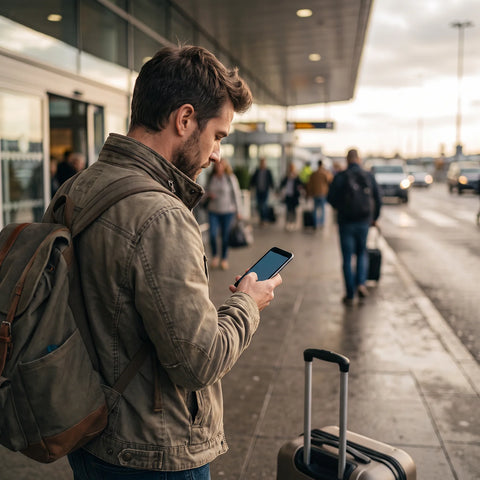
In short: Yes, eSIM data expires. In almost all travel plans, any unused GBs are lost when the validity period ends (7, 15, 30 days, etc.) and do not carry over to another trip. The clock usually starts when the eSIM is activated at the destination, not when it's purchased, so you can install it in advance without losing any days.
You bought 10 GB, used 6, and your trip ended: what happens to the remaining 4 GB? This is the question that generates the most confusion about eSIM data expiration, and also the one that causes the most money to be lost when answered incorrectly, as it leads people to overbuy "just in case." Let's examine it carefully: why it expires, when the period starts, how to avoid losing GBs, and what to do if you've already missed the deadline.
Does eSIM data expire?
Yes, it expires. A travel eSIM is not a data plan with unlimited time; it's a prepaid plan with two limits: one for quantity (GBs) and one for duration (days of validity). When the validity period ends, the plan closes, whether you've used the data or not. This is not a penalty or a provider error; it's the logic by which any prepaid data plan, whether eSIM or physical SIM, operates.
Why unused GBs expire
Behind every travel eSIM is an agreement with local operators who provide coverage for a specific period. The provider cannot reserve your capacity indefinitely, so each plan has an expiration date built in from day one. It doesn't matter if you've used 10% or 90% of your GBs; when the period ends, any remaining data balance is lost and cannot be recovered or transferred to a new plan.
This is not exclusive to eSIMs. A physical prepaid card purchased at the airport of your destination operates with the same balance and expiration logic. The real difference is that with an eSIM, you have the exact date clearly displayed in the provider's app, without having to guess or read fine print at a counter. If you're still unclear about this purchasing model, understanding what a virtual eSIM is and how it differs from a physical international chip, even though the underlying functionality is the same, will provide a good foundation.
When validity starts counting: the most confusing detail
Here's the nuance that almost no one explains well. For most travel eSIMs, the day counter does not start upon purchase, but upon activation: meaning, the moment the eSIM first connects to a network in the destination country. Buying it two weeks in advance doesn't deduct a single day from its validity.
Installing the eSIM on your phone is not the same as activating it. You can download the profile, set it up and configure it at home, and the plan will remain "dormant" until you land and your phone connects to a local tower. The clock starts then, not before.
It's always wise to confirm this in the specific plan's terms and conditions you purchase, as some providers count from the purchase date or a fixed date you choose. But the industry standard is that validity begins with the first use at the destination. This is precisely the opposite of how traditional roaming with your Spanish operator works, where you pay or use data under your usual rate from minute one, regardless of where your physical SIM is located. If you're still unsure which model suits your trip, the comparison of eSIM vs. roaming breaks it down in more detail, and for a step-by-step installation process, you can refer to the guide on how to install an eSIM.
The two clocks: validity days and GBs don't run simultaneously
An eSIM plan runs out based on which comes first: running out of GBs or the days expiring. These are two independent limits that run in parallel, and understanding this is what prevents incorrect purchases.
| Situation | What happens to your data |
|---|---|
| You use up GBs before days expire | You lose connection, but if the plan is rechargeable, you can add more GBs without reinstalling anything |
| Days expire with GBs remaining | You lose the remaining GBs, the plan closes, and there's no way to recover them |
| You use up GBs exactly when days expire | Optimal utilization: you haven't paid for data you wouldn't use |
| You buy long validity for a short trip | Unnecessary excess time; the real risk is the GBs you won't consume in time |
The practical conclusion: there's no point in buying many GBs if the duration is short, nor a very long duration if you're going to use up the data in the first few days. You need to match both variables to your actual itinerary, not to a round number that sounds good at the time of purchase.
Real examples: how it changes depending on the trip
The theory is simple, but it's better understood with specific cases, because each type of trip stresses a different clock.
If you're doing the classic route to Machu Picchu, you'll spend long stretches of the Sacred Valley without data coverage, between mountains and rural areas. This time without signal doesn't stop the plan's validity: it continues to run. Don't calculate your validity days thinking you'll "recover" that lost usage later; buy them thinking about the total duration of the trip, not just the hours you'll actually be browsing. You can find more details in the eSIM for Machu Picchu and Peru guide.
On a journey between Seoul and Busan on the KTX, validity starts the moment your mobile connects to a South Korean network, usually right after landing in Incheon, not when you board the high-speed train. If your trip is ten days split between the two cities, count the full ten days when choosing the plan, not just the ones you'll spend "actively sightseeing." More details in the guide for eSIM for South Korea, Seoul and Busan.
A multi-city trip in Colombia, such as Medellín, Bogotá, and Cartagena, is one where it's easiest to underestimate the days: between internal flights and transfers, the trip extends longer than expected, and the plan's validity might run out before you finish exploring the country. Accurately sum up the actual dates, not just the booked hotel nights.
For a combined trip to Australia and New Zealand, with two countries and several weeks ahead, it's advisable to look directly at long-validity plans (15 or 30 days) instead of risking a short one that expires mid-route and forces you to buy another from scratch.
On the other hand is the short getaway, like an Easter break: four or five days away. In this case, there's no point in buying a plan designed for two weeks, because you're sure to leave time and GBs unused. Adjust to the exact days of the trip. And here's the advice that least interests any store but saves you money: if your plan is a one-day layover at an airport with free Wi-Fi, or a weekend in a European city where your own Spanish rate already covers you without surcharges, don't buy anything. You won't even have time to use a fraction of the GBs before they expire.
How to buy just enough GBs and not waste data
The fact that data expires is not a problem if you buy wisely. The idea is not to carry the maximum GBs "just in case," but to adjust the plan to what you will actually consume. With these habits, you'll use almost everything:
- Calculate by actual trip days, not by hotel nights: multiply your usual daily consumption by the total days away and add a small margin, not double.
- Prioritize a rechargeable plan over a large one upfront: you start with an adequate amount and only add GBs if you really run short, instead of paying for data you might not use.
- Look at validity as much as GBs: a 20 GB plan for 5 days is a waste of money if you won't use even half of it in that timeframe.
- Reserve hotel Wi-Fi for heavy usage (mobile updates, backups, in-room streaming) and save mobile data for navigating outdoors; this extends your plan without changing habits. You can find more specific tips in how to save eSIM data on your trip.
- Install but do not activate prematurely: configure the profile calmly at home, without last-minute rush at the airport, and let the plan start only when you connect at your destination.
If your next destination is within Europe, understanding this is even more relevant because many travelers visit several countries on the same trip: review which validity and data amount suit your route in the eSIM Europe. For routes through the United States, where distances between cities often extend the trip longer than expected, apply the same calculation with the eSIM United States.
Common myths and errors about eSIM expiration
There are several ideas circulating about this topic that are not entirely true, or that only apply to some providers. It's important to debunk them before they lead you to make a bad purchase:
- "If I buy in advance, I lose days." False for the vast majority of travel eSIMs: the period starts upon activation at the destination, not upon payment. Buying in advance only gives you leeway to install without stress; it doesn't penalize you.
- "Data is saved for the next trip." No. Even if you have 4 GB left from a trip to Colombia, they won't be waiting for you for your next trip to Korea. Each plan is independent and closes on its due date.
- "The longer the validity, the better, just in case." Not always. Long validity for a short trip offers nothing but false peace of mind: the risk of losing GBs is still there if actual consumption is low. What truly protects your money is adjusting to the trip's duration, not buying the longest available period.
- "Installing the eSIM activates it." We've covered this, but it bears repeating because it's the error that "wastes" the most plans unintentionally: installing and activating are distinct steps for most providers. Confirm this before scanning the QR if you're concerned.
- "If I lose coverage for a few days, the clock stops." It doesn't pause. Whether you're in a rural area without signal, on an internal flight, or simply not using your phone for a couple of days, validity continues to run. The plan doesn't "know" you're not using it.
What to do with an expired eSIM
If the plan has already expired, any leftover GBs cannot be recovered: they cannot be transferred to another trip or reactivated, no matter how much you complain. What you can often do is reuse the same eSIM by purchasing a new plan on it (a top-up), without having to scan the QR code again or install anything from scratch. This depends on each provider, but it's common for rechargeable plans.
If the eSIM gives an error or doesn't connect after expiring, first check if the plan actually expired or if it's a mobile configuration issue; often the problem has nothing to do with the validity date. And if you simply won't use it again, you can delete the profile from your phone to free up space: that won't affect any new eSIM you install later. An expired eSIM does not block your physical line or any other profile: it is, quite simply, a closed plan that no longer consumes data or causes trouble.
Frequently Asked Questions
Can I recover unused eSIM data?
No. Unused GBs are lost the moment the plan's validity expires and cannot be transferred to another trip or accumulated for a future one. That's why it's advisable to adjust your purchase to the actual days and consumption of your trip, instead of buying too much data "just in case" which then expires without being used.
When does eSIM expiration start counting?
For most travel eSIMs, validity begins upon activation: when the device first connects to a network in the destination country, not when you purchase the plan. This allows you to buy and install days or even weeks in advance without using up any validity time. Always confirm the specific conditions of the plan you intend to use, as some individual providers count from the purchase date.
Can I pause data so it doesn't expire?
You cannot pause the days once the plan is active: the clock runs until the expiration date even if you don't use data on those days. The only thing that truly helps is not activating the eSIM until you arrive at your destination, as in most cases, validity starts with the first connection to the local network, not before.
What happens if I run out of GBs before the days expire?
You'll run out of data, but the plan remains "active" until the validity days expire. If your eSIM is rechargeable, you can add more GBs and continue browsing without reinstalling anything. If it's not, you would need to purchase a new plan. That's why, if you're unsure about your consumption, a rechargeable plan offers more flexibility than a fixed one.
Can leftover data from one trip be used for the next?
No. GBs are not saved from one trip to another: they are lost when the validity of that specific plan expires. What you can often reuse is the eSIM itself as a profile, by purchasing a new plan on it for your next destination. But the data left over from the previous trip does not accumulate or transfer in any way.
Do all eSIMs handle data expiration the same way?
The general model (prepaid plan with GBs and days of validity running in parallel) is the industry standard, but each provider sets its own terms and activation conditions. Before buying, always check the specific validity of the plan you're looking at and when it starts counting, because not all plans are the same even if the destination is the same.
Is it worth buying more GBs than I need just in case?
Generally no, unless you know you'll be a heavy user (remote work, lots of streaming, uploading video). The cost of running short is adding a top-up in two minutes from the app; the cost of buying too much is money lost on the expiration date. If in doubt, a precisely adjusted and rechargeable plan is better than an oversized one from the start.
Conclusion
eSIM data expires because it is, at its core, a prepaid plan with a time limit: the duration runs parallel to the GBs, and whichever runs out first wins. The important thing is not to avoid expiration, which is impossible, but to buy the right plan for your trip: calculate by actual days, prioritize a rechargeable plan, and don't activate it until you land at your destination. Adjust the GBs to what you will actually consume, and you won't give away data you've already paid for again.