In short: The Cartagena eSIM (and the rest of Colombia) gives you mobile data as soon as you land, without roaming or having to search for a store: it's installed before you travel and activated automatically upon arrival. Claro, Movistar, and Tigo provide good 4G coverage in Cartagena, Bogotá, and Medellín, and 5G is already present in major cities, though still limited.
What is an eSIM and why is it convenient for you in Colombia?
An eSIM is a SIM card that is already integrated into the phone itself, so there's no need to insert or change anything physical (you can read more about the concept in what is a virtual eSIM). You buy the data plan, scan a QR code, and that's it: your mobile is connected to a Colombian operator in a matter of minutes, without going to any store or depending on airport Wi-Fi to find one.
For a trip to Colombia, this makes special sense because the country is large and varied: moving through the historic center of Cartagena is not the same as going up to the Coffee Region or working for a few weeks from Medellín. With an eSIM activated before you leave, you land with internet already working, without depending on your Spanish company's roaming (which in Latin America can easily soar above several euros a day) or having to search for an open physical SIM store as soon as you get off the plane. The philosophy is simple: you land, activate data, and that's it. No roaming, no stress, no queues.
eSIM for Cartagena: coverage and speed in the walled city
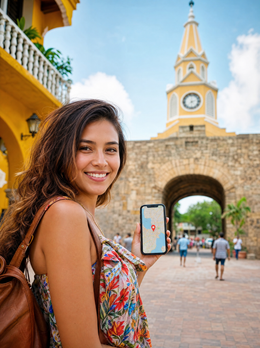
Cartagena de Indias is one of the most popular destinations for travel with an eSIM, and for good reason: it's a compact and very tourist-friendly city, with the historic center, Getsemaní, Bocagrande, and Rafael Núñez Airport relatively close to each other. Claro, Movistar, and Tigo's 4G coverage is solid throughout this urban area, including the walled city. You'll be able to navigate maps, upload photos, and make video calls without a problem as you move on foot through the colonial streets.
Where things change is on the nearby islands. If you're planning a beach day in Rosario or Barú, keep in mind that the signal weakens considerably as you move away from the continental coast: in some island areas, coverage is intermittent, and in others, it's practically nonexistent. This is not an eSIM fault; it's the infrastructure of the area itself. If you're going to spend the day there, download offline maps beforehand and let anyone you need to notify know that you might be slow to respond.
For Cartagena specifically, an eSIM with about 10-15 GB for a week is usually more than enough for typical tourist use: maps, social media, and messaging. If you're going to share a lot of live content, it's better to opt for the 20 GB plan.
Bogotá, Medellín, and the rest of the country: coverage map
Outside of Cartagena, the rest of Colombia's major cities generally have data coverage that pleasantly surprises outsiders.
Bogotá
The capital has virtually complete 4G coverage throughout the city, from the historic center of La Candelaria to the financial north. Being over 2,600 meters above sea level and a very extensive city, it's common to travel long distances by Uber or TransMilenio, and that's where the eSIM is appreciated: real-time maps, updated traffic, and constant communication with your host or travel group.
Medellín
Medellín is probably the Colombian city with the best reputation for connectivity, and it's no coincidence: it has become one of the reference destinations for Spanish-speaking digital nomads, with neighborhoods like El Poblado and Laureles full of cafes with fiber optics and well-equipped co-working spaces. The mobile network supports this reputation: 4G coverage is stable throughout the city and the Aburrá Valley, useful as a backup when the accommodation's Wi-Fi fails or when you work away from home.
Coffee Region, Cali, and Santa Marta
In the Coffee Region (Salento, Filandia, Manizales, Pereira, Armenia), coverage is good in towns and urban centers, and weakens as you go into farms and mountain trails, which is quite logical in a rural area with mountainous terrain. Cali maintains urban coverage comparable to Bogotá or Medellín. Santa Marta and access to Tayrona Park have a good signal in the city and somewhat more limited within the natural park itself, so if you're going on an excursion there, don't count on constant data in the jungle.
5G routes in Colombia: where the network is actually deployed
A common question is about 5G routes in Colombia: where it really works and if it's worth actively looking for it. The short answer is that 5G in Colombia is still in the expansion phase and is concentrated mainly in specific areas of the largest cities—Bogotá and Medellín leading the way, with Cali and some areas of Cartagena gradually joining in. Outside these urban centers, it's common to continue using the 4G network, which in Colombia is more than sufficient for browsing, making video calls, or working remotely without interruptions.
In practice, this means it's not worth choosing your operator or your eSIM plan based on 5G: a traveler's real experience in Colombia almost always depends on 4G coverage, which is extensive, stable, and what you'll actually use for most of your trip. If your phone is 5G compatible and you are in an area with that network deployed, the eSIM will automatically take advantage of it without you having to configure anything.
Operator comparison in Colombia
The three main operators in the country —Claro, Movistar, and Tigo— offer national coverage and are fully compatible with eSIM. The following table summarizes, for guidance, how they perform in the areas where tourists travel most.
| Operator | Urban Coverage | Network | Rural Areas |
|---|---|---|---|
| Claro Colombia | Very extensive (Cartagena, Bogotá, Medellín, Cali) | 4G / 5G in specific areas | The network with the best rural reach |
| Movistar Colombia | Extensive in capitals and coastal areas | 4G | Good in the Coffee Region and medium-sized towns |
| Tigo | Extensive in large cities | 4G | More irregular in remote areas |
It doesn't matter which of the three your eSIM connects you to: on a typical itinerary through Cartagena, Bogotá, Medellín, and the Coffee Region, any of them will let you browse without issues.
How many GB do you need: tourist, backpacker, or digital nomad
Before buying, it's worth thinking about how you'll use the data, not just how many days you'll be there. It's not the same for someone who occasionally checks maps and WhatsApp as it is for someone who works remotely from a cafe in El Poblado.
| Duration | Estimated Data | Traveler Profile |
|---|---|---|
| 7 days | 10-15 GB | Tourist: Cartagena or short getaway |
| 14 days | 20 GB | Bogotá + Medellín + Cartagena route |
| 1 month | 30 GB or renewable plan | Digital nomad settled in Medellín |
If your plan is a one-week getaway focused on Cartagena, with walks around the center and some excursions, using maps and social media, 10-15 GB will be ample. For a longer route that combines Bogotá, Medellín, and the coast, increase it to 20 GB. And if you're going to settle in Medellín for a while to work, consider a 30 GB plan or a month-to-month renewable one, even if you have Wi-Fi at home: the eSIM works as a backup when the Airbnb Wi-Fi fails, which happens more often than one would like to admit. You can review the updated eSIM Colombia plans directly on the product page, where the current price and the amount of GB for each option are listed.
How to activate your eSIM before landing in Cartagena or Bogotá
The process is the same no matter where you land in Colombia:
- Purchase the Colombia eSIM on purasim.com before leaving home, with plenty of time.
- Install the profile by scanning the QR code while you still have Wi-Fi (at home or at your departure airport); never leave this for the last minute at the boarding gate.
- Leave the profile installed but not activated until you land.
- Upon getting off the plane, activate the eSIM's mobile data from Settings and select the corresponding data line.
- Confirm that data roaming is enabled for that profile (this is a step many people forget and then think the eSIM isn't working).
If you've never installed an eSIM, it will take you less than five minutes and no technical knowledge is required. Even so, if you want to see it step-by-step with screenshots, we have a specific guide on how to install an eSIM that covers both iPhone and Android.
eSIM vs. roaming vs. physical SIM in Colombia
At this point, the logical question is: why not just use my Spanish operator's roaming or buy a physical SIM upon arrival?
| Option | Cost | Management |
|---|---|---|
| Spanish operator roaming | Can exceed several euros per day outside the EU | None, but risk of high bill |
| Local physical SIM | Economical, price depends on operator and point of sale | In-store process, sometimes with paperwork and queues |
| PuraSIM eSIM | Check current price on the website | 100% digital, activates automatically upon landing |
Roaming is convenient because you don't have to do anything, but outside the European Union, rates can quickly skyrocket if you don't monitor your consumption. A physical SIM is usually cheap, but it requires time: finding a store, waiting in line, and presenting documentation right after getting off a long flight. The eSIM is at an intermediate point that for most travelers is worthwhile: you buy and activate it from home, and in Colombia, it works from the minute you step into the airport. If you want to delve deeper, we have a complete comparison of eSIM vs. roaming and another on international chip vs. eSIM.
Common mistakes (and what almost no one tells you)
There are a few mistakes that are repeated much more often than they should be, and some tricks that almost no one mentions.
- Activating the eSIM too soon. If you install the profile and activate it days before traveling, some plans start counting the validity period from that moment, not from when you land. Install the QR at home, but leave data activation for when you are already in Colombia.
- Not checking phone compatibility. Not all phones have eSIM, and some unlocked models bought outside official stores may have the feature blocked. Check this in your phone settings before buying, not at the airport.
- Forgetting the APN or data roaming. Most "eSIM not working" problems are resolved by activating data roaming for that specific profile in Settings, a switch that often goes unnoticed.
- Assuming all of Colombia has the same coverage. Large cities are very well connected, but the Amazon, much of the Sierra Nevada, and parts of the Chocoan Pacific have scarce or no coverage. If you are going to these regions, let your people know that you will be disconnected for a while.
- Not keeping the original number active in parallel. The eSIM replaces data, not necessarily the voice/SMS line for verifying your banking apps. Keeping the original physical SIM just to receive SMS avoids issues with two-factor authentication codes.
- The trick almost no one uses: download offline maps of Cartagena and Bogotá before leaving. Even if coverage is good, having the map downloaded saves you in the Medellín metro or in areas with tall buildings in downtown Bogotá.
To get the most out of your GB during your trip (for example, if you've bought a limited plan for Cartagena), check out our tips for saving data with an eSIM.
Special areas: San Andrés, Amazon, and the Coffee Region
Colombia is not just the Cartagena-Bogotá-Medellín triangle, and it's worth clarifying coverage in some destinations that also generate many questions.
In San Andrés and Providencia, being in the Caribbean but connected to the national network, 4G coverage from the main operators works normally on the island, although, like any small island destination, there may be shadow spots on beaches further away from the urban area.
In the Colombian Amazon (Leticia and surroundings), data coverage is much more limited. Leticia has acceptable signal, but once you go into the jungle, it's common to lose coverage for hours or even days. If you go to that area, consider it a trip to disconnect, not a temporary exception. In the Coffee Region, the urban centers of Salento, Filandia, Manizales, and Armenia have a good signal, while farms somewhat far from the town may have weaker coverage, which is typical of any mountainous rural area.
Frequently asked questions about eSIM in Colombia
How does the eSIM work for Cartagena?
You buy the data plan for Colombia on purasim.com, install the eSIM profile by scanning the QR code before traveling (with Wi-Fi), and activate it upon landing at Rafael Núñez Airport in Cartagena. From that moment on, you have mobile data with Claro, Movistar, or Tigo without the need for roaming or finding a physical store.
Is there good 5G coverage in Colombia or only 4G?
5G in Colombia is still being deployed and is concentrated in specific areas of Bogotá, Medellín, and, to a lesser extent, Cali and Cartagena. For the everyday traveler, what truly matters is 4G coverage, which is extensive and stable in all major cities in the country.
Does the Colombia eSIM (esim colômbia) work for the entire country or only for major cities?
It works for the entire national territory where there is coverage from local operators; it is not limited to one city. The experience varies by area: excellent in Cartagena, Bogotá, Medellín, Cali, and the urban Coffee Region, and more limited in remote regions such as the Amazon or parts of the Pacific.
How many GB do I need for 7 days in Cartagena?
For normal tourist use (maps, social media, messaging) with 10-15 GB for a week in Cartagena, you'll have more than enough. If you plan to share a lot of live content or make long video calls, it's better to upgrade to 20 GB.
Does the eSIM work on the Rosario Islands or near Cartagena?
In the continental city of Cartagena, yes, without a problem. On the Rosario Islands and Barú, coverage weakens significantly the further you get from the coast; it's advisable to download offline maps if you're spending the day there. For a digital nomad based in Medellín, however, 20-30 GB per month is usually more than enough, using the eSIM as a backup for the accommodation's Wi-Fi or co-working space.
Is eSIM better than buying a physical SIM upon arrival in Colombia?
It depends on what you value. A physical SIM can be economical, but it requires finding a store, waiting in line, and presenting documentation right after landing. An eSIM is purchased and installed from home and activates automatically upon arrival, without in-person management, which for most travelers outweighs the convenience.
Are there internet restrictions in Colombia?
No. Colombia has open internet access, with no widespread blocking of platforms or messaging and video calling applications. You can find more details about the country's infrastructure in our guide to internet in Colombia. And if your route continues to another Andean country, also check out the eSIM for Peru and Machu Picchu.