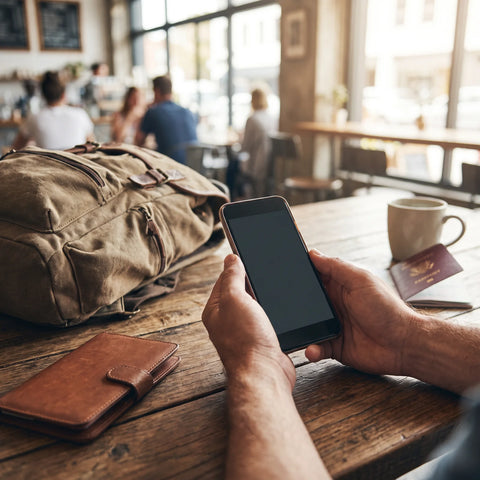
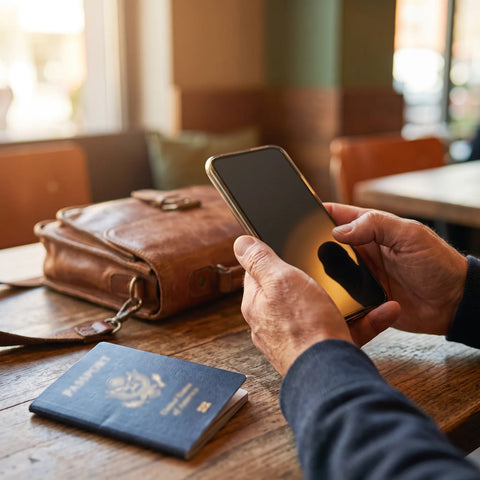
In short: An eSIM is a digital SIM card, a chip pre-installed in your phone that allows you to download a carrier's line via software. No plastic to insert or remove: you scan a QR code and you're connected. Ideal for traveling with data without roaming, without stores, and without stress.
You're hearing the term "virtual eSIM" more and more, and you might be wondering if it's different from a regular eSIM or a traditional SIM card. This guide answers the fundamental question: what is an eSIM, how it works internally, how it differs from the "virtual number" it's sometimes confused with, and how it can truly benefit you, both in your daily life and when you travel. Without unnecessary technical jargon and with real-world examples.
What is an eSIM (and why is it called "virtual")
A virtual eSIM is a digital SIM card: a chip already soldered inside the mobile phone (the "e" stands for embedded) onto which a carrier profile is downloaded via software. There is no physical card to insert; the line is installed using a QR code or a link. "Virtual" and "eSIM" here are practically synonymous, and the word "virtual" simply emphasizes that the SIM is no longer a piece of plastic, but a file.
In other words: where you used to insert a small piece of plastic with your carrier data, now that same data lives as a digital file inside the phone. The phone already comes with the hardware pre-installed; you just load the profile of the company you want on top of it. That's why you can have several lines saved and switch between them from the settings, without opening the tray or looking for the clip. If you want the conceptual basis in more detail, we expand on it in what is an eSIM.
The technology is neither new nor experimental: it is an industry standard (promoted by the GSMA, the global association of mobile operators) and has been working for years in smartwatches and connected cars before reaching phones en masse. When someone tells you that eSIM is "the future," it is actually already the present in most phones sold today.
How an eSIM works internally
Internally, the eSIM works by downloading a carrier "profile" onto the phone's integrated chip. That profile contains the same information as a traditional SIM (network identifiers, permissions, your line), but in digital format. When you install it by scanning the QR code, the phone is registered on the network as if you had inserted a physical card.
The typical flow is simple: you buy or contract a line, receive a QR code, scan it from Settings, and the phone downloads the profile. From then on, that eSIM appears as another line on your phone, with its signal icon, its data, and (depending on the case) its number. You can activate, deactivate, or delete it whenever you want, and save several at once to use as needed. The entire process of installing the eSIM takes about a minute and requires no tools.
A detail that almost no one explains: even if you delete an eSIM profile from your phone, you don't destroy the chip. The hardware is still there to install another line whenever you want. That's why the same "physical" eSIM can host dozens of profiles throughout its lifespan. However, on most phones, you can only have one or two profiles active at a time, even if you store many more in memory.

eSIM vs. Physical SIM: Real Differences
The most obvious difference is the plastic, but there are more practical nuances. The eSIM wins in convenience and flexibility; the physical SIM wins in that you can manually transfer it from one phone to another, without relying on codes or downloads. Here's the side-by-side comparison:
| Aspect | eSIM (virtual) | Physical SIM |
|---|---|---|
| Format | Digital profile (QR) | Plastic card |
| Installation | Scan a code, ~1 minute | Insert card into tray |
| Multiple lines | Yes, several saved at once | One per slot |
| Change phones | Reinstall or transfer profile | Remove and insert card |
| Can be lost | No, it's software | Yes, it's a physical object |
| Buy while traveling | Online, from the couch, instantly | At a store at the destination |
| Compatibility | Only recent phones | Virtually any phone |
For everyday use at home, either one will work. The eSIM shines when you want flexibility: adding a second line, trying a plan without going to a store, or carrying travel data without removing your usual SIM. If you're weighing whether to pay your carrier's roaming fees or load a data eSIM, we compare them in depth in eSIM vs. roaming.
Virtual eSIM and virtual number: they are not the same thing
There's a very common confusion here. Many people search for "virtual eSIM" thinking of a "virtual number" to receive SMS or calls over the internet, and it's not the same thing. An eSIM is your phone's digital SIM (with data, and sometimes with a number on that network). A virtual number is a line that lives in an app or in the cloud, designed for verifications or secondary lines, without a physical chip or connection to the mobile network.
The distinction matters when making a purchase. If what you want is data for travel, you're looking for a data eSIM: it connects to the local network of the country and you can browse. If what you want is a number to receive codes or separate work from leisure, that's another product (a virtual number app). Many travel eSIMs only provide data, without a number for calls, and that's perfect: for talking, you have WhatsApp or internet calls. If you're concerned about bank verifications when you're away, the key is to keep your home line active for SMS while the eSIM provides you with data.
What an eSIM is for in daily life and while traveling
The question of what an eSIM is for has two main answers. In daily life, it allows you to have two lines on one phone without a dual slot: for example, your personal and work lines, or your home plan plus a separate data plan. You switch between them from settings, without manipulating anything and without any cards falling under the sofa.
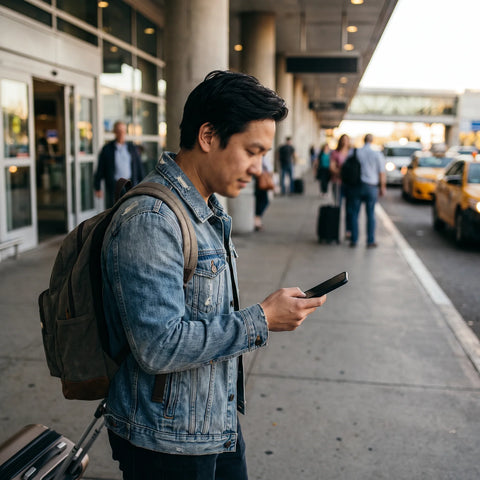
But where it really shines is when traveling. With a loaded data eSIM, you arrive in another country and browse instantly without changing your SIM or paying roaming fees: you keep your home number active for bank SMS and data goes through the eSIM (dual SIM mode). You buy the destination plan before leaving, scan the QR, and land connected. You land with internet, no roaming, no stress. You can choose the country you need, from an eSIM for Europe to destinations worldwide.
Real example: you're going away for ten days. Instead of buying a local chip with paperwork or spending on roaming, you install a data eSIM before you fly. Your Spanish number continues to receive SMS, and you browse with the destination's rate from minute one, as soon as you get off the plane.
What if the trip crosses several countries? There are regional plans that cover entire areas with a single profile, so you don't have to install an eSIM for each border. For a long trip or for someone who travels constantly, a plan like a global eSIM for 139 countries avoids having to think about coverage destination by destination.
How to check if your phone supports eSIM
Not all mobile phones have the integrated chip, although more and more do. The general rule: iPhones from XR/XS (2018 onwards) and most recent mid-to-high-end Android phones (Samsung Galaxy S and several A, Google Pixel, many Xiaomi) support it. Very old or very basic models do not. And beware of a little-known detail: some versions of the same model sold in certain countries (China, for example) may come without eSIM even if the "catalog" model does have it.
The quick way to check is to look in your phone settings to see if the option to add a data plan or eSIM appears, or dial the code that shows the EID (the eSIM chip identifier) on the keypad: if you have an EID, you have an eSIM. You have everything in the list of eSIM-compatible phones. It's worth checking before buying any plan, so you don't get any surprises when you arrive at your destination.

Real advantages and limitations of eSIM
The eSIM has clear advantages, but it's also important to know its limitations to use it well and without false expectations. It's not magic: it's a very convenient tool with a couple of conditions.
- Advantage: no plastic, it can't be lost, damaged, or forgotten in a drawer.
- Advantage: several lines saved and quick switching from settings.
- Advantage: ideal for traveling without roaming or queues in destination stores.
- Advantage: you buy it online and receive it instantly, no waiting for any shipment.
- Limitation: you need a compatible phone and, to install the profile, a connection (ideally WiFi).
- Limitation: changing the eSIM to another phone means reinstalling or transferring the profile; simply moving it manually is not enough.
Overall, for almost everyone, the advantages far outweigh the limitations. The only serious requirement is having a compatible phone; everything else is a matter of learning the flow once. And once you try it on a trip, it's hard to go back to the old chip.
Common myths and mistakes (what almost no one tells you)
There are half-truths circulating about eSIMs that confuse many people. These are the most common pitfalls and how to avoid them:
"eSIM uses more battery"
Not because it's digital. Consumption depends on the signal and data usage, just like with a physical SIM. If anything, having two active lines at once (dual SIM) can consume slightly more, because the phone maintains two connections. The solution is simple: deactivate the line you're not using at that moment from the settings.
"I'll install the eSIM when I arrive at the destination airport"
This is the classic mistake. To download the profile, you need a connection, and when you land in a new country, you don't have one yet. Install and download the eSIM before leaving home, using your WiFi. Activating the line is a different matter, which you can leave for the destination. We clarify this key difference in activating the eSIM before or after traveling.
"The QR code works for multiple phones or multiple times"
Almost never. Most eSIM QR codes are single-use: once you install the profile on a phone, that QR code is "spent." That's why you shouldn't casually delete the eSIM thinking you'll reinstall it with the same code, and why you should never share your QR code with anyone.
"With a data eSIM, I lose WhatsApp and my number"
False. Your number and apps remain linked to your main SIM or eSIM. A travel data eSIM only provides internet; WhatsApp, Telegram, and your home number continue to function normally as long as you keep your usual line active for SMS and calls.
Little-known trick: use your eSIM as a pocket router
If your mobile allows it, you can share your eSIM's data connection with your laptop or tablet via WiFi. This is a cheap way to have internet for several devices on a trip without having to hire a separate router. We tell you how in share eSIM internet via hotspot.
How to get started with your first eSIM, step by step
If it's your first time, here's the quick way to avoid mistakes:
| Step | What you do | Tip |
|---|---|---|
| 1. Check your phone | Verify it supports eSIM (EID or settings) | Do this before buying anything |
| 2. Choose your plan | Destination country or region and data you need | Estimate high: maps and photos consume data |
| 3. Buy online | You receive the QR code or installation link | Save the email with the QR code |
| 4. Install with WiFi | Scan the QR code from Settings, at home | Don't leave it for the destination airport |
| 5. Activate at destination | Turn on eSIM data upon arrival | Set the eSIM as your data line |
With these five steps, you've got 99% of cases covered. The first time it takes five minutes; after that, loading a new eSIM is a matter of a couple of taps.
Frequently Asked Questions
Are virtual eSIM and eSIM the same?
Practically yes. "Virtual eSIM" is a way of emphasizing that the SIM card is digital, without plastic, integrated into the mobile. Technically it is the same as an eSIM: an operator profile that you download by software onto the integrated chip of the phone. The two terms are used interchangeably.
Does an eSIM give me a phone number?
It depends on the plan. Data eSIMs for travel usually only provide data, without a number for calls, because you use WhatsApp or internet calls to talk. Other eSIM lines do include a number. If you're looking for a number to receive verification SMS, that's a "virtual number," a different product from a data eSIM.
Do I need internet to install an eSIM?
Yes, to download the profile you need a connection, ideally WiFi. That's why it's recommended to install the eSIM at home before traveling: you scan the QR with WiFi and it's saved. Once installed, the connection to the destination network activates automatically without needing WiFi.
Can I have both an eSIM and a physical SIM at the same time?
Yes, that's one of its greatest advantages: dual SIM mode. You keep your physical home SIM for calls and SMS, and use the eSIM for data (for example, when traveling). You choose which line uses data from the settings. This way you keep your number and browse with another plan at the same time.
Is eSIM secure?
Yes, it's at least as secure as a physical SIM. The profile is stored encrypted on the integrated chip and you can't lose it like a card. Also, since it's not a physical object, no one can remove it from your phone. Always install your profiles from reliable sources and don't share your QR code with anyone.
What happens to my eSIM if I change phones?
It doesn't transfer automatically like a physical card. On newer phones, there are functions to transfer the eSIM from one phone to another, but in many cases, you'll have to reinstall the profile. With travel data eSIMs, if the QR code is already used, you might need a new profile, so check before changing phones in the middle of your trip.
Does the eSIM work in any country?
The technology is the same worldwide, but each plan covers specific countries. Before purchasing, check that your destination is included in the plan's coverage. For trips through multiple zones, regional or global plans prevent you from installing a different eSIM at each border.
Conclusion
An eSIM is simply the traditional SIM card, but in digital format and inside your mobile: no plastic, with several possible lines, and quick switching from settings. It serves to separate personal and work, and especially to travel with data without roaming or stores. Just check that your phone supports it and that you install the profile with WiFi before leaving. If you're traveling, a data eSIM is the most convenient way to land with internet, no roaming, and no stress at your destination.