In short: For a week in Colombia, an 8-10 GB eSIM covers the vast majority of travelers who combine maps, WhatsApp, and social media with hotel Wi-Fi. Install it before leaving home and activate it upon landing in Bogotá, Medellín, or Cartagena, with no queues or roaming fees.
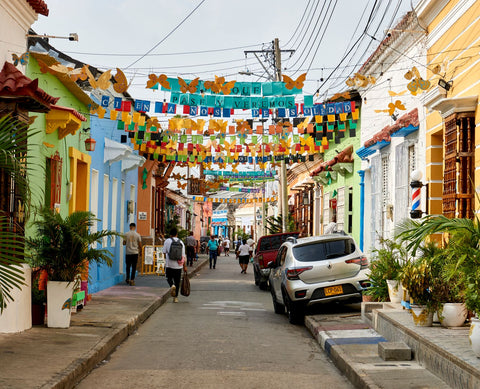
A week in Colombia offers a lot: Bogotá and its almost 2,600-meter altitude, Medellín with its eternal spring climate, Cartagena de Indias and its colonial streets, or a getaway to the Coffee Region if you prefer to swap city life for a farm. Whatever your itinerary, you'll need internet for getting around with Uber or InDriver, booking a table, translating a menu, or simply letting people back home know you've arrived safely. The eSIM solves this without relying on your Spanish operator's roaming, which skyrockets in Colombia once you leave the European Union.
This guide is specifically designed for 7-day trips: how much data you'll need exactly for that period, how to distribute it day by day if your route combines two or three cities, and what mistakes most first-time eSIM users in Colombia make. If you're looking for a city-by-city coverage breakdown, we have a separate guide focused on Bogotá, Medellín, and Cartagena in more detail; here we focus on the week-long trip as a whole.
How many GB do you need for 7 days in Colombia?
The short answer: it depends on how much time you spend away from hotel Wi-Fi. Colombia has good Wi-Fi coverage in accommodations and most restaurants and cafes in tourist areas, so your actual eSIM consumption usually concentrates on commutes, excursions, and moments when you're wandering around without a fixed destination, checking your phone every two minutes to avoid getting lost.
| Traveler profile | Recommended GB for 7 days | Typical use |
|---|---|---|
| Basic (lots of hotel/Wi-Fi) | 3-5 GB | WhatsApp, occasional maps, little Instagram |
| Moderate (active tourist) | 8-10 GB | Almost constant Google Maps, photos, social media, transport apps |
| Intensive (remote work or lots of content) | 15-20 GB | Video calls, video uploads, streaming outside of Wi-Fi |
One detail almost no one considers when calculating GB: in Bogotá and Medellín, you'll use Maps much more than you think, because traffic constantly changes Uber routes, and the driver himself sometimes asks you to guide them via chat. If your week includes these two cities plus a third destination, it's better to stick to the higher end of the table than the lower.
Typical one-week itinerary and how to distribute data
Most people searching for "esim Colombia 1 week" follow some variation of this route: 2-3 days in Bogotá, 2-3 days in Medellín, and the rest in Cartagena, or they replace one of the three with the Coffee Region. It's helpful to think about data consumption in stages, not as a single total:
- Bogotá (days 1-2 or 1-3): El Dorado Airport has signal from passport control itself, so you can activate the eSIM as soon as you land and order an Uber without relying on the airport Wi-Fi. La Candelaria, Chapinero, and Usaquén have solid coverage; on the TransMilenio, the signal holds up well even during peak hours, although crowds cause speeds to drop somewhat.
- Medellín (days 3-4 or 2-4): Very good coverage throughout El Poblado, Laureles, and the city center. If you take the graffiti tour in Comuna 13, keep in mind that between the escalators and narrow alleys, the signal fluctuates; it's not a dead zone, but don't expect fiber-optic speeds either. The Metro and Metrocable maintain reasonable signal on most sections.
- Cartagena (last 2-3 days): The historic center, Getsemaní, and Bocagrande have ample coverage. Where you will notice a difference is on an excursion to the Rosario Islands: on the boat trip and once on the island, the signal drops significantly, so download your map and hotel directions offline before leaving the pier.
If, instead of Cartagena, your week includes the Coffee Region (Salento, Filandia, a coffee farm near Armenia or Manizales), reserve a bit more data margin: in rural farms, coverage is more irregular than in the city, and many rely on a single antenna serving several kilometers around.
eSIM plans for Colombia
At PuraSIM, you have several eSIM plans for Colombia designed for different durations and data volumes, from the tailored pack for those who stay glued to hotel Wi-Fi to the plan designed for digital nomads who need to work on the go. For a standard week, the 8-10 GB range with 15-day validity is usually the best fit: it gives you plenty of leeway in case your return flight is delayed or you decide to extend your trip by a couple of days.
For the exact price of each plan, consult the product sheet: mobile data prices change frequently, and we prefer that you always see the current rate at the time of purchase, not a figure that may become outdated.
How to activate your eSIM before flying to Colombia
- Buy the eSIM in advance, even weeks before your trip. It doesn't expire from buying it early: the validity counter starts when you activate it, not when you buy it.
- Install it at home with good Wi-Fi: Settings → Mobile data (or Mobile networks) → Add eSIM → scan the QR code. This step only downloads the profile, it doesn't consume data from Colombia yet.
- Leave it installed but not activated as your primary data line until you land. This way, you continue using your Spanish SIM normally during the flight and layover.
- Upon landing in Colombia, activate the eSIM as your data plan and deactivate roaming on your Spanish line to avoid a surprise on your bill.
- Check the network name in the status bar: if you see the Colombian operator associated with your eSIM, you have data.
If this is your first time using an eSIM and you want step-by-step instructions with screenshots for your phone model, we have a complete eSIM installation guide. And if you're still weighing eSIM against traditional roaming, this comparison of eSIM versus roaming clarifies when each option is worthwhile.
What almost no one tells you before traveling to Colombia with an eSIM
Beyond the theory, there are a number of details that are only learned by traveling or asking someone who has already done it:
- Don't activate the eSIM on the plane "just in case." Some travelers activate it during the flight thinking they'll be connected sooner, but all they achieve is starting to consume their validity days before they're even in Colombia. Activate it only upon landing.
- An unlocked iPhone or Android may not support an additional eSIM. Some models purchased under contract in Spain come with the eSIM function blocked by the operator. Check this before traveling, not at Bogotá airport with your luggage checked in.
- Dual data usage (active dual SIM) drains the battery faster than normal. If you keep your Spanish line in data roaming off mode but with the line active for calls/SMS, and the Colombian eSIM active for data, your phone is constantly searching for two networks. If you don't need to receive calls on your Spanish number, you can put that line directly in partial airplane mode.
- Bogotá's altitude doesn't affect the signal, but altitude sickness fatigue does affect your patience with your phone. The first few days in Bogotá (2,600 m), many travelers experience fatigue or mild headaches; it's not a coverage problem, it's the altitude. Take it easy on the first day.
- The eSIM QR code can only be scanned once by most operators. If you change phones between purchase and travel, you'll need to request a resend before installing on the new device. Install the eSIM on the final phone you will be traveling with.
When you do NOT need to buy an eSIM for Colombia
It's not all advantages for everyone. If your week in Colombia is actually a business layover with meetings in a single hotel in Bogotá with good corporate Wi-Fi, and you barely go out, you'll probably be fine with the hotel's Wi-Fi plus some occasional data from a temporary roaming rate from your operator, without needing to manage a separate eSIM. It also doesn't make much sense to buy 20 GB if your plan is a week-long retreat at a coffee farm with its own Wi-Fi and short trips to town: a basic 3-5 GB plan will be more than enough there.
Where it clearly pays off is for the most common profile: moving between two or three cities, relying on transport apps and maps, and wanting to be operational from minute one without having to find a Claro or Movistar store as soon as you land with your passport still in hand.
Colombia and the rest of your Latin American itinerary
If your week in Colombia is just part of a longer trip through the region—for example, if you're continuing to Peru and Machu Picchu—it's worth comparing the cost and convenience of buying an eSIM per country versus a regional eSIM. For routes that combine several countries in consecutive weeks, check out our guide to eSIM for Peru and Machu Picchu, which follows the same staged data distribution logic we've used here for Colombia.
And if you want to understand why traditional roaming from your Spanish operator is so expensive outside the EU before deciding on an eSIM, this article on what data roaming is explains it without technical jargon.
Tips to avoid running out of data halfway through the week
Even if you buy a generous plan, there are habits that consume data without you realizing it: automatic app updates in the background, photo backups to the cloud via mobile data instead of Wi-Fi, or leaving GPS active all day in high-precision mode. Reviewing these settings before leaving home extends the life of your data allowance without you having to sacrifice maps or social media during your trip. If you want the complete list of tricks, we have a specific guide on how to save data with an eSIM on a trip.
Frequently asked questions about eSIM for Colombia in 1 week
How many GB do I need exactly for 7 days in Colombia?
For most travelers who combine a hotel with Wi-Fi and active day trips, 8-10 GB is the sweet spot. If your route involves several cities with heavy use of Maps and Uber, it's better to aim for 10 GB than 5 GB.
Does the eSIM work as soon as I land in Bogotá, Medellín, or Cartagena?
Yes, as long as you installed it before leaving home and activate it upon arrival. At El Dorado (Bogotá), José María Córdova (Medellín), and Rafael Núñez (Cartagena), coverage is available directly from the terminal.
Can I activate the eSIM before leaving Spain to test it out?
It's not ideal: the validity of most plans starts counting from the first connection to a data network, so if you activate it in Spain before flying, you'll be using up days of your allowance without being in Colombia yet. Install it at home, but only activate it upon landing.
Do I need a different eSIM if I also visit San Andrés or Providencia?
No, San Andrés and Providencia are Colombian territory and are covered by the same plan. Even so, it's advisable to confirm on the plan's details that island coverage is included before purchasing.
What happens if I run out of data halfway through the week?
You can buy an additional plan or extend data from the same app or provider panel without having to reinstall anything. You can also use Wi-Fi temporarily while deciding if you need more GB for the rest of your trip.
Is a Colombia eSIM or a regional Latin American eSIM more worthwhile?
If your week is only in Colombia, a country-specific plan usually provides more data for the same money than a regional one. A regional eSIM makes sense when you're crossing several countries on the same trip and don't want to manage an eSIM for each destination.
Do I need to remove my physical SIM to use the eSIM in Colombia?
No, most modern phones are dual SIM and allow you to keep your Spanish line active (for calls or SMS, with data roaming deactivated) while the Colombian eSIM handles data.