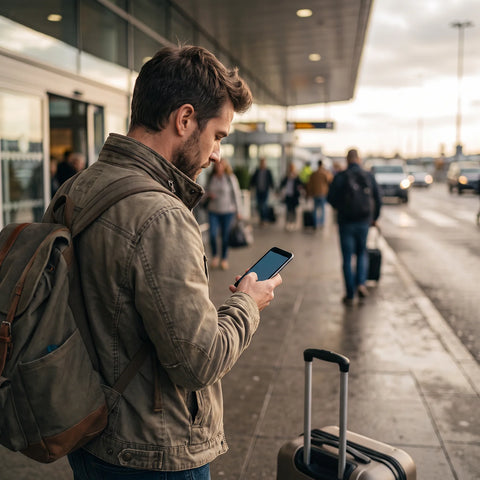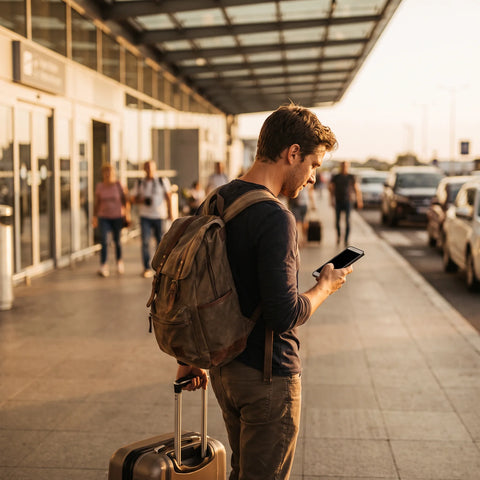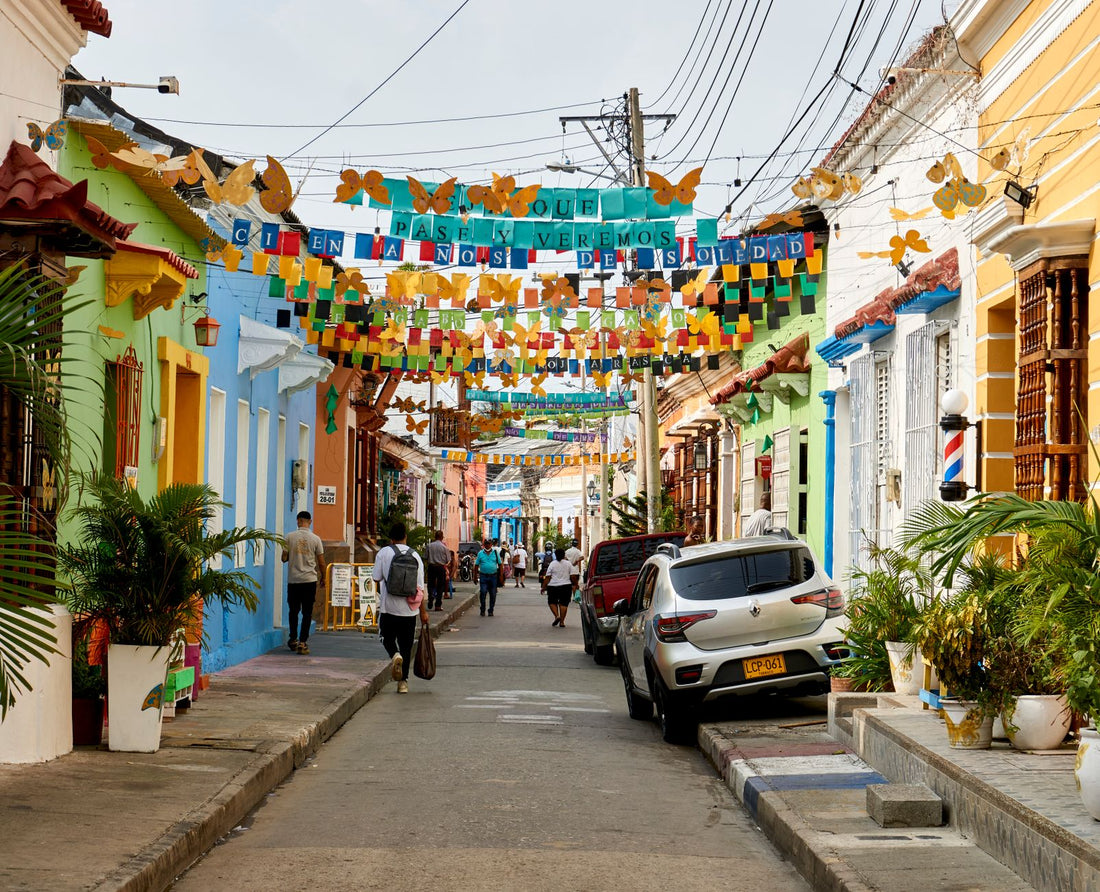
In short: an eSIM for Colombia is a virtual chip you install before traveling that connects you to Claro, Movistar, Tigo, or WOM as soon as you land in Bogotá, Medellín, or Cartagena. You choose the GBs according to your route, activate it in one minute, and avoid roaming and queues to buy a physical SIM.
An eSIM for Colombia gives you internet from the moment you land in Bogotá, Medellín, or Cartagena, without having to look for a SIM store or pay for roaming. It is installed before leaving home and connects to local operators upon arrival. With an eSIM for Colombia, you arrive with data and activate it in 1 minute.
eSIM for Colombia: the essentials
An eSIM for Colombia is a virtual chip you install on your phone that gives you mobile data as soon as you land. It connects to local networks, doesn't require a physical card, and activates in 1 minute. You choose the GBs according to your trip and browse throughout the country without changing your number or paying for roaming.
The big advantage is convenience: you buy and download the profile in Spain, and upon arrival, you just turn on the data. No queues at El Dorado airport or registering a SIM with your passport. Colombia is an ideal destination for an eSIM because it combines large, well-connected cities with nature and towns where having data on your phone saves you more than once for maps, translation, and transportation. If you also want to understand how local internet works before deciding how many GBs to buy, the guide to internet in Colombia gives you the complete context.

Coverage and local operators
The eSIM for Colombia relies on the country's major operators—Claro, Movistar, and Tigo, with WOM gaining ground—which offer 4G in practically all cities and a good part of the roads. Claro has the widest national coverage, very useful if your route takes you outside the major urban centers to rural or coffee-growing areas.
In cities like Bogotá, Medellín, Cali, and Cartagena, you'll have stable 4G and 5G in specific areas. On road trips, in the Coffee Region, or in mountain towns, the signal can drop to 3G in stretches, which is normal due to the Andean geography. For a typical urban tourism and accessible nature trip, the coverage is more than sufficient. A detail almost no one mentions: in the La Candelaria neighborhood in Bogotá and in the historic center of Cartagena, the thick-walled colonial buildings reduce the signal indoors, so if your data fails inside a museum or an old hotel, step outside before thinking the eSIM isn't working. If you want to fine-tune your itinerary city by city in more detail, the guide to eSIM for Bogotá, Medellín, and Cartagena will be useful.
| Operator | Coverage | Ideal for |
|---|---|---|
| Claro | Widest national coverage | Routes and rural areas |
| Movistar | Strong in major cities | Urban stays |
| Tigo | Good in cities and on the coast | Cartagena and Caribbean |
| WOM | Expanding in urban areas | Bogotá and Medellín |
How many GB do you need for your trip
For a standard trip through Colombia, estimate 1-2 GB per week if you mainly use maps, messaging, and some social media; increase to 3-5 GB per week if you share many photos, watch videos, or use your phone as a hotspot. Adjusting GB to actual usage avoids paying too much or running out.
Consider your travel style. A two-week tourist between Bogotá, the Coffee Region, and Cartagena, relying on hotel Wi-Fi at night, will do fine with a mid-range plan. A digital nomad or content creator working from cafes will need significantly more. The advantage of an eSIM is that you can top up if you run out, without having to go to any store. If you want to maximize your GBs without being left in the dark in the middle of a tour, the guide to how to save data with an eSIM on a trip has concrete tips that do make a difference, such as limiting automatic app updates or lowering video quality on social media when you're away from Wi-Fi.
Tip: download offline maps of your cities before you leave. This reduces data consumption and you'll still have navigation even if you enter an area with a weak signal.

How to activate the eSIM in Colombia
Activating the eSIM for Colombia takes 1 minute, and it's best to do it before you travel, using Wi-Fi. You buy the plan, receive a QR or link, install it in your phone's settings, and activate data roaming for that profile when you land. As soon as your phone picks up a local network, you'll have internet.
The only requirement is to have an eSIM-compatible, unlocked phone. Most mid-to-high-end iPhones and Androids from recent years are. Install the profile at home, but leave data activation until you arrive, so you make the most of the plan's validity. If it's your first time and you're not sure how it differs from a physical card, follow the step-by-step guide on how to install an eSIM.
A common mistake: installing the profile and activating mobile data at the same time, still in Spain, "to test if it works." It's not necessary, and depending on the plan, validity might start counting prematurely. Install it calmly at home, with Wi-Fi, and don't touch the data switch for that line until the plane has landed and you're out of airplane mode.
Bogotá, Medellín, Cartagena and Coffee Region
Colombia is best enjoyed with data in your pocket, and each area has its own rhythm. In Bogotá, you'll use it for TransMilenio and maps; in Medellín, for getting around with the metro and transport apps; in Cartagena, for navigating the historic center and coordinating Caribbean excursions.
In the Coffee Region (Salento, Cocora Valley, coffee farms), the signal is good in towns and weaker in the mountains, so offline maps shine there. Specifically, on the hike to the Cocora Valley viewpoint, coverage disappears for a good part of the trail: download the map and route before you start walking, not when you're already among the wax palms. For Pacific beaches and nature or the Amazon, expect intermittent coverage and be prepared to disconnect in some sections, especially in Nuquí, Chocó, or Leticia, where the jungle and low antenna density leave entire stretches without signal. Throughout the main tourist circuit, the eSIM keeps you connected without problems. If your trip continues to Peru, the guide on eSIM for Peru and Machu Picchu will serve as a reference for planning the next stage.
eSIM vs. roaming and local SIM
Compared to roaming from your Spanish operator, the eSIM wins on price and transparency: Colombia is outside the EU, so roaming is billed separately and the cost skyrockets if you don't have a specific bundle contracted; always check the current price with your operator before you leave. A destination eSIM, on the other hand, has a fixed, known cost before you travel. And compared to buying a local SIM, you save yourself the hassle of finding a store, registering with your passport, and changing your number.
A local SIM might make sense for very long stays or if you need a Colombian number for paperwork, but for tourism, the eSIM is more convenient: you have it ready before you leave and you keep your WhatsApp with your usual number. Plus, you don't lose your Spanish line for receiving bank SMS or codes. If you're debating between getting a physical Colombian chip or sticking with the eSIM, the comparison of international chip vs. eSIM makes it clear with practical examples.
That said, there's a case where it's not worth buying anything: if your layover in Bogotá is only a few hours and you stay in the boarding area of El Dorado, the airport has enough free Wi-Fi to check your phone, reply to messages, and check your boarding gate. Save your eSIM money for when you actually go out into the city.
Myths and what almost no one tells you about eSIM in Colombia
There's a lot of noise around eSIMs and Colombia in particular, so it's worth separating what's true from what's exaggerated.
- Myth: "outside major cities there's no coverage." This is half true. Claro reaches most municipal centers and main roads with 4G; what drops is the speed in mountain sections, not that the entire network disappears. The real exception is jungle areas and some sections of the Pacific.
- Myth: "my EU roaming plan works the same in Colombia." No. Those "roaming like at home" bundles are for the European Union; Colombia is not included, so if you travel with your Spanish SIM without having checked anything, you might be in for a bill shock.
- What almost no one tells you: Wi-Fi in hotels and hostels in tourist areas like Cartagena or Salento is a shared network used by dozens of strangers. If you're going to check your bank or make a payment, it's better to use your eSIM data than that open Wi-Fi. If you also connect a lot to public networks, check out the guide on VPN and privacy while traveling to know when it's worth adding an extra layer.
- What almost no one tells you: in Medellín, the metro and metrocable work wonderfully, but when you go down to some underground stations in the center, you lose signal for a few seconds. It's not an eSIM or operator failure; it's the tunnel structure itself; it recovers as soon as you get to the platform.
- When NOT to buy a data eSIM: if your trip is just a short layover with airport Wi-Fi, or if you're going to spend all your time inside an all-inclusive resort with decent Wi-Fi, it's money you won't get a return on. Buy it if you're going to be moving around, not as a matter of course.
Tips for staying connected while traveling in Colombia
A few habits will help you avoid running out of data mid-trip. The idea is to arrive with everything ready and use your GBs wisely so they last your entire itinerary, from the city to the coffee farm.
- Install the eSIM at home with Wi-Fi and save data activation for when you land.
- Download offline maps of Bogotá, Medellín, and Cartagena.
- Use your accommodation's Wi-Fi for backups, videos, and updates.
- Keep your Spanish SIM without data, only for bank SMS.
- Recharge if you run out, without having to find a physical store.
With 24/7 Spanish support and 1-minute activation, your eSIM for Colombia accompanies you from start to finish. Book yours and forget about connectivity during your entire trip.
Frequently asked questions
Does the eSIM work throughout Colombia?
Yes, in areas with coverage from local operators (Claro, Movistar, Tigo). You'll have stable 4G in Bogotá, Medellín, Cali, Cartagena, and on main roads. In mountain towns, the Coffee Region, or remote areas, the signal may drop to 3G or be intermittent, which is normal due to the Andean geography.
How many GB do I need to travel to Colombia?
For two weeks of tourism with maps, messaging, and social media, a mid-range plan is usually sufficient (estimate 1-2 GB per week for light use). If you share many photos, watch videos, or use your phone as a hotspot, increase to 3-5 GB per week. You can always recharge without going to a store.
Can I keep my WhatsApp with the eSIM in Colombia?
Yes. Your WhatsApp remains associated with your Spanish number; the eSIM only provides data for browsing. You can use WhatsApp normally connected via the eSIM. If you keep your home SIM in your phone (without roaming data), you will continue to receive SMS and calls on your usual number.
When should I activate the eSIM for Colombia?
Install the profile at home with Wi-Fi, but activate data when you land in Colombia to take full advantage of the plan's validity. Full activation takes 1 minute by turning on data roaming for that profile. As soon as your phone picks up a local network, you'll have internet.
Do I need a special phone to use an eSIM in Colombia?
Just an eSIM-compatible, unlocked phone. Most mid-to-high-end iPhones and Androids from recent years are. You can check compatibility in your phone's settings or by searching for your model. If it's compatible, the eSIM will work just like in any other destination.
Does my Spanish plan's roaming work for Colombia?
No. Roaming bundles "like at home" only cover the European Union, and Colombia is outside of it. If you use data with your Spanish SIM there, it's billed as international roaming and the cost skyrockets; check the current price with your operator before you leave or, better yet, activate a destination eSIM with a fixed cost before you travel.
Is an eSIM worth it if I only have a layover in Bogotá?
It depends. If you stay in the El Dorado airport boarding area for a few hours, the free Wi-Fi is usually sufficient and you don't need to buy data. If you're going out into the city, even for half a day, then it's worth having the eSIM active from the moment you step outside.
Conclusion
An eSIM for Colombia gives you data from the moment you land, coverage with major local operators, and the freedom to top up whenever you want, without roaming or stores. It's the most convenient way to explore Bogotá, the Coffee Region, and the Caribbean while staying connected. Activate your eSIM for Colombia in 1 minute and travel without worrying about internet: get it from the eSIM for Colombia product.