France is one of those destinations that combines history, gastronomy, and unforgettable landscapes. From the cobblestone streets of Paris to the vineyards of Burgundy, and the beaches of the French Riviera, every corner deserves to be documented and shared. But for that, you need reliable internet, and this is where an eSIM makes all the difference.
If you're traveling from Spain or Latin America, you've probably wondered how to stay connected without paying a fortune in roaming fees. The good news is that France has excellent mobile infrastructure, and with an eSIM, you can take advantage of it from the moment you land. No more searching for physical SIM card stores or dealing with language barriers to activate a plan.
In this guide, we'll tell you everything you need to know about using an eSIM in France: from how much data you actually need to how coverage works on the Paris metro or on high-speed trains. Let's get straight to it.

Why use an eSIM in France
France is one of the European countries with the best telecommunications infrastructure. 4G networks cover practically the entire territory, and 5G deployment is rapidly advancing in major cities. This means that, with the right connection, you can use Google Maps without problems, make video calls from the Eiffel Tower, or work remotely from a café in Le Marais.
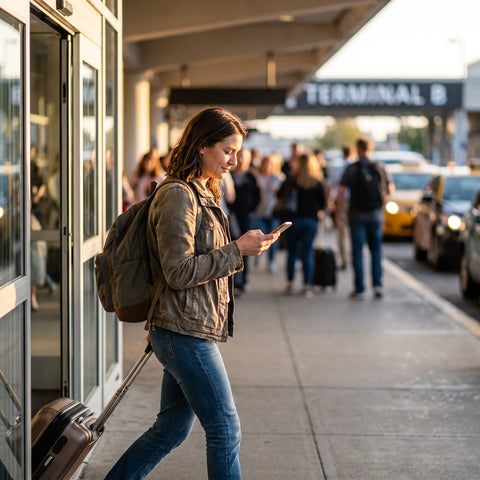
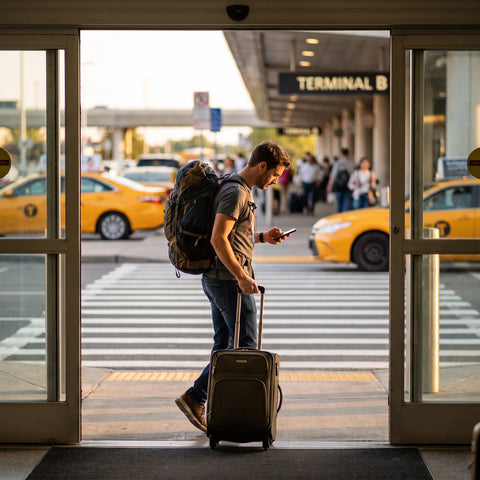
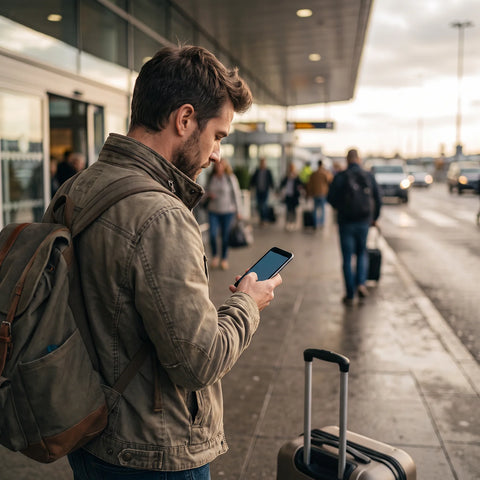
The advantage of an eSIM over a physical SIM is its immediacy. You buy your plan online, receive a QR code by email, and install it on your phone before you travel. When you land at Charles de Gaulle or Nice airport, your connection activates automatically. You don't waste time looking for phone stores or trying to explain in French what kind of plan you need.
Furthermore, PuraSim eSIMs work with major French operators such as Orange, Bouygues Telecom, and SFR, guaranteeing stable coverage in both urban and rural areas. If your plan is to drive through Provence or visit the Loire castles, you'll have a signal for almost the entire journey.
Another important point: you keep your WhatsApp number. The eSIM is configured as a data line, while your physical SIM remains active for receiving calls and messages. This is especially useful if you need to receive bank verification codes or stay in touch with family and friends without changing your number.
For Spanish travelers, although roaming within the EU is included in many plans, eSIMs are still useful if your plan has data limits on roaming or if you travel frequently and prefer to have a dedicated plan without consuming your monthly allowance. For Latin American travelers, the cost difference is enormous: while roaming can cost 10-25 USD per day, a 10-day eSIM costs between 25-35 USD total.
Coverage and operators in France
PuraSim eSIMs automatically connect to the networks of Orange, Bouygues Telecom, and SFR, the three main operators in France. These providers cover over 99% of the population and have a strong presence in both cities and rural areas. 4G is available practically nationwide, and 5G is already active in Paris, Lyon, Marseille, Nice, and other important cities.
In Paris, coverage is exceptional. A remarkable feature is that the Paris metro has 4G signal in all its stations and in many tunnels between stations. This means you can check your route on Google Maps, reply to messages, or even make a video call while waiting for the train or during the journey. Not all metros in the world offer this, so take advantage of it.
Lyon, France's third-largest city, also has excellent coverage. Both in the historic center (Vieux Lyon) and in modern neighborhoods like Part-Dieu, the 4G signal is constant. If you visit the Parc de la Tête d'Or or climb to the Fourvière basilica, you'll have a stable connection to take photos and share them instantly.
On the French Riviera (Nice, Cannes, Antibes), coverage is equally good. Tourist areas, beaches, and the famous Promenade des Anglais have strong signals. Even in small towns like Èze or Saint-Paul-de-Vence, which are in more elevated areas, the connection works without problems.
An important point: if you travel by TGV train (the French high-speed train), the signal may fluctuate in rural sections or when passing through long tunnels. This is normal and not exclusive to eSIMs; it affects all mobile connections. Many TGV trains offer free WiFi, although the quality varies. Generally, you'll have a good connection in cities and for most of the journey, with some weak signal areas in remote regions.
If you plan to visit mountainous areas like the French Alps or the Pyrenees, coverage will depend on the altitude and the specific valley. Major ski resorts like Chamonix or Val d'Isère have good coverage, but in remote hiking trails, the signal may be intermittent. This applies to any operator, not just eSIMs.

How many GB you need based on your trip
The million-dollar question: how many GB should you contract? For a standard 10-day trip in France, we recommend between 8 and 10 GB. This amount allows you to constantly use maps, check social media, make occasional video calls, and share photos without worrying about running out of data. Let's look at the realistic breakdown.
Google Maps consumes approximately 5-10 MB per hour of active navigation. If you use GPS to navigate Paris, visit the Louvre, find restaurants, and move between neighborhoods, you could use about 100-150 MB per day. Over 10 days, that's about 1-1.5 GB just for maps. Instagram and Facebook consume between 100-200 MB per hour of active use (scrolling, stories, posting photos). If you spend an hour a day on social media, that's another 1-2 GB in total.
WhatsApp is quite efficient: text messages consume almost nothing, and voice calls use about 600 KB per minute (36 MB per hour). Video calls are more demanding: 3-4 MB per minute, or about 200 MB per hour. If you make a 30-minute video call every other day, we're talking about 500-600 MB in total.
Uploading photos to Instagram or sending them via WhatsApp: a medium-quality photo weighs 2-3 MB. If you upload 10 photos a day, that's 20-30 MB daily, about 250 MB in total for the trip. Videos consume much more: a one-minute video can weigh 50-100 MB depending on the quality. If you share several videos, this can add up quickly.
Summing all this up, moderate usage puts you at 5-7 GB for 10 days. The recommended 8-10 GB includes a safety margin for unforeseen circumstances: that day you get lost and use the map more, or when you find a beautiful café and decide to make a long video call to show your family.
If you are a heavy user (working remotely, making many video calls, uploading videos to social media, or streaming content), consider a 15-20 GB plan. Netflix consumes approximately 1 GB per hour in standard quality and 3 GB in HD, so if you plan to watch series at the hotel, you will need more data. YouTube has similar consumption.
A practical tip: take advantage of hotel, cafe, and restaurant WiFi to download heavy content or update apps. Save your mobile data for when you really need it: on the street, on the metro, in parks, or when you're exploring. This makes your GB go much further.
Step-by-step activation and setup
Activating your eSIM for France is a straightforward process that takes less than 10 minutes. It's best to do it before you travel, from home, so that when you land in France, all you have to do is activate the eSIM and you're good to go. Here's the complete process.
First, verify that your phone is eSIM compatible. iPhones from the XS onwards (XS, XR, 11, 12, 13, 14, 15 and newer models) are compatible. On Android, most Samsung Galaxy from the S20, Google Pixel from the 3, and many Huawei, Oppo, and Xiaomi models also work. You can check your phone's settings: look for "Add data plan" or "eSIM" in the mobile network settings.
Once you purchase your eSIM plan from PuraSim, you'll receive an email with a QR code and installation instructions. Make sure you're connected to WiFi for this process. On iPhone, go to Settings > Mobile Data > Add Data Plan, and scan the QR code. The system will ask you to label this plan (you can call it "France" or "PuraSim"). Make sure to select your physical SIM as your primary line for calls and messages, and the eSIM only for mobile data.
On Android, the process is similar but varies slightly depending on the manufacturer. Generally, you go to Settings > Connections > SIM card manager > Add mobile data plan, and scan the QR code. Some models allow you to enter the code manually if you have camera issues.
Important: the eSIM is installed on your phone, but it does not activate until you connect to a French network. This means your validity period (for example, 10 days) begins when you land in France and your phone detects the network, not when you install the eSIM. You can install it days or even weeks in advance without any problem.
When you arrive in France, enable data roaming for the eSIM in your phone's settings. On iPhone: Settings > Mobile Data > select your eSIM > enable "Data Roaming." On Android, it's similar: Settings > Connections > Mobile networks > Data roaming (enabled). Your phone will automatically connect to Orange, Bouygues, or SFR, depending on which has the best signal in your location.
You can verify that everything is working by opening your browser or any app. If you have connection issues, try restarting your phone or toggling airplane mode on and off. In 99% of cases, the connection is automatic and instantaneous. If after 10-15 minutes you still have no connection, verify that data roaming is enabled specifically for the eSIM, not for your physical SIM.
Roaming vs eSIM: cost comparison
Here's where the numbers speak for themselves. The cost difference between using international roaming and an eSIM can be dramatic, especially if you're traveling from Latin America. Let's break down the real costs so you can see the concrete savings.
For travelers from Spain, the situation is unique. Thanks to European Union regulations, roaming within EU countries is included in most Spanish mobile plans at no additional cost. This means that if you have a plan with Movistar, Vodafone, or Orange Spain, you can use your data in France as if you were at home. However, there are limits: many operators set a roaming data cap (for example, 10-15 GB even if your plan is 30 GB). If you exceed that limit, you'll be charged extra.
For Spanish travelers, an eSIM is still useful in several scenarios: if your plan includes little roaming, if you travel frequently and prefer not to spend your monthly allowance, or if you want a dedicated plan for work without mixing it with your personal line. Additionally, if you're traveling with family or friends from Latin America, an eSIM levels the playing field for everyone.
For Latin American travelers, the story is completely different. Operators in Mexico, Colombia, Argentina, Chile, and other countries charge international roaming fees that can be astronomical. Let's look at real examples: a major Mexican operator charges approximately 10-15 USD per day for roaming in Europe with limited data (usually 100-200 MB daily). For 10 days in France, that adds up to 100-150 USD.
In Colombia, rates are similar: around 12-20 USD per day with very limited data packages. In Argentina, depending on the operator, you can pay between 8-15 USD daily. Chile has rates around 10-12 USD per day. In all cases, we're talking about 80-200 USD for a 10-day trip with very limited data.
Now let's compare with an eSIM: a 10 GB plan for 10 days in France costs approximately 25-35 USD with PuraSim. The difference is enormous: you save between 70% and 90% compared to traditional roaming. Plus, you have more data available (10 GB vs. 100-200 MB daily that many roaming plans offer), and you don't have to worry about activating and deactivating roaming every day.
Even if your operator offers "travel packages" (e.g., 5 GB for 50 USD for 7 days), the eSIM is still more economical and flexible. You can choose exactly how many GB you need and for how many days, without paying for services you won't use. And if you run out of data, you can easily top up from the app or website, without calling your operator or paying exorbitant additional fees.

Frequently asked questions
How many GB do I need for 10 days in France?
For a 10-day trip to France, we recommend between 8 and 10 GB. This allows you to constantly use maps, check social media, make occasional video calls, and share photos without worries. If you plan to make many video calls or upload videos, consider 15 GB. Typical consumption includes: 1-1.5 GB for maps, 1-2 GB for social media, 500-600 MB for occasional video calls, and the rest for general browsing and content sharing.
Does the eSIM work on the Paris metro?
Yes, the Paris metro has 4G coverage in all its stations and in many tunnels between stations. You'll be able to use your eSIM without problems to check maps, send messages, or browse while traveling around the city. This is a significant advantage compared to other metro systems in Europe that don't have underground coverage. Take advantage of this to plan your routes or respond to messages while waiting for the train.
Can I use my eSIM on the TGV train?
Yes, but the signal may fluctuate in some rural areas or when passing through long tunnels. TGV trains have onboard WiFi on many routes, although the quality varies. In general, you'll have good connectivity with your eSIM in cities and for most of the journey, with some weak signal areas in remote regions. This is normal and affects all mobile connections, not just eSIMs. Coverage is especially good on routes like Paris-Lyon or Paris-Marseille.
When does the eSIM for France activate?
The eSIM activates automatically when you connect to a French mobile network for the first time. You can install it on your phone before you travel (even weeks in advance), but the validity period begins when you arrive in France and your device connects to Orange, Bouygues, or SFR. This means you don't lose days of your plan while on the plane or before traveling. Activation is completely automatic; you just need to have data roaming enabled for the eSIM.
Is it cheaper to use an eSIM than roaming in France?
For Latin American travelers, definitely yes. While roaming can cost between 10 and 25 USD per day (80-250 USD for 10 days), a 10 GB eSIM for 10 days costs around 25-35 USD in total, saving you between 70% and 90%. For Spanish travelers, although EU roaming is included in many plans, an eSIM is still useful if your plan has data limits on roaming or if you prefer not to consume your monthly allowance. Additionally, eSIMs usually offer more data than traditional roaming packages.
Activate your eSIM before you leave and arrive connected from the very first moment. Guaranteed coverage in Paris, Lyon, Nice, and all of France.
View eSIM plans →