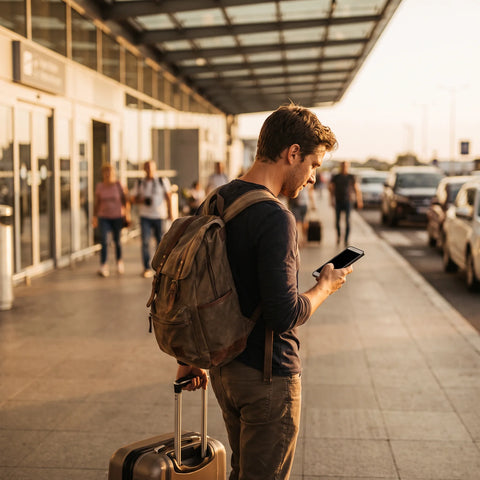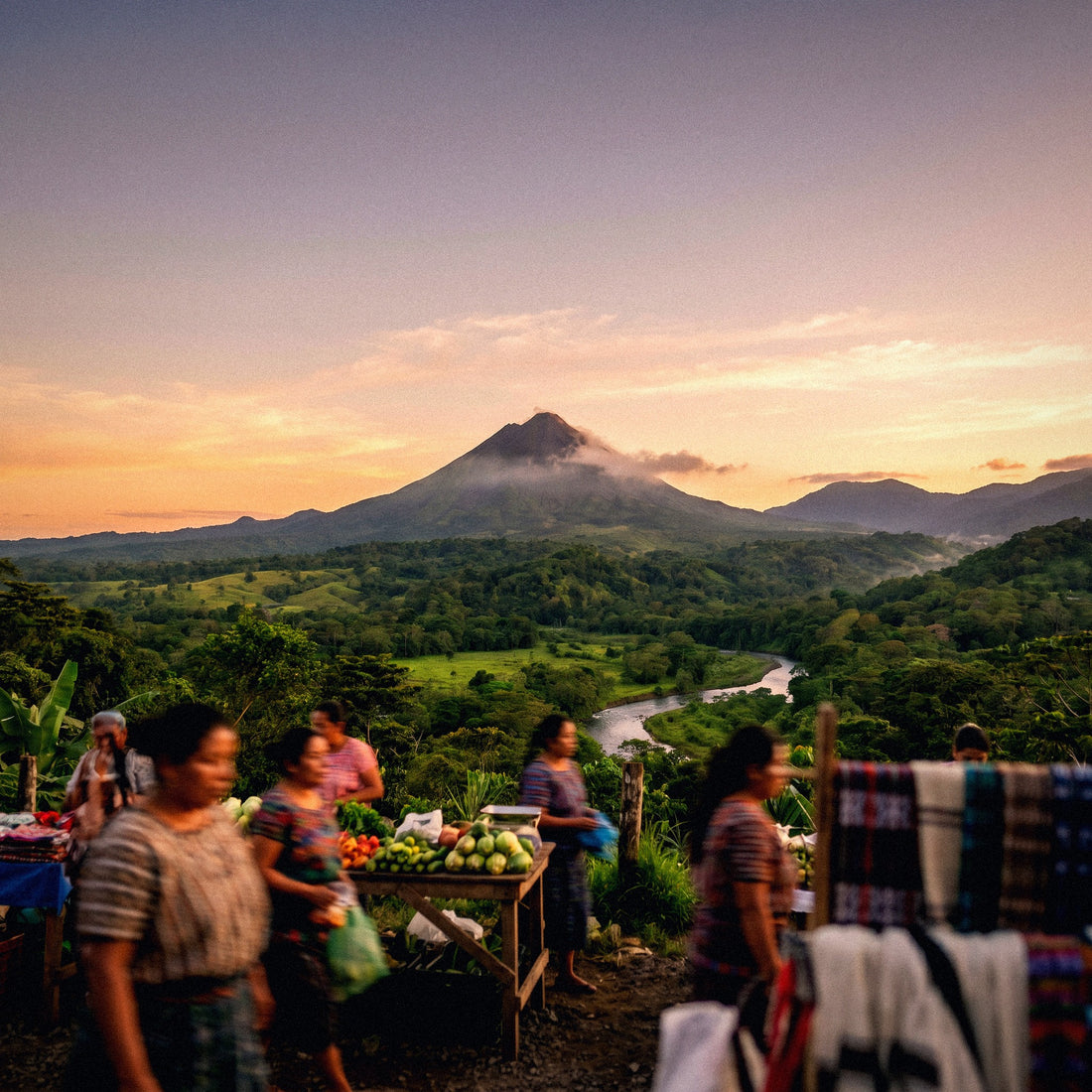
If you've already decided to get data and the only thing left to know is how many GB to buy for Costa Rica, this is about numbers, not theory. And Costa Rica has a very unique particularity: it's a trip of rental car, open maps, and many hours on the road, with entire stretches of jungle and national park where your phone won't get any signal. That drives consumption up in some things and down in others. Here I'll give you the number, the table by profile, and the two or three mistakes that cause a package that was more than enough to evaporate in three days.
The quick answer: how many GB for Costa Rica
For a typical 10-15 day trip to Costa Rica by rental car, 10 GB is more than enough for most people. If you're mostly using maps and WhatsApp, 5-6 GB will suffice. If you're uploading sloth videos daily or teleworking, count on 20 GB.
That's the short answer, and I believe it because I've broken down consumption activity by activity below. But I want you to understand where it comes from, because many people's intuition here is completely wrong: almost everyone assumes that GPS will eat up their data package and that Waze is to blame for running out of data. That's not the case. Navigation is one of the cheapest things on a modern phone.
What truly drives up consumption in Costa Rica are three very specific things: automatic photo and video backups (and you'll be taking a lot here), social media scrolling during dead hours in the car and during rain, and sharing your connection with family because the accommodation's Wi-Fi isn't enough. If you control these three, a 10 GB package will last you two weeks with plenty to spare.
If you want the general framework before diving into the country's specifics, in the master guide on how much data you need for travel I explain the logic I use for any destination. Here, I'm going straight to what makes Costa Rica different.
Why Costa Rica changes the number: here you drive
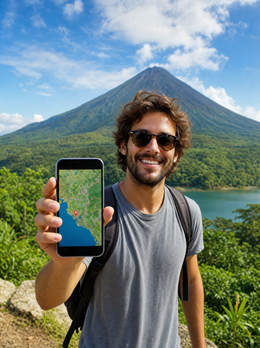
The classic Costa Rica itinerary isn't about a city and excursions: it's a circuit. San José, Arenal and La Fortuna, Monteverde, Manuel Antonio, Tamarindo or Guanacaste, and sometimes Puerto Viejo on the South Caribbean. Between each point, there are three, four, or even five hours of driving, many of them on secondary roads, under construction, or directly unpaved. That means four or five hours with your phone plugged into the dashboard with the map open on a transfer day.
And there's an extra reason why you can't put down the map here: in much of the country, street names and numbers don't exist. Directions are typically "200 meters south of the church, green house." Without a GPS, and without being able to look up the location on the spot, you're taking a risk. That's why Waze and Google Maps are almost mandatory and why it's a good idea to have them downloaded too.
The good news is that navigation consumes very little. Here's a realistic breakdown of a long travel day:
| Time of day | What you do | Approximate consumption |
|---|---|---|
| Morning, 4 h driving | Waze or Google Maps navigating | 25-40 MB |
| Stops and lunch | Search for restaurant, site photos, WhatsApp | 30-60 MB |
| Afternoon tour | Phone stored in backpack | Almost 0 MB |
| Evening at the lodge | Social media, messages, send 10 photos | 150-400 MB |
| Daily total | — | 200-500 MB |
Multiply by 12 days and you get between 2.5 and 6 GB. That's why 10 GB is a comfortable recommendation and not an inflated number. If you also want to understand how to connect there (operators, coverage, alternatives), I cover that in the Costa Rica internet guide.
Where there's coverage and where you don't spend a single MB
Costa Rica has much better coverage than people expect from such a green country. The Central Valley (San José, Alajuela, Escazú, Heredia) works well, with solid 4G and 5G rolling out in urban areas and parts of Guanacaste. The tourist beaches of Guanacaste and the Quepos and Manuel Antonio area work well. The towns of La Fortuna and Santa Elena, Monteverde, also have good service.
What changes is what's in between and what's inside. As soon as you enter a trail, the signal drops: cloud forest, national park interiors, Corcovado, Tortuguero, much of the South Caribbean, and stretches of mountain road. This isn't a problem for your data plan; it's a gift: these are hours when consumption is zero.
| Area | Typical coverage | Effect on your consumption |
|---|---|---|
| San José and Central Valley | Solid 4G/5G | High: this is where you really spend |
| La Fortuna / Arenal (town) | Good 4G | Medium-high |
| Monteverde / Santa Elena | 4G in town, irregular outside | Medium |
| Manuel Antonio / Quepos | Good 4G | Medium-high |
| Tamarindo and Guanacaste | Good 4G, 5G in spots | High |
| Puerto Viejo and South Caribbean | Irregular | Low |
| Trails and national parks | Scarce or none | Almost zero |
Practical translation: on a 12-day trip with six nature tours, there are easily 25-30 hours where your phone won't consume anything because it has no signal. This is one of the reasons why Costa Rica requires fewer gigabytes than an equivalent urban trip.
How much each activity actually consumes
These are the figures I work with. They are realistic orders of magnitude for mobile usage, not promises down to the megabyte: they depend on your video quality, whether you have data saving enabled, and how well the network is performing. But they serve for calculation.
| Activity | Approximate consumption | Note for Costa Rica |
|---|---|---|
| GPS Navigation (Waze / Google Maps) | 5-10 MB per hour | You'll use it a lot and it costs very little |
| WhatsApp text only | Less than 5 MB per day | Irrelevant |
| WhatsApp voice notes | ~1 MB per minute | Cheap |
| Send a photo via WhatsApp | 0.3-1 MB (compressed) | Cheap if you don't send it "uncompressed" |
| Upload an original photo from your phone | 3-5 MB | This is the hidden cost |
| Upload 1 minute of 1080p video | 100-150 MB | A long sloth video = half a gigabyte |
| Upload 1 minute of 4K video | 300-400 MB | Avoid with mobile data |
| Browsing Instagram or TikTok | 500-800 MB per hour | The biggest data consumer on the trip |
| WhatsApp video call | ~400-450 MB per hour | Half an hour a day is already 2.5 GB in 10 days |
| Streaming music | 40-150 MB per hour | Very manageable on the road |
| Streaming video (Netflix, YouTube) | 0.5-3 GB per hour | Only over Wi-Fi, always |
| Email and normal web browsing | 10-20 MB per hour | Irrelevant |
If you like numbers and want the long detail per application, I have it broken down in mobile data usage statistics by activity. The important thing is to see the scale jump: one hour of scrolling is equivalent to one hundred hours of GPS navigation. One hundred. That's why the map is never the culprit.
The table that matters: GB by profile and days
Find your row, find your column, and that's your number. These figures already include a margin: they are designed to ensure you reach the end of your trip without surprises, not to leave you with half a data package unused.
| Traveler profile | 5 days | 10 days | 15 days | 30 days |
|---|---|---|---|---|
| Tourist with maps and WhatsApp (road trip, little scrolling) | 2 GB | 4 GB | 6 GB | 10 GB |
| Photos and social media (daily stories, uploading content) | 5 GB | 10 GB | 15 GB | 25 GB |
| Digital nomad / teleworking (video calls, files) | 10 GB | 20 GB | 30 GB | 50 GB or unlimited |
| Family sharing (2-4 phones with hotspot) | 8 GB | 15 GB | 20 GB | 40 GB |
A couple of honest nuances about this table. First: if you're a couple and only one of you has data and shares with the other, you're not in the "tourist" row, you're halfway to the family row; add between 60% and 80% to your number. Second: the digital nomad row assumes real video calls, not just checking email. If you telework for two isolated mornings from La Fortuna, 10-15 GB for two weeks will be fine.
And third, the most overlooked nuance: the weight of your habits matters more than the destination. Someone who consumes 25 GB per month at home is not going to consume 4 GB in fifteen days just because they're on vacation, even if it's in the jungle. On the contrary: people use their phone more on vacation, not less. That's why the next step is to look at your own history, and I'll explain that below.
The ecolodge's Wi-Fi is not your backup plan
This is where Costa Rica differs from almost any other destination, and where most people miscalculate. A good portion of the country's beautiful accommodations are ecolodges, jungle cabins, and mountain hotels that sell disconnection as part of the experience. Some openly state it: Wi-Fi only in common areas, no Wi-Fi in rooms, or a shared satellite connection among forty guests that's only enough for checking email and little else.
The classic mistake is buying 3 GB thinking "I'll upload photos using the hotel's Wi-Fi." You arrive, the Wi-Fi is 2 Mbps shared among the entire reception area, and those photos end up being uploaded with your mobile data or not at all.
Add to that, during the rainy season, from May to November, there are entire afternoons of downpours when you can't leave your accommodation. And there, if the Wi-Fi doesn't work, people use their data: series, social media, video calls home. One poorly managed rainy afternoon can use more gigabytes than three days of travel.
| Type of accommodation | Realistic Wi-Fi | Can you count on it? |
|---|---|---|
| Hotel in San José or Escazú | Good | Yes, even for uploading video |
| Beach hotel in Guanacaste | Decent in common areas | Yes, with patience |
| Jungle or mountain ecolodge | Slow or nonexistent | No |
| Puerto Viejo cabins and hostels | Highly variable | Partially |
| Lodge in Tortuguero or Corcovado | Almost none | No |
Practical conclusion: calculate your gigabytes as if the accommodation's Wi-Fi didn't exist. If it works, you'll have extra data, which is great. The reverse hurts.
Sloths, toucans, and the silent killer
Costa Rica is a destination for the amateur photographer gone wild. A sloth, a toucan, a red frog, a white-faced monkey stealing your snack in Manuel Antonio. You're going to come back with two thousand photos and forty videos, many of them in 4K without even realizing it, because that's what your phone does by default.
Here's the important nuance: taking photos and videos doesn't consume data. Zero. They're saved on your phone. What consumes data is sending them or, above all, having them upload automatically. And that's the silent killer of data plans: Google Photos or iCloud's automatic backup. If you have it activated with mobile data, every video of a monkey uploads in the background while you're driving towards Monteverde. Two hundred photos and five videos from one day can be a gigabyte and a half uploaded without you even touching your phone.
What to do, in two minutes and before leaving home:
- On Android: Google Photos, your profile, Backup, and set "Only over Wi-Fi" for both photos and videos.
- On iPhone: Settings, your name, iCloud, Photos, and deactivate mobile data usage for uploads.
- Also check Dropbox, OneDrive, WhatsApp (automatic media download), and app updates.
- If you record a lot, lower your camera to 1080p: better battery, less space, and uploads four times lighter.
With these four adjustments, half of the "my data disappeared and I don't know why" cases vanish. And this isn't a sales trick: it's because I want the package you buy to last.
How to know your real consumption before flying
All of the above are averages. Your actual number is already in your pocket, free, and takes thirty seconds to appear. Look at how much you've spent in the last month and extrapolate.
- Android: Settings, Connections or Network & Internet, Data Usage. You'll see the total for the cycle and the breakdown by app.
- iPhone: Settings, Mobile Data. Scroll down to see usage by app and, if you've never reset it, check the "Last Reset of Statistics" date to know how long it corresponds to.
- You can also find this in your home operator's client area or app, usually with a month-by-month breakdown.
With that data, the calculation is simple: divide your monthly consumption by 30 to get your daily average and multiply it by the number of travel days. Then adjust with two Costa Rica-specific corrections. Subtract 20-30% for hours without coverage on trails, in parks, and during tours where your phone is put away. And add 20-30% if you're going to share your connection, if you're going to upload content daily, or if you're traveling during the rainy season.
Real example: someone who spends 12 GB per month at home uses 400 MB per day. For 13 days, that's 5.2 GB. Minus 25% for hours without signal, 3.9 GB. Plus 25% because they upload photos every night, 4.9 GB. That traveler buys 5 GB and runs it close, or 10 GB and has plenty without thinking. Since the price difference between these two packages is usually small, I almost always recommend the latter.
How to stretch your data on a 15-day trip
If you want a small package to last until the end, there are five things that really work and one that doesn't. I'll start with what works.
- Download offline maps before you leave. Google Maps lets you download regions; the entire country is around 200-400 MB depending on the area you select, so do it over Wi-Fi at home. Waze also saves recent routes. With the route downloaded, navigation is practically free and also works in areas without mountain coverage.
- Activate system data saver. On Android, it's under Network & internet, Data Saver; on iPhone, under Cellular, Low Data Mode. This limits background refresh, which is a pure drip.
- Disable auto-play video on Instagram, TikTok, Facebook, and X. This is the setting that saves the most per minute spent.
- Lower music streaming quality and, even better, download playlists and podcasts over Wi-Fi for road trips. Five hours in the car with Spotify on high quality is almost 750 MB wasted.
- Download what you know you'll need via Wi-Fi: tickets, reservations, the park map, a series for a rainy afternoon.
And what doesn't work: relying on public Wi-Fi. In Costa Rica, it's available in cafes in San José, Tamarindo, or Santa Elena, but it's slow, saturated, and won't reach where you'll be for half the trip. Planning your trip around finding Wi-Fi is poor planning. If you want the complete list of settings, I have an expanded version in data-saving tips for your trip, with step-by-step instructions for each operating system.
What happens if you run short
Let's talk about the part nobody tells you because it doesn't sell: it's better to run short and top up than to have too much. And I'm saying this while selling data packages.
The reasoning is simple. If you buy too much, that excess doesn't come back: travel data plans are neither refunded nor saved for next year, and you will have paid for unused gigabytes. If you buy too little, you'll notice it the day it runs out, you can access your account from anywhere with coverage and add more in a couple of minutes. The cost of underestimating is a top-up; the cost of overestimating is money that doesn't come back.
My rule of thumb: I buy the package that covers my realistic estimate and not a single gigabyte more. If I'm wrong, I top up from my phone in two minutes. I've never had to do it from a place without coverage, because when you run out of data, you're almost always in a town, not in the middle of the cloud forest.
A specific warning for Costa Rica: top up when you still have some balance left or when you have Wi-Fi, not when you're at zero on your way to Tortuguero. And have the confirmation email of your purchase downloaded on your phone, with the QR and instructions, because activating something requires a connection for the initial setup. If you've never used this type of digital line and aren't quite sure how it works, in what an eSIM is I explain it without technical jargon: what it is, how to install it, and which phones accept it.
Frequently asked questions
How many GB do I need for 10 days in Costa Rica?
10 GB is more than enough for 10 days. If you mostly use maps and WhatsApp, 4-5 GB will be sufficient. If you upload photos and videos every night or share your connection with your partner, 10 GB becomes the right amount rather than an excess.
What about 15 days traveling around the country?
Between 6 and 15 GB depending on your profile. A relaxed traveler can manage 15 days with 6 GB; an active social media user needs 15 GB. A family sharing with two or three phones should aim for 20 GB. The trick is that hours of tours and trails with no coverage give you zero consumption.
Will the rental car's GPS use up all my data?
No, navigation uses between 5 and 10 MB per hour. Even if you drive five hours a day for two weeks, we're talking about less than one gigabyte for the entire trip. Download offline maps and reduce it even further. The real data usage comes from social media and uploading content, not from the map.
Is there coverage in national parks?
Almost never within the trails. In Monteverde, Corcovado, Tortuguero, or the interior of Rincón de la Vieja, the signal disappears. In the access towns (La Fortuna, Santa Elena, Quepos) there is decent 4G. Download your route and tickets before entering the park.
Can I share my data with my partner's phone?
Yes, with personal hotspot, and it's the most practical option on the go. But calculate the package for two, not one: add between 60% and 80% to your individual estimate. If you're systematically sharing for two weeks, look directly at the family row in the table.
Do I need a VPN in Costa Rica and does it consume more data?
It's not necessary. Costa Rica does not block applications or social media, so you don't have to add the extra cost of a VPN, which usually adds between 5% and 15% to consumption. If you use it habitually for banking on public networks, just add that margin and you're good to go.
Will a camera translator be useful, like in Asia?
You won't use it here. Spanish is spoken, signs and menus are understandable, and Ticos have a well-deserved reputation for helping those who ask. This saves a lot of data compared to destinations like Japan or Thailand, where the translator is on for half the day.
What happens if I run out of data halfway through my trip?
You top up and continue; you don't lose the line. You log into your account from an area with coverage or Wi-Fi and add more data in a couple of minutes. That's why I always say the same thing: it's better to start with a conservative amount and top up than to pay for gigabytes you won't use. The available sizes and how topping up works are detailed in the data guide for Costa Rica.
Conclusion
If I had to give you just one number for Costa Rica, it would be this: 10 GB for a 10 to 15-day trip. This covers the entire route between volcanoes, cloud forest, and both coasts, with the map open every day, sloth photos sent at night, and room for rainy afternoons when the lodge's Wi-Fi isn't enough.
Drop to 5-6 GB if you primarily use your phone for navigation and to let family know you've arrived safely. Go up to 20 GB if you'll be working remotely, sharing with multiple people, or publishing content daily. And whatever you do, before you fly: download maps, back up only on Wi-Fi, and activate data saver. With that, the package you buy will last twice as long.
Once you're clear, choose the size that fits you for our eSIM for Costa Rica and have it installed before you leave home: activating it as soon as you land in San José or Liberia, without looking for a store or waiting in line, is the simplest way to start a trip well. Pura vida.