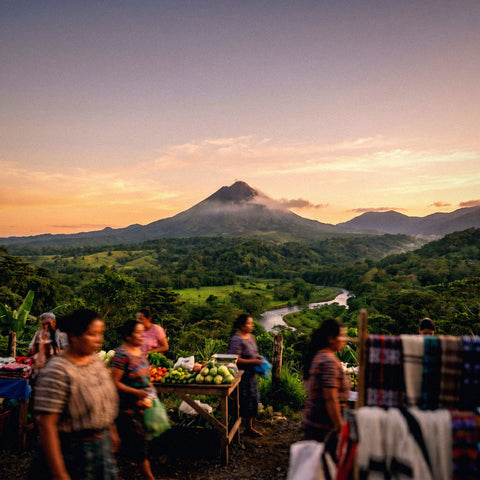
In short: the Costa Rica eSIM gives you 4G internet as soon as you land in San José, without roaming or SIM card stores: you install it via QR before leaving home, activate data upon arrival, and connect to Kölbi, Claro, or Movistar networks depending on the area, with plans starting from $4.99.
You arrive at San José airport, head out for your first coffee, and discover your phone has no signal. With a Costa Rica eSIM, that moment simply doesn't exist: you land with active data and start moving from minute one. In this guide, we tell you how to get reliable internet in the country of pura vida without paying absurd fees from your carrier, what coverage to expect between volcanoes and beaches, and how many gigabytes you need according to your itinerary.
Why you need data in Costa Rica
Costa Rica is a destination that's all about moving: today a volcano, tomorrow a Pacific beach, and the day after a national park in the Caribbean. That freedom depends on one very specific thing: having internet in your pocket. Without data, booking a last-minute canopy tour, finding the right turn-off to your lodge, or paying for park parking via an app become minor odysseys.
Hotel and cafe Wi-Fi exists, yes, but it's irregular and slow once you leave the major tourist areas. In jungle lodges, there's often only signal at reception, and it disappears completely as soon as you venture onto the trails. That's why relying solely on Wi-Fi ties you to specific locations precisely when the good stuff is outside.
With an eSIM, you have your own connection from the moment you land: Google Maps to drive without getting lost, WhatsApp to coordinate transfers, your banking app to pay, and your camera always ready to upload your photos. It's the difference between adapting your trip to where there's Wi-Fi and designing your trip your way. When the time comes, you can choose your eSIM and land already connected.
Coverage and networks: Kölbi, Claro, and Movistar
The country has three main operators. Kölbi, from the state-owned ICE, has the widest geographical reach, especially in rural, mountainous, and hard-to-access areas, where it is often the only one providing a signal. Claro and Movistar offer very good performance in urban and tourist areas, with solid 4G/LTE speeds in the Central Valley and on the coast.
A good travel eSIM doesn't tie you to a single network: it connects to the strongest available network at each point, so you benefit from Kölbi's broad coverage inland and Claro or Movistar's speed in the city. This is key in a country where you go from a well-connected capital to a cloud forest trail in an hour's drive.
| Operator | Strength | Best for |
|---|---|---|
| Kölbi (ICE) | Rural and mountain coverage | Monteverde, Arenal, remote areas |
| Claro | 4G speed in cities | San José, Liberia, Pacific coast |
| Movistar | Coverage/speed balance | Mixed city-beach routes |
Important: 4G coverage is very good in the vast majority of tourist areas, but it drops drastically inside national parks and deep jungle, as we'll see later.

How many GB to take depending on your trip
The amount of data depends on your travel style and how much you use your phone for maps and video. The good news is that with PuraSim's Costa Rica eSIM, you can start with a basic plan and upgrade without any changes if you run out. A simple rule: browsing, chat, and email use little data; video streaming and video calls consume the most.
- Short trip (5-7 days): 3-5 GB if you use Wi-Fi at the hotel and data for maps and messaging.
- 2-week trip: 8-10 GB for comfortable use combining Maps, social media, and uploading photos.
- Nomad or intensive use: 15-20 GB or a plan with ample data if you make video calls or work from the lodge.
If you're going to travel a lot by car, add a buffer: Google Maps with constant navigation consumes more than people realize. To size your plan well, it will help to read how to save data on your travel eSIM before deciding. And remember that PuraSim allows you to use hotspot, so a single plan can provide internet to your companion's tablet or laptop.
How to activate your eSIM with the QR
Activating an eSIM is one of the easiest things to prepare before a trip, and it takes less than a minute. The key is to get it ready before leaving home, with your usual Wi-Fi, so you arrive in Costa Rica with everything configured and just need to turn it on.
The general process is this:
- Purchase your plan and receive the QR code by email instantly.
- On your phone, go to Settings > Mobile Data > Add eSIM (or Add Data Plan).
- Scan the QR with the camera and follow the steps to install the profile.
- Upon landing, activate the eSIM data and roaming for THAT profile.
Romi's tip: Install the eSIM at home but don't activate the data until you arrive. This way, you don't use up data early and you land connected instantly.
You need an eSIM-compatible mobile phone that is unlocked by your carrier. If this is the first time you've heard of this, take a look at what a virtual eSIM is to understand how the technology works. And if you have any questions during installation, PuraSim's 24/7 Spanish-language support will guide you through the process.
Coverage by zones: from San José to Tortuguero
Costa Rica is small but very varied, and coverage changes depending on the area. Here's a quick guide to the most popular destinations so you know what to expect at each stop on your route.
- San José and Central Valley: excellent 4G coverage. Well-connected city, no problems for anything.
- Tamarindo (Guanacaste): very good signal in the town and beach area; it's a well-covered tourist hub.
- Manuel Antonio: good coverage in Quepos and the town, but drops inside the national park; download the offline map before entering.
- La Fortuna / Arenal: solid signal in town and most hotels; somewhat weaker near the volcano and on trails.
- Monteverde: acceptable coverage in Santa Elena, but irregular in the cloud forests due to topography. Kölbi usually holds up better.
- Tortuguero: very remote canal and jungle area; limited and intermittent coverage. Plan to disconnect.
Important notice: inside national parks and deep jungle (Corcovado, Tortuguero, Monteverde trails), the signal is scarce or nonexistent. Download maps, tours, and reservations offline before venturing in.
The practical conclusion: in towns, cities, and on beaches, you'll have plenty of internet; in the wild nature, prepare for a disconnection that, to be honest, is also part of the charm of the trip.
Practical tips: colón, nature, and rain
Beyond data, a few practical tips will make your trip easier. First, money: the local currency is the Costa Rican colón (CRC), although the US dollar is accepted in many tourist places. Having internet allows you to check the real exchange rate of the day and avoid accepting abusive rates when paying.
Regarding the climate: Costa Rica has a dry season (December-April) and a rainy or "green" season (May-November). During the rainy season, strong but brief downpours occur, usually in the afternoon. Having internet helps you check the weather radar and organize excursions in the morning, when it is usually clear.
- Learn "pura vida": it's used to greet, say goodbye, give thanks, and say everything is fine. It's the soul of the country.
- Drive with plenty of time: secondary roads and paths to lodges can be dirt and slow. Maps with data is your best ally.
- Respect nature: do not feed wildlife and always follow marked trails in parks.
- Carry cash in colones for tolls, park parking, and small stands where cards don't work.
If you plan to combine Costa Rica with other countries in the region, you might be interested in comparing with our guide to the eSIM for Colombia or with the eSIM for Peru and Machu Picchu if you continue your route through South America.

Prices: roaming rates vs. eSIM
Here's the difference that makes the most impact on your wallet. If you activate your Spanish plan in Costa Rica, you enter your carrier's international rate, which in Central America can skyrocket to several euros per megabyte or involve expensive daily bonuses with very limited data. One oversight and your travel bill inflates without warning.
The eSIM works the other way around: you pay a fixed and known price before leaving, with no surprises or surcharges. You know exactly how much you spend and how much data you have. With PuraSim, plans for Costa Rica start from $4.99, a fraction of the cost of any traditional roaming bundle.
| Option | Approximate cost | Risk of surprises |
|---|---|---|
| Your carrier's roaming | Expensive bundles or per-MB rate | High (inflated bills) |
| Local SIM at the airport | Cheap but with queues and paperwork | Medium (time and registration) |
| PuraSim eSIM | From $4.99, fixed price | None |
To understand why traditional billing is so expensive, we recommend reading eSIM vs. roaming and how to avoid it. And if you want to delve deeper into how plans for traveling through several countries work, our guide to international chip vs. eSIM explains it in detail. PuraSim covers 218 destinations, so your next trip will also be sorted.
What almost no one tells you about eSIM in Costa Rica
There's a very common mistake that creeps in just before boarding: you install the eSIM at home, perfect, but you forget to disable data roaming for your Spanish SIM. The result: your phone continues to use your home operator's network by inertia and, even if you have the eSIM installed, you're not actually using it. Before getting on the plane, go to Settings and confirm that roaming for your usual line is off and that the eSIM is the one with active data.
Another common myth is to think that "there's no coverage in Costa Rica outside of San José". This is not true: Tamarindo, La Fortuna, Quepos, or Santa Elena are perfectly covered for daily use. What is true is that the signal fails precisely where you'd want it most: at the Arenal volcano viewpoint, on the gravel stretch between Monteverde and Tilarán, or crossing the Cerro de la Muerte at night with fog. Download the route segment on Maps.me or offline Google Maps before getting on the road in those areas, not when you're already lost.
Nor is it necessary to buy a physical SIM at Juan Santamaría or Liberia airports "just in case": the queues at the Kölbi or Claro counters at the terminal exit are usually longer than they seem at ten at night after a long flight, and the price doesn't compensate compared to an eSIM that you already have active from the moment you land. Save that task for emergencies, not as plan A.
And a nuance that is often overlooked: if you are going hiking or rafting in areas with a local guide, do not assume that you will be able to notify anyone in case of an unforeseen event. In the Pacuare or on the high trails of Chirripó, there is no coverage from any operator, eSIM included; there, safety depends on the guide and the team, not on your mobile. If your route includes these sections, review our guide on how to install the eSIM beforehand to have everything ready while you have a signal, and be clear about the exact points where you will lose it.
Frequently asked questions
Does the eSIM work as soon as I land in Costa Rica?
Yes. If you install it at home with your usual Wi-Fi, you just need to activate the data upon landing and you'll connect to the local network in seconds, without searching for stores or queuing.
Is my phone compatible with eSIM?
Most mid-range and high-end phones from recent years are (iPhone XS onwards, Samsung Galaxy S20+, Google Pixel 3+, among others). It must also be unlocked by the carrier. If you have doubts, write to PuraSim's 24/7 Spanish-speaking support.
Will I have coverage in national parks and the jungle?
Within parks like Corcovado, Tortuguero, or the Monteverde forests, the signal is scarce or nonexistent due to the topography and remoteness of the terrain. Download maps and reservations offline before entering. In towns, cities, and on beaches, 4G coverage is very good.
Can I share data with another device?
Yes, PuraSim plans allow you to use your phone as a hotspot, so you can connect a tablet, laptop, or your companion's phone without needing another eSIM.
What happens if I run out of data halfway through the trip?
You can upgrade or buy a new plan instantly from your account, without changing QR or waiting. To better calculate how much you need, check our tips for saving data while traveling.
Do I keep my WhatsApp number with the eSIM?
Yes. The eSIM only provides data; your number and WhatsApp continue to work normally. You can keep your physical SIM for calls and use the eSIM for browsing.
Conclusion
Costa Rica is best enjoyed by moving around, and for that, you need reliable internet from the first minute. A Costa Rica eSIM gives you 4G coverage in cities, beaches, and towns by leveraging Kölbi, Claro, and Movistar networks, with the sole exception of deep jungle and national parks, where disconnection is part of the journey. With no roaming fees, a fixed price from $4.99, QR installation in a minute, hotspot, and 24/7 Spanish support, you arrive connected and travel worry-free. Once your itinerary is ready, choose your eSIM and prepare your trip and consult the official tourism of Costa Rica to finalize your itinerary. Pura vida!