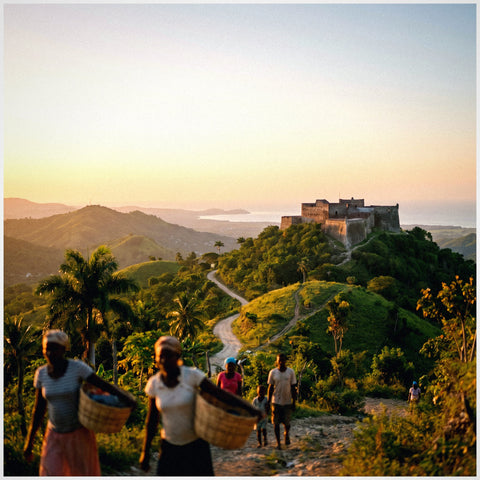
If you've made it this far, you already know you'll need data and just need to decide how many GB to buy for Haiti. I'm going to give you a well-informed figure, but I'll warn you from the start: this is not a normal tourist destination. Haiti is going through a serious security crisis, and conventional tourism has stopped, so I'm writing with humanitarian workers, missionaries, journalists, or family visitors in mind. Before looking at gigabytes, check the official recommendations from the Foreign Ministry: that takes precedence over any connectivity advice.
The honest figure, no beating around the bush
For a mission of about 10 days focused on coordination—WhatsApp, email, maps, and a few calls—most people will have more than enough with 5-8 GB. If you're going to tether to your laptop or send a lot of photos and videos, plan for 12-15 GB. But in Haiti, the limit isn't the GBs; it's the network.
I'll be blunt because that's what I'd want someone to tell me: in Haiti, don't buy with the idea of accumulating gigabytes; buy with the idea of not being cut off. Most people traveling for work use between 3 and 8 GB for a one-to-two-week stay, and only those making video calls or tethering to a laptop or team go above that. If you're deciding between two sizes, don't pick the large one: pick the medium one and leave room to top up if necessary, which takes a minute.
Before getting into tables, I want you to understand one idea: the problem in Haiti is usually not the balance, it's that the network goes down. That's why this article emphasizes redundancy so much. If you want a general framework for how much data to take on any trip, you can find it in my guide to calculating how much data you need; here, I'll go into detail for this specific country. The number matters, yes, but less than having a plan for when there's no coverage or electricity.
First, the official recommendations
This comes before any advice on gigabytes. The Ministry of Foreign Affairs strongly advises against travel to Haiti due to deteriorating security: gang violence, kidnappings for ransom, and fuel shortages. The United States maintains a Level 4 ("Do Not Travel") advisory, the highest level, and Spanish citizens already present whose stay is not essential are advised to leave the country using available commercial flights. If your trip is not essential, the recommendation is not to go.
If you go anyway—because you work in humanitarian aid, report news, or visit family—do your homework before thinking about data:
- Read the updated Foreign Ministry advisory the day before you leave; the situation changes week by week.
- Register with the Ministry's Registry of Travelers so they know you are in the country.
- Have emergency numbers and the nearest embassy (the representation might be in the Dominican Republic) readily available.
- Share your itinerary and a backup contact method with someone trustworthy.
I mention all this because connectivity isn't a luxury here: it's part of your security. How to connect specifically—which operator, how to activate the line—I explain separately in Internet in Haiti; this article assumes you already know you'll be using mobile data and just want to get the right amount.
Why redundancy matters more than gigabytes here
In a normal destination, buying too much is a waste of money. In Haiti, the risk is the opposite: you can have 20 GB untouched and still be without a connection for hours. The network is fragile. Power outages are frequent—especially in summer—and when the power goes out, antennas without generators stop providing service. In addition, gangs have cut fiber optic sections on several occasions, causing data outages lasting several days in entire areas, especially in the north.
The useful question in Haiti isn't "how many GB should I bring?", but "what do I do when there's no signal or power outlet?". Answer that, and the number of gigabytes almost sorts itself out.
That's why my advice here isn't to buy more, it's to duplicate paths:
- Carry a large power bank (20,000 mAh or more) and charge it whenever there's power.
- Don't rely on a single connection: having a second option can save you on a bad day.
- Download essentials—maps, documents, contacts—when you have a good signal, so you don't depend on it later.
This is where an eSIM helps: it allows you to carry a backup line on the same phone without risking a physical SIM card, and activate one or the other depending on which provides better signal in each area.
How much data apps actually consume
Before choosing a size, it's good to know what eats up your data, because almost no one has it well calibrated. The usual surprise is that what you'll use most in Haiti—WhatsApp messages, maps, and email—consumes very little, and what drastically increases consumption is video in any form: video calls, reels, and streaming. If you internalize that difference, you'll choose the right size almost without thinking. These are real, rounded figures to help you with your calculations:
| Activity | Approximate Consumption |
|---|---|
| Maps (Google Maps navigation) | 3-5 MB per hour (up to 10 with live traffic) |
| WhatsApp (messages, photos, voice notes) | 1-5 MB per day of normal use |
| WhatsApp voice call | ~30 MB per hour |
| WhatsApp video call | ~300 MB per hour |
| Social media (feed scrolling) | 100-150 MB per hour; with reels, up to 1 GB |
| Uploading photos | 2-5 MB per photo |
| Work video call (Zoom/Meet) | 500-900 MB per hour in HD |
| Music streaming | 40-80 MB per hour |
| Video (Netflix/YouTube) | 500 MB to over 1 GB per hour depending on quality |
Look at the table and draw your own conclusion. An entire day coordinating via WhatsApp, checking maps, and reviewing email rarely exceeds 150-250 MB per day. In contrast, a single one-hour video call can cost you as much as two days of messaging, and half an hour of reels before bed can use more data than an entire morning of work. That's why two people with the same data plan might finish their trip, one with half their data untouched and the other completely out of balance. If you want an expanded breakdown by app, I have it in the mobile data usage statistics by activity. The mental rule is simple: text and maps cost pennies, video costs dollars.
Port-au-Prince, Cap-Haïtien, and the border
The geography of your trip changes consumption more than you might think. The Port-au-Prince airport has been closed to international flights due to insecurity, and many enter through the north, via Cap-Haïtien, or by crossing overland from the Dominican Republic. Each scenario has its data trick:
- Port-au-Prince: very difficult access and risky road travel. The less you move around, the less live map data you'll use, but the more you'll depend on hotel Wi-Fi, which can fail.
- Cap-Haïtien: an alternative and somewhat more stable entry point; even so, expect power outages that knock out the network at times.
- Border with the Dominican Republic: Haiti shares the island of Hispaniola with its neighbor. Near the border, your phone might jump to a Dominican network without warning; if your plan is only for Haiti, check that you're not consuming (or overpaying) in the wrong country.
On the ground, the two operators are Digicel and Natcom, with coverage mainly in urban areas. And a practical note that isn't about data but helps: the US dollar circulates here alongside the gourde, so carry some cash in dollars in case you need to top up or pay for something when the connection is down. A breakdown of operators and how to activate your line can be found in the eSIM guide for Haiti; here I only use it to determine how many gigabytes to buy.
How many GB according to your profile and days
This is the table you've been looking for. I've cross-referenced four real profiles of people traveling to Haiti today with the most common durations. The figures already include a reasonable buffer; you don't need to add anything extra unless you know you're a heavy data user.
| Profile | 5 days | 10 days | 15 days | 30 days |
|---|---|---|---|---|
| Essential communication (maps, WhatsApp, email) | 1.5-2 GB | 3-4 GB | 5-6 GB | 10-12 GB |
| Reporting with photos and social media (press, dissemination) | 3-4 GB | 6-8 GB | 10-12 GB | 20-25 GB |
| Video calls and remote work | 5-7 GB | 10-14 GB | 15-20 GB | 30-40 GB |
| Sharing connection (team or family) | 6-8 GB | 12-16 GB | 18-24 GB | 35-45 GB |
How to read it without getting overwhelmed:
- If you're mainly going to coordinate and do little else, look at the first row: 3-4 GB will easily cover ten days.
- If your job is to report what's happening—photos, short videos, social media—jump to the second or third row.
- If you're going to use your phone as a router for your laptop or for several people, go to the last row and add an external battery, because hotspots consume a lot.
I reiterate my usual advice for this country: choose the figure from your row calmly, but don't inflate it "just in case." It's better to have a medium size with the option to top up on the go than a huge package that you won't be able to use if the network leaves you stranded for three days.
How to know your own consumption before leaving
My tables are a good guide, but you have the most reliable data in your pocket: what you normally spend. Before traveling, take two minutes to check it and fine-tune your purchase instead of going in blind.
On Android: Settings → Network & Internet → Data usage (or "SIM"), and check the consumption for the last month. On iPhone: Settings → Mobile Data, scroll down to the total for the period (it's a good idea to reset the statistics at the beginning of the month for a clean reference). Look at the total number and, especially, which apps top the list.
Now extrapolate with common sense, keeping in mind an important nuance for Haiti:
- Divide your monthly consumption by 30 to know your daily spending at home.
- Subtract what you'll do via Wi-Fi in Haiti or simply won't do: series, large downloads, heavy social media use.
- Add what you'll use more there: maps in new areas, and perhaps a translator.
- Multiply by the number of travel days and round up to the nearest package size.
An example: if at home you use 6 GB per month (200 MB/day) and on the trip you cut out video but add maps, it's realistic to stay at 150-250 MB/day. For ten days, that's 2-3 GB. That calculation made with your own numbers is worth more than any average, because nobody spends like the average.
How to make your data last in a country with outages
In Haiti, saving data isn't just about money: every MB you don't waste is autonomy for when the network is tight. The good news is that most savings come from four or five adjustments you activate once and forget about, without giving up anything important. These are the most effective:
| Setting | What it does | Savings |
|---|---|---|
| Offline maps | Download the area via Wi-Fi and navigate without using data | Almost 100% of map data |
| Video at 480p | Lower default playback quality | Up to 60-70% |
| Backups only over Wi-Fi | Prevents photos and cloud uploads from using data | Hundreds of MB per day |
| Disable autoplay | Social media videos don't start automatically | 200-500 MB per day |
| Data saver mode | Limits background data usage for all apps | 10-30% overall |
In addition to the table, there are three habits that are doubly valuable in this destination, as they make you less dependent on a signal that can disappear without warning:
- Download offline maps, documents, and translations when you get good Wi-Fi; this way, you don't depend on street coverage.
- Send photos and videos via WhatsApp in standard quality, not "best quality," which multiplies the file size.
- Use the accommodation's Wi-Fi for heavy tasks—backups, updates, downloads—keeping in mind that it might go out just when the power does.
None of these tricks will change your life individually, but together they make the difference between reaching the end of your trip with plenty of data or running out. I have a longer list in my guide on how to save data on a trip. By applying just half of them, it's easy to stretch a medium-sized package further than you think.
What happens if you run short (and why it's better that way)
Many people buy too much data for fear of running out in the middle of their trip. Let me break it down for you: running short in Haiti is not a disaster, and it's certainly less bad than overbuying. If you run out of data, you can top up in a couple of minutes from your phone, without going to any store or changing anything. You only pay for what you truly need and don't leave unused gigabytes.
Overbuying, on the other hand, has two specific drawbacks in this country:
- Packages usually have an expiration date: if you buy 20 GB for two weeks and the network leaves you without a connection for several days, you won't use it all and you'll lose it.
- It gives you a false sense of security. Here, true security isn't more gigabytes; it's a charged battery and a second connection option.
My way of doing it, and what I recommend: buy the size from your row in the table, no more, and know how to top up just in case. Monitor your consumption for the first two or three days—it will tell you if you have plenty or are just enough—and adjust from there. This way, you travel without the mental burden of "will I have enough?", which in a place like Haiti is exactly the energy you need for what truly matters.
Frequently Asked Questions
The most common questions I get about data in Haiti, answered to the point:
How many GB do I need for 10 days in Haiti?
For ten days, most people will have more than enough with 3-4 GB if their use is limited to coordinating via WhatsApp, checking maps, and email. This goes up to 6-8 GB if you take photos and use social media, and to 10-14 GB if you make video calls or share your connection with others.
Is it safe to travel to Haiti right now?
No: The Foreign Ministry strongly advises against travel, and the U.S. maintains a Level 4 "Do Not Travel" advisory. If you still go for work or family, register with the Travelers' Registry, follow the official advisory the day before you leave, and share your itinerary.
Does my phone work at Port-au-Prince airport?
When the airport is operational, there is usually coverage, but it has been closed to international flights due to insecurity. Many enter via Cap-Haïtien; have your data ready before landing so you don't depend on Wi-Fi.
Does my Haiti connection work in the Dominican Republic?
Don't assume so: they are different countries, and a Haiti plan does not cover the Dominican Republic. Additionally, near the border, your phone might switch to a Dominican network; check which network you're connected to so you don't spend where you shouldn't.
How do power outages affect the Internet?
Quite a bit: when the power goes out, antennas without generators stop providing signal, leading to data outages lasting hours or days. That's why it's advisable to have a power bank, download essentials in advance, and not rely on a single connection.
Digicel or Natcom?
These are the two operators in the country, with mostly urban coverage; neither will save you from blackouts. Rather than looking for "the best," the sensible thing to do is to have a primary option and a secondary backup in case one area works better with one than the other.
Is 1 GB enough for a week?
It can be enough if you limit yourself to messaging and maps and use Wi-Fi for everything else. It's a very tight plan: any video call or video streaming will consume it quickly. To be comfortable for a week, 2-3 GB is a more realistic figure.
Conclusion
If you take away only one idea, let it be this: in Haiti, it's more important to arrive connected and with a backup plan than to have many gigabytes. For most missions and trips of one or two weeks, 3-8 GB is the sensible range; only increase it if you plan to make many video calls or share your connection. Buy the right size for your needs, carry an external battery, download essentials via Wi-Fi, and know how to recharge. And above all, I repeat what I said at the beginning: follow the official recommendations from the Ministry of Foreign Affairs, because here, security comes before any other matter.
Once you've decided, get your connection ready before you leave with our eSIM for Haiti: activate it upon landing and enter the country with data from minute one, without looking for a store or changing cards.