I'll be honest from the first line: if you're looking for internet in Haiti, you're probably not planning a vacation. Haiti has been in a serious security crisis for years, conventional tourism is practically non-existent, and those who visit the country today are usually humanitarian workers, religious missions, aid workers, journalists, or members of the Haitian diaspora returning to see family. This guide is written for you, not for the postcard traveler. This is not a vacation trip: it's a journey that requires preparation, and connectivity is part of that preparation. I'll tell you how real mobile networks work, what each option costs, where there's coverage and where there isn't, and why the first stop before buying anything should be the official Ministry of Foreign Affairs website.
Internet in Haiti today: what to really expect
In Haiti, there are only two mobile networks: Digicel and Natcom. The practical option is a local eSIM activated before you fly, because buying a physical SIM requires a passport and traveling on the street. Spanish roaming works, but costs several euros per megabyte. And Wi-Fi depends on generators and an electrical grid that fails daily.
Let's start with the basics. Haiti has two mobile operators and nothing else: Digicel Haiti, the largest by number of customers, and Natcom, partly owned by the Haitian State and by Vietnamese Viettel. There is no third. That simplifies the decision and also limits it: if one network goes down in your area, you only have the other.
2G and 3G coverage reaches almost all inhabited areas of the country. 4G LTE is another story: it is concentrated in the metropolitan area of Port-au-Prince, in Cap-Haïtien and in a handful of intermediate cities such as Gonaïves, Les Cayes or Jacmel. Outside of these areas, 3G is usually irregular, and in mountainous areas of the Massif de la Selle or the Massif du Nord there is no coverage at all.
The real bottleneck is not the antenna, it's electricity. The public electricity grid (EDH) supplies power for only a few hours a day in much of the country, so cell towers operate on diesel generators and batteries. When there is a fuel shortage—a recurring issue when armed groups block terminals—entire network sectors go down for hours or days. This is the difference between two networks and a failing electrical grid: the infrastructure exists, but its availability is not guaranteed. If your work depends on being reachable, plan for redundancy: two operators, a large external battery, and, for missions outside the city, a satellite phone.
First, official Foreign Affairs recommendations
Before we talk about gigabytes and prices, this: always consult the Haiti country page in the Travel Recommendations of the Ministry of Foreign Affairs, European Union and Cooperation (exteriores.gob.es). This is not just a form to fill out. It is the official and updated source on security, areas to avoid, consular situation and evacuation, and it changes frequently because the situation on the ground changes frequently.
No connectivity guide, including this one, replaces the official Foreign Affairs recommendations. If Foreign Affairs advises against travel to Haiti, that warning takes precedence over any advice on data tariffs.
Haiti is classified by multiple foreign ministries—including the US Department of State, with its level 4 "Do Not Travel"—in the most restrictive category due to armed violence, kidnappings, and organized crime. Armed groups control a very large part of the capital and national roads. This is not a nuance: it dictates where you enter, where you move, and what coverage you will actually have.
Three concrete things you can do today:
- Register with the Foreign Affairs Travelers' Registry (registroviajeros.exteriores.gob.es). It's free and allows them to locate you in an emergency.
- Write down the consular details found on the official page and keep them on paper, not just on your phone.
- Purchase insurance that explicitly covers high-risk areas and medical evacuation. Many standard policies exclude countries with a "do not travel" warning.
Here, the official Foreign Affairs page supersedes everything else. Read it the day you buy your ticket and read it again 48 hours before you leave.

Port-au-Prince: the airport, closures and your connection
The Toussaint Louverture International Airport (PAP) is the perfect example of why Haiti should not be planned like any other destination: the airport has completely closed, and not just once.
It closed in March 2024 after attacks by armed gangs, remained inoperative for months, and reopened in phases until December 2024 when Haitian authorities announced the return to normal operations. But before that, in November 2024, US commercial planes were fired upon during approach, and the FAA prohibited US civil aviation from flying to Port-au-Prince. That prohibition has been extended repeatedly since then—the last known extension reaches September 2026—and airlines like American Airlines, JetBlue, and Spirit have kept the route suspended. In April 2026, a Belgian military plane was hit by gunfire near the airport, indicating that the situation has yet to normalize.
Always verify the status before purchasing: the airport might technically be "open" and still not have international commercial flights operating.
What does this mean for your connection? That you shouldn't count on activating anything upon landing in PAP. In an airport with intermittent operations, Digicel and Natcom counters may not be staffed, and the journey from the airport to the city center passes through areas that are consistently advised against. In the metropolitan area—Delmas, Pétion-Ville, Tabarre, Carrefour—4G coverage is the best in the country when there's electricity, but it degrades significantly during outages. The practical conclusion is simple: arrive with data already working on your phone from the moment airplane mode is turned off.
Cap-Haïtien: the alternative gateway
With Port-au-Prince blocked for much of international air traffic, Cap-Haïtien is now the primary gateway. The Hugo Chávez International Airport (CAP), on the north coast, has absorbed routes that no longer reach the capital: flights from Miami, regional connections with Sunrise Airways to the Caribbean, and links from Turks and Caicos or the Dominican Republic. Some also enter by road from Dajabón, on the Dominican side, crossing through Ouanaminthe.
I reiterate the same point: routes change with the security situation and with the decisions of each airline, so confirm actual availability before booking and cross-reference with the Foreign Affairs recommendations.
In terms of connectivity, Cap-Haïtien is one of the best spots in the country. It is Haiti's second-largest city, with 4G from Digicel and Natcom in the urban area and near the airport, and speeds that typically range between 5 and 20 Mbps download when the network is not saturated. Sufficient for video calls, uploading material to a cloud, or working with heavy documents.
A couple of honest warnings. First, the city also experiences power outages and, with them, network degradation. Second, as soon as you head inland—National Road 3 towards Milot, or towards Fort-Liberté—the signal becomes 3G or disappears in sections. And third: the relative calm of the north compared to the capital does not equate to security. This is still Haiti, and official warnings still apply.
Citadelle Laferrière and Sans-Souci: coverage in the historic north
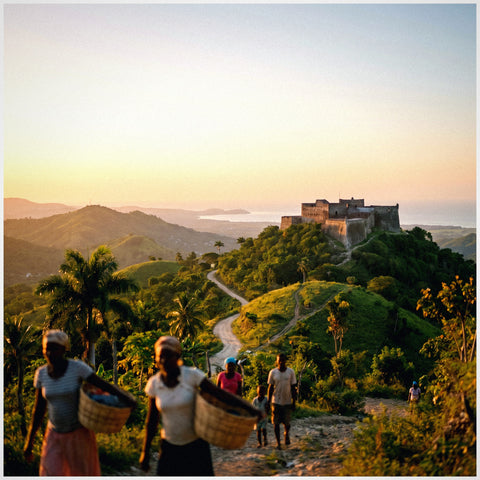
About 20 kilometers from Cap-Haïtien, near the town of Milot, is the country's most important monumental complex: the Sans-Souci Palace, the ruins of Ramiers, and, crowning Bonnet à l'Évêque mountain at about 900 meters altitude, the Citadelle Laferrière. The complex forms the National Historical Park and was inscribed on the UNESCO World Heritage list in 1982: the first Haitian site on the list.
It's not just any fortress. Henri Christophe ordered its construction after Haiti's independence in 1804, when Haiti became the first independent black republic in the world and the first state born from a revolt of enslaved people who managed to defeat a European army. The Citadelle was built to resist a French return that never came. It is, literally, architecture of freedom.
Regarding coverage, what you'll find:
- Milot and Sans-Souci: there is signal, usually 3G and sometimes 4G from Digicel. Enough for messaging and uploading photos with patience.
- Climb to the Citadelle: the path of about 7 km from Milot goes through sections without coverage. Don't count on being reachable all the time.
- At the top of the fortress: paradoxically, there is usually some signal due to the altitude and line of sight with repeaters in the valley, but it is unstable.
If you're documenting the site—press, NGO, heritage—record and upload later, once back in Cap-Haïtien. And download offline maps of the area before you leave.
Labadee: the cruise enclave and its network bubble
Labadee deserves its own section because it's the most curious case in the entire country. It's a fenced peninsula on the north coast, near Cap-Haïtien, leased for decades by Royal Caribbean and operated as a private enclosure: passengers disembark, spend the day on the beach and on the zipline over the sea, and return to the ship without having set foot in real Haiti or passed through immigration control. For years, millions of cruise passengers "visited Haiti" without realizing they were in Haiti.
Now for the honest fact, because a lot of outdated information circulates: Royal Caribbean suspended calls to Labadee in March 2024, briefly resumed them in early 2025, and then canceled them again. The latest communications from the cruise line extend the suspension until June 2027, redirecting those itineraries to Nassau, Grand Cayman, San Juan, or Bimini. In other words: as of today, no cruise ships are arriving. Verify the status with your cruise line if you have an itinerary that includes it.
The connectivity nuance is genuinely interesting: although Labadee operated as a bubble with a Haitian passport, passengers' phones didn't know it. Upon disembarking, they would connect to Digicel or Natcom antennas on the mainland and be billed as Haiti.
More than one cruise passenger was surprised by a data bill from a country they thought they hadn't visited. If calls ever resume, the rule is always the same in port: either ship Wi-Fi, or locally purchased data specifically for the purpose, but never leave your phone on automatic mode.

Roaming, Wi-Fi, local SIM or eSIM: the four options face to face
Four ways to connect, and none are perfect. I'll lay them out clearly, with their drawbacks.
| Option | Estimated Cost | Advantage | Drawback in Haiti |
|---|---|---|---|
| Spanish Roaming | Several € per MB without a bundle; daily bundles of 10-20 €/day where available | Works without doing anything | Haiti is not EU: "Roam Like at Home" does not apply. Sky-high bills |
| Hotel or Office Wi-Fi | Included | No extra cost | Depends on generator; goes down with power outages and not always available on missions |
| Local SIM (Digicel / Natcom) | SIM from 50-75 HTG; bundles from 200 HTG | Cheapest per gigabyte | Requires passport, registration, and travel to a physical store |
| Travel eSIM | Data plan purchased before departure | Activated and working upon landing | Requires compatible and unlocked phone; usually data-only |
Roaming is the classic expensive mistake. Haiti does not belong to the EU, the EEA, or any outermost region of a member state, so European roaming regulations offer no protection here whatsoever: each megabyte is billed at "rest of the world" rates. If you want specific numbers on what that entails, I broke it down in how much international roaming costs, and the direct comparison is in eSIM vs. roaming.
Wi-Fi is not a strategy, it's a supplement. And a pocket Wi-Fi, which makes sense in other destinations, here is just another gadget to carry, which can break and attracts attention; I compare it in depth in eSIM vs. pocket Wi-Fi.
That's why the recommendation is to arrive already connected. If you're not sure how the technology works, start with what an eSIM is and then check the specific guide for eSIM for Haiti.
Digicel and Natcom: prices, coverage and procedures
If you're going to be on the ground for weeks or months, a local SIM card ends up being the cheapest option. These are the magnitudes to expect, with the caveat that Haitian operators change tariffs very frequently, so it's advisable to confirm in store:
| Operator | Product | Estimated Price | Validity |
|---|---|---|---|
| Natcom | Prepaid SIM (XChange) | 50-75 HTG | — |
| Natcom | 60 MB | 9 HTG | 24 hours |
| Natcom | 1.5 GB | 200 HTG | 30 days |
| Natcom | 5 GB | 1,000 HTG | 7 days |
| Digicel | Regular prepaid top-ups | 617 - 3,550 HTG | depending on plan |
| Digicel | "Pale Net" type packages | from 550 HTG | depending on plan |
Regarding currency: the official currency is the gourde (HTG), which has fluctuated around 130 gourdes per dollar with considerable volatility. The US dollar circulates normally, and many service prices are quoted directly in dollars. And be aware of a local peculiarity that confuses everyone: in the street, the "Haitian dollar" is still used as a unit of account, which equals 5 gourdes. If someone tells you "20 dollars" in a market, they might be saying 100 gourdes.
For a SIM, you need a passport and a physical store: ownership registration is mandatory, and street vendors don't always process it correctly, risking your line being deactivated after a few days. This process, in a country where moving around has a security cost, is precisely what is avoided by arriving with active data. The honest comparison between both options is in eSIM vs. local SIM.
How much data you need and the network jump at the border
Haiti shares the island of Hispaniola with the Dominican Republic, and this is where one of the most important warnings in this guide comes in. In Ouanaminthe/Dajabón (north), Belladère/Elías Piña (center), and Malpasse/Jimaní (south), Dominican cell towers from Claro, Altice, and Viva extend several kilometers into Haitian territory, and Haitian towers do the same on the other side. Your cell phone doesn't distinguish between countries; it distinguishes the strongest signal.
The result: you could be in Ouanaminthe, with your Haitian plan active, and see your phone connect to a Dominican network, starting to charge international rates. Network hopping at the border has ruined the budgets of many missions. The solution takes one minute: go into your network settings, disable automatic operator selection, and manually select Digicel HT or Natcom while you are in the border area. If you are actually crossing, get a plan that covers both countries or have a second profile ready.
| Profile | Stay | Recommended data | Why |
|---|---|---|---|
| Short mission / diaspora | 1 week | 3-5 GB | Messaging, offline maps, occasional calls |
| Aid worker in the field | 2-4 weeks | 10-20 GB | Coordination video calls and report synchronization |
| Press / documentation | 1-2 weeks | 20-30 GB | High-resolution video and photo uploads |
| Long stay | 1 month or more | Local SIM + backup data | Lower cost per gigabyte, with alternative backup network |
And a recommendation that's not about data but about connection: bring an external battery of at least 20,000 mAh and a solar charger if you're going outside the city. It's no use having coverage if your phone is dead because you haven't had electricity for eight hours.
Frequently Asked Questions
These are the questions I actually receive about getting connected in Haiti.
Does my Spanish mobile phone work in Haiti?
Yes, technically it works, but Haiti is not in the EU and "Roam Like at Home" does not apply. Your operator will charge at rest-of-world rates, on the order of several euros per megabyte if you don't contract a specific bundle. Before you leave, check your customer area to see what exact rate your company applies for Haiti and consider deactivating roaming data.
Is Port-au-Prince airport open?
Toussaint Louverture Airport has completely closed down and its operations remain irregular. It closed in March 2024, reopened in phases, and in December 2024, a return to normal operations was announced, but the FAA's ban on US civil aviation has been repeatedly extended, and major airlines have kept the route suspended. Verify the current status before purchasing any tickets.
Do cruises arrive in Labadee?
Not at this time: Royal Caribbean has suspended calls in Labadee and has extended the cancellation until June 2027. Calls were stopped in March 2024, there was a brief resumption in early 2025, and they were cancelled again. Affected itineraries have been rerouted to the Bahamas, Grand Cayman, or Puerto Rico. Always confirm with your cruise line.
Do I need a passport to buy a SIM in Haiti?
Yes, ownership registration with an ID document is mandatory. You will need to go to an official Digicel or Natcom store with your passport. Avoid buying already activated SIMs from street vendors: if the registration is not done correctly, the line may be deactivated within a few days, and you will have lost money and time spent traveling.
Is there coverage at Citadelle Laferrière?
There is signal in Milot and Sans-Souci, usually 3G, but the path up to the Citadelle has stretches without coverage. At the top of the fortress, some signal is sometimes regained due to the altitude, though unstably. Download offline maps before climbing and don't count on being reachable throughout the journey.
What happens to coverage if I get close to the Dominican border?
Your mobile might automatically connect to a Dominican network and charge you as if you had changed countries. This happens in Ouanaminthe, Belladère, and Malpasse, where Claro, Altice, and Viva signals penetrate several kilometers. Disable automatic operator selection and manually select Digicel HT or Natcom while you are in the border area.
Can I pay in dollars or do I need gourdes?
The US dollar is commonly used, but the official currency is the gourde (HTG), at around 130 per dollar. Many services are quoted directly in dollars. Be careful with the "Haitian dollar" used as a unit of account on the street: it equals 5 gourdes, so always confirm what currency the price is being given in.
Is it safe to travel to Haiti right now?
The short answer is no, and that's why the first thing to do is consult official Foreign Office recommendations. Haiti is going through a serious security crisis, with armed groups controlling large areas of the capital and roads. If your trip is essential for humanitarian work, a mission, press, or family ties, register with the Travel Registry and get insurance that covers evacuation.
Conclusion
To summarize without embellishments. Haiti has two networks, Digicel and Natcom, with decent 4G in Port-au-Prince and Cap-Haïtien and little beyond; the real enemy of connection is power outages and generator fuel. Spanish roaming is very expensive because Haiti is not covered by European regulations. A local SIM is the cheapest option per gigabyte, but it requires a passport and going to a store. And the capital's airport remains an open front, with Cap-Haïtien as a practical entry point, and Labadee, that fenced-off cruise enclave, without calls until at least June 2027.
If your trip is essential, prioritize things correctly: first, official Foreign Office recommendations and the Travel Registry, then insurance with evacuation coverage, and only then data logistics. Here, the recommendation is clear: sort out your connection before you leave, so you land with data working and don't have to rely on on-the-ground management that can be complicated. You can purchase your eSIM for Haiti in two minutes, activate it from home, and have an operational communication channel from the moment you set foot in the country. Take good care of yourself.