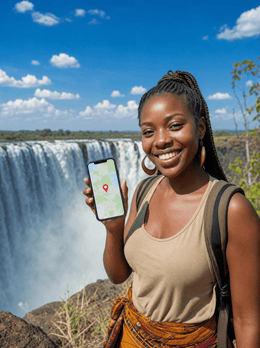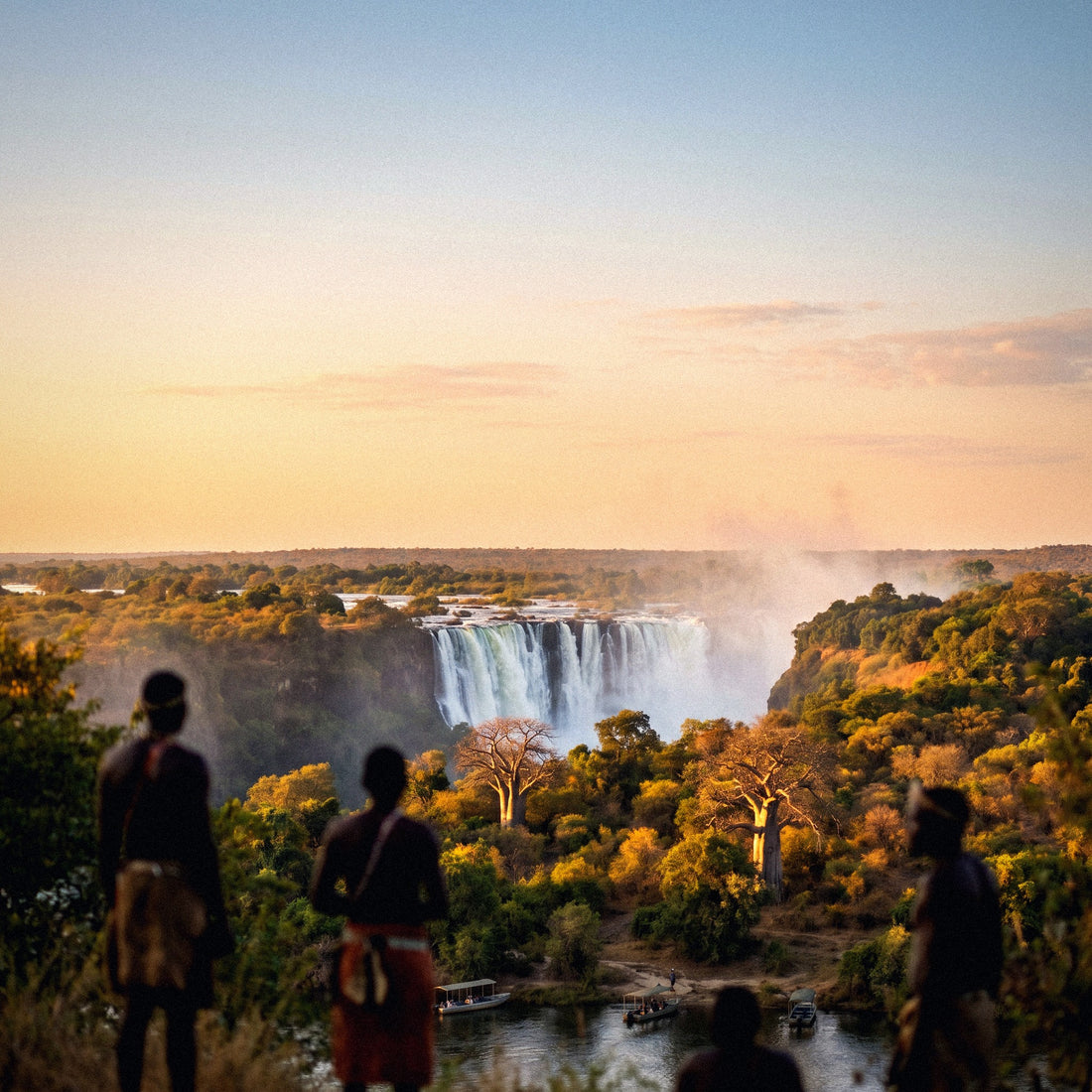
Zambia is one of those destinations where your cell phone goes from working perfectly to being dead in a few kilometers, which is why you ask me so often how to get internet in Zambia without any surprises. In Lusaka or Livingstone, you'll be connected almost all the time; inside South Luangwa or Lower Zambezi, your phone becomes an expensive camera. Here, I'll tell you about the real options, what coverage is available zone by zone, and a detail that catches many people off guard at Victoria Falls.
What it's like to connect to the internet in Zambia
In Zambia, you connect via the 4G mobile network. You have four options: roaming (expensive, as the country is outside the EU), hotel and lodge Wi-Fi (limited), a local SIM from MTN, Airtel, or Zamtel (cheap, with passport and registration), and an eSIM ready before you fly.
The first thing to understand is that fixed internet barely exists here outside of offices and hotels: the country connects via mobile. The good news is that the Zambian mobile network has grown significantly in the last decade, with thousands of new towers and 4G in all major cities and tourist corridors. According to the regulator, the vast majority of the population now lives under mobile broadband coverage.
The bad news is the other side of the coin: Zambia is huge and sparsely populated, and that coverage follows the map of roads and cities, not national parks. As soon as you enter the bush, the signal disappears for hours, and no card will bring it back, because they all use the same antennas. For travelers, this means planning in two modes: an urban mode, where you can work without problems, and a wild mode, where you accept being disconnected with downloaded maps.
Your options: roaming, Wi-Fi, local SIM, and eSIM
Before going into detail, here's a quick overview of the four real ways to get data in Zambia. Each has its moment: your operator's option should only be saved for emergencies, accommodation Wi-Fi is a backup, a Zambian card is unbeatable in price if you don't mind the paperwork, and the digital option is the balance I recommend to almost everyone.
| Option | Approx. Cost | Coverage | Ease | Ideal for |
|---|---|---|---|---|
| Roaming | Very high (several €/MB) | That of the local allied network | Zero setup | Specific emergencies |
| Hotel/lodge Wi-Fi | Included or paid | Only at the accommodation | Easy, but slow | Email at night |
| Local SIM | Low (kwacha) | Excellent in the country | Passport registration | Long stays |
| eSIM | Low-medium | Zambian networks | Activated before flying | Most travelers |
As you can see, the difference is not in coverage—all four use the same Zambian antennas—but in price and the hassle of setting them up. Your company's option wins in convenience but loses significantly in terms of the bill; the local card wins in price but requires queuing; the digital option is in the middle, cheap and ready before you land. Now I'll break down each one and then go into detail about coverage by area.

International roaming: the most expensive option
Roaming means keeping your Spanish line active and using it as is in Zambia. It's the most convenient—you don't configure anything—and also the one that causes the most headaches, because the country is outside the European Union and the regulated tariffs you enjoy within it do not apply. Many operators charge several euros per megabyte in sub-Saharan Africa, so an afternoon of maps, WhatsApp, and photos can end in a three-figure bill.
I've seen travelers return with surcharges of hundreds of euros just for leaving their data on when they landed. If you still want to go this route, the minimum is to call your company before leaving and contract a package for Africa: some cushion the blow, although they are still expensive compared to any local alternative. And there's a very Zambian nuance that we'll see later: near the falls, your phone might latch onto a Zimbabwean antenna, with its own tariff, even if you don't cross the bridge.
My honest advice: save this option for a real emergency and travel with data turned off by default. If you want to see the numbers calmly, I explain it in my comparison of eSIM vs. roaming and in the guide on how much international roaming costs.
Hotel and lodge Wi-Fi: when it's useful
Almost all hotels in Lusaka and Livingstone and a good number of safari lodges offer Wi-Fi for guests. In the city, it usually works well for basics: email, a short video call, uploading photos at night. In the bush, the story changes, as many camps connect via satellite and share that connection among all guests.
The novelty of recent years is that several lodges in South Luangwa and Lower Zambezi have installed low-orbit satellite internet, which has greatly improved the experience. Even so, it's still a shared connection, concentrated in the common area (dining room, bar, or reception) and slows down at peak times, when everyone returns from the game drive and connects at the same time.
There's another important detail: many camps explicitly ask you to disconnect. Some limit it to certain time slots, others only provide it upon request, and a few don't offer it at all because they sell disconnection as part of the experience. Check the accommodation's website before booking if you need to work. Treat it as an extra, never as your primary connection; and if you were thinking of a portable router, I explain why it's usually not worth it in my comparison of eSIM vs. pocket Wi-Fi.
The local SIM: MTN, Airtel, and Zamtel
Buying a Zambian SIM card is the cheapest option if you're staying for many days. There are three operators: Airtel, the leader with about 48% of lines; MTN, around 33%; and Zamtel, the state-owned company, with the remaining 19%. The card costs about 5 kwacha (just over €0.20) and packages are competitive: with Zamtel, 100 ZMW (about €5) provides around 6 GB and 250 ZMW (about €12) provides around 15 GB.
| Operator | Approx. Share | Best for | Notes |
|---|---|---|---|
| Airtel | ~48% | General coverage and long routes | The most extensive network in the country |
| MTN | ~33% | Lusaka, Livingstone, and Copperbelt | Good urban 4G; kiosk at the airport |
| Zamtel | ~19% | Tight budget | Cheap packages; more in-store processing |
The annoying part is the mandatory registration: every prepaid card must be activated in a person's name, so you'll need your passport and provide your details at the point of sale. The seller will process it with you, but it involves queuing at Lusaka airport or an official store. If you're looking for the lowest cost, go ahead; if you prefer to leave the airport without formalities, compare it first in my guide on eSIM vs. local SIM.
The eSIM: the option I recommend
An eSIM is a digital card that you install by scanning a QR code, with no physical component and without removing your Spanish SIM. You buy it and have it ready before leaving home, and when you land in Lusaka or Livingstone, it automatically connects to Zambian networks. No queues, no passport on the counter, and no losing the first afternoon looking for a store.
I recommend it to most people for three reasons. Convenience: you keep your Spanish number for bank SMS and use the data from the digital line for everything else, which is appreciated on a trip with internal flights. Cost control: you contract the gigabytes you need at a fixed price, with no surprises upon return. And peace of mind: you arrive connected to request a transfer or open a map.
There's a fourth reason specific to this destination: you can have one line for Zambia and add another for Zimbabwe if you cross, without changing cards. The only requirement is a compatible phone: almost all iPhones from XS and most recent Androids are. If you've never used one, I explain it in what an eSIM is and how it works, and I go into detail about plans in my eSIM guide for Zambia.

Coverage in Lusaka and the cities
Let's start with the easy part. In Lusaka, you'll be well connected with any option: there's solid 4G throughout the city, enough for video calls, maps, and occasional work, and operators have started deploying 5G in selected urban areas. The same applies to the Copperbelt (Ndola, Kitwe), Kabwe, and Chipata, the gateway to the Luangwa Valley.
Where expectations need to be lowered is on the long roads between cities. Zambia involves journeys of many hours—from Lusaka to Livingstone there are about 470 km, and to Chipata more than 550—and on these stretches, the signal comes and goes: good when passing through towns, weak or nonexistent in between. If you're driving yourself, download the map of the entire route before starting.
There's an extra factor that we don't consider in Spain: power outages. Zambia has experienced long periods of electricity rationing, and when a tower's batteries run out, it stops providing service even if your phone showed plenty of coverage a while earlier. All the more reason to do the heavy lifting in the city: uploading photos, downloading tickets, and saving maps offline.
Livingstone and Victoria Falls
Livingstone is, after Lusaka, the best-connected area in the country. The city, the hotels on the road to the falls, and the park area itself have reasonable 4G coverage, and you'll be able to send videos from the Knife-Edge Bridge almost live. The signal degrades in the Zambezi Gorge—exactly where rafting and bungee jumping are done—which is logical due to the geography.
And here comes the warning that gives half the guide its title: across the bridge, on the other side, is Zimbabwe. Antennas on the Zimbabwean side reach the Zambian side perfectly, so your phone can connect to the neighboring country's network without you crossing the border. With your Spanish line, this is billed as Zimbabwe, with its own tariff; with a plan bought for Zambia, you'll simply lose data until it picks up the local network again.
The solution is simple: go into your phone settings, disable automatic network selection, and manually choose a Zambian operator (Airtel, MTN, or Zamtel). It takes a minute and saves you the problem for the entire visit. And if you're going to see the falls from the Zimbabwean side as well, treat it for what it is: another country, with its own data plan.
Safaris: South Luangwa and Lower Zambezi
Here I have to be honest: there's no real mobile coverage inside the parks. In South Luangwa, there's some signal in the Mfuwe area, near the main gate and the airport, where the village and several lodges are located. As soon as you cross the river and enter the park, the signal completely disappears throughout the game drive. In Lower Zambezi, it's even more extreme: a remote valley that many reach by plane.
What you will find in many camps is satellite internet. It's good for sending an "I'm okay" message, checking email, and little else: it's a shared connection, almost always in the common area and often limited to certain hours. And remember that many lodges will ask you to put your phone away during meals and outings.
Traveler's tip: In South Luangwa and Lower Zambezi, don't rely on your phone. Download maps and documents before leaving Lusaka or Chipata, let your loved ones know you'll be unreachable for a couple of days, and enjoy the silence. Your guide has a radio and the camp has its own communication for any unforeseen events.
The good thing is that this disconnection is predictable: you know when it starts and when it ends, so it's enough to organize yourself beforehand.
How much data you'll need for your trip
The million-dollar question: how many gigabytes to buy. An average traveler consumes between 500 MB and 1 GB per day with normal use (WhatsApp, maps, social media, some photos). For the classic itinerary—a few days in Livingstone, a couple of nights in Lusaka, and three or four days of safari—a plan of 5 to 10 GB is more than enough for most, especially if you use hotel Wi-Fi at night.
| Traveler Profile | Daily Usage | For 10 Days |
|---|---|---|
| Basic (maps, WhatsApp, messages) | 300-500 MB | 3-5 GB |
| Medium (social media, photos, some video) | 700 MB-1 GB | 7-10 GB |
| Intensive (video, active maps, sharing connection) | 1.5-2 GB | 15-20 GB |
Keep in mind a detail that works in your favor: on safari days, you'll barely use any data because there won't be a network to use it on. Your real consumption is concentrated in Lusaka, Livingstone, and during transfers, so there's no need to buy a giant plan "just in case." And a trick I always use: activate data saver, disable automatic video playback, and schedule photo backups only over Wi-Fi. With that, the same plan lasts twice as long.
Frequently asked questions
Is there coverage at Victoria Falls and on safaris?
At the falls, yes: Livingstone and the park area have reasonable 4G, though it weakens in the Zambezi Gorge. On safaris, no: inside South Luangwa and Lower Zambezi, there is no mobile network, only satellite Wi-Fi at some lodges in the common area.
Why does my phone pick up a Zimbabwean network in Livingstone?
Because antennas on the Zimbabwean side reach the Zambian side, and your phone picks the strongest signal. This is billed as another country. Go into settings, disable automatic network selection, and manually choose Airtel, MTN, or Zamtel to avoid this.
Do I need my passport to buy a SIM in Zambia?
Yes. Every prepaid card must be registered in a person's name, so the seller will ask for your passport and details at the store or airport kiosk. It's a legal requirement. An eSIM is activated online and saves you this hassle.
How much does a local data package cost?
Little: the card costs around 5 kwacha and packages are competitive. With Zamtel, about 100 ZMW (around €5) provides about 6 GB, and 250 ZMW (around €12) provides about 15 GB. Airtel and MTN have similar daily, weekly, and monthly packages.
Does my Spanish operator's roaming work in Zambia?
It works, but it's expensive. Zambia is outside the European Union, so regulated tariffs do not apply, and many companies charge several euros per megabyte. Only use it for emergencies or pre-contract a package for Africa.
Which operator has the best coverage in Zambia?
Airtel is the market leader, with about 48% of lines and the most extensive network; MTN is around 33% and works very well in Lusaka, Livingstone, and the Copperbelt. Zamtel, the state-owned company, is the cheapest but has the least rural reach.
Is there Wi-Fi in safari lodges?
In many, yes, via satellite and increasingly better thanks to low-orbit systems. But it's a shared connection, usually limited to the common area and certain hours. Additionally, several camps ask you to put your phone away during meals and outings.
Can I use the same eSIM in Zambia and Zimbabwe?
It depends on the plan: one bought only for Zambia does not cover Zimbabwe. If you're going to see the falls from both sides, choose a regional plan that includes both countries or add a second digital line. Being virtual, they coexist on the same phone.
Conclusion
In summary: Zambia has good connectivity where people live and none where animals live. You'll have comfortable 4G in Lusaka, the Copperbelt, and Livingstone, spotty signal on long roads, and total disconnection in South Luangwa and Lower Zambezi, with the lodge's satellite Wi-Fi as your only link. Your carrier's line is very expensive outside the EU, a local SIM card is very cheap but requires a passport and queuing, and an eSIM is the middle ground: you land already connected, with fixed costs and no paperwork. Manually select your network at the falls to avoid jumping to Zimbabwe, estimate 5-10 GB, and download maps before entering the park. If you want to sort it out before flying, check out PuraSIM's eSIM for Zambia.