In short: between eSIM and local SIM, for trips lasting days or a few weeks, the eSIM wins: you activate it before leaving home, you keep your usual WhatsApp number, and you don't waste time looking for a store upon landing. A local SIM only pays off for long stays, a month or more, or when you truly need a local phone number.
This is the question that assails anyone packing their bags: should I activate an eSIM before leaving or wait to buy a local SIM as soon as I land? Both provide mobile data at your destination, but they don't serve the same purpose, nor do they cost the same in terms of time and money. Here's a direct comparison, highlighting what really changes depending on the trip you have ahead.
What each one is, without technical jargon
An eSIM is a digital profile installed on your mobile by scanning a QR code. There's no plastic to insert or tray to open: you activate it from home, with Wi-Fi, and it's stored alongside your usual line. You can set it to activate automatically upon landing, or turn it on manually as soon as you get off the plane.
A local SIM is a physical card from an operator in the country you're visiting. You buy it there—at the airport, a phone shop, or an official store—insert it into your phone's tray, and it gives you a number for that country, usually with data, minutes, and sometimes SMS included in the same pack.
The real difference that matters isn't the format, it's what happens with your number from Spain. With a local SIM, that number is set aside while you use the local card: if someone calls your usual number, it won't connect. With an eSIM, your Spanish line remains active at all times because both coexist on the same phone. To understand why this relates to your carrier's roaming, take a look at what data roaming is.
Head-to-head comparison
There isn't one option that wins in every aspect. Each traveler prioritizes different things: some don't want to waste a minute upon arrival, others absolutely need a local number for procedures. This table summarizes where each option excels.
| Criterion | eSIM | Local SIM |
|---|---|---|
| When it's ready | Before leaving home | Upon landing, searching for a store |
| Your Spanish number | Remains active | Takes a back seat |
| Number of the country you're visiting | No, except for plans with voice | Yes, it's included |
| Handling the SIM tray | Not necessary | Yes, you have to open it |
| Registration process | None | In some countries, with passport |
| Ideal for | Trips from days to a few weeks | Long stays, a month or more |
| Risk of unreliable store | Low, verifiable online purchase | Depends on where you buy it |
The eSIM offers convenience and a lack of bureaucracy. The local SIM provides a local number. The rest of the decision depends, above all, on how many days you'll be away.

Real price: where the money goes
On paper, a local SIM seems like the cheaper option. But the price of the card doesn't tell the whole story. At many airports, it's sold with an obvious "recently-landed tourist" surcharge, and in several countries—Mexico and a good part of Latin America and Asia among them—you have to register the SIM with your passport before it works, which adds to queuing time and sometimes a fee. If you're only staying for a few days, that theoretical saving quickly vanishes.
With an eSIM, on the other hand, you buy a pack tailored to your actual travel days: you choose the gigabytes you'll need and don't overpay for data you won't use. We won't give you a price per gigabyte figure here because it varies by destination, season, and the pack you choose; it's more honest to compare the current price at the time of purchase, not a table that may have changed.
Traveler's tip: always compare the cost per gigabyte and per day of validity, not just the pack price. A "cheap" local SIM with data that expires in a week can end up being more expensive than an eSIM tailored to your exact number of days.
If you also want to make your purchased data last longer, whether it's an eSIM or a local SIM, you can find specific tips in how to save data on your travel eSIM.
Coverage and speed: do you lose anything with an eSIM?
In terms of coverage, a local SIM has a theoretical advantage: it directly uses the network of the national operator that issues it. But a serious travel eSIM relies on agreements with those same local operators, so in cities and tourist areas, the real difference is barely noticeable: you browse in 4G or 5G just as well with either one.
Where it might be slightly noticeable is in very specific rural areas or mountain routes far from urban centers, where the dominant operator in the country might have better coverage than the secondary network your eSIM connects to. This is a nuance, not a rule: for most city and coastal routes, including capitals with a lot of tourism, any decent eSIM with several networks available per country handles the job well.
One difference that is real and in favor of the eSIM: your Spanish line remains active at all times, so if you need to receive a verification code from your bank or someone from home needs to reach you, it will come through. With a local SIM, that number is disconnected while you're using it, unless you activate call forwarding before you leave.
When a local SIM wins (for real)
A local SIM is not the "worse" option; it simply excels in other contexts. It makes sense to buy one when:
- You're staying more than a month in the same country: For a long stay, living, studying, or working abroad, the calculation changes, and a monthly local plan is usually better than repeatedly renewing eSIM packs.
- You genuinely need a local number: To register for local apps, order a taxi, book a restaurant that only confirms via local SMS, or provide it as a contact to a landlord or company.
- You'll be making many national calls: If you're going to call local numbers frequently, a local plan with included minutes is more cost-effective than buying international minutes.
- Your phone doesn't have eSIM capability: Some older or very basic models don't support it, so it's advisable to check before assuming you can activate it.
Outside of these cases, dealing with the hassle of a physical card—queues, passport registration, storing your home SIM somewhere you won't lose it—is usually more trouble than real savings.
When you shouldn't buy anything (neither eSIM nor local SIM)
Here we have to be upfront, even if it doesn't directly benefit us: if you're traveling within the European Union with a Spanish line, your operator already includes roaming at no extra cost, due to European regulations. For a long weekend in Paris, a getaway to Rome, or a weekend in Amsterdam, you don't need to buy anything: your home plan covers you just like in Spain. Buying an eSIM there would be spending on something you've already paid for. You can check in detail when it's worthwhile to take the step in eSIM vs. your operator's roaming.
It's different if you leave the EU: there, your Spanish operator's roaming usually becomes very expensive or directly doesn't include data, and that's when an eSIM starts to make real sense.

Myths and what almost no one tells you
"A local SIM is always cheaper." Not always. Between the airport surcharge, the passport registration required by several countries, and data that expires in a few days, the savings can be nil if your trip is short.
"You need a very expensive phone for an eSIM." False: most mid-range phones from recent years already incorporate it; you don't need the most expensive model on the market. What is advisable, however, is to check before you travel, not at the airport: you can find the details in how to install an eSIM step by step.
"If I have an eSIM, I can no longer use a physical SIM." On the contrary: the beauty of an eSIM is that it coexists with your traditional physical SIM (or with another eSIM) in dual SIM mode. You don't have to choose one or the other.
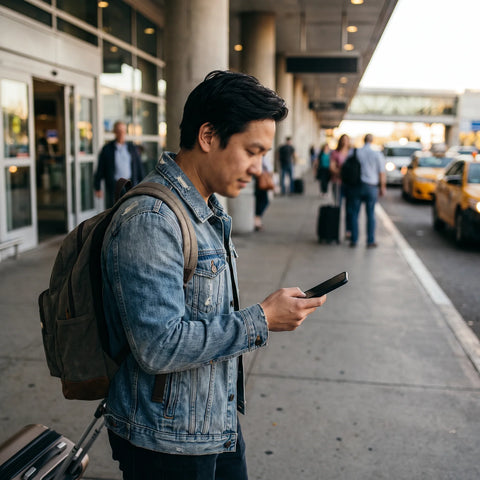
What almost no one tells you: If your flight lands in the early hours, the SIM card stores at the airport might be closed or have only one counter with a long queue—this happens quite often in Asian airports with night flights. Activating your eSIM before leaving home avoids this problem altogether: you land with data without depending on someone being awake to sell you a card.
Another less obvious detail: save a screenshot of your eSIM installation QR before you leave, not just the email. If you lose connection upon landing, you'll need to be able to open that image without relying on Wi-Fi to download the email again.
And if what you're looking for is a physical card that works in several countries at once instead of buying a different SIM at each border, you can find that comparison in international chip vs. eSIM.
How to decide in 30 seconds
Boil it down to three questions and you'll clear up any doubts without overthinking:
- How many days will you be away? Less than a month → eSIM. More than a month in the same country → consider a local SIM.
- Do you need a local number? Yes → Local SIM. No, you just want data and WhatsApp → eSIM.
- Do you want it sorted before leaving home? Yes → eSIM, without hesitation.
For the vast majority of getaways and holidays, all three answers point to an eSIM. If your case is a temporary move, a semester of studies abroad, or several months working in the same place, a local SIM fully enters the conversation.
Before you go: the data you can check
If you opt for an eSIM, PuraSIM has plans for over 200 destinations, so it's rare that you'll be without coverage for the country you're visiting, whether it's a getaway to Spain or a trip around Europe with eSIM Europe. And if anything goes wrong during installation or activation, there's 24/7 support in all languages via email and WhatsApp, so you don't depend on finding an open store at three in the morning. If you're also concerned about what your operator or hotel Wi-Fi networks see while you browse, that's a separate topic we cover in eSIM, VPN, and privacy when traveling.
Frequently asked questions
What is the real difference between an eSIM and a local SIM?
The format: an eSIM is a digital profile installed via QR and coexists with your Spanish line; a local SIM is a physical card from a destination operator that replaces or parks your home number while you use it. An eSIM is activated before you leave; a local SIM, upon arrival.
Is an eSIM more expensive than a local SIM?
It depends on the trip. A local card often seems cheap, but you have to add potential airport surcharges and the passport registration required by some countries. For short trips, an eSIM pack tailored to your actual days often works out to be the same or more cost-effective, without wasting time on paperwork.
Do I lose my Spanish number if I use an eSIM?
No. The eSIM is installed alongside your usual line, so your Spanish number remains active for calls, SMS, and verification codes while you use the eSIM only for data. With a local SIM, however, your home number is set aside while the local card is inserted.
Do all mobile phones have eSIM?
Not all, but most mid-range and high-end phones from recent years do. Before deciding, check your specific model's compatibility: it's better to find out at home than in the airport queue.
Can I use an eSIM and a local SIM at the same time?
Yes, if your phone supports dual SIM, which is the case for most recent devices. You can keep your Spanish line on the eSIM (or physical SIM) and add a local SIM for the country's number, or vice versa. This combination is used by those who need both at the same time.
Do I need a passport to activate an eSIM?
No. That's precisely one of the procedures you save yourself compared to a local SIM: in several countries, the operator requires you to register the physical card with your passport before it works. An eSIM is purchased and activated online, without that step.
When is it better for me to buy a local SIM than an eSIM?
When you're going to spend more than a month in the same country, need a local number for procedures, apps, or daily contacts, or are going to make many national calls. Outside of these cases, the eSIM usually wins in convenience and time.
Conclusion
The local SIM has its place for long stays and when you truly need a local number. But for the vast majority of trips, the eSIM wins in convenience, time, and peace of mind: you activate it before leaving, keep your usual number, and land with internet from the first minute, without queues or surprises at the airport store.