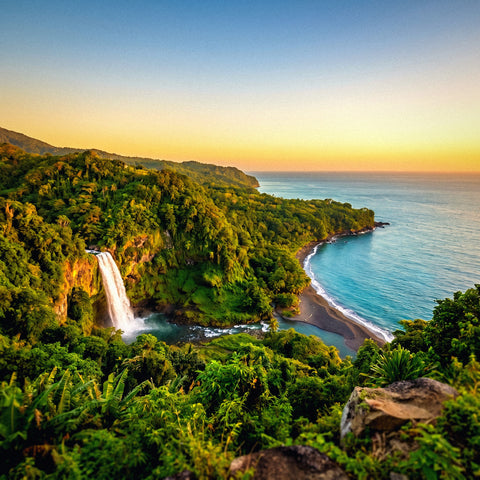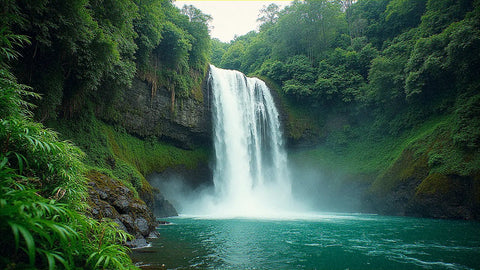
If you're planning a trip to Dominica, let's start with the number one question: Dominica is not the Dominican Republic. They are two distinct countries, separated by more than 800 kilometers of sea. The Dominican Republic shares Hispaniola with Haiti, speaks Spanish, and uses pesos; the Commonwealth of Dominica is a small, mountainous, and forested island in the Eastern Caribbean, located between Guadeloupe and Martinique, English-speaking, with its capital in Roseau, and using the Eastern Caribbean dollar (XCD) as its currency. With that confusion cleared up, let's get to the practicalities: how to get internet in Dominica without bill shock or getting stranded in the middle of the jungle, so you can explore the nature island with your mobile needs sorted.
How to connect (and why it's not the Dominican Republic)
Dominica is a different country from the Dominican Republic: it is the "nature island" of the Eastern Caribbean, English-speaking, with its capital in Roseau. To connect there, you have four options: roaming, hotel Wi-Fi, a local Flow or Digicel SIM with a passport, or an eSIM activated before flying, which is the most convenient option.
The confusion is understandable, as the names are similar, but the contrast couldn't be greater. The Dominican Republic has eleven million inhabitants, resorts in Punta Cana, and direct flights from Spain. Dominica has around 73,000 inhabitants, no direct flights from Europe—you arrive via Antigua, Barbados, or San Juan, or by ferry from Guadeloupe and Martinique—and its appeal lies in its jungles, volcanoes, and water.
This difference also applies to connectivity. There isn't a dense urban network here, but rather two operators—Flow and Digicel—deploying 4G LTE over steep mountains and enclosed valleys. In Roseau, Portsmouth, and along the coast, you'll have good coverage; as soon as you venture into the rainforest, things change. That's why it's advisable to make two decisions before packing your bags: how you'll connect, which affects your wallet, and where you'll be traveling, which determines whether you'll have a signal.
The four options for connecting
You have four paths to choose from, and it's worth knowing them before deciding. What works perfectly for someone on a short cruise stop in Roseau is a mistake for someone coming to hike the national trail for two weeks. Dominica attracts a specific profile—hikers, divers, naturalists—who spend a lot of time away from cell towers.
I'll present them as four very different approaches instead of just selling you one. Here's a quick overview of where each fits based on your trip, budget, and willingness to deal with hassle upon arrival.
| Option | Estimated Cost | Convenience | Ideal for |
|---|---|---|---|
| Spanish Roaming | High (per MB or bundles) | Zero management | 2-3 day getaways |
| Hotel or eco-lodge Wi-Fi | Almost always free | Only on-site | Occasional checks |
| Local SIM Flow/Digicel | Low (from 20 XCD) | Passport and store visit | Longer stays |
| Travel eSIM | Medium-low | Activates automatically | Most travelers |
None is universally superior; it depends on the number of days and, more importantly, how much time you'll spend in the mountains. On an island where the main activity is hiking for six hours through the jungle, the question isn't just how much a gigabyte costs, but what you do when there's no antenna in sight.

Roaming with your Spanish operator
First important warning: Dominica is not part of the European Union. Although it has French neighbors to the north and south—Guadeloupe and Martinique are indeed European territory—it is an independent country, so the "roam like home" rate you use in Lisbon or Rome does not apply here. As soon as your mobile connects to Flow or Digicel, you'll be on international roaming rates.
And in the catalog of almost all Spanish operators, the Eastern Caribbean falls into the most expensive zone: prices per individual megabytes or daily bundles that can eat up your excursion budget in two days. The advantage is undeniable—you arrive, turn on your phone, and it works—but that convenience comes at a cost, and often it's the surprise bill upon returning home that pushes people to seek alternatives.
If you're still considering it, ask your operator for the exact price for Dominica, emphasizing that it's not the Dominican Republic: I've seen people contract the wrong country's bundle and only discover it with the first usage notification. For the numbers, I refer you to my guide on how much international roaming costs and the comparison of eSIM vs. roaming.
Hotel, eco-lodge, and port Wi-Fi
Free Wi-Fi is your ally for anything not urgent. Almost all accommodations offer connection, and there are free public spots at Douglas-Charles Airport, Roseau Library, and the cruise port. For planning the next day or uploading a waterfall video, using the dining room router after dinner is usually sufficient.
The fixed network is better than many expect: domestic broadband averages triple digits in megabits thanks to the Southern Caribbean Fiber submarine cable, which landed in Canefield in 2019 and connects fifteen islands. The problem isn't the cable, but how far it reaches.
Beware of eco-lodges: much of Dominica's charm lies in accommodations hidden in the forest or high in a valley. There, Wi-Fi can be slow, intermittent, or disappear with the rain. Ask before booking if there's a stable connection in the room or only in the common area.
Treat Wi-Fi as a complement, never as your sole network: on the road and on trails, there's no router to connect to. If you value a portable device, I compare it in my guide to eSIM vs. pocket Wi-Fi.
Local SIM: Flow and Digicel with passport
A local SIM is the cheapest option if you're staying for weeks. The operators are Flow (formerly Cable & Wireless, now part of Liberty Latin America) and Digicel, with stores in Roseau and Portsmouth. A pre-paid card costs around 20 XCD—about 7 dollars, as the Eastern Caribbean dollar is pegged at 2.70 XCD per US dollar—and tourist packages are around 25 XCD for 1 GB for seven days or 35 XCD for 3 GB with minutes.
The downside is the management. In Dominica, you have to register the SIM with your passport, so you'll have to queue with your document in hand at an official store. Douglas-Charles is about 40 kilometers from Roseau; if your connecting flight arrives late, you'll find the store closed and will have to wait until the next day.
If you're coming to hike the entire trail, dive for a while, or work for a few weeks from the island, it's worth it: the price per gigabyte is hard to beat, and you'll have a local number for guides and transporters. For a week-long stay or a cruise stop, most people prefer to avoid it. I compare it in my article on eSIM vs. local SIM.
The eSIM, my recommended option
For the vast majority of trips to Dominica, my recommendation is a data eSIM. It's a digital SIM that you buy online, receive by email, and install by scanning a QR code: you can set it up from your couch at home days before you fly and arrive already connected, without having to search for stores or show your passport. If you've never used one, I explain it step-by-step in my guide to what an eSIM is.
The advantages fit well with this destination. You keep your Spanish number active in your phone's physical slot for bank SMS or airline calls if your connection in Antigua is canceled, while data travels over the local network. There's no plastic to lose in a wet backpack, nor do you depend on a store being open if you land at night.
The honest downside: for very long stays and huge data consumption, a rechargeable local SIM might be slightly cheaper per gigabyte. But factoring in convenience and lack of paperwork, the eSIM clearly wins for the average traveler. The only requirement is that your phone is compatible, which almost all recent models are. You can find the fine print in my eSIM guide for Dominica.

Real coverage and the rebuilt network
This is the section most people skip and then regret. Flow and Digicel's 4G LTE covers the inhabited strip well: Roseau, the west coast towards Portsmouth, Calibishie and Marigot in the northeast, and southern towns like Soufrière and Scotts Head. Neither has deployed 5G, so don't expect dizzying speeds, but for maps and messaging, you'll be fine.
The situation changes as you gain altitude. The island is rugged—mountains over 1,400 meters, enclosed valleys, dense forest—and the signal weakens as soon as a ridge intervenes. Knowing where you'll lose a bar of signal saves you stress and reminds you to download maps.
| Area | Mobile Coverage | What to Expect |
|---|---|---|
| Roseau and Cruise Port | Very good (4G LTE) | Smooth upon disembarking |
| Portsmouth and Cabrits | Good | No problems |
| Calibishie and Northeast Coast | Good | Decent near the airport |
| Transinsular Road | Irregular | Cuts in mountainous areas |
| Upper sections of Waitukubuli | Weak or none | Hours without data |
| Boiling Lake and Valley of Desolation | Almost none | Assume total disconnection |
It's important to understand the context. In September 2017, Hurricane Maria, a Category 5 storm, ravaged roads, forests, and cell towers. In 2018, Digicel signed a fifteen-year contract to rebuild the network with climate-resilient infrastructure, and today over 83% of the population is connected. Even so, the hurricane season runs from June to November, peaking between August and October; if you travel then, bring an external battery.
Hiking: Waitukubuli and Boiling Lake
Dominica is probably the best hiking destination in the Caribbean. The Waitukubuli National Trail spans the island from end to end, covering 184 kilometers in 14 segments, from Scotts Head to Cabrits National Park. It is the longest long-distance trail in the Caribbean, requires a paid pass for non-residents, and takes about twelve days to complete.
The other classic is the Boiling Lake, in the Morne Trois Pitons National Park, a UNESCO World Heritage site. It's between six and eight hours round trip, crossing the Valley of Desolation, a lunar landscape of fumaroles and sulfurous rivers, to the world's second-largest hot spring. It is mandatory to go with an authorized guide.
At Boiling Lake and in the upper segments of Waitukubuli, you won't have data, period. Download offline maps the night before and inform others that you'll be unreachable for the entire day. The summit offers views and steam, not coverage.
The waterfalls are more accessible: Trafalgar Falls is minutes from Roseau and usually has a decent signal. Emerald Pool, Middleham, or Victoria Falls are further inland, and the connection comes and goes. My routine is to download the route and reservations the night before and upload photos when I return to town.
Sea, hot springs, and sperm whales
If the jungle is half the attraction, water is the other half. Champagne Reef, on the southwest coast near Pointe Michel, is a reef where volcanic vents release bubbles that rise like in a glass of cava: one of the world's rarest snorkeling spots, within the Soufrière-Scotts Head Marine Reserve. Access is from the shore, a short walk from the coastal road, where there is good coverage.
Dominica is also one of the very few places on the planet with a resident population of sperm whales year-round. The best window is from October to March, and during high season, tours boast close to 90% sighting rates. Here you have to accept something: when the boat goes offshore, the signal disappears. It's not your connection; it's physical.
The hot springs round off a day of hiking. In Wotten Waven, a fifteen-minute drive from Roseau, there are outdoor sulfur spas, and in Soufrière there's Bubble Beach Spa, where hot water bubbles up on the seashore. There, you'll have signal, though my advice is to leave your phone in your backpack while you soak.
How much data you need
The million-dollar question. In Dominica, the calculation works out cheap, precisely because you'll spend many hours without coverage. An average traveler uses about 1 GB per day: light use of maps and messaging is around 0.4 GB, and uploading videos and making video calls can go up to 2.5 GB daily. For one or two weeks, between 7 and 30 GB.
| Profile | Daily Consumption | 7-14 Days |
|---|---|---|
| Light (maps and chat) | ~0.4 GB | 3-6 GB |
| Medium (social media and browsing) | ~1 GB | 7-15 GB |
| Intense (video and live streaming) | ~2.5 GB | 18-35 GB |
If your plan involves strenuous hiking, aim for the lower end: on the Waitukubuli and at Boiling Lake, your phone will effectively be in airplane mode. The best approach is to sort everything out before you depart. These are the steps I follow:
- Check if your phone supports eSIM in your phone settings.
- Purchase the plan with the right amount of GB and days for you, before flying.
- Install the profile by scanning the QR code from home, with Wi-Fi and no rush.
- Set the eSIM for "data" and your Spanish SIM for calls and SMS.
- Download offline maps for Morne Trois Pitons and your trail segment.
- Upon landing, activate data roaming for the profile.
Frequently asked questions
Is Dominica the same as the Dominican Republic?
No, they are two distinct countries separated by about 800 kilometers. Dominica is a small, English-speaking island in the Eastern Caribbean, with its capital in Roseau and its currency XCD. The Dominican Republic is on Hispaniola, speaks Spanish, and uses the Dominican peso.
Will I have coverage on the Waitukubuli Trail or Boiling Lake?
In the upper sections, almost never. The mountain segments of the national trail and the entire Boiling Lake route, including the Valley of Desolation, are out of signal for hours. Download offline maps and expect to be disconnected.
Does my Spanish operator's roaming work in Dominica?
Yes, but at international roaming rates, not European rates. Dominica is not in the EU, so "roam like home" does not apply. Check the cost before you leave and verify that the bundle covers Dominica and not the Dominican Republic.
Do I need a passport to get connected?
Only if you buy a local SIM. Flow and Digicel require you to register the prepaid card with your passport at an official store. With a travel eSIM activated from home, no in-person paperwork or store visit is needed upon arrival.
What currency is used and how much does a local SIM cost?
The Eastern Caribbean dollar (XCD) is used, pegged at 2.70 per US dollar. A prepaid SIM card costs around 20 XCD, and tourist packages range from about 25 XCD for 1 GB for seven days to 35 XCD for 3 GB.
I'm arriving by cruise in Roseau, is it worth it for me?
Yes. Upon disembarking, you'll have good 4G coverage in Roseau and free Wi-Fi at the port. With your own data, you can navigate with Google Maps without relying on the ship's slow and paid satellite network.
How many gigabytes should I contract for a week?
For average use, between 7 and 15 GB is usually more than enough. If you make a lot of videos or live streams, aim for 18-35 GB. On hiking days, you'll barely consume data, so don't inflate the calculation.
Can I continue using WhatsApp with my usual number?
Yes. With a data eSIM, you keep your Spanish number active on the physical SIM for SMS and calls, and WhatsApp continues to work with that same number using data from the digital profile. You won't lose your account or your chats.
Conclusion
To recap: Dominica is not the Dominican Republic, and confusing them when making a booking can be costly. It's the nature island of the Eastern Caribbean, with solid 4G in Roseau, Portsmouth, and along the coast, and long gaps of silence in the jungle interior. Roaming is convenient but expensive, Wi-Fi is patchy in eco-lodges, a local SIM card is worthwhile if you're staying for weeks, and an eSIM is the sweet spot for almost everyone.
If you want to forget about it and arrive connected from the first minute, check out PuraSIM's eSIM for Dominica: buy it, install it at home, and land in Douglas-Charles with your maps working. Have a great trip and enjoy the nature island.