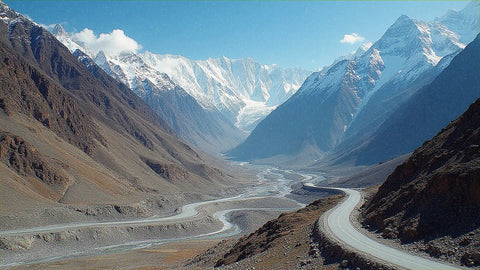
Pakistan is one of those trips that hooks you with its raw intensity: the bazaars of Lahore, the human tide of Karachi, the administrative calm of Islamabad, and above all, the Karakoram Highway ascending towards Hunza and Skardu amidst eight-thousand-meter mountains. In a country like this, your phone is your map, your translator, and your lifeline, which is why it's wise to decide before flying how you're going to get internet in Pakistan. In this guide, I compare all the realistic ways for tourists to connect: roaming with your Spanish carrier, hotel Wi-Fi, local SIM cards from Jazz, Zong, Telenor, or Ufone—with a serious pitfall almost no one tells you about—and the digital eSIM that activates automatically. Pay attention to IMEI phone blocking: this is where many travelers get an unpleasant surprise.
Internet in Pakistan: the quick answer
For a tourist, an eSIM is the best way to get internet in Pakistan: it activates in minutes, uses local networks, and bypasses SIM biometric registration and, above all, the dreaded IMEI phone blocking applied by the PTA after 120 days.
That's the short conclusion, but it's worth understanding why, because Pakistan has a peculiarity you won't see in France or Portugal. Here, the decision isn't so much about price—local SIMs are very cheap—as it is about paperwork, biometrics, and a state system that monitors which phone uses each card. The PTA, the telecom regulator, has a system called DIRBS that pairs your number with your phone's IMEI.
Translated: the moment you insert a Pakistani SIM into your phone brought from Spain, a clock starts ticking. If you exceed the deadline without registering the device and paying taxes, the phone loses network access. A digital travel card (eSIM) avoids this entire mess because it functions as a roaming device, and that's where it wins over a country's local SIM.
All options at a glance
Before going into detail, here's the full picture. There are four realistic ways to connect in Pakistan, and not all of them weigh the same in your backpack or wallet. Focus less on the price and more on the "but" column, because in this destination, the cheapest option on paper is also the one that comes with the most bureaucracy and the highest risk for your phone.
| Option | Approximate price | Process | Its big "but" |
|---|---|---|---|
| Carrier roaming | €10-15/day or pay-per-MB | None | Very expensive outside the European Union |
| Free Wi-Fi (hotel, cafes) | Free | None | Only works where you are stationary |
| Local SIM (Jazz, Zong, Telenor, Ufone) | €1-5 for a few days of GB | High: passport, fingerprint, and IMEI registration | Risk of phone blocking after 120 days |
| Travel eSIM | From ~€10 for a few GB | None: QR and ready | Requires compatible phone |
As you can see, the Pakistani SIM wins hands down on price: one to five euros for plenty of gigabytes is unbeatable. But that price hides considerable fine print, which I elaborate on below. Portable Wi-Fi routers (pocket Wi-Fi) are barely available as a rental option for tourists in Pakistan, so I've excluded them; if you're traveling in a group and considering one, the eSIM vs. pocket Wi-Fi comparison will be useful. The digital card (eSIM) falls into a very comfortable middle ground: it's the only thing that keeps you connected without visiting a store or touching the PTA system.

Roaming with your Spanish carrier
Roaming is the "do nothing" option, and for that very reason, the most expensive. Pakistan is far from the European Union's "roaming like at home" zone, so your Spanish gigabytes don't travel with you: you enter an international zone, where the bill skyrockets without you realizing it. On a pay-per-use basis, some carriers charge absurd amounts per megabyte, turning any video or map usage into financial ruin.
To mask this, carriers sell daily passes. Typical rates outside Europe range between €7 and €15 per day, and pay attention to what they include: some passes offer a couple of gigabytes, while others only provide 100-200 MB daily, a pittance if you rely on Google Maps in Lahore's old city. Do the math: two weeks in Pakistan at €10-15/day amounts to €140-210 just for data.
My advice is to treat roaming as an emergency network: activate it if something goes wrong, and that's it. And above all, check your carrier's app before you leave to find out what rate applies in Pakistan, because conditions vary widely by carrier and plan. If you want the detailed numbers, check out how much international roaming costs and the comparison of eSIM vs. roaming.
Hotel, cafe, and airport Wi-Fi
The second temptation is to rely on free Wi-Fi. In Pakistan, there's more than you might imagine in cities: almost all hotels offer it, many modern cafes in Islamabad and Lahore do too, and major airports in Karachi, Lahore, and Islamabad provide access. The problem is that it only works where you are stationary, and a trip through Pakistan is precisely about the opposite: moving around a lot, and often heading north, where there's no mobile coverage, let alone cafe Wi-Fi.
There's also a detail worth knowing: speed varies wildly. Excellent in a business hotel in Islamabad, dismal in a guesthouse in Karimabad where Wi-Fi runs on a satellite link or an antenna shared by the entire valley. And in many places, Wi-Fi "exists" but goes down every now and then due to power outages, a classic Pakistani issue that also affects cell towers.
The honest conclusion: accommodation Wi-Fi is a good support for planning the next day's route, downloading offline maps, or making a video call at night. But as a primary plan, it's a disaster. You need it precisely when you don't have it: negotiating a rickshaw, looking for the right platform at Rawalpindi station, or trying to locate your hotel in an alley of the bazaar. Use it as a complement, never as the backbone.
Local SIM: passport and biometric registration
And here we come to the first trap. Buying a local SIM in Pakistan is not like buying one in Italy: the country applies strict identity control for security reasons, so getting the card is a full-blown process, not a one-minute purchase. You can do it at the airport, at an official Jazz, Zong, Telenor, or Ufone store, or with an authorized distributor.
Here's what they'll ask for:
- Original passport: this is your identification document; Pakistani CNICs cannot be used by foreigners.
- Biometric fingerprint verification: the clerk takes your fingerprint and verifies it against the NADRA system before activating the line.
- A limited number of SIMs: as a foreigner, you can only register one or two cards, tied to the validity of your visa.
- Sometimes, a local address in Pakistan, and a hotel reservation usually serves as proof.
The price of the card and bundles is ridiculously low—we're talking about one to five euros for plenty of gigabytes—and urban coverage is excellent. So far, so good. The problem isn't the SIM itself, but what happens to your phone as soon as you put it in, which is precisely what I'll tell you in the next section and what causes the most headaches for the unprepared traveler.
The key point: IMEI phone blocking
This is the section that truly matters in Pakistan and one that almost no guide explains well. The PTA has a system called DIRBS that registers the IMEI—the serial number—of every mobile phone that connects to the country's networks with a Pakistani SIM. The moment you insert a local card into your phone brought from Spain, the device is flagged, and a countdown begins.
The current rules for visitors are as follows: you can temporarily register your mobile phone for free to use it for up to 120 days per trip, through the official portal dirbs.pta.gov.pk/drs, using your passport number. After this period, the exemption expires, the phone is blocked on Pakistani networks, and to reactivate it, you would have to pay the full FBR import taxes, which are not exactly cheap. Additionally, the registered IMEI is paired with the number you provided: if you then change to a different local SIM, it may stop working.
Translate this to your actual trip: you arrive in Islamabad, buy a Zong SIM at the airport, put it in your phone, and either register the device on the PTA portal in your first few days, or risk losing data right when you are furthest from home. One more step, one more state website, and a deadline to watch.
I'm not saying the Pakistani SIM is bad: it's very cheap and works wonderfully. What I am saying is that it comes with a state process and a real risk of blocking that most tourists are unaware of. And that, precisely, is the hassle that the digital card (eSIM) saves you in one fell swoop.

eSIM: the option I recommend
This is where the eSIM becomes the obvious solution for Pakistan, and not because of marketing, but because it eliminates the IMEI problem at its root. An eSIM is a digital card that already lives inside your phone. You buy the Pakistan plan from home, receive a QR code, scan it, and you're ready. You set it up on the couch before flying and activate it upon landing, with no stores, no fingerprint, and no forms.
The key technical point is this: travel eSIMs connect to Jazz, Zong, or Telenor networks in roaming mode, with a foreign identifier. And the PTA itself clarifies that devices using an international line and roaming are exempt from IMEI registration and remain operational at all times. In other words, with a digital card, you don't register your phone in the state system, there's no 120-day countdown, and no risk of blocking. That's the main argument in this destination, even above price.
In terms of cost, plans start from about €10 for a few gigabytes and increase depending on the number of days. It's not as cheap as a local SIM, but the difference is a few euros in exchange for skipping all the bureaucracy. If this is your first time, read what an eSIM is and then the eSIM guide for Pakistan, where I explain the installation step-by-step.
Local SIM vs eSIM, head-to-head
This is the comparison that truly matters in Pakistan, because roaming is ruled out by price alone, and Wi-Fi isn't enough to get by. The table pits the two competing options against each other, and you'll see that the battle isn't decided by your wallet but by paperwork, biometrics, and that IMEI registration that can render your phone silent halfway through your trip.
| Criterion | Local SIM (Jazz / Zong) | Travel eSIM |
|---|---|---|
| Price | ~€1-5 with many GB | From ~€10 for a few GB |
| Process | Passport and biometric fingerprint in store | None: QR from home |
| IMEI registration (PTA) | Mandatory; blocked after 120 days | Exempt: roams internationally |
| Time to get data | Queue in store plus verification | Minutes: scan QR and ready |
| Network used | Jazz, Zong, Telenor, or Ufone | The same, while roaming |
| Your Spanish number | Lost if your phone has only one slot | Remains active with Dual SIM |
| Main risk | Phone blocking by IMEI | Your phone not being compatible |
My take: if you're going to spend months traveling around Pakistan and don't mind registering your device with the PTA, a local SIM is worth it for the price. If you're visiting for two or three weeks as a tourist, exposing yourself to biometrics and the risk of blocking to save a few euros is a bad deal. You can find more details in the comparison of eSIM vs. local SIM.
Coverage: Islamabad, Lahore, Karachi, and the north
There are two very distinct Pakistans here. In the cities, the connection is much better than its reputation suggests: solid and widespread 4G. 5G is still in its early stages—the PTA auctioned the spectrum in early 2026, and commercial deployment is gradually reaching selected neighborhoods—so for now, count on 4G for almost everything. Zong usually leads in coverage and consistency according to Opensignal, with Jazz very close behind.
- Islamabad and Rawalpindi: Excellent 4G, ample speeds for maps, video, and video calls.
- Lahore: Great 4G coverage throughout the urban area and bazaars; no signal problems.
- Karachi: Extensive 4G, although the network can get congested in the mega-city during peak hours.
- Peshawar, Faisalabad, and Multan: Reliable 4G in the city core.
The other Pakistan begins when you head north on the Karakoram Highway. In Gilgit, in the village of Karimabad (Hunza), and in Skardu, there is 4G in the center, but the signal drops as soon as you leave the town: remote valleys, mountain passes, and stretches of road where there is nothing. There, the operator with the best reach is usually Jazz, and in the higher areas of Gilgit-Baltistan, only a special local provider (SCOM) works, which travel cards do not use. If your route is mountainous, expect sections without data and download offline maps no matter what.
How much data you need in Pakistan
The million-dollar question before buying any plan. The short answer: less than you fear, but it's advisable to calculate by days and by actual usage. In Pakistan, you'll mostly be using maps, messaging, transport apps, translation, and some social media. Video and large downloads are best left for hotel Wi-Fi. This table gives you an approximate reference by activity and day.
| Daily activity | Approximate consumption |
|---|---|
| Google Maps and navigation | ~50-100 MB/day |
| WhatsApp and messaging | ~20-50 MB/day |
| Transport apps (Careem, InDrive) | ~30-60 MB/day |
| Social media (normal scrolling) | ~150-300 MB/day |
| Uploading photos and some video | ~200-400 MB/day |
Summing up normal tourist usage, you'll need about 400-800 MB per day. With that reference, for one week in Pakistan, 3-5 GB should be enough; for two or three weeks, a 10-15 GB plan will be more than sufficient; and if you upload videos daily, tether to your laptop, or work remotely, opt for a more generous or unlimited data plan. My usual trick: calculate your gigabytes, round up with a small buffer, and download offline maps for your destinations. This way, you won't run out in the middle of the Lahore bazaar or pay too much for gigabytes you won't touch in the mountains, where there often won't even be a signal to use them.
Frequently asked questions
Will my phone be blocked by IMEI in Pakistan?
Only if you use a local SIM and exceed the deadline without registering the device. When you insert a Pakistani SIM, the PTA registers your IMEI and gives you 120 days; after that time without registration and tax payment, the phone will be blocked. With a travel eSIM, which roams, there is no registration or blocking.
How do I register my phone with the PTA in Pakistan?
Go to the official portal dirbs.pta.gov.pk/drs, create an account with your passport number, provide your travel dates and phone details (IMEI). Temporary registration is free and valid for 120 days. If you use an eSIM for roaming, you skip this process entirely.
Do I need a passport to buy a SIM in Pakistan?
Yes. For a local SIM, you will need your original passport and a biometric fingerprint verification which is cross-referenced with the NADRA system. As a foreigner, you can only register one or two cards, tied to your visa. With a travel eSIM, you don't need to present any documents.
Does a travel eSIM avoid PTA IMEI registration?
Yes, and that's its big advantage in Pakistan. The PTA itself exempts devices using an international roaming line from registration, and a travel eSIM works exactly like that. You don't register your phone, there's no 120-day countdown, and no risk of blocking.
Which operator has the best coverage in Pakistan?
In general, Zong leads 4G coverage and consistency in cities, with Jazz very close behind. For the north and the Karakoram Highway, Jazz usually has better coverage in towns. Travel eSIMs use these same networks, so your coverage is equivalent to that of a local.
Is there internet on the Karakoram Highway, Hunza, or Skardu?
In the centers of Gilgit, Karimabad, and Skardu, there is 4G, but the signal drops as soon as you leave the town: in mountain passes and remote valleys, there will be stretches without data. In higher areas, only one local provider (SCOM) works. Always download offline maps before heading up.
Does WhatsApp work with an eSIM in Pakistan?
Yes, no problem. WhatsApp works with data, not with the voice network, so it works the same with an eSIM. And with Dual SIM, your Spanish number remains active to receive bank SMS while data travels through the digital card.
How many GB do I need for two weeks in Pakistan?
For normal tourist use —maps, messaging, transport apps, some social media, and photos— 10 GB will be more than enough for two weeks. If you work remotely, watch videos, or share your connection with a laptop, choose a larger or unlimited plan.
Conclusion
Getting internet in Pakistan is easy; the hard part is doing it the traditional way without getting a surprise. A local Jazz or Zong SIM is very cheap, but it requires a passport, biometric fingerprint, and, most importantly, registering your phone with the PTA with the 120-day clock ticking and the risk of IMEI blocking if you're not careful. Roaming frees you from the process but costs you €140-210 for a normal trip. And free Wi-Fi is only useful when sitting in your hotel. That's why, for most, an eSIM is the answer: the same coverage as Zong or Jazz, zero paperwork, and no IMEI to register. Install it before you take off and you'll have data as soon as you land. Once you're clear on this, check out the eSIM for Pakistan.