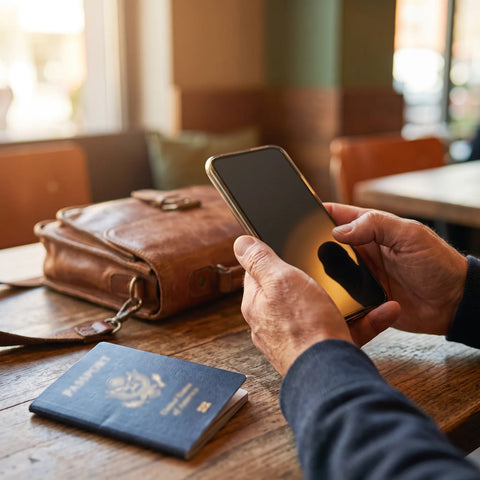
In short: a Pakistan eSIM gives you mobile data as soon as you land, without having to register your passport in a store or rely on hotel Wi-Fi. Coverage is solid in Lahore, Islamabad, and Karachi, but drops significantly in the mountainous north (Hunza, Skardu, Karakoram). For a typical two-week trip, 10 GB is usually plenty; increase it if you plan to upload videos or make long video calls.
Landing in Pakistan and having to search for Wi-Fi to call a taxi is the worst way to start a trip. With an eSIM for Pakistan activated before leaving home, your phone gets data the moment the plane touches down in Islamabad, Lahore, or Karachi: maps, a translator for bartering in Anarkali Bazaar, and your own Wi-Fi to notify loved ones without depending on the hotel. In this guide, we'll look at coverage by region, how many GB you'll need depending on your itinerary, and why, in a country with Pakistan's SIM registration process, an eSIM is often better than searching for a Zong or Jazz store upon arrival.
How the internet works in Pakistan
Pakistan has extensive 4G in major cities and data coverage that, in urban areas, is comparable to that of a European country. A travel eSIM relies on these same local networks, so the level of service you receive is the same as what a Pakistani person would get with their own line: it's not a separate "tourist" network, but a data profile that uses the same operator.
The real difference lies in the process. With a physical SIM, you have to go to a store, show your passport, sometimes provide fingerprints, and wait for the line to be activated – a process designed primarily for long-term residents. With an eSIM, that step disappears: you buy and activate it before you fly, and at the airport, you just need to turn on your data.
There's a specific nuance in Pakistan worth knowing before you go: the country occasionally implements temporary mobile data suspensions, decided by authorities for security reasons or on specific dates (religious processions, election days, sensitive anniversaries). When this happens, it affects all operators equally, including your eSIM, because the cutoff is applied at the network level, not by company. It's not a fault with your purchased plan: it's a country-specific circumstance, and the only real defense is to have maps and contacts downloaded in case you find yourself without data on a particular day.

eSIM vs local operator (Zong, Jazz, Telenor, Ufone)
The four major operators in Pakistan are Zong, Jazz, Telenor, and Ufone, and all offer cheap data packages for the local market. If your only criterion is price per gigabyte and you're staying for weeks or months, a local SIM might be cheaper. But that's not the same as saying it's more convenient, and for a tourist trip, convenience matters a lot.
SIM registration for foreigners in Pakistan is not a simple "show me your passport and you're done": it involves the official biometric verification system, requires physical presence at an authorized store, and depending on the city or time of day, it can take much more time than a traveler fresh off a plane, jet-lagged and eager to get to their hotel, is willing to invest. With an eSIM purchased before leaving home, that process disappears completely: you scan a QR code with your home Wi-Fi and arrive already connected.
The other alternative, leaving your Spanish operator's roaming activated, is the least convenient option except for a specific emergency: outside the European Union, the cost of roaming skyrockets and isn't worth it compared to a travel eSIM, as we explain in detail in our guide on eSIM vs roaming. If you're not sure what data roaming is exactly and why you're charged this way outside the EU, we explain it step-by-step in what is data roaming.
| Option | Registration | Activation | When it pays off |
|---|---|---|---|
| Travel eSIM | None | 1 minute, on landing | Short and medium trips without hassle |
| Local SIM (Zong, Jazz, Telenor, Ufone) | Passport + biometrics in-store | After registration, may take time | Long stays, minimum cost per gigabyte |
| Spanish operator roaming | None | Automatic | Only for a specific emergency |
If, in addition to the eSIM, you want to understand the technical difference between having a physical SIM from another country in your phone and using an eSIM profile, we compare them thoroughly in international chip vs eSIM.
Coverage by cities and zones
Data coverage in Pakistan has two very different faces: the urban axis and everything else. If your route is the classic cultural one (Lahore, Islamabad, Karachi, maybe Peshawar) you will have stable 4G almost all the time, enough for maps, video calls and uploading photos without thinking about it. In Lahore, for example, the signal holds up well even in crowded areas like the Fort or Anarkali Bazaar, where the concentration of mobiles sometimes saturates the network at peak times more than the coverage itself.
Things change as soon as you leave the big cities. In the northern mountain routes —Hunza, Skardu, the Karakoram Highway itself— the signal becomes intermittent and disappears completely for long stretches, especially in the more enclosed valleys and in areas near the border with China or India, where there may also be additional network restrictions for security reasons. If you are going to go up to these areas, download offline maps of the entire route before leaving the city: do not assume that you will be able to do it on the fly, because just when you need it most you may not have coverage to download anything.
A flexible plan, with a top-up option if you run short, is especially convenient if you are going to alternate between city and nature: in the city you consume data without realizing it (social networks, real-time maps, messaging with photos) and on trekking days in the north you hardly spend anything because there is no signal to spend it with.

How many GB you need for your trip
As a general reference, an average traveler uses between 500 MB and 1.5 GB per day if they use maps, messaging, and social media in moderation. If you connect to your accommodation's Wi-Fi at night to back up photos and watch shows, your mobile data consumption drops significantly. For a week-long trip to major cities, 5 GB is usually plenty; for two or three weeks combining city and northern regions, it's better to consider 10-15 GB or a plan with top-up in case your trekking trip lasts longer than expected.
What most drives up consumption isn't maps or WhatsApp, but uploading videos to social media or making long video calls with good image quality. If you know you'll be doing that daily, step up your forecast:
| Duration | Light usage | Normal usage | Heavy usage |
|---|---|---|---|
| 1 week | 3 GB | 5 GB | 10 GB |
| 2 weeks | 10 GB | 15-20 GB | |
| 3 weeks or more | 10 GB | 15 GB | 20 GB + top-up |
Tip: save offline maps of your routes before heading north and enable photo backup only over Wi-Fi. With that, a 10 GB eSIM is enough for almost an entire two-week trip combining city and mountains.
If you want to maximize your gigabytes without running out of data halfway through your route, in how to save data with an eSIM on a trip you'll find specific tricks that work just as well in Pakistan as in any other destination.
Install and activate your eSIM
Installing an eSIM takes a minute and is done before leaving home, with Wi-Fi, without rushing. You buy the plan, receive a QR code by email, scan it from your phone settings, and it's saved as another profile. Upon landing in Pakistan, you just need to activate the data for that eSIM and deactivate roaming on your Spanish line to avoid any surprises on your bill.
The step-by-step, without complications:
- Check that your phone is eSIM compatible (most mid-to-high-end phones from recent years are).
- Purchase the Pakistan plan and receive the QR code by email.
- Scan the QR code from your settings, connected to your home Wi-Fi, before flying.
- At the airport, activate that eSIM as your data line and turn on data roaming only for that profile.
If it's your first time with an eSIM, the guide on how to install an eSIM explains it step by step with screenshots, and if you have doubts about whether your own phone supports it before buying anything, it's advisable to resolve them first.
What almost no one tells you
There are a number of details about Pakistan that don't appear in the technical specifications of any data plan, but will affect your daily travel.
Some apps and networks have experienced temporary blocks. Pakistan has a history of occasional restrictions on platforms like X (formerly Twitter) during periods of political tension or unrest, and in the past, there were also blocks on Wikipedia for weeks. This does not depend on your eSIM or your operator: it is a decision by the authorities that applies at a country level. If your work or social life depends on a specific app, check before traveling if there are any active restrictions at that time, and have a backup plan (another network, email) just in case.
Fingerprint for local SIM is not an urban legend, it's the standard procedure. Many travelers arrive thinking they'll just show their passport and are met with a full biometric process, designed for resident registration, not for tourists staying two weeks. This is the main reason why a physical SIM in Pakistan, despite being cheap, is not worth it for a short stay.
The network gets saturated during religious and festive gatherings, not just due to coverage. During dates like Eid or large gatherings, the number of people connected simultaneously at one point can slow down 4G even if the coverage on paper is good. It's not a problem with your eSIM: it's network physics, and it happens to any operator.
When NOT to buy an eSIM for Pakistan. If you're going to be traveling extensively for more than a month and prioritize price over convenience, consider a local Zong or Jazz SIM after the first couple of days: in the long run, the cost per gigabyte is lower. And if your trip is a short one-day stopover in Islamabad or Karachi before continuing to another country, you might not even need local data: check if your accommodation or the airport has decent Wi-Fi before spending on a plan you'll barely use.
A privacy note. In a country where there may be occasional restrictions on access to certain platforms, some travelers choose to combine their eSIM with a VPN to maintain access to their usual apps. If this is your case, it's good to understand how this combination works before leaving; we explain it in eSIM, VPN and privacy while traveling.
Tips for staying connected while traveling
With the eSIM installed, a few adjustments can save you surprises. The idea is to have internet when it really matters and not spend extra when you don't need it, always bearing in mind that in Pakistan there may be occasional network outages that do not depend on your plan.
- Offline maps: download your areas before traveling, especially if you're heading north or there's a risk of a temporary data outage.
- Accommodation Wi-Fi: use it for photo backups and large downloads; this will make your gigabytes last much longer.
- Your Spanish line without roaming: keep it active for bank SMS and verifications, but with data roaming turned off.
- Reserve cash: if there's a network outage one day, you won't be able to pay with your phone or order a car through an app, so carry some local cash separately.
- Support in your language: choose an eSIM with 24/7 Spanish support in case something goes wrong at an inconvenient time, which in such a large time difference with Spain always ends up happening.
If your route continues through more countries after Pakistan, always check the coverage of the next destination in advance: not all regional eSIMs cover every country equally well, and something as simple as checking before you leave can save you the disappointment of landing without data at your next stop.
Frequently asked questions
Do I need to register the eSIM with my passport in Pakistan?
No. The travel eSIM does not go through local SIM registration: you buy and activate it online before leaving home. This process with passport and fingerprint only applies to physical SIMs from local operators like Zong, Jazz, Telenor or Ufone, which require in-person registration at a store for foreigners.
Does the eSIM work in northern Pakistan and the mountains?
In the northern mountain areas (Hunza, Skardu, the Karakoram), coverage is limited and intermittent, sometimes only 3G or directly without signal in the more enclosed valleys. The eSIM uses local networks just like any mobile phone, so it will have the same outages. Download offline maps for these routes before heading up.
Why is there sometimes no mobile internet in Pakistan?
In Pakistan, temporary mobile data suspensions may occur for security reasons or on specific dates, decided by the authorities. They affect all operators equally and also the eSIM, because the cut is applied at the network level. It is not a failure of your plan; it is advisable to have maps and contacts downloaded just in case.
How many GB do I need for two weeks in Pakistan?
For normal use (maps, messaging, moderate social media), about 10 GB is usually enough for two weeks if you rely on the accommodation's Wi-Fi at night. If you upload a lot of video or make long video calls, go up to 15-20 GB or choose a plan with a top-up option.
Can I use WhatsApp and keep my Spanish number with the eSIM?
Yes. The eSIM only provides data, so WhatsApp and other apps work normally. Your Spanish number remains on your main SIM or eSIM to receive SMS and calls; you just need to disable data roaming for that line to avoid paying extra.
Are there any blocked networks or apps in Pakistan that I should be aware of?
Pakistan has a history of temporary restrictions on certain platforms, especially during periods of political tension. This is not permanent or affecting all apps, but it is advisable to check the situation before traveling if you rely on a specific social network for work or contact with your people.
Is an eSIM or a physical SIM from Zong or Jazz better?
For a trip of up to two or three weeks, the eSIM wins on convenience: you avoid biometric registration in store and arrive connected from landing. If you're staying for more than a month and prioritize cost per gigabyte above all else, a local SIM might be cheaper in the long run.
Conclusion
Pakistan has good data coverage in cities and much weaker coverage in the mountains, with occasional network outages that should be anticipated and are not dependent on any operator. An eSIM saves you the biometric registration of a local SIM and connects you upon landing with much less hassle than roaming with your Spanish operator. Calculate your GB based on your route and duration, have a backup plan for days without coverage in the north, and travel with peace of mind with PuraSIM's Pakistan eSIM, activated in one minute and with 24/7 Spanish support.