If you're already picturing yourself dancing at the Trinidad Carnival, lounging on Pigeon Point beach, or leaning over the rail of a glass-bottom boat over the Buccoo Reef, there's one unglamorous detail to sort out before packing your bags: how to get internet in Trinidad and Tobago without spending a fortune or losing signal at the worst possible moment. You'll want it for maps, calling a taxi, sending photos via WhatsApp, and booking a diving trip. In this guide, I compare, with real data, all the options available to tourists —roaming, hotel Wi-Fi, local SIM, and the one I recommend— so you can arrive with your phone ready from day one.
All ways to get internet in Trinidad and Tobago
To get internet in Trinidad and Tobago, you have four options: roaming with your operator (convenient but expensive and no European rates), hotel Wi-Fi (free but limited), a local Digicel or bmobile SIM (cheap, requires passport), and an eSIM that you set up before flying. For most, the eSIM wins.
Trinidad and Tobago has an advantage that many Caribbean destinations don't offer: mobile connectivity is among the fastest and cheapest in the region, with a median download speed around 32 Mbps and a gigabyte costing on average about $1.90. So the challenge isn't so much finding signal as not overpaying and knowing where it's weak. Before detailing each option, here's the summary I wish I had seen before landing.
| Option | Approximate cost | Convenience | Ideal for |
|---|---|---|---|
| Spanish roaming | High (bundles or pay-per-use) | Zero hassle | Very short trips |
| Hotel Wi-Fi | Free | Only at accommodation | Occasional checks |
| Local SIM (Digicel/bmobile) | Low (from ~$7) | Requires passport and store visit | Long stays |
| Travel eSIM | Medium-low | Activates automatically | Most travelers |
None is "the best" in abstract: it depends on how many days you stay, whether you cross over to Tobago, and how far you stray from tourist areas. In the following sections, I break down each one with prices and drawbacks.
Roaming with your Spanish operator
Roaming is the most convenient option: you land in Piarco, turn on your phone, and you already have data without touching anything. The problem comes with the bill. Trinidad and Tobago is not part of the European Union, so your "roaming as at home" rate does not apply here: as soon as your phone connects to Digicel or bmobile, you enter international rates, which are among the most expensive.
Without a contracted plan, data can cost you several euros per MB, and with a couple of videos, your daily budget is gone. Almost all Spanish operators sell daily bundles for "zone 2" or "rest of the world" that cost around €6 to €15 per day for a small amount of data; multiply that by ten days of Carnival and beach, and you'll see that convenience comes at a very high price. It is precisely the most expensive way to stay connected in the country.
My personal rule: I only leave roaming on as an emergency network on the day I arrive, until I have a cheaper option ready. Never as a plan for the entire stay.
If you want specific numbers for your company, I'll leave you with my guide on how much international roaming costs and a direct comparison of eSIM vs. roaming. In short: convenient, yes, but incredibly expensive.

Hotel and accommodation Wi-Fi
If you're staying in a hotel in Port of Spain or a resort in Crown Point, Tobago, Wi-Fi is your natural ally for everything non-urgent. Almost all tourist accommodations offer free Wi-Fi in common areas, and many mid-range and high-end hotels already have fiber with very decent speeds. For uploading photos, making a video call at night, or planning the next day's itinerary, using the lobby Wi-Fi late at night is more than enough and costs nothing.
The usual downside: this Wi-Fi usually works fine in the reception, bar, or pool, but it falters inside the room, especially in distant blocks or on upper floors. And as soon as you leave the premises —to a public beach, a tour of inner Tobago, or the Port of Spain market— the Wi-Fi doesn't follow you.
Another drawback is security: on open networks, it's advisable not to enter bank details without a VPN. I always treat it as a complement, never as my sole network. If you're considering renting a portable router, in my comparison of eSIM vs. pocket Wi-Fi, I explain why it almost never pays off in a destination like this, where data is already cheap anyway.
Local SIM: Digicel and bmobile
A local SIM is the cheapest option if you're staying many days or consuming a lot. In Trinidad and Tobago, there are two operators: Digicel and bmobile, the brand of the state-owned TSTT. Digicel is king in coverage —its 4G/LTE is almost nationwide and offers the fastest speeds— while bmobile has greatly improved and now covers around 90% of the population, although its reach weakens faster in rural areas.
Prices are a steal compared to Europe. With Digicel, you can find bundles like 30 GB for 3 days for about $9 (TTD 60), 20 GB for 7 days for about $18 (TTD 120), or 30 GB for 10 days for about $22 (TTD 150). bmobile offers "unlimited" data: 3 days for about $7 (TTD 49) or 7 days for about $15 (TTD 99). A standalone SIM costs around $7-30 depending on where you buy it, and you can get one at Piarco airport, official stores, or ANR Robinson airport in Tobago.
The drawback is the process: by law, you have to register the card with your passport in hand, and then deal with recharges and the operator's app. If you're staying for weeks, it's worth it. For a short trip, many find it a hassle. I detail it in my comparison of eSIM vs. local SIM.
The eSIM, my recommended option
For the vast majority of trips to Trinidad and Tobago, my recommendation is a data eSIM. It's a digital SIM that you buy online, receive by email, and install by scanning a QR code: you can set it up from your couch at home a few days before flying and land in Piarco already connected, without looking for stores or registering anything with your passport. If you've never used one, in my guide on what an eSIM is, I explain it step by step.
The advantages are clear. You keep your Spanish number in the physical slot of your phone —to receive bank SMS or an occasional call— while the data travels via the eSIM connected to the local network with the best coverage, usually Digicel. There's no plastic to lose, no deposit, and you don't depend on finding an open store on the day you arrive, which you'll greatly appreciate if you land in the middle of the night during Carnival season.
The honest downside: for very long stays and huge consumption, a rechargeable local SIM might be slightly cheaper per GB, because data here is already very cheap. But when you factor in convenience and zero paperwork, the balance tips toward the digital side for the average traveler. You have all the fine print, prices, and coverage in my eSIM guide for Trinidad and Tobago.
Coverage by area: Trinidad yes, rural Tobago less so
This is the section most people skip and then regret. The good news: in Trinidad, coverage is very good. In Port of Spain, San Fernando, Chaguanas, and Arima, you'll have plenty of 4G for maps, social media, and video calls. In Tobago, the tourist areas of Crown Point and Scarborough are also well covered. The weak spot appears in the interior of Tobago: the Main Ridge Forest Reserve, mountain roads, and the most remote beaches in the northeast have stretches where you lose all signal, and not even the best eSIM can fix it.
Also keep in mind that as of 2026, there is still no widespread 5G deployment in the country: both operators mainly rely on 4G/LTE, which works perfectly for what a tourist needs. Here, Digicel holds up a bit better than bmobile in less populated areas.
| Area | Mobile coverage | What to expect |
|---|---|---|
| Port of Spain and San Fernando | Very good (4G) | Smooth connection for everything |
| Crown Point and Scarborough (Tobago) | Very good (4G) | Ideal at resorts and beaches |
| Pigeon Point and Buccoo | Good | Decent signal along the coast |
| Interior and northeast Tobago | Irregular | Stretches with intermittent signal |
| Main Ridge (jungle) | Scarce or none | Be prepared to be disconnected |
Moral of the story: in cities and on the tourist coast, you'll have plenty; for days in the jungle and remote beaches of Tobago, download maps and expect periods without a connection.

How much data do you really need?
The million-dollar question. The good news is that calculating gigabytes wisely is easier than it seems if you separate by type of use. As a general rule, an average traveler uses around 1 GB per day: light use (maps, messaging, some web browsing) is around 0.4 GB, while intense use with social media, video, and uploading parade photos goes up to 2.5 GB daily or more.
For a week between Trinidad and Tobago, that's about 7-15 GB; for two weeks of travel including Carnival, between 15 and 30 GB. If you use hotel Wi-Fi a lot at night, you'll stay at the lower end. Here it is in a table so you can see it clearly.
| Profile | Daily consumption | 7-14 days |
|---|---|---|
| Light (maps and chat) | ~0.4 GB | 3-6 GB |
| Medium (social media and browsing) | ~1 GB | 7-15 GB |
| Intense (video and live streaming) | ~2.5 GB | 18-35 GB |
My trick: since you'll often be on hotel Wi-Fi or out of signal in Tobago's jungle, don't inflate your estimate. And if in doubt, choose a plan with a buffer or with a top-up option; running out of data on the main day of Carnival is a common, avoidable hassle.
Carnival in Port of Spain: connection in crowds
Trinidad Carnival is the country's biggest event and one of the most spectacular in the world: two days of mas, soca, and crowds taking over the streets of Port of Spain. And that's where a problem almost no one tells you about arises: with hundreds of thousands of people concentrated in the same spot, the network gets saturated. It's not that you lose coverage, it's that it slows down because everyone is uploading videos at the same time. That's why it's advisable not to rely on your phone for essentials on that day.
My tips for not losing your group or your mind during the parades:
- Agree on a physical meeting point in case WhatsApp doesn't load in the middle of the avenue.
- Download the parade route map and schedules before leaving the hotel.
- Bring a power bank: between photos, videos, and searching for signal, your phone will die by midday.
- Send text messages or short voice notes instead of heavy videos when the network is slow.
With a good data connection, you'll fare better than with hotel Wi-Fi, which is far from the hustle and bustle, but expect things to be a bit slower during peak parade times. That's the price of being at the biggest party in the Caribbean.
Tobago: beaches, Pigeon Point and Buccoo Reef
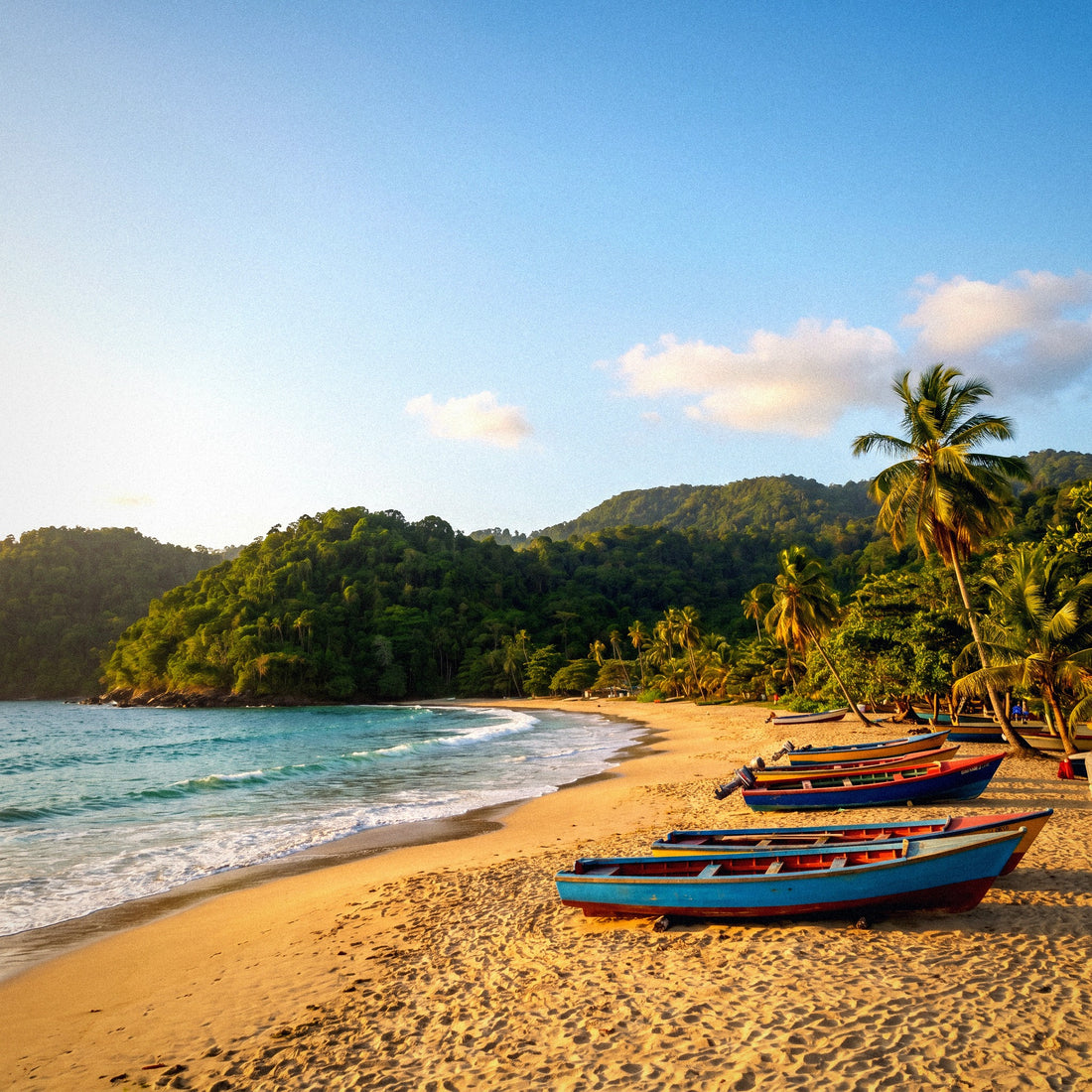
If Trinidad is all about parties and cities, Tobago is the tranquil opposite: postcard beaches, diving, and nature. In the tourist hotspot, around Crown Point, Pigeon Point, and Store Bay, coverage is good, and you'll easily be able to share photos of that incredible sand. Things change when you get on a boat to the Buccoo Reef for snorkeling or a visit to the Nylon Pool, or when you go diving in Speyside and Charlotteville in the northeast: there, the signal starts playing hide-and-seek.
The rule is simple: the further you get from Crown Point towards the island's green and mountainous interior, the less coverage. The Main Ridge Forest Reserve, the oldest protected rainforest in the Western Hemisphere, is beautiful and practically dead when it comes to mobile data. It's not a flaw in your connection; it's simply that there are no antennas in the jungle.
Tip for Tobago: before a diving or jungle excursion, download offline maps and let your people know your schedule. When you return to Crown Point, you'll regain signal and can upload everything at once.
For beach and town days, you'll have plenty; for adventure days, plan on being disconnected for a good while.
How to choose and activate your connection
Choosing wisely is a matter of cross-referencing three pieces of information: travel days, estimated gigabytes, and how far you'll be from tourist areas. If your plan is Carnival and beaches near the coast, almost any option works and convenience is key; if you're going to explore inland Tobago or dive in the northeast, prioritize the network with the best rural reach, which is Digicel. The best thing is to have everything sorted before takeoff and not improvise at the airport.
With an eSIM, the process is quick. These are the steps I follow:
- Check that your phone is eSIM compatible (phone settings or manufacturer's website).
- Buy the plan with the GB and days that suit you, a few days before flying.
- Install the profile by scanning the QR you receive by email, using home Wi-Fi.
- Set the eSIM for "data" and your Spanish SIM for calls and SMS.
- Upon landing in Piarco or Tobago, activate data roaming for the eSIM, and you're good to go.
A practical note: install the profile at home, but don't activate it until you arrive, to avoid using up plan days prematurely. With that, you'll leave the airport with Google Maps working and without wasting a minute looking for where to buy a signal.
Frequently Asked Questions
Does my Spanish operator's roaming work in Trinidad and Tobago?
Yes, but at international roaming rates, not European rates. Trinidad and Tobago is not in the EU, so "roam like home" does not apply. Check the exact cost per MB or the travel bundle before you leave, as it's usually one of the most expensive options.
Do I need a passport to get internet in Trinidad and Tobago?
Only if you buy a local SIM: the law requires you to register it with your passport at an authorized store or point. With a travel eSIM or your operator's roaming, no in-person process or document is needed.
Is there 5G in Trinidad and Tobago in 2026?
Generally, not yet. Both Digicel and bmobile primarily operate on 4G/LTE, which here is fast and more than sufficient for maps, social media, streaming, and video calls. Don't count on stable 5G, but as a tourist, you won't miss it.
Digicel or bmobile, which has better coverage?
Digicel, by far, for getting around the entire country: its 4G is almost nationwide and has the fastest speeds. bmobile has improved a lot and covers around 90% of the population, but it loses signal sooner in rural areas and inland Tobago.
Will I have coverage at the Port of Spain Carnival?
Yes, but it will be slow during peak parade times due to network saturation: hundreds of thousands of people are connected at once in the same place. Agree on a physical meeting point and download maps and schedules before leaving the hotel.
What about the beaches and Buccoo Reef in Tobago?
Coverage is good in the Crown Point, Pigeon Point, and Store Bay areas. Signal drops at Buccoo Reef, during diving excursions to the northeast, and in the Main Ridge Forest Reserve. Download offline maps before your excursion.
How many GB do I need for a week in Trinidad and Tobago?
For average use, 7 to 15 GB is usually sufficient; if you take a lot of photos, videos, or live stream during Carnival, aim higher. Remember that you'll use hotel Wi-Fi and won't consume data in the jungle, so don't inflate your estimate.
Conclusion
To summarize: roaming is convenient but expensive and without a European rate, hotel Wi-Fi is free but limited to the accommodation, a local Digicel or bmobile SIM card is worthwhile if you stay for a long time but requires a passport, and an eSIM is the sweet spot for most. And the local lesson: in Trinidad and on Tobago's tourist coast, you'll have plenty of coverage, but in the Main Ridge Forest Reserve and during the height of Carnival, the network will be unreliable, so have your maps downloaded.
If you want to forget about it and arrive connected from the first minute, check out PuraSIM's eSIM for Trinidad and Tobago: buy it, install it at home, and land in Piarco with Google Maps working. Have a great trip and enjoy the mas, soca, and those beaches.