In short: to have internet in Dominica, the Caribbean's nature island (not to be confused with the Dominican Republic), the most practical option is to install an eSIM Dominica before flying: it activates automatically upon landing, works with local operators Digicel and Flow, and frees you from sky-high roaming charges outside the EU. Coverage is good in Roseau, Portsmouth, and coastal roads; in the mountainous interior, it's advisable to have downloaded maps.
What is an eSIM and why it's useful in Dominica
An eSIM is a digital SIM card: there's no plastic to insert, it's installed by scanning a QR code, and it coexists with your Spanish line without touching it. For a destination like Dominica, where you'll spend more hours on a jungle trail than in a city, having your own data from minute one changes the trip. No more looking for Wi-Fi at every stop to check the route to Boiling Lake or confirm the boat time to Portsmouth.
PuraSim's Dominica eSIM relies on local operators, so your phone automatically picks up the best available signal in each area without you having to configure anything manually. You buy it online, install it with Wi-Fi before leaving home, and it's ready to activate as soon as the plane lands on the island.
Compared to roaming from your Spanish operator, the difference is not just in price: it's in control. With roaming, you depend on the conditions applied to you outside the EU, which are often unclear; with an eSIM, you know exactly how much data you have contracted. If you want to understand the difference in detail before deciding, the guide on eSIM vs. roaming compares both options point by point, and the one on what is data roaming explains why outside the European Union, roaming charges can skyrocket without warning.

Dominica is not the Dominican Republic
This is the most common mistake and it's worth clarifying before buying anything. Dominica (officially Commonwealth of Dominica) is a small English-speaking island located between Guadeloupe and Martinique, known for its rainforests, waterfalls, and diving, with almost no mass beach tourism. The Dominican Republic is a completely different country: much larger, Spanish-speaking, shares an island with Haiti, and has Punta Cana as its major tourist hub.
They are destinations with different mobile operators, different plans, and, most importantly, different eSIMs. If your flight is going to Punta Cana, Santo Domingo, or Puerto Plata, you need the eSIM for the Dominican Republic, not this one. If you're going hiking among waterfalls and hot springs on the green island, this guide and the Dominica eSIM are for you.
Quick rule to avoid mistakes: if your flight lands in Douglas-Charles (DOM) or Canefield (DCF), you're going to Dominica. If you land in Punta Cana (PUJ), Las Américas (SDQ), or Puerto Plata (POP), you're going to the Dominican Republic.
The English name itself, "Dominica," is pronounced differently (accent on the "i"), and in practice, almost no one confuses both countries once they've seen a map, but it's surprising how many flight, hotel, or eSIM bookings are made each year by mistake between the two. Checking the airport code on your ticket before paying is the thirty-second gesture that saves you from annoyance.
Real Coverage: Digicel and Flow on the island
In Dominica, the two mobile operators covering the territory are Digicel and Flow. Between them, they provide 4G/LTE service in the capital, coastal villages, and main roads, which is the coverage you'll use almost all the time: maps, WhatsApp, uploading photos, checking the weather before an excursion.
In Roseau, Portsmouth, and the coast
The signal is solid in Roseau (the capital), in Portsmouth to the north, and generally along the entire coastline, including well-known diving areas like Champagne Reef or Scott's Head. If you stay near the coast, you'll notice little difference from the coverage you're used to in Spain, except for the speed, which is somewhat more limited as 5G has not yet been significantly deployed.
In the mountainous interior and hiking trails
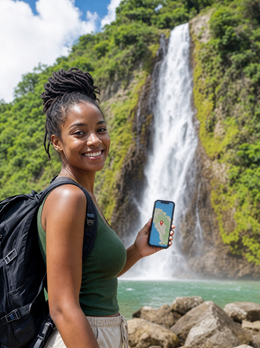
Dominica is the most volcanic and forested island in the Eastern Caribbean, and this is noticeable in the interior coverage. In Morne Trois Pitons National Park—a UNESCO World Heritage site—the signal comes and goes depending on the terrain: there are stretches with acceptable coverage near parking lots and the first few kilometers of trails, and stretches of dense jungle where you won't get a single bar, especially on the Boiling Lake trail, a full-day hike through sulfur, steam, and steep inclines. This is normal behavior in volcanic and forested terrain, not a fault of the eSIM or the operator.
The eSIM automatically switches operators to connect to the network with the best signal at each point, so you don't have to do anything manually. Even so, on an island with this terrain, the recommendation is simple: download offline maps of the route before heading into the jungle, because relying on having data in the middle of Titou Gorge or climbing towards Boeri Lake is a gamble.

How many GB you need and what to avoid
On a nature trip, you usually consume less data than you imagine, because much of the day you spend hiking, diving, or in a hot spring without coverage. Still, to have enough margin for maps, photos, and messaging, this indicative reference will help you decide:
| Option | Indicative Use | Ideal for |
|---|---|---|
| eSIM 1-3 GB | Light use: maps and occasional messaging | 3-4 day getaway |
| eSIM 5 GB | Normal use: maps, photos, and daily social media | A week of hiking and diving |
| eSIM 10 GB or rechargeable | Intensive use: video, occasional remote work | Long stays or combining several islands |
| Spanish operator roaming | Variable and difficult to predict cost | Not recommended in the Caribbean |
You don't need to get it exactly right: if you run short, you can always extend the plan from your phone within the app. If you have doubts about your consumption profile, the guide on tricks to save data on an eSIM trip helps you adjust the plan without overspending or running out, with useful ideas even if the destination changes.
Regarding roaming: this is where you pay the most for not planning. Outside the European Union, your Spanish tariff does not include free data, and traditional operators' per-megabyte rates often inflate your bill without you noticing until you get home. We can't give you a precise figure because it varies by operator and contract, but the recommendation is almost always the same: better an eSIM with pre-fixed data than roaming whose final amount you don't know until the statement.
There's also an extra reason to carry your own data in Dominica specifically: as a nature destination with little mass tourist infrastructure, many rural accommodations—especially eco-lodges near Wotten Waven or in the Kalinago Territory—have slow, shared, or unreliable Wi-Fi that drops with tropical rain, which is common on the island. The eSIM stops being a backup and becomes your main connection for checking boat schedules, weather forecasts before an excursion, or the condition of a road after a downpour.
How to activate your eSIM step-by-step
You can get everything ready from your couch at home, before checking your luggage. The process takes less than a minute:
- Purchase the Dominica eSIM and you will instantly receive the QR code by email.
- With Wi-Fi at home, go to Settings > Mobile Data > Add eSIM and scan the QR.
- Leave data roaming activated on the eSIM line; this is the complete explanation you'll find in how to install an eSIM step-by-step.
- Upon landing at Douglas-Charles or Canefield, the eSIM will automatically connect to Digicel or Flow. If it takes time, simply restart your phone once.
Before buying anything, check that your phone supports eSIM and is unlocked by the operator; most iPhones from the XS and a good part of the mid-to-high-end Android phones from recent years are compatible, but it's advisable to verify this in your phone's settings. With that sorted, installation takes seconds and you don't need a physical store or airport queue.
What almost no one tells you
There are a number of details about Dominica that are not found in general Caribbean guides but do make a difference in the actual trip:
- Your phone's GPS works without data. Even if you lose coverage in the middle of a trail, satellite location remains active if you've downloaded the map beforehand. Many people believe that "no signal" means "no GPS," but that's not the case: they are two different things.
- Tropical rain affects the signal more than you think. Dominica experiences intense and sudden downpours, especially inland, and during these showers, 4G coverage can degrade for a few minutes. This is not an eSIM fault: it happens with any operator and any line in mountainous terrain during a strong storm.
- Wotten Waven smells of sulfur, and the signal there is weak. The hot springs area southeast of Roseau is nestled between volcanic hills; if you're booking an excursion from there, do it before you arrive.
- The ferry to other Caribbean islands can leave you without coverage mid-journey. If you're combining Dominica with Guadeloupe or Martinique by boat, don't assume you'll have data throughout the entire sea crossing.
- Don't buy an eSIM if your layover is only a few hours. If you're just making an airplane connection in Dominica without leaving the airport, an eSIM won't help you: Douglas-Charles airport usually has basic free Wi-Fi, and you won't need mobile data for a transit wait.
Tips for staying connected while moving around Dominica
Dominica is best explored slowly, almost always outdoors, so a little mobile planning will save you trouble. Take note:
- Download offline maps of key routes—Boiling Lake, Trafalgar Falls, Boeri Lake, Middleham Falls—before leaving your accommodation each morning, not the night before in a rush.
- Carry a power bank. Dominica's excursions are long, humid heat drains battery, and GPS with the screen on consumes more than usual; a dead phone in the middle of a trail is useless.
- Protect your phone from water and humidity. Between waterfalls, rivers, and hot springs, a basic waterproof case prevents many mishaps; an eSIM is useless if your phone gets wet.
- Language: English and a local Creole (Kwéyòl) are spoken in Dominica; with data, you always have a translator handy if you encounter someone who only speaks Creole in a small village.
- Install the eSIM before leaving Spain. This way, you leave the airport already connected, without relying on passport control Wi-Fi.
- If you're diving in Champagne Reef or Scott's Head, keep in mind your phone stays on the surface: use the time before and after to download wave and visibility forecasts.
With this sorted, all that's left is to focus on the waterfalls and marine life, not on finding Wi-Fi from bar to bar. The eSIM works in the background whenever there's coverage, and you decide when to check it.
Frequently Asked Questions
Is Dominica the same as the Dominican Republic?
No, they are two distinct countries. Dominica is a small, English-speaking island between Guadeloupe and Martinique, known for its nature. The Dominican Republic is a much larger, Spanish-speaking country, with Punta Cana as its major tourist destination. You need the eSIM for the correct destination: verify your arrival airport code before purchasing.
Does the eSIM work throughout the island of Dominica?
It works with good coverage in populated areas and main roads, relying on Digicel and Flow's 4G networks. In the mountainous interior and on deep hiking trails, such as the Boiling Lake route, it is normal to lose signal due to the terrain and dense vegetation. Download offline maps before entering the jungle.
How many GB do I need for a week in Dominica?
For a nature trip with maps, messaging, and some photos, between 3 and 5 GB is usually enough for a week, especially if you use your accommodation's Wi-Fi at night. If you upload many videos or need to work from the island, it's better to opt for a 10 GB plan or a rechargeable one.
Can I make calls and use WhatsApp with the eSIM?
Yes. The eSIM provides internet, so WhatsApp, video calls, and maps work normally where there is coverage. You keep your Spanish number on your main SIM or eSIM to receive bank SMS, while using the data eSIM for everything else. Data calls are the most practical way to talk to home without voice roaming.
When does the data plan start counting?
You can install the eSIM at home with Wi-Fi without it starting to use any data; normally, the plan starts when the eSIM first connects to a mobile data network at the destination. It is advisable to install it before flying, leave data roaming activated on that line, and thus connect automatically upon landing in Dominica.
Do I need Wi-Fi to install the eSIM in Dominica, or can I do it upon arrival?
It's ideal to install it at home, with your usual Wi-Fi, before traveling: this way, you avoid depending on the Wi-Fi at Douglas-Charles or Canefield airport. If you forget, you can also install it upon arrival using the airport or accommodation Wi-Fi, although you'll lose the convenience of being connected from the moment you land.
Can I use the same eSIM if I visit several Caribbean islands in addition to Dominica?
The Dominica eSIM is designed specifically for that island, supported by its local operators. If your itinerary includes several Caribbean islands, it's advisable to check the coverage for each one beforehand, as not all share the same operators or network reach.
Conclusion
Dominica is a paradise of jungle, waterfalls, and diving where arriving connected is not a luxury: it saves you lost time, unpleasant weather surprises, and the need to rely on the Wi-Fi of every accommodation. With Digicel and Flow providing good coverage in populated areas and main roads, activation that takes less than a minute, and no sky-high roaming charges, the eSIM is the simplest way to have internet on the island, always making sure not to confuse it with the Dominican Republic. If you also need privacy when connecting to public Wi-Fi networks at the airport or a cafe in Roseau, check out the guide on eSIM and VPN for private travel. Prepare your Dominica eSIM before flying and explore the nature island without connection interruptions.