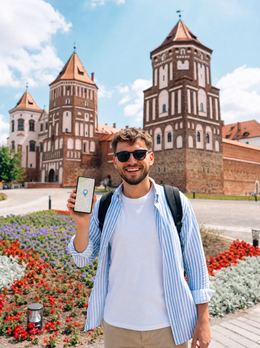
You've decided to purchase data for your trip and now just need to figure out how much: knowing how many GB you need for Belarus without overspending or running out halfway through your journey. I won't repeat the comparison of connection options here; I'll go straight to the numbers, with criteria and real consumption figures, so you buy exactly what you'll use and not a single gigabyte more.
The quick number: how many GB to take
For a typical 10-day trip to Belarus, most people will find 3 GB is more than enough if they use downloaded maps and hotel Wi-Fi. If you take photos, use social media, and watch some videos, aim for 5 GB; and if you work connected, plan for 15 GB or more.
That's the short answer, and for almost everyone, it's sufficient. Belarus is a destination where data consumption tends to be lower than people fear: hotels and many cafes in Minsk have decent Wi-Fi, distances between points of interest are short, and you spend much of the day walking through the historic center or inside a castle, not glued to your phone. The trick isn't to buy a lot, but to buy just enough and organize your trip so you don't depend on mobile data when it's not needed.
What is advisable is to have your GB purchased and paid for before leaving home, for a very specific reason related to this country, which I'll explain in the next section. If you want the general framework for sizing data for any destination, I cover it in the master guide on how much data you need for travel. Here, we'll continue with the specifics of Belarus, which is where the real nuance lies.
Why Belarus changes the calculation
Here's the detail that makes this destination unique and that almost no one tells you about: due to sanctions, foreign Visa and Mastercard cards work very erratically within Belarus. In physical stores, they sometimes go through and sometimes are rejected for no apparent reason, and they almost always fail for online payments, including the online top-up portals for local operators like A1 or MTS. It's a documented problem: paying on Belarusian websites with a foreign card usually results in an error.
What does that mean for your data? That the usual strategy of "buy a little and I'll top up on the go" becomes complicated here. If you run out of gigabytes on a local SIM, topping it up from your phone with your card might be impossible, and you end up looking for a kiosk, scratch cards, or paying cash in Belarusian rubles. It's an annoyance, especially if it happens on a Sunday night or in the middle of an excursion.
That's why the practical advice for Belarus is to buy and pay for your data before traveling, when your card works normally from home. A travel eSIM solves exactly that: you contract and pay for it before leaving, and if you run short, you can extend it online with your usual card, without depending on a Belarusian operator's gateway. The "buy less and top up" still applies, but only if you can actually do the top-up.
How much apps really consume
Before deciding on your number, it's worth seeing what a gigabyte actually goes to, because intuition can be deceiving: people think maps devour data and video is harmless, and it's exactly the opposite. These are approximate and realistic consumption figures per activity, useful for any trip and not just for Belarus. If you want the long detail, I have it in the mobile data usage statistics by activity.
| Activity | Approximate Consumption | Notes |
|---|---|---|
| Maps (online navigation) | ~5 MB per hour | Almost 0 with downloaded map |
| WhatsApp (chats and voice notes) | 5-10 MB per day | Text and audio are very light |
| WhatsApp voice call | ~30 MB per hour | About 0.5 MB per minute |
| Video call | 300-500 MB per hour | One of the biggest data users |
| Social media (feed and stories) | 100-150 MB per hour | Moderate use |
| Reels / TikTok / vertical video | up to 1 GB per hour | The silent black hole |
| Music streaming | 60-150 MB per hour | Less in normal quality |
| Video (YouTube / Netflix) | 0.5-1 GB per hour | Depending on SD or HD |
| Uploading photos to cloud or social media | 3-5 MB per photo | Better via Wi-Fi |
The quick takeaway: maps, WhatsApp, and checking email barely count; what drives up consumption is video, reels, and video calls. If you control those three things, a small package will last you a surprisingly long time. That's the secret to almost any data-efficient trip.
Recommendation by profile and duration
This is the table you came looking for. I've crossed four traveler profiles with the most common durations, already including a small safety margin so you're not on edge on the last day. The figures assume you use accommodation Wi-Fi at night and have downloaded maps, which is especially sensible in Belarus due to the top-up issues we discussed.
| Traveler Profile | 5 days | 10 days | 15 days | 30 days |
|---|---|---|---|---|
| Map and WhatsApp tourist | 1 GB | 2-3 GB | 3-4 GB | 5-6 GB |
| Photos and social media (medium use) | 3 GB | 5 GB | 8 GB | 15 GB |
| Digital nomad / remote work | 8 GB | 15 GB | 20 GB | 40 GB or unlimited |
| Family sharing (2-4 phones) | 5 GB | 10 GB | 15 GB | 30 GB |
Be honest with yourself when choosing a row. If your plan is to wander through Minsk, visit Mir and Nesvizh castles, and send photos via WhatsApp, you're a map tourist even if you have Instagram: 2-3 GB for ten days will be more than enough. The "photos and social media" row is for those who upload stories daily and watch a reel or two while waiting for the bus. The remote work row jumps because video calls and work downloads really consume data, and there it's advisable to have plenty of allowance or opt for an unlimited plan. The family row assumes one phone shares with the others; if each person has their own line, divide and distribute.
Passport registration and topping up a local SIM
If you're still considering a local SIM, there are two points of friction you should be aware of. The first: in Belarus, SIM card purchases are linked to your passport. The law requires every card to be registered in the name of a person, so at Minsk airport or in a store, they will definitely ask for your passport. There are plans designed for visitors (like A1's "Drive Tourist") that streamline some of the paperwork with authorities, but your document will still be requested.
The second point of friction, which we already covered and is truly important for your GBs, is topping up that SIM on the go. Operator payment portals almost always reject foreign cards, meaning extending data involves physical coupons, payment terminals, or cash. It's not the end of the world, but it's time and effort you'd rather spend on something else.
My rule for Belarus: decide on your data amount before flying and have it paid for. If you're debating between two sizes, go for the larger one only if the price difference is small; topping up here is more cumbersome than in almost any other country.
Therefore, for most people, a Belarus eSIM makes more sense, which you can manage entirely from your phone with your usual card, without queues at the airport or hunting for kiosks that sell top-ups.
Coverage: Minsk, Brest, and dead zones
Coverage influences your data needs more than you might think, because where there's no signal, you don't use data. The good news is that in cities, Belarus has excellent coverage: Minsk and Brest have extensive and stable 4G, as do medium-sized towns. Walking along Independence Avenue or through Brest's old town, you won't miss speed.
Where things change is off the beaten path. The Belovezhskaya Pushcha forest, the country's natural gem, has patchy coverage once you venture among the trees; and the roads to Mir and Nesvizh castles alternate good stretches with weak signal areas. This actually works in your favor for calculation: during those hours in nature and transit, you'll consume very little, so don't inflate your data package for them. What you absolutely must have downloaded are the maps for the area and, if you're going to Belovezhskaya, the park info, because you won't want to depend on it loading there.
If you're interested in the full picture of how connectivity works in the country (operators, speeds, and connection options), I detail it in the internet in Belarus guide. For gigabytes, remember this idea: cities are well covered, rural areas are quieter, always use offline maps.
Internet outages, blocked networks, and VPN
A useful note, without getting into politics, because it affects how you use and how much data you spend. In Belarus, during specific periods of tension, there have been restrictions and outages of internet access and certain social networks. For a tourist's daily life, it's usually fine to browse without issues, but it's good to be prepared in case a particular service is blocked or slow at any given time.
Preparation boils down to one thing: install and test a VPN before leaving home. It's important to do it from your home country, because VPN websites themselves might be blocked once you're in Belarus, preventing you from downloading one. Keep it installed, logged in, and tested, so you're not dependent on anything when you arrive.
Regarding data: an active VPN adds a small overhead, around 5-10% due to encryption, nothing dramatic. You don't need to keep it on all the time; only turn it on if you notice a specific app isn't responding. That margin is already accounted for in the table figures, so you don't need to add gigabytes for it. And, as always before such a trip, review your country's official travel advisories and updated visa requirements, as these can change over time.
How to calculate your own consumption
Tables are a good starting point, but the most reliable data comes from yourself. Your phone has been precisely measuring your usage for months, so use it to nail down your number instead of guessing. It's the most honest advice I can give you and it costs nothing.
- On Android: Settings > Network & internet > SIM / Data usage, and check the consumption for the last month.
- On iPhone: Settings > Mobile Data, and scroll down to see the accumulated usage (it's advisable to reset the counter at the beginning of the month to get a clean figure).
Take that monthly total, divide it by 30, and you'll have your real daily usage. Now adjust it for travel: on vacation, you typically use much less than usual, because at home and work you use Wi-Fi all day, and many background apps don't travel with you. A 30-40% reduction from your average is a prudent estimate for a normal tourist trip.
Example: if you use 6 GB per month, that's about 200 MB per day; subtract a third for travel, and you're left with ~130 MB daily, meaning a little over 1 GB for ten days. It aligns with the "map tourist" row in the table, see? This personal method always beats the internet average, because the average isn't you.
How to make your GB last and what to do if you run short
With a few simple adjustments, a small data package can go twice as far. None of them change your travel experience, and all can be activated in two minutes. These are the biggest savers:
| Adjustment | How much it saves |
|---|---|
| Downloaded offline maps | Eliminates almost all navigation data usage |
| Video and reels in low quality (480p) | Up to 60-75% less |
| Backups only over Wi-Fi | Hundreds of MBs per day not used |
| Disable video autoplay | 100-300 MB per hour less on social media |
| Data saver mode activated | Reduces background data consumption |
You can find the full manual of tricks in the guide on how to save data while traveling. And if you still run short, don't worry: it's always better to buy too little and top up than to buy too much. You pay for what you use and don't waste money on gigabytes that expire unused. The only condition, and why I insist so much for this destination, is that you can actually top up: with a travel eSIM, you top up in a minute from your phone with your usual card, whereas a local Belarusian SIM will leave you stranded due to top-up issues. Run short with a network, not with a card you can't recharge.
Frequently asked questions
The most common questions I get about data in this destination, answered in two lines each:
How many GB do I need for 7 days in Belarus?
2 GB is generally enough for a week of normal tourism (maps, WhatsApp, and some photos). Increase to 3-4 GB if you're into social media and video, and 8-10 GB if you work connected via video calls.
Can hotel and cafe Wi-Fi help me save data?
Yes, and it's your best ally in Belarus. Minsk and Brest have reasonable Wi-Fi in accommodations and cafes. Save heavy downloads, photo backups, and streaming for those times, and your data package will last much longer.
Will my card work to top up data there?
It's best not to count on it. Foreign Visa and Mastercard cards almost always fail on Belarusian online payment portals, including those of A1 and MTS. That's why it's advisable to purchase and pay for data before traveling, from home.
Do I need my passport to get data?
For a local SIM, yes; for a travel eSIM, no. Buying a SIM in Belarus requires passport registration. A travel eSIM contracted before leaving activates online without that hassle or airport queues.
Do maps use a lot of data?
Very little: about 5 MB per hour navigating, and almost none if you have them downloaded. Download Minsk, Brest, and the areas of Mir, Nesvizh, and Belovezhskaya before you leave, and navigation won't count towards your data usage.
Do I need a VPN, and does it consume extra data?
It's recommended to have it installed and tested from home. Some services might be blocked at specific times. A VPN adds only 5-10% consumption due to encryption, a margin already included in this guide's figures.
What happens if I run out of data halfway through my trip?
With an eSIM, you can top up in a minute from your phone using your card. This is a big advantage over a local SIM, whose online top-up often fails with foreign cards. As long as you have coverage, running short isn't a disaster.
Is it better to get extra GBs for peace of mind?
No: it almost always pays to buy just enough. Unused gigabytes expire and are wasted money. Choose your row in the table honestly, and if in doubt, opt for the smaller size knowing you can top up online.
Conclusion
To summarize without exaggeration: for a ten-day tourist trip to Belarus, 3 GB is more than enough for most people, 5 GB if you're constantly online, and 15 GB or more if your work requires a constant connection. Download maps, use Wi-Fi at night, and manage video usage, and you'll find you spend less than you feared. What's truly unique about this destination isn't the number, but when and how you pay: since foreign cards often fail for local top-ups, the smart move is to buy your data in advance with an option to top up online without depending on a local operator. If you want to have it sorted before packing your bags, check out the PuraSIM eSIM for Belarus: you activate it at home, pay with your usual card, and travel with your connection already set up.