If you've come this far looking for how many GB you need for Sudan, the first thing I owe you out of honesty is this: Sudan is not a travel destination today. Since April 2023, there has been an open civil war, and the Ministry of Foreign Affairs advises against any travel to the country. This guide is not intended for tourists but for humanitarian personnel, press, and diaspora who, out of necessity, have to move around there or communicate with those inside.
First of all: Sudan is at war
The honest answer: in Sudan, no data package guarantees a connection. There have been telecommunications blackouts for weeks. If you are still going for work, don't overbuy: 3 to 10 GB per month will be more than enough, as you will spend long periods without any network to consume.
I'm not going to sugarcoat it. Since April 2023, Sudan has been experiencing an armed conflict between the army and paramilitary forces that affects the entire country to varying degrees. The Ministry of Foreign Affairs recommends avoiding any travel and asks Spanish citizens inside the country to leave as soon as possible. The capital, Khartoum, and the entire Darfur region are among the most dangerous areas, along with Kordofan, Blue Nile, and border areas with South Sudan.
That's why the first piece of advice in this guide isn't about gigabytes, but about judgment: always consult and follow the official travel recommendations from the Ministry of Foreign Affairs before making any decisions. Connectivity is the least of your worries if your safety isn't assured.
This guide is therefore useful for a specific group of people:
- Humanitarian and cooperation personnel deployed with an organization that already has security protocols.
- Field press and journalists entering with accreditation and their own logistics.
- Sudanese diaspora who want to understand what connection a family member inside the country will have, or to prepare their own communications.
If you don't fit into any of these profiles, the best "data guide" for Sudan is not to travel. To find out how people on the ground actually connect, you can find the details on internet in Sudan.
The real question: it's not how many GB, it's if there will be a network
In a normal destination, calculating data is arithmetic: you add up your hours of maps, messaging, and video, and you get a figure. In Sudan, that calculation breaks down because the dominant variable isn't your consumption, but whether there will be coverage that day in that area. The war has damaged towers, exchanges, and fiber lines, and there have been deliberately ordered outages that left tens of millions of people without phone or internet for weeks.
In Sudan, you don't buy gigabytes to "spend" them: you buy the possibility of being connected during the times the network exists. Plan for scarcity, not for consumption.
The practical consequence is counter-intuitive. Many people who arrive expecting 20 or 30 GB end up using a fraction, not because they are restraining themselves, but because there is nowhere to spend them: the network goes down, comes back for a few hours, and then leaves. On the other hand, when there is a signal, usage is concentrated on essentials (notifying that you are okay, coordinating, sending a report) and everything else is turned off.
Therefore, the correct approach here is to buy little and have a Plan B. A modest mobile data package for moments with coverage, plus an alternative communication method for when there isn't any. Sizing for optimism is throwing money away; sizing for realism means assuming that many days the best message will be an SMS or a short call when the signal appears.
Data consumption by activity
Even with all the caveats, it's important to know how much each activity weighs, because when the network appears, you'll want to spend only on what's important. These are real and approximate figures for consumption by activity; they help me explain why in Sudan, a text message is gold and a video call is a luxury you sometimes can't afford even if you have gigabytes.
| Activity | Approximate consumption | Note for Sudan |
|---|---|---|
| WhatsApp: text and images | A few MB per day | Most efficient; absolute priority |
| WhatsApp: voice call | 18-30 MB/hour | Cheap and very useful with weak signal |
| Maps with navigation | 3-5 MB/hour | Almost 0 if downloaded offline |
| Email and work messaging | Few MB per day | Ideal for reports and coordination |
| Sending photos | 2-5 MB per photo | Compress before sending |
| Streaming music | ~150 MB/hour | Download via Wi-Fi if available |
| WhatsApp: video call | ~300 MB/hour | Only if the signal holds up |
| Social media (feed) | 120 MB/hour | Increases rapidly with video |
| YouTube or video (SD quality) | 500-600 MB/hour | Avoid unless on Wi-Fi |
| Reels and vertical video | 600-720 MB/hour | The biggest data hog |
| Zoom/Teams video call | 0.5-2.5 GB/hour | Reserve for critical meetings |
If you want fine detail on how much each application uses, it's broken down in the mobile data usage statistics by activity. The takeaway for Sudan is simple: text and voice cost almost nothing; video eats everything. When connection is a scarce commodity, every megabyte you don't spend on video is a megabyte available for the message that truly matters.
How many GB depending on your profile (humanitarian, press, diaspora)
Here lies the heart of the guide, tailored for those who are actually on the ground in Sudan. The figures are generous upper limits in case there's a good network one day, not consumption you'll reach every single day. In practice, most people stay well below these figures because outages do the "saving" work for you. Think of these numbers as the package size that won't leave you stranded, not as a spending forecast.
| Profile | 5 days | 10 days | 15 days | 30 days |
|---|---|---|---|---|
| Remote coordination (little field, much text) | 1 GB | 2 GB | 3 GB | 5 GB |
| Humanitarian / cooperation personnel | 2 GB | 3 GB | 5 GB | 8 GB |
| Diaspora visiting family | 2 GB | 4 GB | 5 GB | 8 GB |
| Press / field journalist | 3 GB | 5 GB | 8 GB | 10-12 GB |
The press profile is the only one that might justify buying more, because they sometimes need to send high-quality photos or a video when a decent connection window appears. Even so, we're talking about 10-12 GB for an entire month, not the figures you'd see for a country at peace. The other profiles can manage with less.
Note that not even the most intense month reaches what you would spend on a tourist weekend in Europe. This isn't stinginess: it's that Sudan doesn't allow you to consume more. If you've just read the general data calculation for travel, you'll see that here you need to divide any standard estimate by three or four, precisely because of the intermittency of the network.
Zain, MTN, Sudani and the blackouts
On paper, Sudan has three mobile operators: Zain, MTN, and Sudani (the latter, state-owned). On the ground, what works and what doesn't depends on the day, the city, and, above all, who militarily controls that area. During the major outages of 2024, operators were ordered to suspend service, and MTN and Sudani's connectivity dropped to practically zero while Zain was almost completely offline.
| Operator | Presence | Reality in conflict zone |
|---|---|---|
| Zain | Extensive in cities | Relatively better coverage, but intermittent |
| Sudani | State-owned, large network | Affected by ordered outages and damage |
| MTN | National | Has suffered prolonged total outages |
| Starlink (informal) | Unofficial | The last resort when all else fails |
Coverage is more solid in urban centers and degrades as you go out into rural areas or active combat zones. There is no stable "best operator": the one that works well this week might be down the next if territorial control changes or there's a new blackout. That's why those who know the country don't commit to a single SIM.
The practical recommendation is to have connectivity that doesn't rely on a single physical network. An eSIM for Sudan relies on the available local operators and saves you from having to buy a physical card at a counter that might be closed. It doesn't work miracles—if there's no network, there's no network—but it gives you the best available option at all times without having to deal with local procedures.
Informal Starlink: the internet that remains
When mobile networks go down for weeks, many people in Sudan have connected via Starlink, the satellite internet network. It is not an official service in the country: it operates through an informal market of terminals and shared access, often priced per hour or per megabyte. It has become a lifeline for coordinating aid, making transfers, and contacting relatives abroad when there was no other way.
It is important to understand this precisely and without dramatization. Starlink in Sudan is:
- A third-party resource, not something a visitor installs and activates on their own.
- Expensive and uneven: it is paid for in usage blocks and the quality varies greatly.
- Also vulnerable: in November 2025 there was a general Starlink outage for a couple of days coinciding with the intensification of fighting.
For your data planning, this means two things. First: don't count on Starlink as if it were your connection; count on it as what it is, the internet that appears when there is no other left. Second: if your organization operates on the ground, it probably has its own managed satellite links, and that is the serious way, not the informal market. Your mobile GBs are for times with cellular coverage; satellite is a whole other world that cannot be bought in an eSIM store.
Paying and buying data: why your card won't serve
There's a logistical detail that catches many people off guard: in Sudan, foreign card payments are practically unfeasible. The country has been under severe financial restrictions for years, and the war has finished off what remained of the banking system and POS terminals. Your European card won't work to top up a local SIM, nor for almost anything else. This completely changes how you prepare your connection: you can't count on "I'll buy it there".
Buying a physical local SIM implies cash in local currency, registration with documentation, and an open, accessible counter—three things that are not guaranteed in a conflict context. That's why, for the profiles this guide is aimed at, it makes much more sense to get your connection sorted before entering, paying from abroad with your usual card while you still can.
That's where an eSIM fits well: you contract and pay for it from your country as usual, and it arrives on your phone as a code that you activate when the time comes, without depending on buying anything inside Sudan. If you've never used one, the idea is simple: it's a digital data card that lives inside your mobile, without plastic. It's the way to have data paid for and ready without exposing yourself to a payment system that, quite simply, won't work.
How to stretch every megabyte when the network comes and goes
In a country where connectivity is intermittent, saving data is not stinginess: it's ensuring that when the network appears, you use it for essentials. These habits make the difference between letting people know you're okay or running out of leeway:
- Offline maps downloaded before entering: navigation goes from 3-5 MB/hour to virtually zero.
- Prioritize text and voice over video. A WhatsApp message or call costs a fraction of a video call.
- System data saver mode activated, and in each app too.
- Disable auto-play for videos on social media and messaging.
- Backups and updates only via Wi-Fi, never with mobile data.
- Compress photos before sending and avoid sending videos unless absolutely necessary.
Keep in mind an additional factor unique to restricted contexts: if you need to use a VPN to access certain services, add between 5% and 15% of additional consumption, because encrypting traffic has a small data cost. It's not much, but it's worth considering when the margin is tight.
You can find more applicable tips for any destination in the guide on how to save data while traveling. In Sudan, an additional saving comes automatically: the blackouts. It sounds bitter, but the reality is that many days you won't have to worry about spending, but about being able to connect even for a short while.
Meroë and what Sudan was for travelers
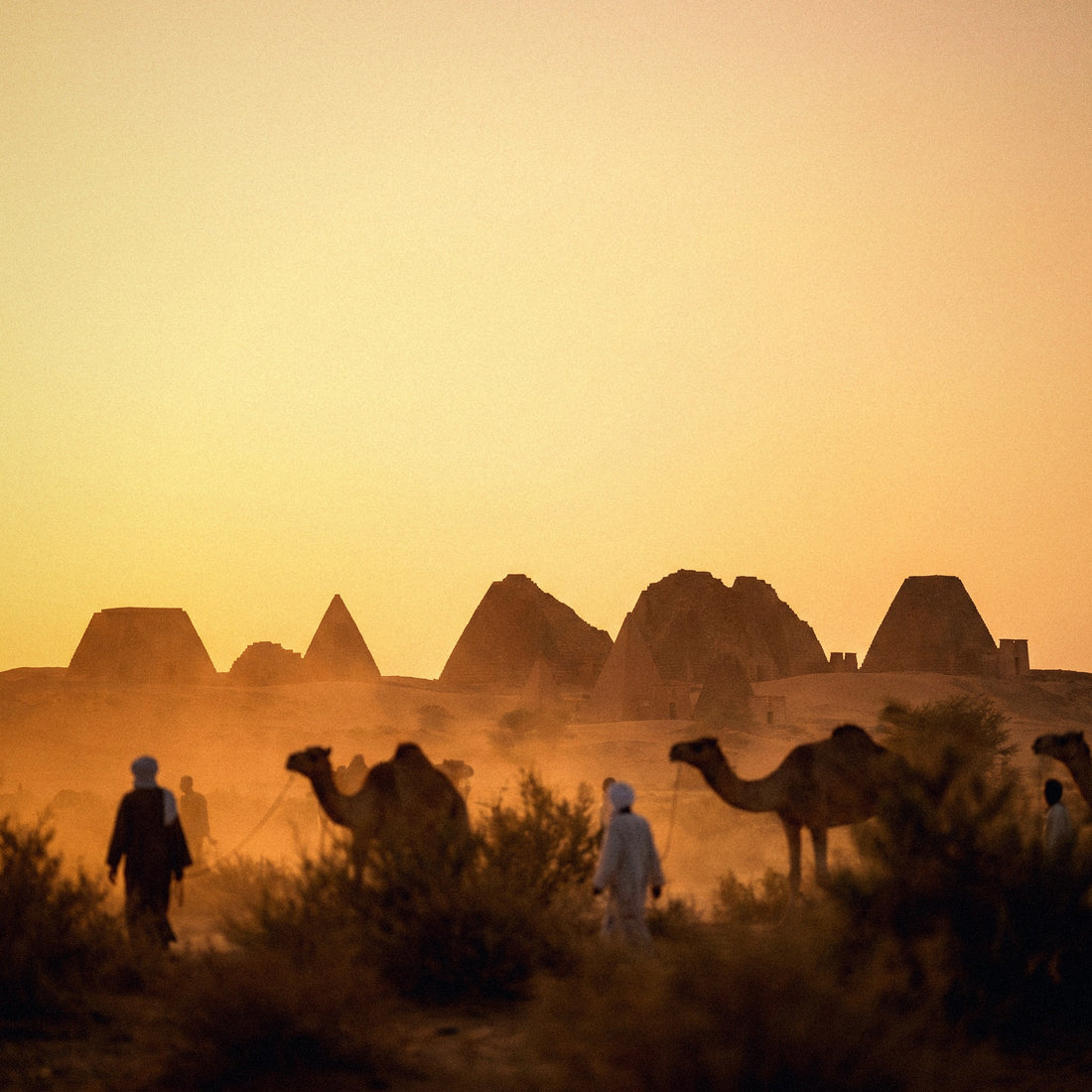
It's worth remembering, without false nostalgia, what Sudan once was for travelers. The pyramids of Meroë, more than two hundred of them, from the ancient kingdom of Kush, rise over the dunes in the north of the country and outnumber those of Egypt. For years, they were one of tourism's great secrets, a place where you could have a World Heritage site almost to yourself, without queues or crowds.
I mention this for context, not as an invitation. Today, Sudan is not normally visitable: there is no operational tourism, logistics are broken, and security completely advises against it. Cultural trips to Meroë belong, for now, to the past and to a future that will depend on the country regaining peace.
If you keep those pyramids on your dream list, keep them patiently. The best tribute you can pay to that Sudan is not to try to sneak in now in the middle of a war, but to wait until it is once again a place where a traveler can walk among ancient tombs without risking their life or complicating the work of those who are there trying to help. In the meantime, honest information is the best form of respect.
Frequently asked questions
How many GB do I really need for Sudan?
Less than you think: between 3 and 10 GB per month is more than enough for almost any profile. Not because you're holding back, but because the network is intermittent and doesn't allow you to consume more. Buy little and have an alternative communication plan. First of all, review the travel recommendations from the Ministry of Foreign Affairs, which advise against travel.
Will I have a stable connection in Sudan?
There is no guaranteed stable connection anywhere in the country. The war has damaged the infrastructure, and there have been telecommunications blackouts lasting for weeks. Coverage depends on the area, the day, and who controls it. Plan assuming that you will not have a network for long periods.
Can I buy a local SIM when I arrive?
In practice, it's very difficult. Foreign card payments don't work, local cash and registration are needed, and counters might be closed due to the conflict. It's safer to have data contracted from outside before entering, when you can still pay normally.
What is informal Starlink and can I use it?
It is satellite internet access through an unofficial market. It has been a lifesaver during outages, but it's expensive, inconsistent, and not something a visitor would set up on their own. Don't count on it as your primary connection; consider it a last resort when everything else fails.
Which operator works best, Zain, MTN, or Sudani?
There is no stable winner. Zain usually has relatively better coverage in cities, but all three have suffered severe outages. What works well one week might be down the next, depending on who controls the ground. That's why it's advisable not to depend on a single physical card.
What if I run out of data?
It's better to run short and top up than to overbuy. In Sudan, paying too much is throwing money away, because outages will prevent you from using your gigabytes anyway. Start with a modest package; extending is easy, and that way you don't tie up data you might not be able to use.
Can I go see the Meroe pyramids?
No, Sudan is not a viable tourist destination today. There is no operational tourism, security completely advises against it, and the Ministry of Foreign Affairs asks to avoid any travel. Meroe is context for what the country was and can be again, not a current travel proposition.
Does an eSIM work even if there are outages?
It serves to provide the best available connection at all times, not to create a network where there isn't one. It relies on operational local operators and saves you from buying a SIM on the ground. If there's coverage, you use it; if there's an outage, no solution will connect.
Conclusion
With Sudan, I'm not going to give you a neat figure, because that would be lying. The reality is that connection is not guaranteed: the infrastructure is damaged, there have been weeks-long outages, and everything depends on the area and who controls it. If there's a network one day, 3 to 10 GB per month will be more than enough for what really matters—letting people know you're okay, coordinating, working—and no larger package will change the fact that much of the time, there simply won won't be a signal.
And first and foremost, always: this is not a travel destination. Follow the recommendations of the Ministry of Foreign Affairs, which advise against going. If your job takes you there anyway, arrange your data before entering and don't rely solely on it. You can sort out your connection before entering with an eSIM for Sudan paid for from home, ready to activate when there's coverage, without depending on a payment system that won't work on the ground. Little, well-planned, and with a backup plan: that's the only honest recommendation I can give you.