If you've already decided to buy data for your trip and just need to know how many GB you need for Cameroon, this is the place for you. Cameroon is a destination where data consumption varies greatly: in Douala and Yaoundé, you use your phone at a normal pace, but when climbing Mount Cameroon or in the north, you barely consume anything because there's no coverage. Here, I'll give you a well-reasoned figure for a mixed business and adventure trip, without confusing you with theory.
The short answer: straightforward figures
For 10 days in Cameroon, most people will have enough with 6 GB: in Douala and Yaoundé you use data at a normal pace, but when climbing the mountain and in the north, you consume almost nothing due to lack of coverage. If you have daily work video calls, increase to 10-12 GB.
That's the quick overview for a mixed business and adventure trip, which is often what a trip to Cameroon entails. The key is that not all your days weigh the same: a day working from the city with two video calls can consume more than 1 GB, while a day hanging on the side of the volcano or crossing a northern park will use barely 100 MB because the phone doesn't get a signal.
That's why I don't like to give you just a round number. I prefer that you understand where the figure comes from so you can adjust it to your specific trip. If you want the general framework for how to size data for any country, I'll leave you the hub on how much data you need for travel. And if you're wondering which operator or type of connection to use, I'll cover that in a separate article; here we're only talking about gigabytes.
Why Cameroon changes the calculation
Cameroon is called "Africa in miniature," and for mobile data, that label is literal: in the same trip, you go from decent 4G to zero coverage in a matter of hours. This breaks the "X GB per day" rule that works for a homogeneous destination like Portugal or Italy.
What makes the calculation unique here is the gap between city and nature. MTN and Orange, the two dominant operators, provide good urban coverage in Douala (the economic capital) and Yaoundé, sufficient for work video calls. But as soon as you head towards Mount Cameroon, the northern parks, or remote tracks, the signal drops to intermittent 3G or disappears. Less coverage means less consumption: no matter how many GB you've bought, without a network, you consume nothing.
Adding to this is a practical detail: you'll rely heavily on maps and messaging, and less on continuous video, because much of the time you'll be in transit or in areas where you wouldn't even think of watching a series. If you're still unsure how you'll connect (local SIM, internet in Cameroon explains it in detail), resolve that first; this article assumes you already know you'll buy data and are only wondering about the package size.
How much each activity consumes (real figures)
Before deciding on your GBs, it's good to know what really consumes your data. These figures are based on real consumption and serve as a guide; video and video calls are what drive up the bill, not maps or WhatsApp.
| Activity | Approximate consumption |
|---|---|
| Messaging (WhatsApp, text and voice notes) | Less than 5 MB per hour |
| GPS navigation with online map (Google Maps) | 5-15 MB per hour (almost 0 with downloaded map) |
| Email and light web browsing | 20-50 MB per hour |
| Music streaming (Spotify normal quality) | 40 MB per hour (up to 150 MB in high quality) |
| Uploading 10 photos to the cloud or social media | 30-50 MB |
| Social media (Instagram, TikTok with video) | 300-600 MB per hour |
| Video call (WhatsApp, Zoom, Meet) | 200-350 MB per hour |
| Video in 1080p (YouTube, Netflix) | 1.5-3 GB per hour (0.5-0.7 GB in low quality) |
Notice the jump: chatting all day barely moves the needle, but one hour of work video call is equivalent to more than 60 hours of WhatsApp. If your trip involves remote meetings, that's where the bulk of your consumption will be. You can find a more detailed breakdown in the mobile data usage statistics by activity.
How many GB according to your profile and days
This is the table that truly matters. It crosses your traveler profile with the duration of the trip, already taking into account that in Cameroon there will be city days (normal consumption) and mountain or northern days (almost no consumption). These figures have plenty of margin: I prefer you have a little too much than to run out of data in Douala.
| Profile | 5 days | 10 days | 15 days | 30 days |
|---|---|---|---|---|
| Tourist using maps and WhatsApp | 2 GB | 4 GB | 6 GB | 10 GB |
| Photos and social media user | 4 GB | 7 GB | 10 GB | 20 GB |
| Mixed business + adventure | 5 GB | 8 GB | 12 GB | 22 GB |
| Digital nomad / remote work (video calls) | 8 GB | 15 GB | 22 GB | 40 GB |
| Family sharing (multiple phones) | 8 GB | 15 GB | 25 GB | 45 GB |
For the classic Cameroonian trip of meetings in Douala plus a getaway to the volcano or the coast, the "mixed business + adventure" profile is your reference: about 8 GB for ten days. If you truly work remotely, with almost daily video calls, consider the telework profile. And if two or more people are traveling and sharing a single package, add it up: the family table already accounts for that distribution.
Douala and Yaoundé: where you really consume data
This is where almost all your data consumption is concentrated. Douala and Yaoundé have good urban MTN and Orange coverage, with 4G that supports work video calls without too many interruptions. If your trip has a business component, assume that these two cities set the pace for your data bill.
A typical workday in the city can easily reach 1-1.5 GB if you string together a couple of video calls, check heavy emails, share documents, and upload photos of the day. A normal tourist day in the city (maps to get around, WhatsApp with home, some social media) stays at 400-600 MB. The difference, again, is video calls.
| Type of day in Cameroon | Estimated consumption |
|---|---|
| Workday in Douala/Yaoundé (video calls) | 1-1.5 GB |
| Tourist day in city or on coast | 400-600 MB |
| Day climbing Mount Cameroon | 50-100 MB |
| Day in the north and the parks | 100-300 MB |
Practical advice: make important video calls from your hotel or office via Wi-Fi whenever you can. Not because of coverage, which is good in the city, but because it saves your mobile GBs for when you're out and about or on the road and don't want to rely on Wi-Fi.
Mount Cameroon, Kribi, Limbé, and the North
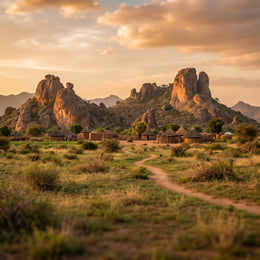
This is the data-friendly side for your wallet: adventure zones barely consume data because there's no coverage to use. The ascent of Mount Cameroon, the highest volcano in West Africa, takes several days and much of it occurs without mobile signal. As much as you want to upload a time-lapse from the summit, you won't be able to until you descend.
On the coast, things change: Kribi and Limbé, the reference beaches, have reasonable coverage, so there you consume data like in any small city. The north, however, with its national parks and wildlife, has weak and intermittent coverage: 3G at times and dead zones. Count this in your favor.
The mental rule for Cameroon is simple: the more spectacular the landscape, the less data you consume. The mountain and the north are free for your package; the city is where the money goes.
Key practice for these stretches: download maps before leaving the city, and save the park information or ascent route offline. When you regain signal upon returning to a populated area, your phone will try to sync photos and messages all at once; if you don't want a data spike, leave that synchronization for Wi-Fi only.
How to calculate your real consumption before traveling
The most honest way to get the GB right is not to trust a generic table, but to check your own consumption from the last month. Your phone already keeps track and doesn't lie. With that data, you have a personalized basis much better than any estimate.
- On Android: Settings > Network & Internet > SIMs/Mobile data > Data usage. You'll see the GBs for the monthly cycle.
- On iPhone: Settings > Mobile Data and scroll down to the total for the period (remember to reset statistics at the beginning of the month to have a clean cycle).
Take your monthly consumption, divide it by 30, and you have your average daily usage at home. For Cameroon, adjust it like this: city days count more or less like at home; mountain, ascent, or northern days count almost as zero. Sum by segments and you'll have your real number.
Quick example: if at home you consume 6 GB per month (200 MB/day) and you spend 10 days with 6 in the city and 4 on adventure, that would be about 6 × 200 MB for the city plus 4 × 50 MB for the mountain, so around 1.4 GB as a base. To that, you add the extra for work video calls if you have them, which is why the figures in the table are higher. Always round up: unused data doesn't hurt, running out does.
How to stretch your GB in Cameroon
With four basic adjustments, the same package will last twice as long. There's no need to turn off your phone; just avoid the holes where data leaks without you noticing. These are the most effective for a trip like this, with city and travel segments: focus on maps and video, which is where avoidable consumption lies.
- Offline maps: download Douala, Yaoundé, the coast, and your route area before leaving. Navigation goes from consuming to almost no consumption.
- Low quality video: lower YouTube and social media to standard definition. You go from 3 GB per hour to less than 1.
- Backups only via Wi-Fi: photos and videos that upload automatically are the silent enemy. Let them wait for the hotel Wi-Fi.
- Disable autoplay of videos on Instagram, TikTok, X, and Facebook. They activate automatically and consume data without you even watching anything.
- Data saver mode activated in the system and in apps that have it.
You have the complete list with more tips in the guide on how to save data while traveling. With this, a 6-8 GB package will last a mixed ten-day trip without any scares.
What happens if you run out
Let's be clear: running out is not a disaster; overspending is throwing money away. With digital data, you can usually top up in minutes from your phone when you see it's running low, without going to any store or changing anything. That's why my advice is always to start with a modest package and top up if necessary.
The logic is simple. If you buy too much "just in case," those GBs expire when you return home, and you don't get them back. If you buy just enough and run out, you add a small package, and that's it. The cost of underestimating is minimal; the cost of overestimating is all the leftover data.
Furthermore, in Cameroon, geography works in your favor: since you consume almost nothing in the mountains and the north, it's easy to end the trip with more data than you thought. Save the video of the summit to watch with Wi-Fi and don't push it. And if a workday skyrockets with video calls, you know you'll compensate for it the next day on the road. The expensive option is the opposite: buying a huge package for a trip where half the adventure takes place without coverage.
SIM registration and safe travel
Two contextual points worth keeping in mind, which, although they don't change the number of GBs, do affect your peace of mind. First: in Cameroon, local SIM registration is mandatory, and you'll be asked for identification when activating it. This is standard procedure in the country, but it adds time and paperwork right when you arrive, when you most want to be connected.
Second, and more importantly: before organizing the adventure part, check the official travel recommendations from your foreign ministry. In Cameroon, there are regions where travel is not advised for security reasons, and this directly affects where you can move and, consequently, how much coverage you'll have. Planning your route with that information in mind is common sense.
Regarding the connection itself, if you prefer to avoid queues and in-person registration upon landing, you have the option of having it sorted from home; I explain this in the guide on eSIM for Cameroon, and if all this sounds like gibberish to you, start with what an eSIM is. With data already active from minute one, you forget the hassle and go straight to your business, whether it's a meeting in Douala or the first leg of the climb up the volcano.
Frequently asked questions
The most common questions I receive about data in Cameroon, answered with figures and no embellishments.
How many GB do I need for 10 days in Cameroon?
For 10 days, most people will be fine with 6 GB, and 8 GB will be more than enough if you mix city and adventure. If you have work video calls almost daily, aim for 10-12 GB. Remember that days in the mountains and the north barely consume data.
Will I have coverage during the ascent of Mount Cameroon?
No, for most of the climb, there is no signal. The ascent takes several days and occurs without mobile coverage. Download maps and anything else you need before you leave, and don't expect to upload anything until you get back to a populated area.
MTN or Orange, which consumes less data?
Neither consumes more or less: your usage consumes the data, not the operator. Both dominate the market and provide good urban coverage in Douala and Yaoundé. Coverage affects whether you can connect, but not how many GB a video call consumes.
How much data does a workday with video calls consume?
A day with a couple of video calls will use 1-1.5 GB. Video calls are the heaviest: 200-350 MB per hour. If you do meetings via hotel Wi-Fi, you save mobile data for when you're out and about.
Do I need to register my SIM in Cameroon?
Yes, local SIM registration is mandatory and you will be asked for identification. This is a standard country procedure that adds time upon arrival. If you want to avoid it, having your data sorted before you leave saves you the queue as soon as you land.
Do I consume a lot of data in the north and the parks?
No, in the north, coverage is weak and intermittent, so you consume very little. Expect 3G at times and dead zones. This works in your package's favor: those days balance out the high consumption of city and workdays.
What do I do if I run out of data halfway through my trip?
You top up in minutes from your mobile phone without going to any store. That's why it's advisable to start with a modest package and top up if necessary, instead of buying too much and wasting GBs on a trip where half the adventure takes place without coverage.
Conclusion
For a mixed business and adventure trip to Cameroon, 8 GB for ten days is a safe bet for most, and 6 GB if you go light on video calls. Only go up to 10-12 GB if you work remotely daily. Remember the key: the city determines your data usage, and the mountains and the north barely count, so don't inflate your plan thinking about the whole country equally. Start with a lean plan, recharge if necessary, and save photo uploads for Wi-Fi. If you want to arrive with data already active and skip in-person registration, check out the eSIM plan for Cameroon and take off connected from the first minute.