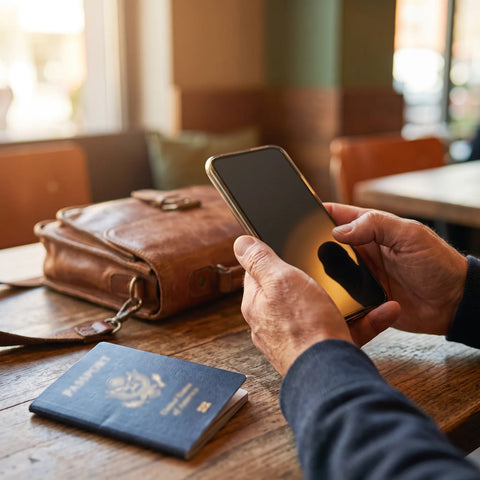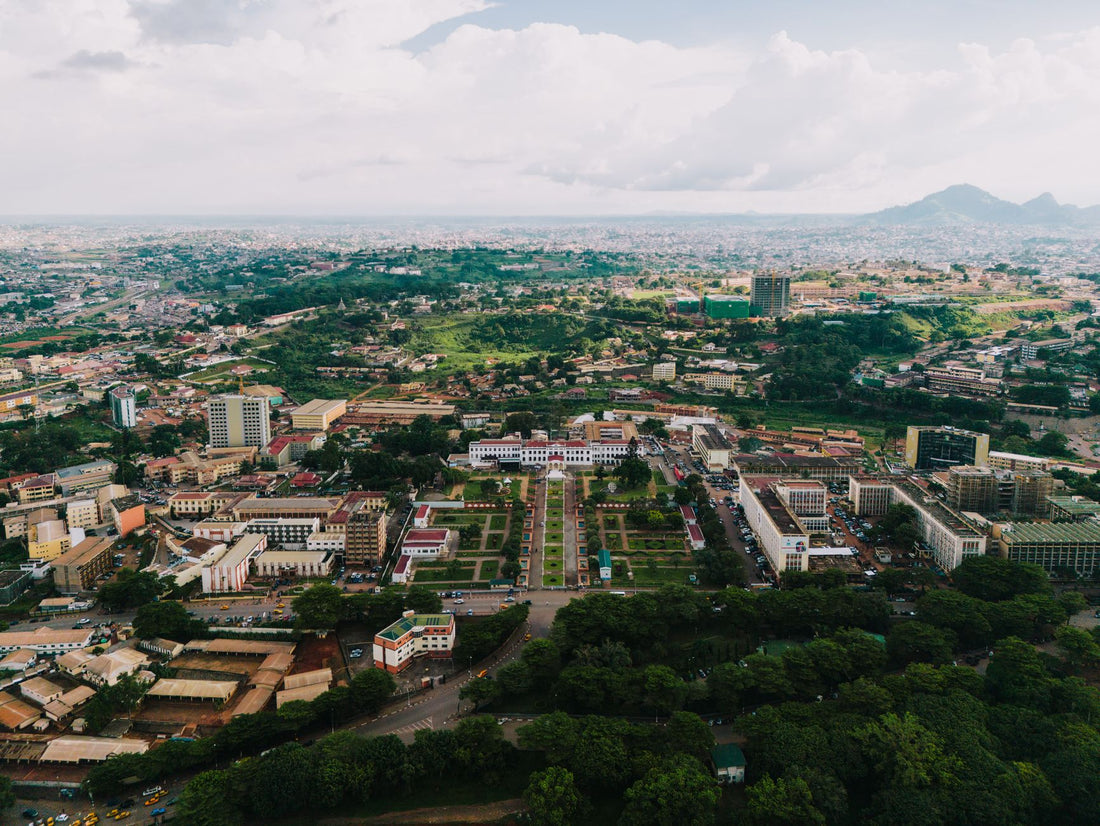
In short: an eSIM for Cameroon gives you 4G internet in Yaoundé and Douala from the moment you land, without exorbitant roaming charges or queues to register a local SIM with your passport. It relies on the networks of MTN Cameroon, Orange Cameroon, and Camtel, is installed before you leave home, and activates automatically upon arrival. For a normal week, 2-3 GB is more than enough.
Why an eSIM for Cameroon is better than roaming
Cameroon is not a destination where you can improvise your connection on the go. Roaming from Spanish operators to Central Africa is among the most expensive available—when it's not directly excluded from the tariff—so the real option almost always comes down to two: buying a physical SIM as soon as you land or having the Cameroon eSIM already installed. The difference is noticeable in the first twenty minutes of your trip, which are precisely the worst to go without coverage: finding the taxi you booked at Nsimalen Airport (Yaoundé) or Douala International, confirming the accommodation address, or letting people know you've arrived safely.
Buying a local SIM in Cameroon means locating an official MTN or Orange point of sale, presenting your passport for the mandatory registration required by the country's telecommunications regulations, and, depending on your arrival time, waiting for the line to be activated. Nothing dramatic, but it is a hassle that takes time when you are most tired. With an eSIM, you skip all that: you download it at home with Wi-Fi, it travels "asleep" on your phone, and you only need to wake it up by activating data and roaming when you land. If you first want to understand the fundamental difference between the two options, the comparison of eSIM versus roaming makes it quite clear with numbers from other destinations.
Real coverage: MTN, Orange, and Camtel on the ground
The travel eSIM doesn't create its own network: it relies on the infrastructure of local operators, so your coverage in Cameroon depends on the same antennas used by any Cameroonian. The market share is dominated by MTN Cameroon and Orange Cameroon, with Camtel as a third player and more limited presence. The eSIM automatically connects to the best available signal in each area, without you having to choose an operator or do anything.
Yaoundé and Douala: where the connection never fails
In the capital, Yaoundé, and in Douala—the country's largest city and its economic and port hub—4G is solid in the city center, business districts, and most residential areas. Working from a hotel, making video calls, or getting around with Yango (the most used ride-hailing service in both cities) works smoothly. Where the signal does suffer a bit is inside solid concrete buildings in central Douala and in dense neighborhoods like Bonanjo late in the day, when the network gets saturated due to the volume of simultaneous users: nothing that a couple of minutes of patience can't fix.
Kribi, Bafoussam, Mount Cameroon, and the North
Outside the Yaoundé-Douala axis, the map changes. In Kribi, the country's most visited beach area, coverage is decent in the urban core and degrades as you move towards the Lobé Waterfalls. In Bafoussam and the western mountainous region, 4G coexists with stretches of 3G between villages. If you climb Mount Cameroon or go trekking, expect to lose coverage for hours: download your route map before leaving the last village with signal, not at the foot of the volcano. In the more sparsely populated north, the network is more intermittent. If your itinerary includes any region of the Anglophone Northwest or Southwest, also review current official travel advisories before moving, regardless of mobile coverage.

eSIM, roaming, or local SIM: what's best in each case
There's no one-size-fits-all answer. It depends on how long you'll be in the country, whether you need a local number for calls, or if your priority is simply to avoid complications.
| Option | Cost | Time to get data | When it's best |
|---|---|---|---|
| Roaming from Spanish operator | Very expensive in Central Africa; check current price with your operator before leaving | Immediate, but expensive per MB | Only if you need to keep your number active for specific hours |
| Local physical SIM (MTN/Orange) | Affordable, in local currency (CFA franc) | Requires store, queue, and passport registration | Long stays or if you'll need a real Cameroonian number |
| Data eSIM for Cameroon | Fixed, in euros, paid before leaving | Active upon landing | Short or medium stays focused on data, without needing a local number |
If your trip is for work and you need a Cameroonian number for return calls, a physical SIM still makes sense for that specific purpose; combine it with an eSIM just for data if you want the best of both worlds. For everything else—tourism, getaways, short trips—the eSIM wins in terms of time and convenience. Also review the difference between an international chip and an eSIM if you're unsure between the two physical options.
How many GB to get depending on your trip type
The calculation mostly depends on whether you'll rely on hotel Wi-Fi or mobile data almost all day.
| Travel Profile | Approx. GB | Main Use |
|---|---|---|
| 5-7 day getaway | 2-3 GB | Maps, WhatsApp, social media |
| 2-week trip through several cities | 5-6 GB | Daily browsing, photos, and transport apps |
| Work, NGO, or long trekking | 8-10 GB | Video calls, uploading content, heavy email |
| Only essentials, with hotel Wi-Fi | 1 GB | Occasional messages and maps |
If you're going to Kribi or Mount Cameroon and planning to download offline routes and share photos along the way, it's better to stick to the higher end of the table: in areas with irregular coverage, you'll consume more data than expected because your phone constantly retries connections looking for a signal. And if you run short, topping up or buying another plan takes just a couple of minutes from your phone, without having to install anything new.
How to activate your Cameroon eSIM step-by-step
It's most practical to install it at home with Wi-Fi and leave it on standby, so you don't have to rely on the—often slow—Wi-Fi at Yaoundé or Douala airports.
- Purchase your Cameroon plan and receive the QR code or manual eSIM details.
- Install it from your phone's settings, at home and with Wi-Fi, before your trip.
- Upon landing, activate the mobile data for that eSIM and its data roaming.
- Wait a few seconds for it to connect to the MTN, Orange, or Camtel network, and you're good to go.
The process is the same as in any other country; if it's your first time with this type of card, full details are in how to install an eSIM. You don't need to remove your physical Spanish SIM: it can stay in your phone to receive calls and bank verification SMS, while data runs on the Cameroonian eSIM. Just make sure your Spanish line's data roaming is turned off, or you might unknowingly incur charges there.
Myths and what almost no one tells you before you go
There are several circulating ideas about staying connected in Cameroon that should be debunked before they complicate your trip.
- "With an eSIM, I no longer need to carry my passport." False. An eSIM saves you from registering for a local SIM, but in Cameroon, it's common to be asked for identification at road checkpoints and some hotels during check-in. Always keep it handy, on your phone or in paper form.
- "If I have an eSIM, I don't need a power bank." Quite the opposite: power outages are more frequent than one might think, especially outside Yaoundé and Douala, and without battery, the eSIM is useless. A charged power bank is as important as the data itself.
- "Hotel Wi-Fi is more reliable than mobile data." Not always. In many mid-range accommodations, Wi-Fi is slower and less stable than MTN or Orange's 4G network in the same area. If your priority is speed for uploading photos or making a video call, try mobile data first.
- "Cameroon is bilingual, so all apps and maps are in French and English equally." The country is officially bilingual, but in practice, signage, menus, and much of the local information you'll encounter daily are predominantly in French in the central and eastern areas, and English in the northwest and southwest. Set up your offline translator before leaving the big city.
- "The entire city has the same coverage." Neither Yaoundé nor Douala are uniform: entire neighborhoods on the outskirts have 3G where the city center has stable 4G. If you're staying far from the center, don't assume the same performance you've seen in reviews from other travelers who stayed in a central area.
When you DON'T need to buy an eSIM for Cameroon
Not everything is advantageous for everyone. If you're spending two or three full days in a Yaoundé hotel for a conference, with hardly any outings, and the accommodation confirms stable Wi-Fi, you probably have enough with that and a couple of offline maps downloaded before leaving home. It also doesn't make sense if you're with an expedition or NGO that already provides you with a local SIM as part of their logistics: buying another line would be a duplicated expense. And if your Spanish operator, under an unusual business plan, includes data coverage for Cameroon, check the actual conditions first: it happens sometimes, though it's the exception.
For all other profiles—tourism, combined travel with other countries, work with movements within the country—the eSIM remains the option with the least friction and most control over spending.
Tips to make your data last your entire trip
Data consumption almost always spikes for the same reasons: high-quality video playing automatically and photo backups running in the background without you noticing. In a country where coverage outside major cities is more irregular, managing data also prevents you from running out of a map precisely when you need it most.
- Download offline maps for Yaoundé, Douala, and any routes to Kribi or the interior before leaving the last area with good signal.
- Disable auto-play video on social media; it's the most common silent consumption.
- Leave photo backups and app updates for accommodation Wi-Fi, never for mobile data.
- Check consumption every two or three days from your phone to catch if anything is using too much.
- If traveling in a group, consider sharing data via hotspot from a single phone for short trips, instead of everyone having their own plan.
- If you're going to use public Wi-Fi in a hotel or airport to save data, keep in mind that it's not always reliable in terms of privacy; the guide on eSIM, VPN, and travel privacy explains when it's also advisable to protect yourself in those cases.
With these habits, a modest 2-3 GB plan will easily last a week in Cameroon. If you do run short, there are more general tips applicable to any destination in how to save data with an eSIM on a trip.

A couple of practical facts that help you get around
Cameroon uses the Central African CFA franc and is one hour behind peninsular Spain, something easy to forget when coordinating a video call. Being a bilingual country, having data handy for a translator resolves many language barriers if your route passes from the Francophone to the Anglophone zone. If your itinerary through Africa continues to another country in the region, eSIM for Comoros offers the equivalent approach; and if your return includes a layover or a few days in Europe, the Europe eSIM handles that part without relying on the connecting airport's Wi-Fi.
Frequently Asked Questions
Does the eSIM work immediately upon landing in Cameroon?
Yes, provided you have installed it with Wi-Fi before traveling. Upon landing in Yaoundé or Douala, you just need to activate mobile data and roaming for that eSIM; within seconds, it connects to the local network, and you're online, without looking for stores or registering with your passport.
Which operators does the Cameroon eSIM use?
It relies on the networks of the country's main operators: MTN Cameroon and Orange Cameroon primarily, with Camtel as a third option. You don't contract directly with any of them: the eSIM automatically connects to the best available signal in each area.
How many GB do I need for a week in Cameroon?
For normal use of maps, messaging, and social networks, 2-3 GB is more than enough for a week if you use the accommodation's Wi-Fi for large downloads. If you're going on routes through Kribi or Mount Cameroon with offline maps and constant photos, it's better to estimate a bit more.
Can I keep my Spanish number while using the eSIM in Cameroon?
Yes. The eSIM provides internet data, and your physical Spanish SIM can remain in place to receive calls and SMS, for example, from the bank. You just need to assign mobile data to the Cameroonian eSIM and verify that roaming for your home line is deactivated.
Is there good coverage outside Yaoundé and Douala?
In towns and tourist routes like Kribi or Bafoussam, coverage is usually good, although it can drop to 3G or weaken between localities. In remote areas of the north or on trekking routes like Mount Cameroon, it's advisable to download offline maps before leaving the last point with a signal.
Do I need a local SIM in addition to an eSIM if I'm working in Cameroon?
Only if you need a real Cameroonian number for people to call you back, for example, for paperwork or local contacts. For data, an eSIM is sufficient and quicker to set up; many travelers combine both when the purpose of the trip justifies it.
What happens if I run out of GB halfway through my trip?
You can top up or buy another plan from your phone in a couple of minutes, without having to install a new eSIM or go to any store. This is one of the practical advantages over a physical SIM, where recharging can be complicated depending on the area.
Conclusion
An eSIM for Cameroon solves what is most frustrating when arriving in a new country: not knowing if you'll have a connection when you get off the plane. With MTN, Orange, and Camtel covering Yaoundé and Douala well, and with enough margin if you calculate GB according to your route, you'll be online from the first minute without exorbitant roaming charges or queues to register a local SIM. Install it before you leave, activate it when you land, and if your trip gets complicated along the way, add data from your phone without wasting time. PuraSIM has over 200 destinations in its catalog, including Cameroon, and 24/7 support in all languages by email and WhatsApp if you need help at any point during your trip.