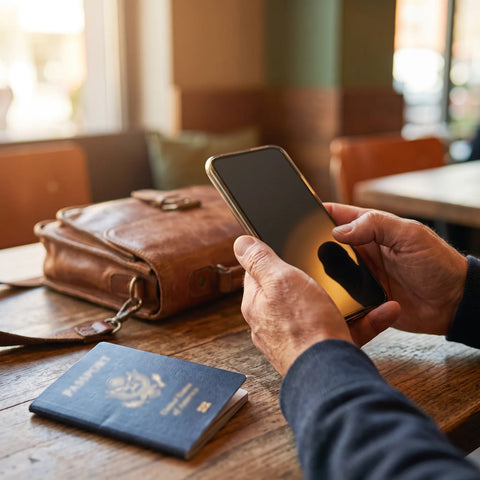
In short: an eSIM for Lithuania gives you internet in Vilnius, Kaunas, and Klaipeda as soon as you land, with a fixed price and without relying on EU roaming or having to find a Telia or Bite store. It's installed before you leave home and activates automatically upon arrival, in less than a minute.
Are you traveling to Lithuania and wondering how to get internet without a shocking bill? An eSIM connects you as soon as you land in Vilnius, without searching for stores or changing your SIM card. In this guide, we review coverage, how many gigabytes to get, a comparison with local operators, and how to activate it in one minute from your phone.
Does an eSIM work well in Lithuania?
Yes, and very well. Lithuania has one of the best fiber and mobile infrastructures in Europe, with almost total 4G coverage and growing 5G in cities. A travel eSIM relies on local networks, so you browse with the same quality as a Lithuanian, but paying a fixed data price and without surprises when you return.
Lithuania is an EU country, which matters for one detail: if you have a Spanish plan, roaming would technically apply "as if at home." But this roaming has fair use policies and data limits that, for long stays or heavy consumption, run out quickly, leaving you with reduced speed or extra charges. With an eSIM, you control exactly what you pay and how much you browse. Also, if you fly from outside the EU or combine Lithuania with neighboring countries like Latvia or Estonia, an eSIM saves you the hassle of multiple physical SIMs. It's the cleanest way to arrive connected without relying on hotel Wi-Fi.

Coverage in Vilnius, Kaunas, and Klaipeda
In the three major cities, coverage is excellent. In Vilnius (the capital, with its Old Town and VNO airport) you'll have solid 4G/5G in streets, museums, and transport. In Kaunas, the second city and with its own airport (KUN), the signal is equally reliable. And in Klaipeda, the port city on the way to the Baltic coast and the Curonian Spit, you'll also browse without problems.
The eSIM activates automatically when it detects the local network, so as soon as you leave the baggage claim area, you'll have data to order a Bolt, open Google Maps, or send the first photo via WhatsApp. In rural areas, such as national parks or the forested interior, the signal may drop to basic 4G in some isolated spots, but it's still sufficient for maps and messaging. A useful tip: if your route crosses into neighboring Latvia or Poland, see if a regional eSIM is worth it; we'll provide a comparison below. For the bulk of your city trip, the Lithuania eSIM more than covers it.
Tip: save an offline map of Vilnius in Google Maps before leaving your hotel. You'll save data and won't be stranded if you enter a museum with thick walls.
How many GB to get depending on your trip
The million-dollar question. It depends on the number of days and whether you use maps, social media, and video extensively. For a typical long weekend trip to Vilnius, with navigation, messaging, and some Instagram, 3-5 GB will be more than enough. If you're staying a week or streaming, go for 5-10 GB. This table will guide you:
| Type of trip | Days | Recommended data |
|---|---|---|
| Vilnius getaway | 3-4 days | 3 GB |
| Week in Lithuania | 7 days | 5 GB |
| Baltic route (several cities) | 10-14 days | 10 GB |
| Work trip with hotspot | 5-7 days | 10 GB+ |
If you're unsure, it's better to overestimate than underestimate. And if you want to make the most of every gigabyte without running out halfway through your trip, we have a specific guide with tips for saving data with an eSIM with practical examples.

eSIM vs local operators and roaming
You have three ways to get internet in Lithuania: buy a local physical SIM, use your Spanish operator's roaming, or use a travel eSIM. Local Lithuanian operators (Telia, Bite, Tele2) sell prepaid SIMs with good data, but they involve finding a store with opening hours, having your passport ready, and sometimes registration. EU roaming seems free, but it is governed by fair use limits.
The eSIM combines the best: fixed price, instant activation, and zero paperwork. Here's a quick comparison:
- Local SIM (Telia, Bite, Tele2): good data, but you have to go to the store, register, and change your physical SIM.
- Spanish roaming in the EU: convenient, but with data limits that run out and reduced speed when exceeded.
- Travel eSIM: installed before leaving home, you control spending and don't touch your usual SIM.
If you want to delve deeper into why classic roaming is expensive compared to this alternative, read eSIM vs roaming. And if you're torn between an eSIM and the classic prepaid card sold at kiosks in Vilnius, compare them in international chip vs eSIM.
How to activate your eSIM upon arrival
The process is simple and you only do it once. With a compatible mobile (most iPhones from XS and many modern Androids), installation takes about one minute. Ideally, you should install it with Wi-Fi before leaving home and activate data once in Vilnius.
Basic steps: buy the eSIM, receive a QR code by email, scan it from your phone settings, and that's it, the profile is saved. Upon arrival, you just need to select the Lithuania eSIM as your data line and activate data roaming for THAT line (not your Spanish SIM). If it's your first time, follow the step-by-step guide on how to install an eSIM, which works for any destination. In a couple of taps, you'll have internet and can call home via WhatsApp without spending an extra penny.
Tips for your trip to Lithuania
A couple of traveler tips you'll appreciate on the ground:
- Download the Vilnius transport app and Bolt before you arrive; you'll get around much better.
- Lithuania uses the euro, so you don't need to exchange currency, but you do need data to pay with your mobile.
- If you combine with Latvia and Estonia on the same trip, consider a regional eSIM that covers all three countries at once.
- Save the email with your eSIM QR code; it will come in handy if you change phones or reinstall.
For getaways that touch several Baltic or other European countries, a single European option saves you from buying individual cards. In those cases, directly consider the Europe eSIM, with plans that cover Lithuania along with its neighbors without having to buy anything separately.
Myths and what almost no one tells you
There are several ideas circulating about eSIMs and Lithuania that should be clarified before traveling, because some of them can cost you money or a stressful time at Vilnius airport.
"If I'm from the EU, I don't need anything else." This is the most repeated myth and the one that causes the most trouble. "As if at home" roaming exists, yes, but it is governed by your operator's so-called data roaming policy: a data limit calculated on your national rate that, if you travel for more than two or three consecutive weeks through several countries, runs out sooner than you think. And when it runs out, you don't run out of everything: you are charged an extra per MB which, for most plans, is much more expensive than what you would pay for an eSIM in advance. If your trip is a three-day long weekend, your Spanish plan will probably be enough and you don't need to buy anything; if it's two weeks or more, or you combine Lithuania with another country outside the EU, then an eSIM is worthwhile.
"An eSIM is slower than a physical SIM." False: an eSIM uses exactly the same antenna and the same local operator's network (in Lithuania, usually Telia or Bite depending on the provider), only the physical support changes. The speed you get depends on the coverage of your location, not the type of card.
"I need to activate it as soon as I land." On the contrary: the typical mistake is to wait until you are in the passport queue with poor airport Wi-Fi coverage to install the profile. Do it calmly at home, with your usual Wi-Fi, and leave data activation (which does require a network) for when you already have coverage in Vilnius. This way you avoid the classic awkward moment in the baggage claim area, staring at your phone with no signal.
"If I travel with my laptop for work, any plan will do." Not exactly: sharing data via hotspot with a computer consumes data much faster than normal mobile use, especially during video calls. If you're going to telework from Vilnius, add 3-4 GB extra to what the table above indicates, and if you also need privacy on public Wi-Fi networks in cafes, consider whether a VPN for travel interests you in addition to the eSIM: these are different things and cover different needs.
A detail almost no one mentions: as a Schengen and EU country, there are no border controls in Lithuania if you enter from another Schengen area country, so if your Baltic route includes Latvia, Estonia, or Poland, the eSIM continues to work without interruptions when crossing; the only thing that changes is the local network to which the profile connects in each country. And if your flight has a layover outside the EU before arriving in Vilnius, it is advisable to have the eSIM already installed (though not activated) so as not to depend on the connection airport's Wi-Fi.
Frequently asked questions
Do I need an eSIM in Lithuania if I have a Spanish plan?
As an EU country, your Spanish plan applies "as if at home" roaming, but with fair use limits that run out quickly for long stays or heavy usage. An eSIM gives you a fixed price and enough data without relying on those caps or risking excess charges.
Does the eSIM work as soon as I land in Vilnius?
Yes. If you installed it beforehand with Wi-Fi, upon arrival, you just select the Lithuania eSIM as your data line and activate roaming for that line. As soon as it connects to the local network (a matter of seconds), you'll have internet for maps, WhatsApp, or ordering a taxi.
What coverage does the eSIM have outside cities?
In Vilnius, Kaunas, and Klaipeda, 4G/5G coverage is excellent. In rural areas, national parks, or the forested interior, it might drop to basic 4G in isolated spots, but it's usually sufficient for maps and messaging. For roads and cities, you won't notice a difference from a local.
Can I use the same eSIM in Latvia or Estonia?
The specific eSIM for Lithuania only covers that country. If your route touches several Baltic countries, a European or regional eSIM that includes all of them with a single plan will be better for you, avoiding buying a card for each destination. Check the list of countries before choosing.
How many gigabytes do I need for a week in Lithuania?
For a week with normal use (maps, messaging, social media, and some video), about 5 GB is usually enough. If you stream daily or share data with your laptop, go up to 10 GB. It's better to have some margin than to run out of data halfway through your trip.
What happens if I run out of eSIM data before returning?
It depends on the plan, but usually, the speed will be reduced, or consumption will simply stop until you activate a new data plan from your account. There are no surprise surcharges like with roaming: you decide whether to buy more gigabytes or wait until you get to Wi-Fi. That's why it's advisable to calculate with a margin using the table above, especially if your trip might be extended.
Is an eSIM the same as a virtual SIM?
Yes, the terms are used interchangeably: an eSIM is a digital profile that replaces the physical card, not a chip you insert. It's installed by software, occupies the same logical space as a normal SIM on your mobile, and works exactly the same for data calls; only how it reaches your phone changes.
Conclusion
Lithuania is a convenient destination for connectivity: good network, well-covered cities, and an eSIM that saves you expensive roaming and SIM stores. Choose your gigabytes according to your days, install it before leaving, and activate it upon landing in Vilnius. With your Lithuania eSIM ready before takeoff, you land with internet and no surprises on your bill.