Mayotte throws anyone off: you're in the middle of the Mozambique Channel, between Comoros and Madagascar, surrounded by one of the largest lagoons on the planet… and it turns out you're on French and European soil. That completely changes the equation for internet in Mayotte compared to its neighbors. In this guide I'll tell you about the pleasant surprise and also the fine print: why your local plan works here without paying extra, how the network is really doing after Cyclone Chido in December 2024, and when it still makes sense to carry separate data.
Internet in Mayotte: the quick answer
In Mayotte, your local plan with EU data works without extra charges, because the island is a French department and a European outermost region. The mobile network was rebuilt after Cyclone Chido and now works normally in populated areas. You only need separate data if your allowance is short.
That's the short version, and it already hints that Mayotte plays in a different league than its neighbors in the Mozambique Channel. In Comoros or Madagascar, just a few kilometers away, international usage skyrockets; not here, because for phone purposes you count as if you were in France. In other words: your gigabytes cross the Mozambique Channel with you at the usual price, within fair-use limits that a normal tourist never comes close to hitting.
So why complicate things? For three very concrete reasons: because your plan has little data and you'll be leaning heavily on maps here, because your plan isn't "EU" type or you live outside the Union, or because you'd rather have plenty of data without watching the counter. And there's a fourth factor that doesn't exist in other French departments: the state of the network after the cyclone, which I'll explain without alarmism a few sections below.
Mayotte is France and Europe: what your phone gains
Here's the key that almost no one has clear before flying. Mayotte is not a foreign country or an "associated" territory: it's an overseas department and region of France since March 31, 2011, when it became the 101st department. And since January 1, 2014, it's also one of the European Union's outermost regions, with the same status as the Canary Islands for Spain or Madeira for Portugal. Before that date it wasn't part of the EU, and that change transformed everything for your phone.
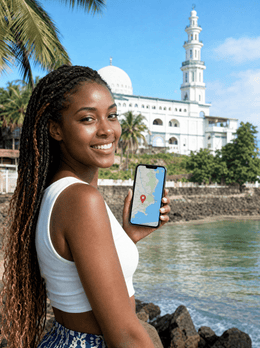
What does that mean in practice? That the European "roam like at home" regulation applies, the same one that lets you use your data in Italy or Germany without extra cost. Mayotte is explicitly listed among the French territories in the European zone, alongside Guadeloupe, Martinique, French Guiana and Réunion. When you land at Dzaoudzi-Pamandzi, your phone connects to Orange, SFR or Only's network and you keep drawing from your local allowance.
It's a little-known and huge advantage: you're on an Indian Ocean island, more than 8,000 km from home, replying to messages with your neighborhood plan. That said, that "free" comes with conditions, and I'll go over them below.

The state of the network after Cyclone Chido
We need to talk about this honestly, because it's the biggest concern. On December 14, 2024, Cyclone Chido —the most violent in decades— devastated the island's infrastructure, and telecommunications took a brutal hit. In the following days, Orange operated with barely 13 to 16 of the island's 67 antennas, and population coverage was around 39% on December 19. Only reported around 40%, with ten of its 54 sites destroyed. The bottleneck wasn't just the downed antennas, but the electricity: without power, there's no network.
Recovery, however, was quick: on December 23, Orange reported 63% population coverage and on January 6, 2025, it announced 90%. SFR even used about twenty Starlink satellite links to reactivate isolated sites. Then came the reinforcement: in April 2025, Arcep allocated 3.4-3.8 GHz frequencies to Orange, SRR, and Telco OI for fifteen years, and that same month Orange turned on its 5G.
Translated for today's traveler: the mobile network is already operational in the areas you'll be visiting. Don't expect the density of mainland France, but you won't be arriving on an isolated island.
All options at a glance
Before we dive into details, here's the full picture. In Mayotte, there are four realistic ways to get connected, and since the starting point —your own plan working without extra charges— is so good, the balance tips differently than in other destinations. Look at the "Who it fits" column: the answer depends on your local plan, not the island.
| Option | Approximate price | Process | Who it fits |
|---|---|---|---|
| Your local plan (EU zone) | Free, included in your plan | None | Most people: plans with plenty of data |
| Accommodation Wi-Fi | Free | None | Nighttime backup, never outside the hotel |
| Local SIM (Orange, SFR, Only) | From ~€10-30 depending on package | Medium: ID in store | Long stays or high usage |
| Travel eSIM | From ~€10 for a few GB | None: QR and done | Short-term plans or non-EU residents |
As you can see, the first row is no longer the usual trap: here your own plan is a fully valid option and, for many, the winner. The local SIM and travel eSIM come into play when your data runs short or your carrier does weird things with overseas departments. A pocket router hardly makes sense on such a small island; if you still want to consider it, check out the comparison of eSIM vs. pocket Wi-Fi.
Your local plan: free, but with fine print
It's the star option in Mayotte, so it's worth understanding it well. With a local plan that includes the EU zone —the vast majority today— you'll keep using calls, SMS, and data at the same price as at home. No need to activate or install anything: your phone connects automatically to the local network. For one or two weeks of normal use, it's usually enough, and at zero cost.
Now, the three nuances you should check before flying:
- Fair use policy: carriers set a data cap linked to the price of your plan, so a cheap plan with lots of data may offer significantly less outside your home country.
- Permanent use: the rule is intended for travel, not for living abroad for months. If you stay for long weeks, your carrier may warn you.
- Carrier-specific zones: here's the real trap, and it especially affects Mayotte.
Some low-cost plans exclude overseas departments from their EU zone, or place them in a separate zone with surcharges. Check your carrier's terms by searching for "Mayotte" or "DOM" before assuming it's included.
The check takes two minutes in your carrier's app and saves you a scare. If you get confused with zones and per-megabyte prices, it helps to read how much international roaming costs.
When a travel data card is still worth it
Having European roaming included doesn't mean it's always the best option. There are four very clear profiles where a travel data card still makes sense in Mayotte, and it's worth checking if you're one of them.
- Your plan has limited data. You'll be using maps constantly here: the island is explored by car on narrow roads and poorly marked detours. If your plan comes with 5 or 10 GB and you already run through that at home, you'll run short.
- Your plan doesn't cover the overseas departments or you live outside the EU. If your plan excludes Mayotte from the European zone, or you live in Latin America or the UK, you're looking at expensive international rates.
- You want a real backup plan. With the network still stabilizing after the cyclone, having two profiles on your phone lets you switch carriers if one is weak in your area.
- You don't want to watch your data counter. A generous separate package gives you peace of mind and keeps your local plan untouched.
The beauty of the data card is that you buy it from home, install it with a QR code, and land with data without touching your physical SIM. If it's your first time, start with what is an eSIM and then follow the eSIM guide for Mayotte, with step-by-step setup.

Accommodation Wi-Fi and the newly arrived fiber
Hotels, guesthouses, and accommodations in Mayotte usually offer Wi-Fi, and the temptation is to think "I'll get by with that." It works as a backup, but building your trip around it is a mistake, and on this island more than others for a specific technical reason: the fixed network in Mayotte is still under construction.
Mayotte never had a copper network deployed evenly, and the cyclone irreversibly damaged part of what existed. Fiber is simply arriving now: the Mayotte Fibre project, awarded to Mayotte THD, started in May 2025, with the first connections in early 2026 and the goal of connecting more than 60,000 homes by 2030. As of April 1, 2026, fiber-to-the-home coverage was around 10%. In plain terms: many accommodations are still relying on limited connections or the mobile network itself.
Use the Wi-Fi for what it's good for: downloading offline maps of the island at night, backing up the day's photos, and streaming something without burning through your data. For everything else—getting around, browsing, booking a boat trip on the fly—you need your own connection. Here, Wi-Fi is a nice bonus, never the backbone of your trip.
Local Mayotte SIM: Orange, SFR, and Only
If you're staying long-term or have high data usage, a local SIM is a reasonable alternative. Three mobile networks operate in Mayotte: Orange Mayotte, SFR Mayotte (SRR), and Only (Telco OI). All three have stores in Mamoudzou and received fifteen-year licenses in April 2025 in the 3.4–3.8 GHz band to roll out 5G. Orange switched theirs on that same month; SFR activated five zones starting June 2025: Doujani, M'tsapéré, Majicavo, Bouyouni, and Combani.
Since it's French territory, activating a line means you'll need to identify yourself with a document—ID or passport—a more formal process than in other tropical destinations. A few things to keep in mind:
- Orange is the operator with the most extensive network on the island and the first to restore coverage after the cyclone.
- SFR and Only compete on price, with prepaid data packages starting at low figures.
- The options at Dzaoudzi-Pamandzi airport are limited; the norm is to buy once you're in Mamoudzou.
The catch isn't the price—it's the logistics: taking out your local SIM, inserting the new one, and losing your regular number unless you have Dual SIM. Since you already have European roaming included, a local SIM only makes sense for longer stays. I compare it in detail in eSIM vs. local SIM.
Local SIM vs. Digital eSIM, Side by Side
When your plan runs out and you need a data top-up, the real choice is between a local Mahoran SIM and a digital eSIM. Both use the same towers from Orange, SFR, or Only, so the signal you get is the same—what changes is convenience, paperwork, and whether you keep your number.
| Criteria | Local SIM (Orange / SFR / Only) | Travel eSIM |
|---|---|---|
| Estimated price | From ~10-30 € depending on the package | From ~10 €, depending on days and GB |
| Documents | ID card or passport at the store | None |
| Where to buy | Physical store in Mamoudzou, in person | Online, from home, before you fly |
| Time until you have data | Travel, queue, and activate | Minutes: scan the QR and you're done |
| Network used | Orange, SFR, or Only | The same local network |
| Your home number | You lose it with a single SIM slot | Stays active with Dual SIM |
| Switching carrier if it fails | You have to buy another card | You can carry a backup profile |
My take for Mayotte: if you're staying a month or using a ton of data, the local prepaid is worth it. But for the typical traveler—one or two weeks of lagoon, diving, and road trips—the digital eSIM wins on convenience: you install it at home, arrive with data, and keep your home number for bank SMS. No hassle after a long flight with a layover.
Coverage: Lagoon, Mont Choungui, and the Interior
Mayotte is small—two islands, Grande-Terre and Petite-Terre—but mountainous and very green, and that shapes where you get signal. The rule is simple: coverage is concentrated where people live. Mamoudzou and its area, Petite-Terre with Dzaoudzi and Pamandzi, and the larger towns work well, with solid 4G and 5G in several urban areas. The interior of Grande-Terre is another story.
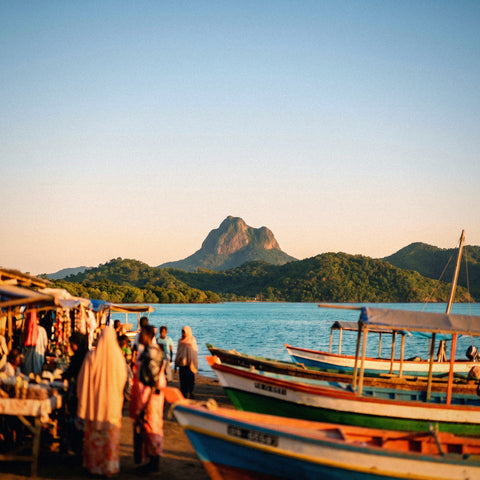
- The lagoon: one of the largest enclosed lagoons in the world, and the main reason to come. On boat trips to the coral reef, diving, or humpback whale watching between July and October, signal becomes intermittent as you move away from the coast.
- Mont Choungui: the climb is short but very steep, and from the top you get a 360° view of the island and the reef. Coverage is patchy on the ascent, somewhat better at the summit due to the altitude.
- Interior and south of Grande-Terre: between forests, ylang-ylang fields, and dirt roads, expect dead spots.
The golden rule for volcanic islands remains: download offline maps before you go, especially if you're driving in the south or hiking. No SIM gives signal where there's no tower. For daily life in Mamoudzou and Petite-Terre, coverage is more than sufficient.
How Much Data You Need in Mayotte
Before buying anything, calculate by day and by actual use—real consumption is almost always lower than you think. In Mayotte you'll mostly use data for maps and road navigation, messaging, some social media, and photos of the lagoon. It's not a remote work destination, so usage stays moderate. This table gives you a reference per activity and day.
| Daily Activity | Approximate Usage |
|---|---|
| WhatsApp and messaging | ~20-50 MB/day |
| Maps and car navigation | ~80-200 MB/day |
| Social media (scrolling and stories) | ~150-300 MB/day |
| Uploading photos and some videos | ~200-400 MB/day |
| Video call (30 min) | ~300-500 MB |
| Video streaming (1 hour) | ~1 GB |
Summing up an active tourist's usage, you're looking at about 500 MB to 1 GB per day. With that baseline, for a week of lagoon trips and excursions you'll do fine with 5 GB; for two weeks exploring Grande-Terre and Petite-Terre, a 10–15 GB plan will be plenty; and if you're working remotely or doing video calls daily, aim for 20 GB or more. A trick I always use: save heavy streaming and photo backups for the Wi-Fi at your accommodation. That way you stretch every gigabyte, whether you're using your local plan or a separate package.
Frequently Asked Questions
Do I get free EU roaming in Mayotte?
Yes. Mayotte has been a French department since 2011 and an outermost region of the European Union since 2014, so it falls under the "roam like at home" zone. If you have a plan that includes EU roaming, you use data, calls, and SMS at no extra charge, subject to fair use policy.
Is the network working well after Cyclone Chido?
Yes, in populated areas. After the cyclone in December 2024, Orange went from 39 % coverage in mid-December to 90 % in January 2025, and 5G was activated in 2025. Expect occasional outages, not a disconnected island.
Do I even need an eSIM for Mayotte?
Not always. If your plan has plenty of data, EU roaming is enough. It makes sense if your plan has limited data, if your carrier excludes overseas departments, if you live outside the EU, or if you want a backup profile in case one carrier falters.
Does my low‑cost plan include Mayotte in the EU zone?
Almost all do, but some low‑cost plans exclude overseas departments or put them in a separate zone with surcharges. Search for "Mayotte" or "DOM" in your carrier's terms before you fly.
Where can I buy a local SIM in Mayotte?
At Orange, SFR, or Only stores, especially in Mamoudzou; the selection at Dzaoudzi‑Pamandzi airport is limited. Since it's French territory, you'll need to show a form of ID, so bring your national ID card or passport.
Is there coverage on the lagoon and Mont Choungui?
Patchy. On boat trips across the lagoon, the signal drops as you move away from the coast, and on the climb up Mont Choungui there are stretches without coverage. Download offline maps before you go: no SIM card gives you a signal where there's no tower.
How many GB do I need for a week in Mayotte?
With active tourist use — driving maps, messaging, social media, and photos — you'll use about 500 MB to 1 GB per day. For one week, 5 GB works; for two weeks, 10–15 GB. If you're working remotely, go for 20 GB or more.
Is there fiber at accommodations in Mayotte?
Not much yet. Rollout began in 2025 and as of April 1, 2026 covered around 10 %, with a target of 60,000 homes by 2030. Many places rely on limited connections or simply the mobile network.
Conclusion
The great news about Mayotte is that you don't have to deal with international rates: because it's a French department and an outermost region of the EU, your plan travels with you at no extra charge, even though it's in the middle of the Mozambique Channel. For most people, that's enough and at zero cost. The second piece of honest news: the network took a heavy hit from Cyclone Chido and has been rebuilt quickly, but don't expect the density of mainland France or fiber at your accommodation. And the third: on the lagoon, inland, and climbing Choungui you'll lose signal, so always have maps downloaded in advance. Check before you fly whether your carrier includes Mayotte in the European zone; if it doesn't, or if your data allowance is low, take a look at the eSIM for Mayotte and compare it with your current roaming plan.