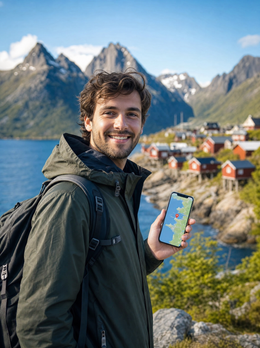
If you're planning your trip to the land of fjords, internet in Norway is one of those loose ends best tied up before leaving home. Connection is excellent in Oslo, Bergen, and cities, and surprisingly solid in many coastal towns, but as you head north towards the Arctic, cross mountain tunnels, or enter isolated fjords, the signal becomes fickle. In this guide, I'll compare all your options, without hype, so you can choose the one that truly suits your travel style.
Your connection options
In Norway, you have four ways to connect: roaming from your Spanish plan (included as Norway is in the EEA), accommodation Wi-Fi, a local Norwegian SIM, or a data eSIM. For most travelers, reasonable roaming or an eSIM are the most convenient options.
There's no single answer: the best alternative depends on your traveler profile, your current plan, and where you'll be traveling. Someone spending a weekend in Oslo doesn't need the same thing as someone driving up the coast to North Cape in a campervan. The first step is to be clear about the four options and what each offers in terms of coverage, price, and convenience; in such a long and mountainous country, in many sections, what you contract matters less than whether there's an antenna nearby. Here's an overview to help you decide:
| Option | Coverage | Estimated Cost | Ideal for |
|---|---|---|---|
| Roaming (Spanish plan) | The network of the associated Norwegian operator | Included in your plan, with data limit | Short stays and moderate consumption |
| Hotel and transport Wi-Fi | Only within the building or vehicle | Free | Uploading photos and planning at night |
| Local SIM | Excellent, especially with Telenor | €10-30 for 5-20 GB | Long stays and unlocked phone |
| Data eSIM | Network of the country's leading operator | From €5-15 for 5-10 GB | Convenience and immediate activation |
Roaming in Norway: Is it included?
Here's the honest part that almost no one explains well: Norway is not part of the European Union, but it is part of the European Economic Area (EEA) and is included in the European Roam Like At Home regulation. In practice, if you have a recent Spanish plan, your data and minutes work in Norway just like in the EU, at no extra cost. For many people, the short answer is that they already have internet included without doing anything.
But it's worth knowing the nuances. This measure has been in effect since 2017 and is extended until 2032, covering the 27 EU countries plus Iceland, Liechtenstein, and Norway. However, it is subject to a fair use policy: your operator may limit the data you use outside Spain, especially on unlimited or high-volume plans, and does not allow permanent use abroad (it's for travel, not for living abroad). Before you leave, check the fine print of your plan or consult my comparison of eSIM vs. roaming to see what your actual limit is. The quick conclusion: if your plan is modern, you're almost certainly covered; if not, keep reading.
When it pays to switch to an eSIM
If roaming is included, why bother complicating things? Because it's not always worth it, and there are very specific profiles for whom a data eSIM is clearly a better idea. It's worth identifying yourself in one of these categories before deciding:
- Older or low-cost plans that don't include EEA roaming or give you very few gigabytes outside Spain.
- Travelers from outside the EEA (e.g., with a UK, Latin American, or US line): the European regulations don't cover you, and roaming charges can be exorbitant.
- Heavy data users: if you're going to be using navigation, maps, and video all day, it's easy to hit your plan's fair use limit.
- Prepaid plans with few gigabytes, where every megabyte abroad is deducted too quickly.
An eSIM gives you a fixed data allowance, with no surprises on your bill and at a known price beforehand. If you want to see how high an incorrectly calculated bill can go, I break it down in how much international roaming costs. My simple rule is: if your plan is modern and you consume little, stick with your operator; otherwise, an independent data package will save you headaches on next month's bill. Norway, moreover, is expensive for almost everything, so having data costs fixed provides peace of mind.
Hotel, train, and ferry Wi-Fi
Almost all Norwegian hotels, cabins, and apartments offer free Wi-Fi, and in cities, it usually works wonderfully. It's perfect for the usual: uploading photos, making video calls at night, and downloading maps and series for the journey. Many trains (like the Bergensbanen or the famous Flåmsbana), several ferries, and a good portion of regional buses also have Wi-Fi on board.
The problem is evident: that network stays where it is. On a trip where you spend the day between viewpoints, waterfalls, and mountain roads, relying only on Wi-Fi means being disconnected for most daylight hours. And precisely when you need it most—for GPS or to check a ferry schedule—you don't have it handy. Furthermore, transport Wi-Fi comes and goes depending on the coverage of the area the train or boat is passing through, so it's not reliable for anything critical. That's why I see it as a great complement, never your sole solution. If you're weighing this against a portable router and other alternatives, my guide on eSIM vs. pocket Wi-Fi can help. My advice: use Wi-Fi for heavy tasks at night and save your mobile data for the day's route.
Local Norwegian SIM: Telenor, Telia, and Ice
Norway has three main operators, and knowing them helps understand the country's coverage. Telenor is the historic operator and has the best coverage in rural areas, along the coast, in remote fjords, and in the Arctic north, including villages in Lofoten and the North Cape area; it's the safest bet if you're venturing away from cities. Telia is very close, usually a bit cheaper, and has a very solid urban network in Oslo, Bergen, Trondheim, Stavanger, and Tromsø. Ice is the budget operator: it has improved a lot, but outside urban centers, it relies on agreements with other networks, making it less reliable for a road trip.
You can buy a prepaid SIM card at operator stores, kiosks, and large supermarkets in cities. As a guide, Telenor offers packages starting from around 99 NOK (about €9) for 1-2 GB, and Telia has top-ups ranging from 3 GB for about 269 NOK up to 50 GB for 649 NOK. The downside: you need an unlocked phone, physically change the card (and keep yours safe), and sometimes register it with your passport. For a direct comparison with the digital alternative, see eSIM vs. local SIM. If you're staying for many weeks or want a Norwegian number, it makes sense; for a normal getaway, it's more cumbersome than other options.
eSIM for Norway: How it works
An eSIM is a digital SIM card that is already integrated into most modern mobile phones. Instead of searching for a store upon landing in Gardermoen or Flesland, you purchase the plan online, receive a QR code, scan it, and are connected in a matter of minutes. You can prepare everything from home and activate it just upon arrival. If this concept sounds foreign to you, start with my explanation of what an eSIM is and then come back here.
The great advantage for Norway is convenience without compromise: the eSIM connects to the network of a leading operator in the country, usually prioritizing the one with the best coverage, so you have coverage equivalent to a local SIM, but without changing cards or losing your Spanish number, which remains active to receive bank SMS or calls. Since it coexists with your main line, you can browse with the eSIM's data and keep your usual phone for anything necessary. You choose a data package according to your trip, you know what you're paying, and you don't depend on finding an open store. For many travelers, it's the sweet spot between price, coverage, and zero complications upon arrival.
Coverage by region: from Oslo to the fjords
Norwegian mobile coverage is among the best in Europe where people live, and weaker where no one lives. Oslo, Bergen, Trondheim, and Stavanger have plenty of signal, with 5G in wide areas and very fast 4G everywhere. The main towns in the major fjords—Flåm, Geiranger, Odda, Voss, Åndalsnes, or the areas around Sognefjord and Hardangerfjord—maintain good 4G coverage, sufficient for maps, messaging, and uploading photos without stress.
The nuance comes with geography. Norway is a country of mountains, tunnels, and deep valleys, which means the signal cuts out at times: in long tunnels, mountain roads, and some stretches between towns. These are temporary cuts that quickly recover when you get to open country. On common tourist routes, you'll be fine almost always, but don't count on 100% continuous connection if you venture into the mountainous interior. Here's an indicative summary by region:
| Region | Mobile Coverage | Notes |
|---|---|---|
| Oslo, Bergen, Trondheim, Stavanger | Excellent, with 5G | No connection issues |
| Towns in the major fjords | Good (4G) | Stable coverage in population centers |
| Mountain roads and tunnels | Irregular | Intermittent cuts that recover |
| Lofoten and Vesterålen | Good in towns, irregular outside | Better with Telenor |
| Finnmark and North Cape | Variable, with gaps | Don't rely 100% on your mobile |
Lofoten, North Cape, and the Arctic
If your trip takes you north, this is the section that matters most. In the Lofoten Islands, the most visited fishing villages—Svolvær, Henningsvær, Reine, or Å—have reasonable coverage, especially with the widest-reaching network, and you'll be able to share your photos almost daily. But between villages, on secluded beaches, mountain viewpoints, and secondary roads, the signal becomes fickle and there are stretches with no signal at all.
Further north, in Finnmark and on the way to North Cape (Nordkapp), the reality is that of a huge Arctic region with very sparse population: coverage exists in population centers and on the main road, but there are long gaps. Neither the best eSIM nor the best local SIM can work magic: if there's no antenna, there's no internet, full stop. This is the geography of the Arctic, not a defect that can be fixed by contracting a better plan. Therefore, if you're going to these areas, travel prepared.
Tip for the north: download offline maps of your route before leaving the last big town, ensure your battery is fully charged, and note down 112. In Finnmark, you can go for a long time without coverage, and an offline map can get you out of more than one tight spot.
No type of connection frees you from this, so the key is not just what you contract, but planning your route and having downloaded maps for isolated sections.
How much data do I really need?
The million-dollar question. The good news is that on a trip to Norway, your main consumption is usually navigation, and maps use less data than you think: Google Maps consumes around 50-100 MB per hour. What significantly increases data usage are social media, video streaming, and tethering to other devices. For a trip of 7 to 10 days, here are my recommendations based on how you use your phone:
| Profile | Typical Usage | Data for 7-10 days |
|---|---|---|
| Light User | Maps, WhatsApp, and some social media | 3-5 GB |
| Medium User | Daily navigation, photos, and some video | 5-10 GB |
| Heavy User | Streaming, tethering, and remote work | 10-20 GB or unlimited |
For most travelers, a data package of 5-10 GB is the sweet spot: it covers navigation, messaging, and a few daily photos without running out or overpaying. If you're going to share your connection with a partner or family from a single device, or you upload videos daily, step up to a larger package. And remember: since part of the trip will be without coverage or with Wi-Fi at your accommodation, many days you'll use less than you imagine. Downloading music, series, and maps over hotel Wi-Fi significantly extends your data.
How to decide based on your trip type
With all the above, the decision becomes quite simple if you consider the nature of your trip. For a city break to Oslo or Bergen with a modern Spanish plan, your EEA roaming is more than enough: you don't need to buy anything. For a road trip through the fjords with high map and photo usage, or if your plan is limited, an eSIM gives you flexibility and a fixed price. And if you're traveling from outside the EEA, an eSIM stops being an option and becomes almost a necessity.
My way of summarizing it, so you don't overthink it, is this:
- Modern Spanish plan + few days in the city: use your roaming, don't complicate things.
- Old plan, prepaid, or high consumption: eSIM with a 5-10 GB package.
- Long trip or Norwegian number: consider a local Telenor SIM.
- Line from outside Europe: eSIM no matter what, activated before flying.
Whatever your case, the overarching recommendation is the same: have your connection sorted before landing and download offline maps for mountainous and northern areas. With that covered, you can enjoy Norway without thinking about coverage, which is precisely the point.
Frequently Asked Questions
Do I have roaming in Norway with my Spanish plan?
Yes. Although Norway is not in the European Union, it is part of the EEA and Roam Like At Home applies, so your data works as in the EU, at no extra cost. Be aware of older plans and the fair use policy, which may limit your data.
Is Norway in the European Union or just the EEA?
Only in the EEA. Norway is not a member of the EU, but it is part of the European Economic Area, and therefore European roaming applies without surcharges until 2032. For your mobile, it works just like an EU country.
Which Norwegian operator has the best coverage?
Telenor has the best coverage in rural areas, remote fjords, and the Arctic north, including the Lofoten and North Cape areas. Telia is very close and excels in cities. A good eSIM usually relies on the country's widest-reaching network.
How many GB do I need for a week in Norway?
For normal use for one week, between 5 and 10 GB is the most balanced. For light use (maps and messaging), 3-5 GB is enough; if you're streaming or sharing your connection, aim for 10-20 GB or an unlimited plan.
Is there coverage in the fjords and at North Cape?
Yes, in the fjord villages and on the main road to North Cape, with stable 4G. But in tunnels, mountain roads, and isolated sections of the Arctic, there are cuts and gaps. Travel with offline maps downloaded for those areas.
Is a local SIM worth it or is an eSIM better?
A local SIM is worthwhile if you're staying for many weeks or want a Norwegian number for calls. For normal getaways and road trips, an eSIM usually wins: coverage from the leading operator, without changing cards, and without losing your Spanish number.
Can I make calls and use WhatsApp with a data eSIM?
WhatsApp, Telegram, and video calls work perfectly because they use data. For normal phone calls, you keep your Spanish line active in parallel, so you continue to receive SMS and calls as usual while browsing with the eSIM's data.
Conclusion
Solving the internet issue in Norway is simpler than it seems if you understand the rules of the game. Since the country is in the EEA, many Spanish plans already cover you without extra charges; if yours is old, you consume a lot, or you're traveling from outside Europe, a data pack gives you peace of mind and a fixed price. Hotel and transport Wi-Fi helps, but isn't enough, and a local SIM only pays off for long stays. And most importantly: in tunnels, mountains, and the Arctic, there will be stretches without coverage for anyone, so travel with downloaded maps.
If you want to refine your choice for this destination, I've included my specific eSIM guide for Norway, and once you've decided, you can have everything ready from home with PuraSIM's Norway eSIM and land already connected. Have a good trip.