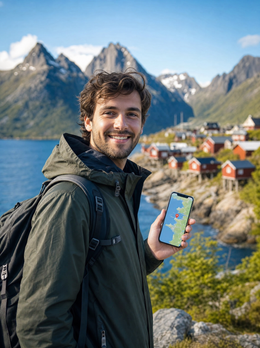
Norway is one of those destinations that leaves you speechless. The fjords that seem straight out of a painting, the northern lights dancing in the Arctic sky, the colorful houses in Bergen, the imposing glaciers... every corner is a living postcard. But let's be honest: to enjoy all of this to the fullest, you need to stay connected.
Whether it's to use Google Maps while navigating the scenic roads, share those incredible photos of Preikestolen in real-time, check ferry schedules, or simply let loved ones know you're okay while chasing the Northern Lights in Tromsø, reliable internet is not a luxury, it's a necessity. And this is where an eSIM makes all the difference.
In this guide, I'm going to tell you everything you need to know to stay connected in Norway without complications or exorbitant costs. From how much data you actually need to how coverage works in the most remote fjords. Let's get down to business.

Why you need an eSIM in Norway
First things first: why bother with an eSIM when you could simply activate your operator's roaming? The answer is simple: money and peace of mind. Latin American and Spanish operators charge roaming fees in Norway that can ruin your travel budget. We're talking between 10 and 25 dollars a day, just for mobile data.
With an eSIM, you pay a fixed rate for your entire trip. No surprises on your bill, no ridiculous daily limits. You buy your data package, activate it, and you're good to go. In Norway, where everything is already expensive (a coffee can easily cost you 5 euros), saving on connectivity allows you to spend that money on truly worthwhile experiences.
Furthermore, Norway is a country where being connected is not optional. Distances are vast, many attractions are in remote locations, and public transport, while excellent, requires planning. You need to be able to check train schedules, book ferries, find restaurants that fit your budget, and above all, use real-time maps. Road signs are good, but when you're in the middle of a fjord looking for the perfect viewpoint, Google Maps is your best friend.
An eSIM also gives you flexibility. You arrive at Oslo airport, turn on your phone, and you already have internet. You don't need to look for physical SIM card stores (which in Norway are usually only in large cities), you don't waste time in queues, and you don't have to deal with language barriers. Everything is set up before you take off from home. For a country where every hour of daylight counts (especially if you travel in winter), this convenience is invaluable.
And there's another important point: Norway is not in the European Union, although it is part of the European Economic Area. If you are Spanish and think your European roaming covers you, technically it does, but many operators have specific limits for Norway, Switzerland, and Iceland. An eSIM eliminates all that confusion and guarantees connectivity without asterisks in the contract.
Coverage and operators in Norway
Norway has one of the best telecommunications infrastructures in the world. The main operators are Telenor (the national giant), Telia, and Ice, and between the three, they cover practically the entire country with 4G networks. In major cities like Oslo, Bergen, Trondheim, and Stavanger, 5G coverage is already a reality, although for tourist purposes, 4G is more than sufficient.
When you contract an eSIM for Norway, you generally connect to the Telenor or Telia network, which have the best national coverage. Telenor, in particular, has invested heavily in covering rural and tourist areas because they understand that tourism is vital for the Norwegian economy. This means that even in places that seem like the end of the world, like the western fjords or the Lofoten Islands, you will have a decent signal.
Let's talk about the fjords specifically, because I know it's a common concern. Cruises through the fjords (like the famous Flåm route or the Geirangerfjord) have surprisingly good coverage. Operators have strategically installed antennas in the mountains surrounding the main fjords, so while sailing, you can make video calls, upload photos, and use the internet without a problem. Of course, in the narrowest and deepest sections, the signal may momentarily weaken, but it recovers quickly.
In Tromsø, the Arctic capital and starting point for viewing the Northern Lights, 4G coverage is excellent both in the city and its surroundings. Organized Northern Lights excursions usually go to places with good signal, so you can share those magical photos in real-time. If you venture on your own to very remote areas of the Arctic, there may be areas without coverage, but they are the exception rather than the rule.
Bergen, the second-largest city and gateway to the fjords, has perfect 4G coverage throughout the city and its surroundings. The same applies to popular tourist routes like the Atlantic Road or the path to Preikestolen. Norwegians are very aware that tourists need to be connected, so they have prioritized infrastructure in these areas.
An important tip: if you're going hiking in mountains or very remote areas, download offline maps beforehand. Although coverage is good, in deep valleys or mountainous areas far from tourist routes, the signal can be intermittent. But for 95% of tourist experiences in Norway, you'll have reliable internet.

How many GB you need for your trip
This is the million-dollar question, and the answer depends on how you use your phone. But based on the experience of thousands of travelers, for a typical 10-day trip to Norway, between 6 and 8 GB is the sweet spot. I'll explain why.
Google Maps and navigation apps are your biggest data consumers in Norway. If you're renting a car (which is the best way to explore the country), you'll be using maps constantly. Google Maps consumes approximately 5-10 MB per hour of active navigation. If you estimate 3-4 hours of daily navigation for 10 days, we're talking about 200-400 MB just for maps. It's not much, but it adds up.
Social media is the second major consumer. Uploading high-quality photos to Instagram or Facebook can consume between 2-5 MB per photo. If you upload 10 photos a day (and believe me, in Norway you'll want to upload more), that's another 50 MB daily, about 500 MB in total. Instagram stories and short videos consume more: a 30-second video can easily be 15-20 MB.
WhatsApp and video calls also count. A 10-minute video call consumes around 30-40 MB. If you make a daily video call to show your family those incredible landscapes, that's another 300-400 MB in total. Text messages and audio are practically irrelevant in terms of consumption.
General searches, checking schedules, booking restaurants, reading travel blogs, checking the weather: all this adds up. Estimate about 100-200 MB daily for general internet use. In 10 days, that's an additional 1-2 GB.
Summing it all up: maps (400 MB) + social media (500 MB) + video calls (400 MB) + general use (2 GB) = approximately 3.3 GB as a basic minimum. But this is being conservative. In reality, you always use more than you plan. That's why we recommend 6-8 GB: it gives you room for unforeseen circumstances, for that day you upload a video of the fjord, or for when you discover a Spotify playlist you need to listen to while driving along the Atlantic Road.
If you're someone who streams music or video, or if you work remotely during the trip, consider 10-15 GB. Netflix and Spotify streaming consume data at industrial speeds: one hour of Netflix in standard quality is about 700 MB, and in HD it can reach 3 GB per hour. If you plan to work with Zoom video calls or upload heavy content to the cloud, it's better to go straight for a 15-20 GB plan.
A trick I always recommend: activate your phone's data counter from day 1. This way you can monitor your actual consumption and adjust your habits if you see that you're going over. Most eSIMs allow you to top up data if you run short, but it's cheaper to buy the right package from the start.
Step-by-step activation and setup
Activating your eSIM for Norway is easier than it seems, even if you've never used one before. The entire process takes about 5-10 minutes, and you can do it from the comfort of your home before traveling. I'll guide you step by step.
First, make sure your phone is eSIM compatible. Most iPhones from XR onwards are, as are Samsung Galaxy S20 or later, Google Pixel 3 and above, and many recent Huawei, Xiaomi, and Motorola models. In your phone's settings, look for "Add cellular plan" or "eSIM": if the option appears, you're ready. If you're not sure, check with your manufacturer.
Once you purchase your eSIM plan from PuraSim, you'll receive an email with a QR code and detailed instructions. Here's the important part: you can install the eSIM profile before traveling, but it won't activate until you arrive in Norway. This is perfect because it avoids the stress of setting everything up at the airport with travel fatigue.
To install the eSIM on an iPhone: go to Settings > Cellular > Add Cellular Plan. Scan the QR code you received by email. The phone will download the eSIM profile and ask you to label it (name it something like "Norway" to easily identify it). Make sure to keep your physical SIM active as your primary line for calls and messages, and configure the eSIM for data only. This allows you to receive important calls on your usual number without paying roaming for data.
For Android, the process is similar but varies slightly by brand. On Samsung: Settings > Connections > SIM card manager > Add mobile data plan. On Google Pixel: Settings > Network & internet > Add > Download a SIM. Scan the QR and follow the on-screen instructions. The phone will ask you which SIM you want to use for data: select the Norway eSIM.
A crucial step that many forget: disable data roaming on your physical SIM. Go to your primary line's settings and make sure "Data Roaming" is off. This prevents accidental charges from your usual operator. Leave voice roaming on if you want to receive calls (though you'll be charged for receiving them), or better yet, use WhatsApp to communicate.
When you arrive in Norway, simply turn on your phone and activate mobile data on the eSIM. Within 1-2 minutes, you should see the signal bars with the name of the Norwegian operator (usually Telenor or Telia). If it doesn't connect automatically, go to Settings > Cellular > Options > Data Network and manually select the operator. In 99% of cases, the connection is automatic.
One last tip: do a quick test at the airport before leaving. Open the browser, search for something on Google, send a message via WhatsApp. Confirming that everything works gives you peace of mind for the rest of the trip. If there are any problems, Oslo Airport has free WiFi where you can contact your eSIM provider's support.
Traditional roaming vs. eSIM: cost comparison
Now comes the part where the difference in your pocket really shows. Let's compare what it would cost you to use your usual operator's roaming versus contracting an eSIM for a 10-day trip to Norway. The numbers are revealing.
If you're from Mexico, operators like Telcel charge approximately 12-15 USD per day for roaming in Norway. For 10 days, we're talking about 120-150 USD. Movistar Mexico has similar plans, around 10-12 USD daily. AT&T Mexico offers roaming packages that cost around 100-130 USD for 10 days. And this is only for limited data, generally 1-2 GB daily with reduced speed after a certain limit.
From Argentina, operators like Personal and Movistar charge between 8-12 USD per day in Norway. Claro Argentina has similar rates. In 10 days, that's easily 80-120 USD. And beware: these prices are usually for very limited data packages, sometimes only 500 MB or 1 GB per day, which is insufficient if you use maps intensively.
For travelers from Colombia, Claro and Movistar charge around 10-15 USD daily for roaming in Norway. Tigo has similar rates. We're talking about 100-150 USD for your entire trip, with strict data limits and reduced speeds once you exceed them.
From Spain, although Norway is technically covered by some European roaming policies, operators like Movistar, Vodafone, and Orange have special conditions. Many plans include roaming in Norway but with lower data limits than in the EU, or charge supplements of 3-6 euros per day. For 10 days, that's an additional 30-60 euros (35-70 USD).
Now let's compare with an eSIM. A typical 8 GB plan for 10 days in Norway costs between 30-45 USD with PuraSim. That's it. No daily limits, no reduced speeds, no asterisks. A full 8 GB that you use however you want during your 10 days. The savings are brutal: between 50 and 120 USD depending on your country of origin.
But beyond the money, there's peace of mind. With traditional roaming, you're always worried about how much you've consumed, if you've exceeded the daily limit, if you'll be charged extra. With an eSIM, you buy your package and forget about it. You use your data freely without the paranoia of receiving a 300 USD bill when you get home.
Furthermore, roaming packages often have slower speeds or prioritize local traffic over roaming. With an eSIM, you connect directly to the Norwegian network like a local user, with the same full 4G speeds that Norwegians have. The difference in user experience is notable, especially when you're trying to load Google Maps in the middle of a mountain road.

Frequently asked questions
How many GB do I need for a 10-day trip to Norway?
For a 10-day trip to Norway, we recommend between 6 and 8 GB. This allows you to use offline maps, share photos on social media, make occasional video calls, and search for tourist information without worrying. If you plan to upload many videos or stream, consider 10 GB or more. Typical consumption includes GPS navigation (300-400 MB), social media (500-700 MB), video calls (300-400 MB), and general internet use (2-3 GB). It's better to have a safety margin than to run out of data in the middle of a fjord.
Does the eSIM work on cruises through the Norwegian fjords?
Yes, cruises through the Norwegian fjords have decent coverage. Local operators like Telenor and Telia have strategically installed antennas in the mountains surrounding the main fjords, so you will have 4G signal on most popular tourist routes like Geirangerfjord, Sognefjord, and the Flåm route. In the deepest and narrowest sections, there may be moments with intermittent signal, but it usually recovers quickly. Organized excursions know the areas with the best coverage.
Can I activate my eSIM before arriving in Norway?
Yes, you can and should install the eSIM profile before traveling while connected to Wi-Fi at home. However, activation and data consumption will only begin when you arrive in Norway and turn on the eSIM's mobile data. This is ideal because it saves you the stress of setting everything up at the airport. Simply scan the QR code you receive by email, install the profile, and when you land in Oslo or Bergen, activate data, and you'll be connected in minutes. We recommend doing this 1-2 days before your flight to resolve any questions in advance.
Is there good 4G coverage in Tromsø to see the Northern Lights?
Yes, Tromsø has excellent 4G coverage both in the city and in the surrounding areas where Northern Lights excursions are organized. Norwegian operators have prioritized infrastructure in this key Arctic tourist area. Popular aurora hunting routes maintain a good signal, allowing you to share photos and videos in real-time. If you decide to venture on your own to very remote Arctic areas, there might be areas without coverage, but these are exceptions. Most tourist experiences have reliable connectivity.
Is it cheaper to use an eSIM than my operator's roaming?
Definitely yes. Roaming in Norway from Latin America can cost between 10 and 25 USD per day, which adds up to 100-250 USD for a 10-day trip. From Spain, although there is European roaming coverage, many operators charge surcharges of 3-6 euros daily for Norway.