In short: the eSIM is a chip integrated into the phone, not a removable card: it activates with a QR code in seconds, stores several profiles at once, and frees you from airport queues. The physical SIM wins in universal compatibility and in countries with restrictions. The eSIM vs. physical SIM comparison depends on your mobile phone and your destination.
When someone tells you "install an eSIM," you might wonder: what's the exact difference from the usual SIM? The answer goes beyond the physical, and understanding it can save you time, money, and headaches on your next trips.
What is a physical SIM?
The physical SIM (Subscriber Identity Module) is the small plastic card with a gold chip that you've had in your phone for decades. It comes in three standard formats — Standard, Micro, and Nano — although the Nano SIM is virtually universal today. It stores your network user identity: a unique number (IMSI), your phone number, and your contract permissions with the operator.
To change operators, plans, or numbers, you have to physically change the card. To travel with cheap local data, you buy a local SIM at your destination. Simple, but with obvious limitations.
What is an eSIM?
The eSIM (embedded SIM or eUICC — embedded Universal Integrated Circuit Card) is functionally the same as a physical SIM, but integrated directly into the phone's motherboard during manufacturing. It is not a removable card: it is a chip soldered inside the device.
The key difference is that the eSIM is wirelessly reprogrammable. Instead of changing a physical card, you download a digital "profile" from an operator — in seconds, from your mobile phone — and that profile connects you to their network. You can store multiple profiles (up to 5-8 depending on the device) and switch between them in settings.
Apple massively introduced it with the iPhone XS (2018). Since 2022, all iPhones for the American market are eSIM-only (without a physical slot). In Spain and Europe, current phones have dual SIM: one physical slot + eSIM.
If you want to understand in more detail what is behind the digital profile that is downloaded —and why it is not the same as a "virtual SIM" in the app sense—, you have the complete explanation in what a virtual eSIM is and how it works.
Technical Differences: eSIM vs Physical SIM
| Feature | Physical SIM | eSIM |
|---|---|---|
| Format | Removable card (nano, micro, standard) | Soldered chip, not removable |
| Activation | Physically insert the card | Scan QR or install digitally |
| Operator change | Change the physical card | Download new profile in seconds |
| Simultaneous profiles | 1 per slot | Up to 5-8 stored profiles |
| Water resistance | The slot is a water entry point | No slot — better waterproofing |
| Theft/loss | Can be extracted and used in another mobile | Not removable — linked to the device |
| Compatibility | Universal (all mobiles) | Requires compatible device (most post-2020) |
| International travel | Buy local SIM at destination | Activate eSIM from home, without moving |
| Dual SIM | Some mobiles have 2 slots | Physical SIM + eSIM simultaneously |
Advantages of eSIM over physical SIM
1. Installation from home, no waiting at the airport
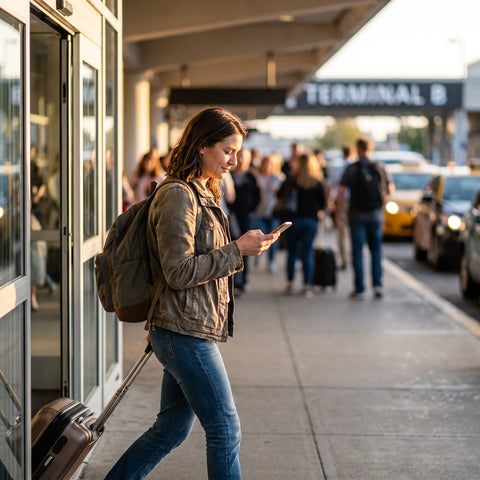
The classic scene of a traveler looking for a SIM kiosk at the destination airport, jet-lagged and with luggage in hand, is no longer necessary. With a PuraSIM eSIM, you install the plan from your couch before you leave: scan the QR code in the confirmation email, confirm the installation, and you're done. Upon landing, you activate data and you already have a connection. If you prefer a step-by-step guide with all the menus according to your mobile model, here is the guide on how to install an eSIM.
2. No risk of losing the original SIM
One of the biggest fears when traveling with a local SIM: losing the tiny card, damaging it, or confusing it. With eSIM, your Spanish SIM stays in its slot the entire trip. There's nothing to extract or store.
3. Native Dual SIM — two active lines at once
With simultaneous eSIM + physical SIM, you can keep your Spanish number active for calls and SMS, while using the cheap data from the travel eSIM. You configure which line uses data in Settings → Mobile Data, and the phone does the rest automatically.
4. More security against theft
If your phone is stolen with a physical SIM, the thief can extract it and use it in another device, charging international calls to your account. The eSIM is linked to the specific device and is not physically accessible, which adds a layer of protection. And if what concerns you is the privacy of your data when connecting to unknown networks in another country, it is also worth reviewing eSIM, VPN and privacy when traveling.
5. Better phone design and waterproofing
Eliminating the physical slot allows manufacturers to have a more compact design and better water resistance. This is especially relevant if you're going to the beach, doing water activities, or traveling to humid climates.
6. Instant switching between operators
If you have several profiles saved — for example, your Spanish rate, a plan for Mexico, and another for the United States — switching between them is a matter of seconds in the settings. Without opening the SIM tray, without toothpicks, without the risk of losing the card.
Advantages of physical SIM over eSIM
Honesty matters: the physical SIM still has its advantages in some scenarios.
1. Universal compatibility
Any mobile, even the oldest or very low-end ones, has a physical SIM slot. eSIM requires a compatible device — most post-2020, but not all.
2. Easy transfer between phones
If you change phones or need to lend your phone, moving the physical SIM is instantaneous. Transferring an eSIM profile to a new device is possible but requires a process (especially on iPhone).
3. No internet connection needed for activation
Inserting a physical SIM does not require internet. Activating an eSIM requires a WiFi connection to download the profile. In situations where WiFi is not available, a physical SIM is more convenient.
4. Better portability between countries with restrictions
In some countries (mainly China, India), eSIM regulations are stricter or more limited. Local physical SIMs may be easier to obtain in those markets.
When to use eSIM and when to use physical SIM for travel?
Use travel eSIM when:
- Your mobile is compatible (iPhone XS+, Samsung S20+, Pixel 4+, among many others)
- You want a fixed and predictable price without bill surprises
- You prefer to activate from home without relying on airport kiosks
- You travel to multiple countries on the same trip (regional plan)
- You don't want to remove your Spanish SIM from the phone
Consider a local physical SIM when:
- Your mobile is not eSIM compatible
- You are going to countries with limited eSIM or no coverage (China, parts of Africa or Central Asia)
- The destination offers very cheap physical SIMs with local data (Thailand, Japan, etc.) — although it's worth comparing carefully: in international chip vs eSIM you have the breakdown of when each option pays off
- The trip is very long and you want the cheapest possible long-term plan
Some concrete examples: if your next trip covers several countries in the European Union, the eSIM for Europe covers the entire itinerary with a single plan, without having to buy a new card at each border. For the United States, where many local operators require a contract or deposit, the eSIM for the United States avoids that hassle. And if you simply need more data within Spain without leaving the country — for example, if your rate falls short for a specific month —, there is also the eSIM for Spain.
Which phones are eSIM compatible?
The list of compatible devices grows every year. These are the main devices with eSIM support:
Apple iPhone
- Compatible: iPhone XS, XS Max, XR (2018) and all subsequent models
- eSIM-only (no physical slot): iPhone 14, 15, 16 and later in the US market
- In Spain: all have physical SIM + eSIM
Samsung Galaxy
- Compatible: Galaxy S20 and above, Note 20+, Z Fold / Z Flip series
- Mid-range: A54, A55 and higher models of the A series
Google Pixel
- Compatible: Pixel 3 and above
Other manufacturers
- Motorola Edge, Razr (recent series)
- Xiaomi 12S Ultra, 13 Pro, 14 series (export models)
- Oppo Find N3
To check if your mobile is compatible: on iPhone go to Settings → General → About → eSIM Information. On Android, search for "eSIM" in the phone settings.
How to install a travel eSIM?
The process is simpler than it seems:
- Buy the eSIM plan on PuraSIM for your destination
- Receive an email with a QR code
- On the phone: Settings → Mobile Data → Add Data Plan (iPhone) or Virtual SIM (Android)
- Scan the QR with the rear camera
- Confirm the installation — the profile downloads in 30-60 seconds
- Upon arrival at the destination, activate data on the eSIM line from Settings
The QR can only be used once and on a single device. Save it until you install it.
Myths and common mistakes about eSIM (what almost no one tells you)
After explaining the theory, it's time to debunk some ideas circulating in traveler forums that generate unnecessary doubts before packing your bags.
"eSIM consumes more battery than physical SIM"
This is not directly true. Consumption depends on network search, not SIM type: if your travel eSIM works with a weak signal or your mobile constantly switches towers —something typical in rural or border areas—, it will consume more battery searching for coverage, exactly the same as a physical SIM would in the same situation. In cities with good coverage, the difference is practically nil.
"If I install a new eSIM, the one I already had will be deleted"
This is one of the most common fears and, simply put, it doesn't happen this way on most current devices: you can store several profiles —usually up to 5-8, depending on the model— and only one is "active" for data at any given moment. Installing the PuraSIM profile for your next destination does not affect your Spanish line or any other profile you already had saved. The only things that disappear are plans that expire or that you manually delete from Settings.
"With eSIM, I won't receive bank verification SMS"
Here's the nuance many people overlook: for calls and SMS, your Spanish line needs to remain active in dual SIM mode, with data turned off on it to avoid accidental roaming. Your bank's SMS will continue to arrive on your usual physical line; the travel eSIM only handles data. If you completely deactivate your Spanish SIM —for example, to save battery— then you will stop receiving those codes, but that's your decision, not an eSIM limitation.
"As soon as I activate data, I have the best available network"
Not always. In some countries, the phone defaults to connecting to the first network it detects, which may not be the best coverage for roaming data. If you notice slow speeds upon landing, go to Settings → Mobile data → Network and check if there is a manual operator selection: switching to the network with the best agreement for your eSIM can significantly improve the connection, especially in mountain or coastal areas far from large cities.
Hidden gem: install the QR before leaving home, not at the airport
Your eSIM QR code can only be used once and requires a WiFi connection to complete. Many travelers leave it until the last minute and find the airport WiFi saturated or down. Install the profile —which is not the same as activating it— calmly at home, with good WiFi, one or two days before flying. Then, leave the line deactivated until you land: this way you don't waste extra data or risk a plan with limited validity expiring.
When NOT to buy a travel eSIM
It's worth saying frankly: if you're going to spend a short weekend in a country where your Spanish rate already includes roaming at no extra cost —a good part of the European Union, for example—, you don't need anything additional: your own line already covers you. And if you know that at your destination you'll be on hotel WiFi almost all the time and barely use data on the street, a small plan will probably be more worthwhile than a large one. Adjusting consumption well has more leeway than it seems: in how to save data with an eSIM on a trip you have specific tricks to stretch any plan.
Frequently asked questions: eSIM vs physical SIM
Can I have my Spanish number and the travel eSIM active at the same time?
Yes, that's exactly Dual SIM mode. Your Spanish SIM receives calls and SMS. The travel eSIM is used for data. To configure which one uses data: Settings → Mobile Data → select the eSIM line.
Can an eSIM be transferred to another phone?
On recent iPhones (iOS 16+), yes, using the "Transfer eSIM" feature. On other devices, the process varies; you generally need to contact the operator to make the transfer.
Does the eSIM stop working if the phone breaks?
If the device is irreparable, you should contact PuraSIM to see reinstallation options. Prepaid travel plans are generally not reinstallable for security reasons. That's why we recommend installing the eSIM just before the trip, not weeks in advance.
Can I use eSIM on iPad, Apple Watch or laptop?
Some iPads, Apple Watch Series 3+, and certain laptops (Surface Pro, some Lenovo) support eSIM. PuraSIM plans are for smartphones, but eSIM technology exists in multiple device categories.
Does eSIM provide the same speed and coverage as a physical SIM?
Yes: once installed, the eSIM connects to the same mobile networks in the country that any physical SIM would use, with the same speed and coverage. The connection technology (4G, 5G) depends on the local operator's network and your mobile, not the card format. The difference between eSIM and physical SIM is in how the service is activated, not in how the signal travels.
What happens if I run out of eSIM data in the middle of a trip?
It depends on the plan you purchased: some allow you to top up additional data from the PuraSIM app or account without reinstalling anything, while others require you to purchase a new plan. Before leaving, check how many GB your plan includes and calculate your usual consumption (maps, messaging, some photos) so you don't run short at a point in the trip without nearby WiFi.
Can I use the same eSIM in several countries on the same trip?
Yes, as long as you buy a regional plan designed for that — for example, one that covers several European countries instead of just one. If your route crosses borders in a few days, buying a plan per country is usually more expensive and slower to manage than a regional one; it's worth checking how many destinations are included in the same plan before booking.
Conclusion: eSIM or physical SIM for travel
For the modern traveler with a compatible smartphone (most since 2020), the eSIM is clearly superior for international travel: fixed price, remote installation, dual active line, and no risk of losing the card.
The physical SIM remains relevant for older devices, certain countries with restrictions, or situations where maximum compatibility is needed. But if your phone supports it, the eSIM is simply the smartest way to have data abroad.
Want to see the available plans for your next destination? Check all PuraSIM eSIM plans.