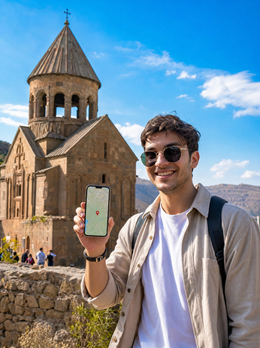
In short: an eSIM for Armenia gives you internet as soon as you land in Zvartnots, without queues to buy a local SIM or the expensive roaming charges outside the European Union. Coverage is solid in Yerevan and on main roads, but drops in mountain gorges like the Tatev canyon. For a one or two-week trip, 5 to 10 GB is usually enough.
Is an eSIM worth it in Armenia?
Armenia is a surprising destination: monasteries perched on mountains, a vibrant Yerevan with terraces and street art, and hospitality you feel from the first taxi. But it is also a country outside the European Union, so your Spanish "EU roaming" plan won't work here. As soon as your phone connects to an Armenian network, your operator switches to an out-of-Europe rate, which usually soars far above what you pay at home. Before looking at specific prices, it's worth understanding exactly what data roaming is and why it varies so much by country.
An Armenia eSIM is, simply, a digital profile that replaces the physical card: it's installed by scanning a QR code and gives you mobile data as soon as you activate the line, without opening your phone's tray or touching your usual SIM. If you've never used one and want to understand the difference from a physical card, here's what a virtual eSIM is explained without jargon.
The classic alternative is to buy a local SIM in Yerevan, but that means queuing, showing your passport, and being without data for the first few hours, right when you need it most to order a taxi on the right app or open the map on your way to the hotel. An eSIM eliminates that gap: you install it at home with your living room Wi-Fi and land with data already working. If you want the full argument for saving over traditional roaming, it's detailed in our comparison of eSIM vs. roaming.
That said, there's one case where it's NOT worth buying anything: if your stopover in Armenia is just a few hours at Zvartnots airport on your way to another destination, the free terminal Wi-Fi is more than enough. Save your money for when you're actually out on the street.

Real coverage: Yerevan, the Caucasus, and the monasteries
Armenia has better coverage than many people imagine before going. In Yerevan and medium-sized cities, 4G is more than sufficient, and there are even stretches of 5G in areas of the capital. Things change as soon as you enter the mountains, which is precisely where most tourists who leave the capital for more than a day go.
- Yerevan and surroundings (Cascade, Republic Square, GUM market): excellent signal, no interruptions, ideal for browsing, video calls, or ordering a Yandex Go from any corner.
- Routes to monasteries (Geghard, Khor Virap, Tatev): there is coverage in villages and on the main road, but it can drop completely in gorges and ravines. The Tatev cable car, one of the longest suspended sections in the world, crosses a spectacular canyon where the signal disappears; don't count on uploading anything live during the journey.
- Lake Sevan, Dilijan, and the north: good coverage in tourist centers and in the town of Dilijan, more irregular as you move away towards forests and remote monasteries like Haghartsin.
- Gyumri and Vanadzor: normal urban coverage, no surprises, similar to Yerevan although with less 5G.
For the rest of the tourist route, an eSIM that relies on the best available network will keep you connected almost the entire way. Even so, download offline maps before entering the more secluded mountain routes: in Armenia there are sections where even the best eSIM in the world has nothing to connect to because there simply isn't an antenna nearby.
Local operators versus a travel eSIM
Several national mobile networks operate in Armenia with a strong urban presence. Buying their prepaid SIM is a legitimate option and, per GB, is usually cheaper than any international plan. But for a short stay, a travel eSIM almost always wins in terms of time and convenience, because you don't depend on finding the right store or on the clerk speaking English. Here's an honest comparison:
| Option | Advantage | Disadvantage |
|---|---|---|
| Local Armenian SIM | Very low rates per GB | Queue, passport, no data on landing, have to remove your usual SIM |
| Spanish roaming | No changes needed, zero configuration | Very expensive outside the EU; cost skyrockets compared to your usual plan |
| Travel eSIM | Instant data from the moment you land, no paperwork, fixed price in advance | Requires an eSIM-compatible phone |
If your trip is one or two weeks long, the time saved by using an eSIM more than compensates for what you would save by going to find a local physical SIM. And since you keep your Spanish number on your main line, you still receive your usual SMS (bank codes, courier notifications) while browsing with the eSIM's data. If you're still debating between carrying a physical chip from another country or doing everything with a digital profile, this comparison of international chip vs. eSIM clarifies the doubt with specific cases. This convenience, without having to struggle with the language in a store, is exactly what you need for a short stay.

How many GB to take depending on your route
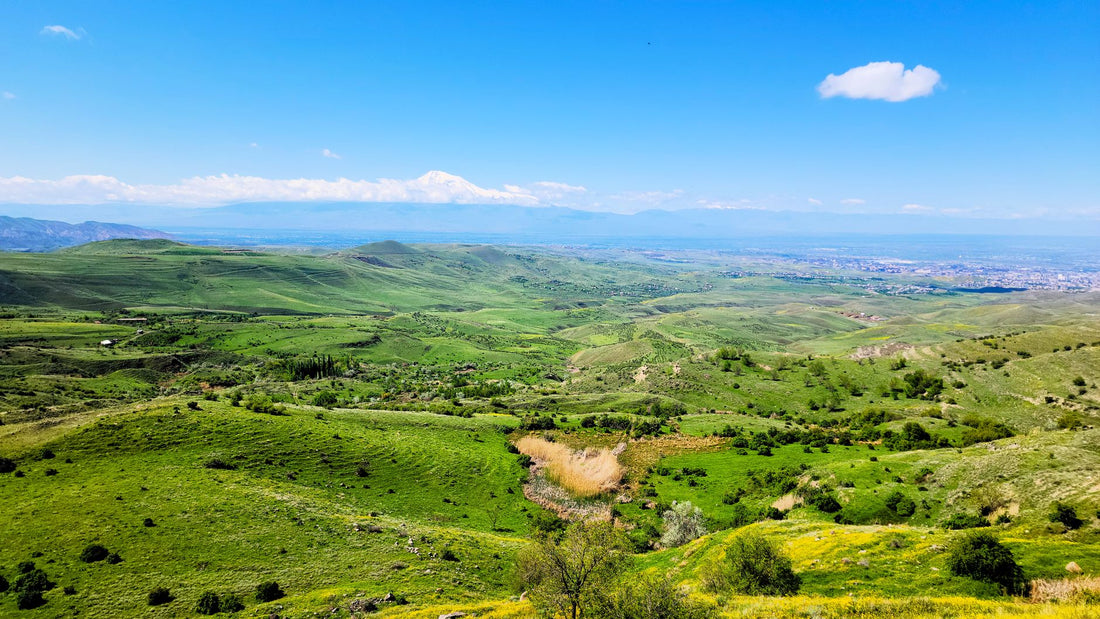
Armenia can be explored in a few days, so you don't need huge plans unless you do a lot of streaming. What consumes the most here are maps, because you'll rely heavily on navigation between monasteries with hardly any physical signs on secondary roads, and the photos and videos you upload of breathtaking landscapes, like Ararat peaking behind Khor Virap.
For a classic 5-7 day trip through Armenia, 3-5 GB is usually enough if you use hotel Wi-Fi for heavy tasks. If you do a lot of stories, video calls, or constant GPS navigation in a rental car, go up to 8-10 GB.
If you combine Armenia with Georgia on the same trip (a very common route through the Caucasus, crossing the Bagratashen or Sadakhlo border), consider a regional plan that covers both countries instead of two separate eSIMs. And if you want to stretch your GBs to the maximum without running out of data halfway through your trip, the guide to tips for saving data with an eSIM has settings that can be activated in two minutes and make a real difference, such as limiting background app refresh for apps you won't be checking.
Plans by days: which travel profile fits which
eSIM plans for Armenia are organized by GB and validity days. These are indicative profiles based on the type of trip, to give you a quick reference when choosing:
| Trip type | Days | Estimated GB | Typical usage |
|---|---|---|---|
| Yerevan getaway | 3-4 | 2-3 GB | Map, messaging, occasional social media |
| Monastery route | 6-8 | 4-6 GB | Constant GPS, photos and stories |
| Armenia + Caucasus (with Georgia) | 10-14 | 8-12 GB | Inter-country navigation, video, occasional streaming |
The price per GB of a travel eSIM is usually much more competitive than traditional roaming outside the EU, so you're unlikely to run out of budget just for data; always check the current price of the plan at the time of purchase, as it varies depending on the offer and the GB you choose. The best approach is to buy the exact plan for your days and, if you run short on the ground, top up instantly from the app itself.
How to activate your eSIM before flying to Armenia
The best thing about an eSIM is that you can get everything ready from home, without relying on airport Wi-Fi or finding coverage as soon as you get off the plane. First, check that your phone supports eSIM: recent iPhones and many mid-to-high-end Androids do, but be careful if your device is a version designed for the Chinese market, as some of those models come without the feature activated. If you have doubts, see how to check if your phone is compatible before buying anything.
- Choose the Armenia plan with the GB and days that fit your itinerary.
- Receive the eSIM by email instantly after completing payment.
- Install it with Wi-Fi at home, by scanning the QR code or with one-tap installation if your phone allows it.
- Leave the data line in airplane mode until landing and activate it when you arrive at Zvartnots: you'll be browsing in a matter of seconds.
If you've never installed an eSIM, the complete step-by-step guide is in how to install an eSIM, with screenshots of each step. With 24/7 Spanish support, you'll have help if the QR code is stubborn, although the normal process literally takes a couple of minutes.
Myths and what almost no one tells you
There are a few details about Armenia that don't appear in general guides and are worth knowing before blindly trusting public Wi-Fi:
- "Yerevan cafe Wi-Fi is always available": not always. Many establishments ask for an Armenian mobile number to send you the password via SMS, something that, as a tourist with only your Spanish line, you cannot receive. With your own data on the eSIM, it doesn't matter: you order your coffee and browse without relying on anyone.
- "Roaming will be fine": technically yes, but you'll be looking at your phone with fear throughout the trip because of what's accumulating on your bill. An eSIM with a fixed price removes that feeling; you know exactly how much you'll pay before leaving home.
- "All of Armenia has the same coverage": no. Areas near the border with Azerbaijan and the Nagorno-Karabakh region have access restrictions and a changing situation; these are not common tourist areas and it is advisable to check official sources before going there, not just rely on whether there is a signal or not.
- "If I run out of GB, that's it, it's over": not necessarily. Most travel eSIMs can be topped up from the app at any time, so if you miscalculate, you don't have to find a physical store to stay connected.
- A truly practical detail: if you use banking or payment applications while traveling, keep in mind that connecting to public Wi-Fi networks to manage money is riskier than doing so with your own mobile data. If you also want an extra layer of privacy on networks you don't control, this guide on eSIM, VPN, and privacy on travel explains when it's worth it and when it's unnecessary.
Frequently asked questions
Does eSIM work throughout Armenia?
In Yerevan, medium-sized cities, and on main roads, coverage is good, with plenty of 4G. In mountain gorges, the Tatev canyon, and very remote areas in the north, the signal may drop, so download offline maps for those specific sections before leaving the city.
Is an eSIM better or should I buy a local SIM in Yerevan?
For a short stay, the eSIM wins: you have data on landing, you don't queue with your passport, and you don't touch your usual card. A local SIM is slightly cheaper per GB, but you lose time and are left without a connection for the first few hours, which are usually the most necessary for orientation.
How many GB do I need for a week in Armenia?
With 3-5 GB you'll be fine for a week-long monastery route if you use Wi-Fi at your accommodation for heavy tasks. If you make a lot of stories, video calls, or rely heavily on GPS navigation in a car, plan for 8-10 GB to be comfortable without checking your data usage.
Does the eSIM also work for Georgia if I combine the two countries?
An Armenia-only eSIM covers Armenia. If you're doing the classic Caucasus route with Georgia, look for a regional plan that includes both countries; it's much more practical than carrying two separate eSIMs and having to switch profiles when crossing the border.
Do I keep my Spanish number with the eSIM?
Yes. The data eSIM coexists with your primary physical SIM, so you continue to receive calls and SMS on your usual number (from the bank, for example) while browsing with data from the Armenia eSIM.
Do I need Wi-Fi to activate the eSIM when I arrive in Armenia?
No, and in fact, it's better that you don't need it: you install the profile with Wi-Fi at home before flying, and you only have to activate the data line upon landing. This way, you avoid relying on airport Wi-Fi, which can be slow during peak flight times.
What happens if I run out of GB halfway through my trip?
You can top up from the app itself at any time, without needing to find a physical store or reinstall anything. This is one of the reasons why it's advisable to buy a plan that fits your route rather than oversizing it from the start.
Conclusion
Armenia is much more enjoyable with data in your pocket: for the map between monasteries, for translating at a stall in Yerevan's GUM market, or for uploading that photo of Tatev with the canyon in the background. An eSIM gives you that connection without expensive roaming or queues in stores, and with a fixed price in advance so there are no surprises on your bill. Get your Armenia eSIM ready before you fly and focus on the trip, not on finding a signal.