Greece is one of those bucket-list destinations: ancient ruins under the Mediterranean sun, white houses with blue domes in Santorini, epic sunsets in Oia, and crystal-clear beaches in Mykonos. But amidst all that beauty, there's something super practical you need to sort out before you board your flight: how you're going to stay connected.
If you're someone who needs to share every sunset on Instagram, search for the best restaurant on Google Maps, or simply stay in touch with your family, connectivity in Greece is essential. And this is where an eSIM becomes your best ally. No need to look for SIM card stores upon arrival, no dealing with language barriers or wasting valuable vacation time.
In this guide, I'm going to tell you everything you need to know about using an eSIM in Greece: from how much data you actually need, to how coverage works when you hop from island to island. Because yes, those ferries between Santorini and Mykonos have their signal peculiarities, and it's better to know that beforehand.

Why use an eSIM in Greece
Let's get straight to the point: using an eSIM in Greece is the smartest way to stay connected during your trip. Forget about the days when you had to land in Athens, search for a Vodafone or Cosmote store at the airport, queue, try to explain yourself in English, and wait for them to activate a physical card. With an eSIM, you arrive at Eleftherios Venizelos airport and your phone already has internet.
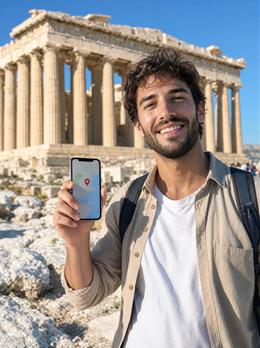
The biggest advantage is convenience. You buy your eSIM online before you travel, install it on your phone while you're at home having coffee, and when you land in Greece, you simply activate the profile. In less than two minutes, you're sharing your first photo of the Parthenon. There are no physical cards to lose, no need to carry a paper clip to open the SIM tray, and best of all: your WhatsApp number keeps working normally.
Another important point is the cost. International roaming from Latin American and Spanish operators in Greece can be very expensive. We're talking about 10-15 euros per day in many cases, which for a 10-day trip translates to 100-150 euros just for connectivity. A 10 GB eSIM for 15 days costs around 25-35 euros. Do the math: it's literally a fraction of the price.
Plus, with an eSIM, you have total control of your data. You know exactly how many GB you have, how much you've consumed, and there are no surprises on your phone bill when you return home. Many travelers have had the unpleasant experience of coming back from vacation and finding roaming charges of several hundred euros. With a prepaid eSIM, that simply can't happen.
And if you travel to several islands, as most do in Greece, the eSIM gives you flexibility. You can be in Athens on Monday, Santorini on Wednesday, and Mykonos on Friday, and your connection works the same everywhere without having to do anything. The network automatically connects to the best available operator, and you just worry about deciding whether you prefer gyros or souvlaki for lunch.
Coverage and operators in Greece
Greece has a fairly solid telecommunications infrastructure, especially in the tourist areas you're likely to visit. The three main operators are Cosmote (the largest in the country), Vodafone, and Wind. When you buy an eSIM for Greece, your device will automatically connect to the network of one of these operators, usually the one with the best signal in your location.
In Athens, coverage is excellent practically throughout the city. From the Parthenon to Plaka, from Monastiraki to Piraeus port, you'll have constant 4G/LTE signal. The same applies to the main tourist islands: Santorini, Mykonos, Crete, Rhodes, and Corfu have excellent coverage in all populated and tourist areas. You can be in Oia watching the sunset or on a beach in Mykonos, and your Instagram will upload stories without a problem.
However, there are some particularities you should be aware of. Mountainous or very remote areas on some islands may have limited coverage. If you plan to hike in inland Crete or visit very remote villages on less touristy islands, the signal may be intermittent. But honestly, 95% of travelers stay in tourist areas where coverage is perfect.
The issue of ferries deserves a separate paragraph because it's super important. When you travel between islands by ferry, mobile coverage is irregular and generally weak. During the first and last minutes of the journey, when you're close to the coast, you'll have a signal. But in the middle of the Aegean Sea, between Santorini and Mykonos for example, the connection will be practically non-existent. That's why it's essential to download offline maps of each island before boarding.
My practical recommendation: before getting on the ferry, download the offline map of your next destination on Google Maps, save your hotel addresses in favorites, and if you have restaurant or tour reservations, take screenshots of the details. Ferry trips can last between 2 and 5 hours depending on the islands, and it's better to be prepared than to spend that time unable to check anything.
As for speeds, Greece has good 4G/LTE infrastructure in tourist areas, with average download speeds of 20-40 Mbps, more than enough for any normal use: social media, video calls, music streaming, and web browsing. Some areas of Athens and the main islands already have 5G coverage, although it's not something you specifically need for a tourist trip.

How many GB you need for your trip
This is probably the question I get asked the most: how many GB do I really need for my trip to Greece? The answer depends on your travel style, but I'll give you concrete references based on actual usage patterns so you can decide with clear information.
For a typical 10-day trip to Greece visiting Athens and a couple of islands, the standard recommendation is 8-10 GB. This covers you if you're a moderate user: you use Google Maps to get around, upload photos and stories to Instagram, check emails, look for restaurants on TripAdvisor, and make an occasional video call to your family. With 10 GB and conscious use, you'll perfectly reach the end of your trip.
Let's break down average consumption to give you an idea: Google Maps consumes approximately 5-10 MB per hour of active navigation (if you don't have offline maps). Instagram can consume between 50-100 MB per hour depending on how much you scroll and how many videos you watch. Uploading photos to social media consumes relatively little, about 3-5 MB per high-quality photo. A 30-minute WhatsApp video call consumes around 200-300 MB.
If you're an intensive social media user, upload a lot of videos to TikTok or Instagram Reels, make frequent video calls, or like to watch series on Netflix during ferry trips, consider upgrading to 15-20 GB. Yes, it's more expensive, but the peace of mind of not constantly checking how much data you have left is worth it. Nothing ruins a vacation more than running out of data halfway through the trip.
A tip to optimize your consumption: take advantage of the WiFi at your hotel, restaurants, and cafes. Greece has a lot of free WiFi in tourist areas. Use those moments to update apps, upload heavy photos to the cloud, or make long video calls. Save your mobile data for when you really need it: when you're walking around the city, exploring islands, or in situations where WiFi isn't available.
Another smart strategy is to download content before leaving the hotel. If you're going on a long ferry ride, download a few episodes of your favorite series or music on Spotify to listen offline. If you plan to use Google Maps a lot, download the maps of the cities and islands you'll be visiting. This can easily save you 1-2 GB during your trip.
For shorter trips, say 5-7 days, 5-7 GB should be fine. And if your trip is longer, 15 days or more exploring several islands, consider a 15-20 GB plan or one that allows you to recharge data if you run out. Flexibility is key, especially on long trips where plans can change.
Activating and configuring your eSIM
Activating your eSIM for Greece is a super simple process, but there are some specific steps you need to follow to ensure everything works perfectly from the moment you land. I'm going to explain the full process so you have no doubts.
First, and most importantly: install your eSIM before you travel, while you're still at home with stable WiFi. After purchasing your plan from PuraSim, you'll receive an email with a QR code and installation instructions. Go to Settings > Mobile Data > Add Data Plan on your iPhone, or Settings > Connections > SIM card manager > Add mobile plan on Android. Scan the QR code and follow the on-screen steps.
Once installed, you'll see your eSIM appear in your phone's settings, but it's not yet active. This is normal and correct. The eSIM will activate automatically when you arrive in Greece and your phone connects to the local network. In the meantime, you can continue using your normal SIM during the flight and until you land.
When you arrive at Athens airport (or the island where you land), turn on your phone and activate data roaming on your eSIM. This is crucial: many people forget to activate data roaming and then wonder why they don't have internet. Go to your eSIM settings specifically and make sure "Data Roaming" is enabled. In a few seconds, you'll see the Cosmote, Vodafone, or Wind signal appear at the top of your screen.
An important detail about dual SIM configuration: if you want to keep your main number active to receive calls or WhatsApp messages, configure your phone to use your original SIM for calls and messages, but the eSIM for data. This is done in Settings > Mobile Data > select your eSIM as the preferred line for mobile data. This way, you still receive everything on your usual number, but internet consumption goes through the eSIM.
If for some reason your eSIM doesn't connect automatically, there are some troubleshooting steps you can try: restart your phone, deactivate and reactivate airplane mode, or go to Settings > Mobile Data and manually select the network operator. In 99% of cases, the connection is automatic, but it's good to know what to do if something doesn't work as expected.
Regarding the APN (Access Point Name), modern eSIMs generally configure themselves automatically, but if you need to configure it manually, the details will arrive in the confirmation email. It's rare that you'll have to do this, but if you work in IT or are someone who likes to have everything under control, it's good to know.
Comparison: Roaming vs. eSIM
Let's talk about concrete numbers because this is where it becomes clear why an eSIM is the smartest option for your trip to Greece. I'm going to compare the real costs of roaming from Latin American and Spanish operators versus using an eSIM, and you'll see the abysmal difference.
If you're from Spain and have an operator like Movistar, Orange, or Vodafone, you technically have free roaming in Greece because it's within the European Union. Sounds great, right? The problem is that this "free" roaming comes with limits. Depending on your plan, you may have a GB limit you can use while roaming (for example, only 10 GB of your total 50 GB), and if you exceed it, you'll be charged approximately 0.20-0.30 euros per additional MB. This can get very expensive if you're not careful.
For Latin American travelers, the situation is clearer: roaming in Greece is simply expensive. Mexican operators like Telcel or AT&T Mexico charge around 10-12 dollars per day for their roaming service. Argentine operators like Personal or Claro charge between 8-15 dollars daily. Chilean, Colombian, and Peruvian operators have similar rates. For a 10-day trip, you're looking at 80-150 dollars just for roaming.
Now let's compare with an eSIM: a 10 GB plan valid for 15 days for Greece costs approximately 25-35 euros on PuraSim. Let's do the math: if you're Latin American and would pay 100 dollars for roaming, with an eSIM you pay 30 euros (about 33 dollars). You're literally saving 70 dollars. If you're Spanish and exceed your roaming limit, you also end up saving because you have dedicated data without worrying about hidden limits.
But beyond the money, there are other important advantages. With roaming, your speed can be limited or prioritized below local users, especially in areas with a lot of network congestion. With an eSIM, you connect like a local user, with the same priority and speeds as anyone with a Greek plan. This means better performance, especially in crowded tourist areas.
There's also the issue of expense control. With roaming, it's easy to lose track of how much you've consumed, especially if your operator doesn't have an app that shows your consumption in real-time. With a prepaid eSIM, you know exactly how many GB you have, how much you've used, and there's no way you'll get surprise charges when you get home. For many travelers, this peace of mind is priceless.

Frequently asked questions
How many GB do I need for a 10-day trip to Greece?
For a 10-day trip visiting Athens and the Greek islands, we recommend between 8-10 GB. This allows you to use maps, share photos on social media, make occasional video calls, and search for tourist information without worrying about running out of data. If you are an intensive social media user or plan to make many video calls, consider 15 GB for greater peace of mind.
Is there mobile coverage on ferries between Greek islands?
Coverage on ferries between islands is irregular and generally weak. You will have signal during the first and last minutes of the journey when you are close to the coast, but in the middle of the Aegean Sea, the connection will be practically non-existent. We recommend downloading offline maps of each island before boarding, saving important accommodation information, and planning your routes in advance so you don't rely on the internet during the crossing.
When should I activate my eSIM for Greece?
Ideally, you should install the eSIM profile before traveling using WiFi at home, but the actual activation (when data consumption begins) occurs when you arrive in Greece and your phone connects to the local network. Once in Greece, simply turn on your phone, enable data roaming on your eSIM, and in a few seconds, you'll be connected. There's no need to do anything complicated at the airport.
Does the eSIM work on all Greek islands?
eSIM works on major tourist islands like Santorini, Mykonos, Crete, Rhodes, and Corfu with excellent coverage in all populated and tourist areas. On smaller islands or remote mountainous areas, the signal may be limited, but 95% of the tourist destinations you visit will have perfect coverage. The main beaches, tourist towns, and urban areas of all popular islands have reliable 4G connectivity.
Is an eSIM better than my carrier's roaming?
An eSIM is significantly more economical than traditional roaming for Latin American travelers. While roaming can cost between 10-15 dollars per day (100-150 dollars for 10 days), a 10 GB eSIM for 15 days costs around 25-35 euros in total. For Spanish travelers with EU roaming, an eSIM offers an advantage if you travel frequently or if your plan has data limits on roaming, in addition to giving you total control without bill surprises.
Activate your eSIM before you leave and arrive connected from the very first moment. Share your Santorini sunsets without worrying about data.
View eSIM plans →