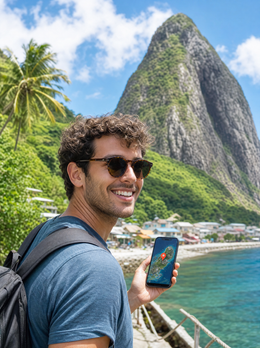
In short: an eSIM for Saint Vincent and the Grenadines gives you mobile data as soon as you land at Argyle airport, without having to look for SIM card stores or change chips. 4G coverage is good in Kingstown, Bequia, Mustique and Union Island, and drops during inter-island boat trips. It is installed before flying and activated upon arrival.
What is an eSIM and how does it work in Saint Vincent and the Grenadines?
You arrive in Kingstown, take your phone out of your pocket, and want to book the ferry to Bequia without paying a fortune for every megabyte. An eSIM for Saint Vincent and the Grenadines gives you data from the first minute, without having to look for card stores or change chips: it's a digital profile that you install by scanning a QR code and that connects to local networks exactly as a physical SIM would.
This Caribbean country consists of the main island of Saint Vincent and about thirty smaller islands spread to the south, the Grenadines, many of them tiny and with hardly any commerce. This is where the eSIM makes the biggest difference: you don't depend on finding a local store in an archipelago where several islands don't even have a single phone sales point. You buy before leaving home, install with the hotel's Wi-Fi or your own home, and when you get off the plane at Argyle airport, you just have to activate the data.
You need two things: your phone must support eSIM (most iPhones since the XS and a good portion of mid-to-high-end Android phones from recent years) and it must be unlocked from your original carrier. If you have doubts about whether your device is compatible, check your phone settings first before buying; almost all recent models are, but it's worth confirming calmly at home and not in the check-in line.
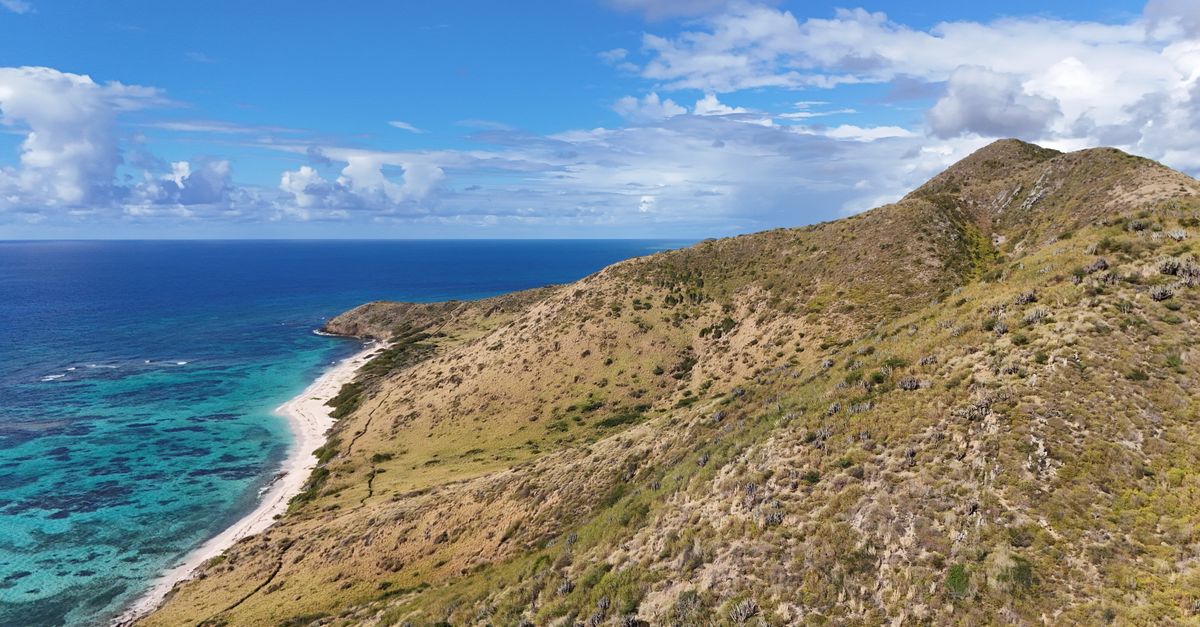
Real coverage by island: Kingstown, Bequia, Mustique, and Union Island
Mobile coverage is concentrated where people live and browse, not uniformly across the entire territory. On the island of Saint Vincent, including the capital Kingstown and its coastal strip, the 4G signal is stable in streets, the market, the cruise port, and at Argyle International Airport. This is where you'll spend most of your time if you combine city, Indian Bay beach, and an excursion to La Soufrière volcano, whose upper area, by the way, loses coverage as soon as you enter the forest path: if you're going up, download the map before leaving the hotel.
In the Grenadines, the story changes from island to island. Bequia, the largest and most touristy of the group, has good coverage in Port Elizabeth, the ferry dock, and Princess Margaret and Lower Bay beaches. Mustique, the private island of luxury villas, maintains 4G in the village and at the local airport, although many of the properties are in dense vegetation areas where the signal is weaker: if you're staying there, ask the villa staff about Wi-Fi before assuming you'll have constant mobile data. Union Island, the gateway to Tobago Cays Marine Park, has solid coverage in Clifton but loses it as soon as you set sail for the cays.
Practical tip: download offline Google Maps for Bequia, Mustique, and Union Island before boarding any ferry or sailboat. On inter-island trips, especially if you're sailing towards Tobago Cays or Canouan, you can spend an hour or more without a single bar of coverage, and arriving at an unknown cove without a loaded map is the typical setback that ruins the first afternoon.
If your Caribbean route doesn't end in Saint Vincent, keep in mind that the eSIM you buy here only covers this country: for other islands, you'll need to activate the corresponding profile for the destination you're in at any given moment.
Local operators: Flow and Digicel
The mobile market in Saint Vincent and the Grenadines is dominated by two operators: Flow, part of the Liberty Latin America group, and Digicel. Both offer 4G networks on the main islands and are the infrastructure supporting all tourist connectivity in the archipelago, both for travel eSIMs and local lines.
When you use a travel eSIM, you don't choose the operator: the profile automatically connects to the best available network in each area through roaming agreements with local operators, similar to what happens with traditional data roaming but without the added cost of roaming from your home company. This has a clear advantage over buying a physical SIM from a single operator upon arrival: if Flow doesn't cover a specific beach in Bequia well, your eSIM can rely on Digicel without you lifting a finger or having to do anything manually.
- Flow: strong presence in Kingstown and the urban core of Bequia.
- Digicel: good coverage in the smaller islands and more dispersed areas of the Grenadines.
- Travel eSIM: connects to the network with the best signal at each point, without you having to configure anything.
This avoids the classic problem of buying the "wrong" SIM at the airport and discovering, two days later on Union Island, that you barely have coverage.

How many GB you need according to your trip
It depends on how much you use your mobile and whether your accommodation has decent Wi-Fi, which is not always guaranteed in remote villas in Mustique or some guesthouses on Union Island. For a typical week-long trip through the Grenadines, with maps, WhatsApp, social media, and some online bookings, most travelers are comfortable with a few gigabytes per day. If you work remotely, make video calls, or upload a lot of photos and videos to social media, you'll need significantly more leeway.
| Traveler Profile | Travel Days | Typical Use | Estimated Data |
|---|---|---|---|
| Beach getaway (basic use) | 4-6 | Maps, messaging, occasional social media | Low |
| Active inter-island tourism | 7-10 | Offline maps, ferries, bookings, photos | Medium |
| Nomad / Remote work | 10-15 | Video calls, email, VPN, file uploads | High or unlimited |
| Island hopping by sailboat | 7-14 | GPS navigation, photos, video, weather | Medium-high |
If you run short, you can always top up without changing your eSIM or scanning any QR code again. The rule that works well in this archipelago: use the hotel or sailboat's Wi-Fi for large downloads and save mobile data for maps, messaging, and browsing while moving between islands. To make the most of every gigabyte without running out halfway through your trip, check out our tips for saving data while traveling.
How to activate your eSIM step-by-step
Activation is the easiest part of the whole trip and takes no more than a minute. Ideally, do it with Wi-Fi at home or at the hotel, before you need the data, so that everything is ready and you just have to activate it upon landing in Argyle.
- Purchase your eSIM and receive the QR code instantly by email.
- With Wi-Fi, go to Settings > Mobile Data > Add eSIM and scan the code.
- Label it (e.g., "Saint Vincent") to distinguish it from your main line.
- Upon arrival, activate the eSIM data and deactivate roaming on your Spanish line to avoid any accidental charges.
If it's your first time installing an eSIM, our general guide on how to install an eSIM resolves all doubts step-by-step. And remember: installing the profile does not consume data, only the connection when you are already at your destination, so you can do it days or even weeks in advance without any risk. Our support is available 24/7 in all languages by email and WhatsApp in case you get stuck at any step.
eSIM vs. your carrier's roaming
Outside the European Union, roaming from Spanish operators skyrockets. In Caribbean destinations like Saint Vincent and the Grenadines, where there are no flat-rate agreements like those within the EU, the cost per megabyte or per day can increase very quickly without you realizing it until the bill arrives. A travel eSIM eliminates that uncertainty: you contract a closed data plan before leaving and you know at all times what you have purchased, with no surprises when you return home.
That said, be honest with yourself about the itinerary: if your return layover includes two or three days in Barbados or another location where you already have coverage resolved, you don't need to activate anything new until you set foot in Saint Vincent. And if your flight has a long stopover in the United Kingdom or a European airport before continuing to the Caribbean, it may be more worthwhile to resolve that stopover with an eSIM for Europe than to force the same profile to cover two different regions.
If your route also includes a connection in the United States, which is common for flights to the Eastern Caribbean via Miami or New York, it's advisable to also separate that stopover with an eSIM for the United States instead of trying to make a single plan work for the entire trip. Each segment with its own coverage is cheaper and simpler to manage than forcing a single eSIM to cover countries it hasn't contracted.
To fully understand the fundamental difference between both models, read our comparison of eSIM versus roaming. For an archipelago that many travelers visit only once in a lifetime, having connectivity resolved before leaving home is the most convenient decision you can make.
Myths and what almost no one tells you
"With an eSIM, I don't need Wi-Fi anywhere." False, and this is the most common mistake that causes headaches in the Grenadines. On small islands and during sea voyages, mobile coverage simply doesn't reach: neither with an eSIM, nor with a physical SIM, nor with any operator in the world. Think of the eSIM as your on-land connection, and the accommodation's Wi-Fi as your safety net for important things: checking in for your return flight, uploading heavy photos, or making a long video call.
"All travel eSIMs are the same." They are not when it comes to something that matters here: the quality of the roaming agreement with Flow and Digicel. A poorly configured profile can get "stuck" to a single operator even if the other has a better signal at that moment; a well-managed one automatically switches between both networks. It's an invisible difference until you need it, usually at the worst possible moment, with your suitcase in hand and the ferry about to depart.
"A local physical SIM is always cheaper." Sometimes it is, but in an archipelago where several smaller islands don't even have a phone store, the theoretical savings vanish in time lost looking for where to buy it, waiting in line at the only point of sale in Kingstown, or simply being unable to find it in Mustique. If you're interested in comparing the two options thoroughly, we have a dedicated guide on international chip versus eSIM that goes into detail.
What almost no one tells you: if you plan to do banking or work on your phone during your trip, connecting to open Wi-Fi networks in bars or marinas in the Grenadines is more common than it should be, and not all of them are well protected. Using your eSIM data for those specific tasks, or adding an extra layer with a VPN, is safer than relying on the Wi-Fi of the first restaurant in front of Bequia's port. You can see how to set this up in our guide on eSIM, VPN, and privacy while traveling.
And one last detail that surprises those who don't expect it: in Mustique, an island of private villas and its own airport, the feeling of isolation is part of the appeal for many guests, so don't assume you'll have the same fluid coverage as in Kingstown just because there's 4G in the village. Ask before you arrive if your type of accommodation has its own Wi-Fi, because in several villas it's the only stable connection.
Frequently asked questions
Does an eSIM work in Saint Vincent and the Grenadines?
Yes, as long as your mobile is eSIM compatible and unlocked. It connects automatically to Flow and Digicel networks just like a physical SIM would, with the advantage that you don't need to find a local store to buy it.
Can I use the eSIM on all the Grenadine islands?
Yes, as long as there is mobile coverage. You will have a good signal in Kingstown, Bequia, Mustique village and Clifton in Union Island. During boat trips between islands and in very isolated coves, such as on the way to Tobago Cays, the signal may drop and will recover upon reaching each populated area.
What currency and operators are there in Saint Vincent and the Grenadines?
The currency is the Eastern Caribbean dollar (XCD). The main mobile operators are Flow and Digicel, both with 4G networks. With a travel eSIM, you don't need to choose between them: the profile automatically connects to the network with the best signal in each area.
When should I activate the eSIM?
Install it at home with Wi-Fi before flying, but don't activate it until you arrive in Saint Vincent. Installing the profile doesn't consume data; usage only begins when you turn on mobile data at your destination, so you use every gigabyte from Argyle airport.
Does the eSIM work for calls and WhatsApp?
The travel eSIM provides data, which is what you use for WhatsApp, video calls, maps, and messaging. You can continue receiving calls and SMS on your Spanish number if you keep your main line active without mobile data, to avoid roaming charges.
What happens if I run out of data halfway through my trip?
You can top up your plan without changing your eSIM or scanning any code again. The profile remains installed and you just add more data from the app or website. It's advisable to calculate well before leaving, but you always have room to extend if you run short.
Do I need a different eSIM if my flight has a layover in Europe or the United States?
If you are going to use data during a long layover in another country, it is advisable to have an eSIM for that segment, because the Saint Vincent and the Grenadines plan does not cover other destinations. For layovers in Europe or the United States, sort out that part of the trip separately before activating the Caribbean profile.
Conclusion
Saint Vincent and the Grenadines is one of those destinations where you don't want to waste time looking for SIM cards or dealing with surprise bills: you want to be on the ferry to Bequia or anchoring in Tobago Cays. With an eSIM, you arrive with internet resolved, stable coverage on the main islands, and a pre-contracted plan that frees you from uncontrolled roaming. Activate your eSIM for Saint Vincent and the Grenadines before you fly and forget about connectivity from minute one, to dedicate the rest of the trip to what really matters.