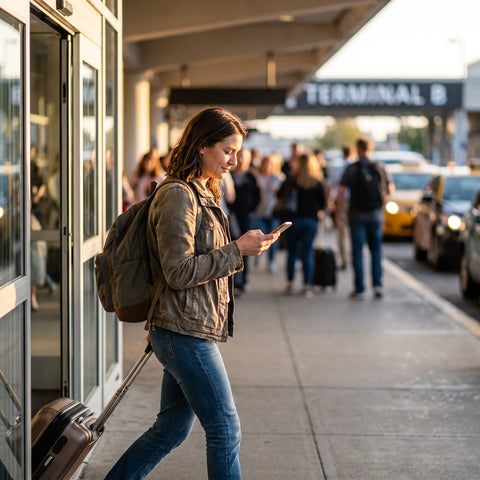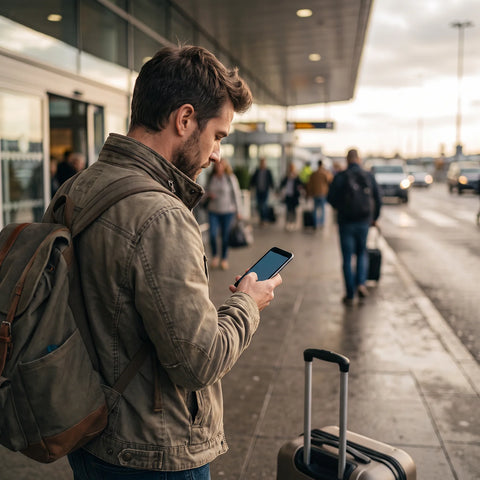
In short: an eSIM for Cape Town gives you mobile data as soon as you land at CPT airport, without expensive roaming or a physical SIM to search for. It is actually a complete South African eSIM, also valid in Stellenbosch, the Garden Route or a safari in Kruger, with solid coverage in the city and more irregular coverage on the road and in rural areas.
Cape Town is best explored with a mobile phone in hand: to call an Uber, check if the Table Mountain cable car is operating (it stops with strong winds, and in this city, wind is boss) or check on the spot if it's worth getting off at a certain stop. An eSIM gives you that connection from minute one, without relying on hotel Wi-Fi or finding a phone store. Here we get straight to the point: real coverage neighborhood by neighborhood, how many GB to take according to your route, when it's not worth spending an extra euro, and what things no one tells you until you're already there.
Is an eSIM worth it in Cape Town?
Yes, and for a very specific reason: South Africa is outside the European roaming zone. Using your Spanish line as is, without an international data plan, is one of the fastest ways to get an unpleasant surprise on your bill when you return. A fixed eSIM gives you a data package with a predetermined price, quality coverage in the city, and immediate connection when you get off the plane.
But here, connection isn't just convenience; it's travel logistics. In Cape Town, you'll almost always travel by Uber or Bolt—they're more reliable and safer than hailing a street taxi—you'll constantly check maps because the city unfolds into very distinct neighborhoods within minutes by car, and you'll want to share your real-time location with your travel companions, especially if you split up for a bit. All of this demands stable data, not intermittent café Wi-Fi. Compared to roaming, which for most operators skyrockets outside Europe, buying a data plan in advance locks in your expenses without surprises. If you're still weighing your options, this comparison of eSIM vs. roaming clarifies it with real-world examples, and if you first want to understand exactly what roaming is, you can find the explanation in what is data roaming.

Connection and security: why they go together here
Cape Town is one of the most beautiful cities you'll ever visit, with the sea on one side and the mountains on the other, but it's wise to move cautiously, as in any large city with stark contrasts between neighborhoods. Staying connected is one of the simplest security tools you have at hand, and an eSIM guarantees it without relying on the Wi-Fi of every place you enter.
With active data, you can request transportation with the app instead of looking for a taxi on the street, quickly check if it's convenient to get off at a stop or continue to the next, have the map ready so you don't get lost when night falls, and share your real-time location with your family or group. A detail that is appreciated: download the city map offline as a backup, because in some sections between neighborhoods the signal may cut out for a moment. And avoid conspicuously taking out your phone on the street, especially in busy downtown areas like Long Street; consult it discreetly, as you would in any large city.
A unique detail about South Africa that few guides mention: during scheduled power outages (what they call load shedding), some antennas run on backup batteries for a while, but during long outages, the signal can feel slower depending on the area and time of day. This is not cause for alarm, just so you're not surprised if the connection is worse one day for no apparent reason.
Traveler's tip: Save screenshots of your accommodation address and the places you plan to visit. If your battery dies or you lose signal for a moment, you'll always have the essentials handy without relying on a connection.
Real coverage: city center, coast, Table Mountain, and roads
Mobile coverage in Cape Town is good throughout the bulk of the city. In the CBD (city center), V&A Waterfront, Camps Bay, Sea Point, or Green Point, you'll have plenty of fast 4G for maps, social media, and video calls without interruption. In Bo-Kaap, with its narrow and colorful streets, the signal also comes in without a problem despite being a hilly neighborhood. On top of Table Mountain, there's usually coverage, as it's a popular spot with nearby antennas, though it can be a bit more strained when many people go up the cable car at once, on weekends, or at sunset.
Where expectations need to be adjusted is outside the urban core. On the Peninsula route towards Cape of Good Hope, coverage comes and goes: in Simon's Town or Muizenberg it works well, but in sections of coastal road — Chapman's Peak Drive is the classic example, with curves clinging to the cliff — there can be moments without signal. The same happens on the Garden Route to the east: good coverage in each town, weaker sections between them. Nothing dramatic if you know it beforehand; that's why we insist on having the map downloaded as a backup. For the city and its beaches, however, you'll have stable 4G almost all the time.

How many GB for your getaway
Data consumption primarily depends on how much video and social media you use, but for an urban getaway with hotel Wi-Fi support at night, you don't need a huge plan. This reference helps you choose without running out halfway through your trip or overpaying for gigabytes you won't use:
| Type of Use | Days of Travel | Approximate Data |
|---|---|---|
| Basic (maps, Uber, messaging) | 4-5 days | 2-4 GB |
| Medium (daily social media & photos) | 5-7 days | 4-6 GB |
| High (video, stories, no fixed Wi-Fi) | 7-10 days | 6-10 GB |
| Long route (Cape Town + Garden Route + safari) | 10-15 days | 10-15 GB |
Keep in mind that Uber, Bolt, and Google Maps use much less data than people think; what really drives consumption is video on social media and long video calls. If two people are traveling and want to use a single data line, activate the hotspot from the eSIM itself and add an extra margin to the plan to cover the consumption of the second phone. And if you want to adjust the calculation to your specific habits, it's worth having some tricks to save data while traveling handy, especially if you're also going to do the long route along the Garden Route.
It's a South African eSIM, not just for the city
A nuance that avoids confusion when purchasing: there is no exclusive plan for Cape Town, but rather a South African eSIM that works across the entire country's network, including the city. And that, far from being a limitation, works in your favor.
Most trips don't stay solely in Cape Town: they combine with the vineyards of Stellenbosch and Franschhoek less than an hour away, the Garden Route to the east for several days, or a safari in Kruger on the other side of the country. With a single South African data plan, you have coverage in all those destinations without changing eSIMs or contracting anything new halfway through your trip. If your itinerary continues to another African country — something increasingly common when combining South Africa with the Indian Ocean — we also have that stretch covered, for example in our guide to eSIM for Comoros.
A frequent question: if you are going to alternate between South Africa and another destination on the same trip, you don't need to use the same physical technology everywhere; the important thing is to understand well the difference between what is a virtual eSIM and a traditional physical SIM, because that determines if you can have several active lines on your mobile at the same time without touching trays or cards.
How to activate it upon landing at CPT airport
Cape Town International Airport (CPT) is about 20 km from the city center, so it's a good idea to have active data before getting into the car, to request transport and confirm the address without relying on airport Wi-Fi. The process is simple if you prepare it from home:
- Before flying, with Wi-Fi at home or at the departure airport, purchase and install the profile following the eSIM installation guide.
- Label the line "South Africa" to distinguish it from your Spanish line at a glance.
- Upon landing at CPT, turn off airplane mode and activate the eSIM data, not your usual line's data.
- Keep your Spanish number active only for bank SMS, with the data off on that line to avoid any accidental roaming charges.
- Check that the South African network appears in the status bar and order your Uber from the terminal itself.
If you've never used this technology, don't worry: it's simpler than it sounds and can be done in five minutes, sitting at the boarding gate, following the same steps in the installation guide mentioned above.
Myths and what almost no one tells you
With South Africa and eSIMs, quite a few half-truths circulate. These are the ones that cause the most confusion, and the ones that really need to be clear before traveling:
"I need my passport to register the line." This applies to local physical prepaid SIMs, subject to South African registration law (RICA), which requires showing identification at a store. With an eSIM purchased online, there's no such process: you buy, install, and activate upon landing, without queues or paperwork at the airport.
"If I have an eSIM, I no longer need a physical backup chip." You don't need to carry a backup chip, but it's important to understand the difference between both technologies before deciding; we explain it in detail in international chip vs. eSIM. Most recent mobile phones are compatible, but it's best to check before buying, not when you arrive at the airport.
"The more public Wi-Fi I use, the more I save." In Cape Town, public Wi-Fi is inconsistent and, in tourist areas, a common vector for scams or misconfigured networks. If you're concerned about privacy when connecting away from home, it's worth reading about eSIM, VPN, and privacy when traveling before trusting any café's Wi-Fi.
"Car guards" are not a scam, they are a real profession. In almost any street parking area in Cape Town, you'll find someone in a fluorescent vest who helps you park and watches your car in exchange for a few coins upon your return. This is a recognized local practice, not extortion; carrying some loose cash for this saves you silly friction.
When you DON'T need to buy anything. And here we have to be honest: if your stop in Cape Town is just a layover at the airport without leaving the city, you don't need an eSIM; the airport Wi-Fi is free and sufficient for basics. And if you're staying at an all-inclusive resort with no plans to explore independently or call an Uber, a couple of extra gigabytes is more than enough; don't buy a fifteen-day plan if your real plan is not to leave the sun lounger.
Frequently asked questions
Is it safe to move around Cape Town with a mobile phone in hand?
Yes, with common sense as in any large city. Use your phone discreetly on the street, travel by Uber or Bolt instead of hailing random taxis, and check the status of an area before getting out of the car if you don't know it. Being connected with an eSIM helps precisely with that: ordering transport on the spot and sharing your location with your travel companions.
Does the South African eSIM also work for the Garden Route and a safari?
Yes. It is not a plan exclusive to Cape Town, but to the entire country. The same eSIM gives you data in Stellenbosch, along the Garden Route, or in parks like Kruger, connecting to the available network in each area. In rural sections and cliff roads, coverage can be irregular, so always carry a downloaded map of the area as a backup.
Do Google Maps and Uber work well with the eSIM?
Yes, without a problem. With active data, both Google Maps and Uber or Bolt work normally throughout the city and consume much less than people think. For calls and messages, WhatsApp over data is the most practical option while the eSIM is active.
Do I need to show my passport to activate the eSIM?
No. That requirement is for local physical prepaid SIMs, subject to South African registration regulations. With an eSIM purchased online, there is no need to present a passport or register anything in a store: it is purchased, installed, and activated upon landing.
What if my phone is not compatible with eSIM?
Then you will need a local physical SIM or maintain your Spanish operator's roaming, which is usually much more expensive. Most mid-range and high-end mobile phones from recent years are compatible, but it is advisable to check this in the phone settings before buying the plan, not when you arrive at the airport without time to react.
How much does it cost more or less compared to my Spanish operator's roaming?
Significantly less in most cases, because South Africa is outside the European roaming zone and data rates outside Europe tend to skyrocket. An eSIM plan is purchased in advance with a fixed price from the start. To know the exact current cost, always check the current plan price on the product page before traveling.
Can I use the eSIM and my Spanish line at the same time?
Yes, that is one of the advantages of eSIM technology: you keep your Spanish line active to receive bank SMS or calls, with the data on that line turned off, while the South African eSIM handles all data traffic. This avoids any accidental roaming charges without missing anything important.
Conclusion
Cape Town is more enjoyable when you don't have to worry about connectivity: you order transportation with the app, consult the map without fear of getting lost, and share your location with your travel companions. An eSIM for Cape Town gives you data from the airport, reliable coverage in the city, and a fixed price without roaming scares. And remember the important nuance: the plan covers all of South Africa, not just the capital, so it also serves you if your route continues through Stellenbosch, the Garden Route, or a safari. Arrive connected and travel with more peace of mind from the first minute on the ground.