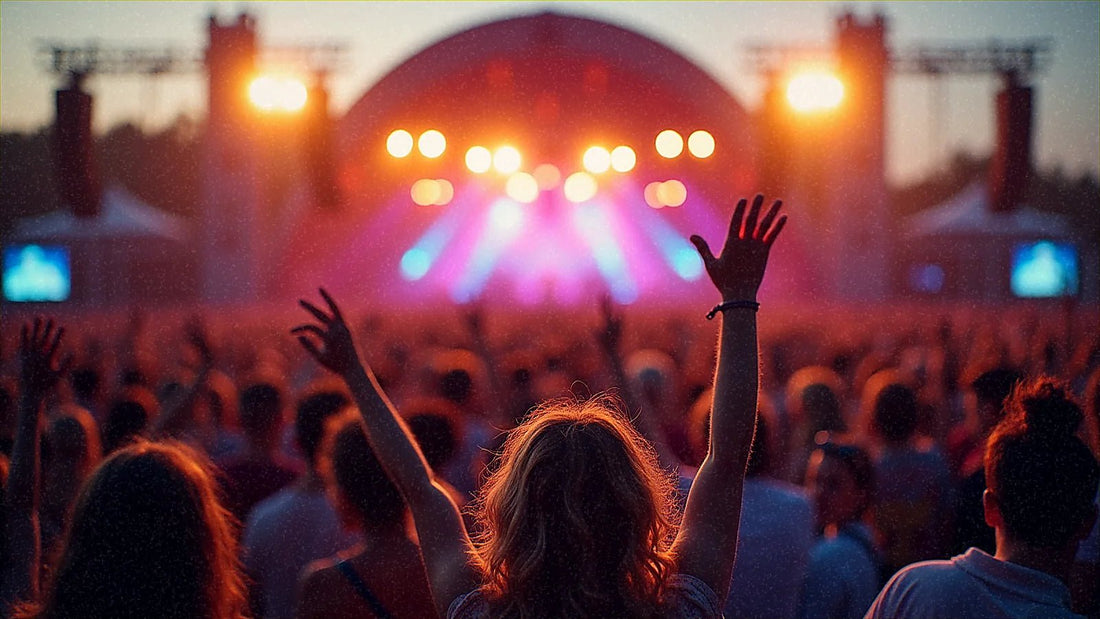
In short: for an international music festival, an eSIM gives you data as soon as you land, but it doesn't solve the real problem: network saturation when tens of thousands of people share the same antenna. The key is not just installing an eSIM for international music festivals, but combining it with offline maps, downloaded music, and low-traffic times to upload content.
Why a festival is the worst-case scenario for your mobile data
An international festival brings together two things that don't mix well: a lot of people in a small space, and a lot of people who want to upload videos at the same time. It's not the same as traveling to a city and spreading out data usage throughout the day as it is to put 60,000 people in a confined space, all recording the same chorus at the same minute. That peak of simultaneous use is what collapses the network, and it happens to a local operator just as it does to a foreign eSIM: the antenna has a physical limit of simultaneous users, and when that limit is exceeded, everything slows down for everyone.
Here's the real difference between having data and not having it at a festival outside of Spain: without an eSIM, you depend on the venue's Wi-Fi (if it exists, and if it works) or you're completely in the dark about the map, the band, and festival notifications. With an eSIM, you have data from minute one without having to look for a SIM card store when you arrive at the airport, but at the peak of the headliner, your speed can be as bad as anyone else's. The eSIM solves your basic connectivity — arriving, moving around, coordinating — but it doesn't guarantee you can upload a live story from the front row.
When to buy an eSIM for the festival — and when not to spend a single euro
This is where we have to be direct, because not all festivals need the same thing. If you're going to Mad Cool, Primavera Sound in Barcelona, or any festival within Spain, don't buy anything: your national plan already covers you, and adding an eSIM there is a waste of money. The criteria changes as soon as you cross a border.
- Festivals in the United Kingdom (Glastonbury, Reading, Boomtown): outside the EU for roaming purposes since 2021, so without a local plan, consumption skyrockets as soon as you open Instagram. Here, an eSIM Europe that includes the UK is advisable, or check if your operator still includes free EU roaming (fewer and fewer do).
- Festivals in continental Europe (Tomorrowland in Belgium, Sziget in Budapest, Exit in Serbia): within the EU, roaming is usually included in your Spanish plan at no extra cost, so before buying anything, check your operator's terms and conditions. If your plan doesn't cover it, or you're going outside the EU (Serbia, for example), then an eSIM Europe makes sense.
- Festivals in the United States (Ultra Music Festival in Miami, Coachella, Lollapalooza Chicago): here, roaming with a Spanish plan really takes off, there's no excuse. A US eSIM installed before you leave saves you the queue at the airport and the shock on your bill.
- Festivals in Asia or Latin America (Fuji Rock in Japan, Lollapalooza Argentina, Estéreo Picnic in Colombia): without a local plan here, there's no discussion possible; your Spanish operator's roaming for these destinations is usually very expensive or directly non-existent for data.
The common mistake is to buy the largest GB plan "just in case." It's not necessary: if you download music and maps before you leave (explained below), less data than you think will be enough for the entire festival.
Capacity and saturation: why the signal disappears just when you need it
The more people, the worse the network performs — but not linearly. A festival of 5,000 people is barely noticeable; one of 50,000 in a confined space can leave you practically without data during the main concert, even if you have plenty of coverage outside the venue or even in the nearby campsite. The following table summarizes what you can expect based on the event size, as a guideline:
| Approximate Capacity | What you will notice | Best time to upload content |
|---|---|---|
| Up to 5,000 people | Practically normal network, festival effect barely noticeable | Anytime |
| 5,000 – 20,000 | Slows down during stage changes and breaks | During performances, not between them |
| 20,000 – 80,000 | Noticeable slowness near the main stage, better in side areas | First hour of the morning or last hour of the night |
| Over 80,000 (Glastonbury, Tomorrowland on weekends) | Almost complete outages can occur during the headliner | Outside the main venue, or when returning to the campsite |
One detail people don't expect: the campsite usually has better coverage than the concert venue, even if it's only a few minutes' walk away. Less people density within the same antenna radius means less saturation. If you need to make an important call or upload something reliably, move away from the main stage instead of closer.
How to prepare your eSIM before leaving home
Anything you prepare from the comfort of your home, with stable Wi-Fi, is something you won't have to struggle with in the middle of the festival with poor coverage and 20% battery. Here's the order that avoids surprises:
- Install the eSIM in advance. No need to wait until you land: it's installed from home and activates automatically when it detects the destination country's network. If it's your first time using one, here's a step-by-step guide on how to install an eSIM without getting confused.
- Understand what you'll pay if you don't. If you're torn between roaming from your usual operator and a local eSIM, it's good to understand what data roaming is and why it skyrockets so much outside the EU.
- Download the offline map of the venue in Google Maps or the official festival app (almost all have an offline mode, activate it before leaving home, not in the entrance queue).
- Download your music and podcasts for offline mode. Every song you don't have to stream is one less piece of data fighting for bandwidth with the other 50,000 people.
- Agree on a physical meeting point with your group — a stand name, a named area, something that doesn't rely on live location sharing. When the network goes down, it's the only thing that works.
- Check how much you actually need. If you already have maps and music downloaded, a few GB for WhatsApp, occasional photos, and checking schedules is usually enough for a multi-day festival. Here are more tips for saving data while traveling that also apply within the venue.
International festivals: which eSIM to choose based on the destination
These are the festivals that readers traveling from Spain ask about the most, and which plan makes sense in each case:
| Festival | Country | Which eSIM makes sense |
|---|---|---|
| Glastonbury | United Kingdom | eSIM Europe (includes UK) or check your usual plan |
| Tomorrowland | Belgium | EU roaming from your plan, or eSIM Europe if not included |
| Ultra Music Festival | USA (Miami) | eSIM United States |
| Coachella / Lollapalooza Chicago | USA | eSIM United States |
| Fuji Rock | Japan | Local eSIM for Japan |
| Lollapalooza Argentina / Estéreo Picnic | Argentina / Colombia | Local eSIM for the corresponding country |
| Primavera Sound Barcelona / Mad Cool | Spain | None — your national plan already covers you. If you're coming from outside, eSIM Spain |
If your route includes more than one country on the same trip — for example, landing in Belgium for Tomorrowland and taking the opportunity to pass through Amsterdam or Paris — it doesn't make sense to buy an eSIM per country. A Europe plan covers the entire trip without reinstalling anything when crossing the border.
Common mistakes and what almost no one tells you
Beyond the theory of saturation, there are very specific details that you only learn from failed festivals:
- The power bank can be left at security check. Many festivals limit the capacity of external batteries you can bring in (it's usually in the fine print of the ticket, check it before packing). Without backup power, a phone constantly searching for network in a saturated area drains in a few hours — the phone itself constantly trying to reconnect consumes more than simply being out of coverage.
- Venue Wi-Fi almost never saves you. If it exists, it's usually reserved for VIP areas or the organization, and when it's public, it gets saturated just like the mobile network, because the bottleneck is not your operator but the fiber connection reaching the venue.
- Wi-Fi access forms or festival apps require a phone number with SMS verification. If your eSIM doesn't have an active voice/SMS number (some data-only eSIMs don't include it), that step might get stuck. Check it before leaving home, not in the entrance queue with the app half-loaded.
- WhatsApp text messages survive almost any saturation. It's the last thing to stop working when the network goes down. If your group relies on live location sharing, have a plain text backup plan: zone name, time, done.
- Changing operators within the group helps more than it seems. If your entire group uses the same eSIM or the same operator, everyone competes for the same piece of antenna at the same second. Splitting between two different operators — even with a cheap second eSIM — reduces the chances of everyone losing data at once.
- Privacy on open festival Wi-Fi networks is a real issue, not just paranoia: hundreds of strangers on the same network can try nasty things. If you're going to use public venue Wi-Fi for anything sensitive (banking, email), it's advisable to check how a VPN works while traveling to protect that connection.
- eSIM is not the same as a "virtual SIM" per se. If this is your first festival outside of Spain and you're still unclear on the concept, here's an explanation without technical jargon: what an eSIM is.
Frequently asked questions
Does eSIM work better than a physical SIM at massive festivals?
Not particularly. Network saturation is a physical antenna problem and affects both physical SIM and eSIM equally, regardless of the operator. The advantage of eSIM lies in convenience — you install it before traveling and it activates automatically upon arrival — not in its ability to better withstand the rush of simultaneous data.
How many GB do I need for a multi-day festival abroad?
It depends on how much you prepare before you leave. If you download maps and music offline and use data primarily for WhatsApp, occasional photos, and checking schedules, a modest plan is usually sufficient. If you also want to upload videos and stories regularly, you'll need much more allowance, although during peak saturation, the speed may not keep up, no matter how many GB you have.
Is it worth buying the biggest data plan "just in case"?
Normally, no. The bottleneck at a massive festival is almost never running out of GB, but rather that the network is so slow during peak times that you can barely use them. It's better to invest that extra money in a decent power bank than in megabytes you won't be able to use when you need them most.
Is there free Wi-Fi at festivals for all attendees?
Some festivals offer Wi-Fi in specific areas, but it's usually limited to VIP areas, press, or the organization. When public Wi-Fi is available for attendees, it saturates just as easily as the mobile network, so don't count on it as your primary plan.
Is coverage better at the campsite than at the concert venue?
Generally, yes. The campsite usually has a lower density of people connecting at the same time within the same antenna radius, so if you need to do something important reliably — make a call, upload a large file — you have more options there than right next to the main stage.
Do I need an eSIM if my festival is in another EU country?
Not always. Within the EU, roaming is usually included at no extra cost in standard Spanish plans, so before buying anything, check your operator's terms and conditions. An eSIM only makes sense if your plan doesn't include free EU roaming or if the festival is outside the European Union (United Kingdom, Serbia, Switzerland, etc.).
What happens if my group gets separated and there's no coverage?
This is where digital planning fails and analog wins: a physical meeting point agreed upon in advance (a named area, a fixed time) always works, whether the network has coverage at that moment or not. Don't rely solely on live location sharing.