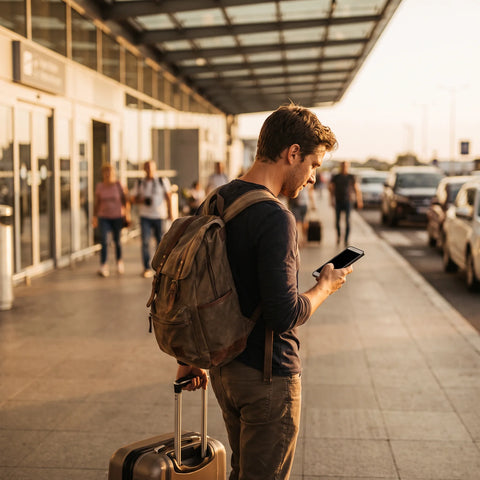

In short: For an Erasmus student in the EU, an eSIM is useful when your Spanish carrier's free roaming doesn't provide enough data or doesn't cover your destination (UK, Switzerland, Balkans). Install it before you travel, keep your Spanish number for calls, and use eSIM data with Dual SIM: this way, you'll have internet from the first minute at the airport, without changing your number or relying on apartment Wi-Fi.
What an Erasmus student actually needs in mobile data
The first common mistake is treating Erasmus connectivity as if it were a one-week trip. It's not: it's four, six, or nine months, with very different usage peaks between the first week (chaotic, everything via WhatsApp and maps) and the rest of the semester (routine, classes, a few getaways). You don't need the biggest plan; you need one that can handle peaks without leaving you stranded when you use it most: the day you arrive, the day you register, and the weekend you leave the city with your Erasmus group.
The actual consumption list for an Erasmus semester looks like this: WhatsApp and video calls home (constant, low data but constant), Instagram and TikTok (the most variable expense from person to person), Google Maps and public transport apps (essential for the first two weeks, then usage decreases), university platforms like Moodle or Teams for some hybrid classes, Spotify or streaming, and weekend travel logistics: tickets, reservations, and again, maps in a new city.
Free EU roaming: its reach and limitations
If you're going on Erasmus within the European Union with a Spanish carrier, in theory, your plan travels with you under the "Roam Like At Home" regulation. In practice, there are two nuances that trip up many Erasmus students in October: first, the fair usage policy limits how many GB you can consume while roaming within your national plan, and this limit often falls short when consumption is no longer that of a one-week tourist but someone living there; second, this free roaming covers the EU (plus Iceland, Norway, and Liechtenstein in most plans), but it doesn't automatically cover the UK, Switzerland, or destinations like Turkey or non-EU Balkan countries, which are precisely where many Erasmus students end up on a long weekend.
If your carrier confirms that their EU roaming is sufficient for the entire semester without issues, you don't need to buy anything. If the limit falls short—you'll notice because the carrier sends an SMS or because the speed drops after exceeding the threshold—then it's time to consider a data eSIM as a complement, not a replacement.
When an eSIM is right for you (and when not to spend a single euro)
Here it's important to be honest, even if it doesn't benefit our sales: if your included EU roaming comfortably covers your usage and your destination is within the EU, you don't need an additional eSIM. Only buy one if any of these situations apply: you're going to the UK, Switzerland, or a destination outside the EU roaming zone; your Spanish carrier has a roaming data limit that runs out halfway through the month; or you want stable connection from the first minute at your destination airport without relying on finding Wi-Fi or your carrier taking time to activate roaming.
For an Erasmus student within the EU with generous roaming, spending on an eSIM in the first few months is a waste of money. It pays off in segments where Spanish roaming doesn't cover: a week in London, an interrail trip that crosses into Switzerland, or the entire semester if the final destination is outside the EU.
Dual SIM: how to keep your Spanish number and have local data
The eSIM does not replace your physical Spanish SIM; it complements it. Most recent mobile phones support Dual SIM: your physical card remains active to receive calls and SMS on your usual number—the one your parents, bank, and doctor have—and the eSIM handles only data. You activate it before leaving home, with Wi-Fi, following the same steps as in how to install an eSIM step by step, and as soon as you land, you activate it manually: no need to go to a store, or look for a SIM vending machine at the airport with your luggage in tow.
This has an advantage that is particularly noticeable for Erasmus students: you can continue using WhatsApp with your Spanish number (your contacts don't change), continue receiving verification SMS from your Spanish bank, and at the same time have mobile data working with the number or data profile of the destination country or your European plan. If you've never used an eSIM and are unsure how it differs from a physical SIM, the step-by-step installation guide clarifies basic questions before installing anything.
The first day of Erasmus: what you need before you have Wi-Fi
No one tells you this in the welcome talk, but on your first day of Erasmus, you'll be most dependent on having data already working, not the apartment Wi-Fi you don't have yet. Before you settle in, you'll likely need to: send your real-time location to your family while looking for your flat or residence; use the map to get to the university office without relying on airport Wi-Fi, which often gets saturated during peak arrival times; fill out enrollment forms or reception program forms (ESN, international relations office) that sometimes require SMS verification or an email with immediate confirmation; and in many countries, mandatory registration with the police or city hall within the first few days, for which you need to locate the exact address and, sometimes, book an appointment online from your mobile on the same day.
Added to this is a detail that catches many people off guard: some local banks and operators require a local phone number to verify registration, a Spanish one won't do. If you plan to open a local bank account in addition to the eSIM, save that process for when you have fixed accommodation and don't leave it for the same day of your flight.
Erasmus outside the EU roaming zone
If your Erasmus destination is the United Kingdom, the situation changes completely since Brexit: your Spanish carrier's EU roaming does not apply, and many operators charge roaming in the UK just like in any destination outside the EU, with surcharges that soar if you don't contract something specific. Here, the two reasonable alternatives are a local British physical SIM (easy to get in supermarkets and phone stores with your passport) or a data eSIM that covers the country, keeping your Spanish SIM only for calls and SMS in Dual SIM mode.
For Erasmus in Switzerland, something similar happens: it's not in the EU or within the roaming agreement, so it must be treated as a destination outside the free zone. Turkey, Serbia, Bosnia, or North Macedonia—common destinations for exchange programs and getaways from the Balkans—also do not fall under EU roaming. The following table summarizes the situation by destination type.
| Erasmus Destination | Does free EU roaming apply? | What to bring |
|---|---|---|
| Portugal, Germany, Italy, Poland, France, Netherlands... | Yes, with fair use policy limit | Spanish carrier's roaming; eSIM only if limit is insufficient |
| Iceland, Norway, Liechtenstein | Usually yes (European Economic Area) | Confirm with your carrier before leaving |
| United Kingdom | No (post-Brexit) | Local SIM or data eSIM + Spanish SIM in Dual SIM |
| Switzerland | No | Data eSIM or local SIM |
| Turkey, Serbia, Bosnia, North Macedonia | No | Destination-specific data eSIM or local SIM |
Weekend getaways with other Erasmus students
The Erasmus experience isn't just lived in the destination city: Interrail trips, long weekends, and group trips organized by ESN are part of the program. This is where a data plan that covers several countries at once saves you the hassle of activating and deactivating roaming every couple of days. If your route crosses several European countries in a short time—the classic Prague-Vienna-Budapest weekend, or an Interrail trip during Easter holidays—a multi-country data plan makes more sense than contracting something different at each border. You can see how this travel logistics for multiple destinations is planned in our guide on eSIM for Easter trips, applicable to any short getaway in Europe during the semester.
For these segments, a data plan like the Europe eSIM for 30 countries covers most typical Interrail destinations at once, so you don't have to worry about which country you're in when crossing the border on a train in the middle of the night.
Save data without missing out on social life
The Erasmus budget is what it is, and mobile data shouldn't eat into what you have left for going out. The settings that save the most gigabytes without you noticing a difference day-to-day: download offline maps of your city and any weekend destination before you leave (Google Maps and Maps.me allow this), lower Spotify and Instagram playback quality to "data saver" in the app settings, disable automatic video playback on social media when you're away from Wi-Fi, and use apartment or library Wi-Fi for automatic app updates, which consume the most gigabytes without you realizing. You can find a complete breakdown of these settings, app by app, in how to save data on your travel eSIM.
A specific Erasmus tip: the first week consumes much more than the rest of the semester due to the combination of maps, photo uploads, and constant video calls home. Don't calculate your data plan based on the semester average; calculate the first fortnight separately and the rest separately, because they are two completely different consumption patterns.
University Wi-Fi, apartment Wi-Fi, and privacy
University Wi-Fi (often under the eduroam network, shared among European universities) is usually reliable on campus, but outside of that, you rely on shared apartment Wi-Fi, which, with many people connected at once, can be slow during peak evening hours. That's where having your own data on the eSIM makes the difference between waiting for a video call home to load or making it without interruptions.
Regarding privacy: connecting to public or shared Wi-Fi networks (library, cafes, a flatmate's apartment you don't know) carries a bit more risk than using your own data, especially if you're checking your online banking or filling out forms with personal data. There's no need to panic, but it's good to know when a VPN is worthwhile, something we explain with specific cases in eSIM and VPN: travel privacy.
Common myths and mistakes of the connected Erasmus student
The first, and the one that costs the most money: thinking you need to buy data for the entire semester as soon as you arrive. Install the eSIM before leaving home but activate it only when you need it; many plans allow you to activate it the day you land, not the day you buy it, so you don't lose validity waiting to see if your carrier's roaming is enough.
The second mistake is assuming that "Europe" is a single, homogeneous coverage zone. It is not: within the EU, free roaming varies by operator and GB limit, and outside the EU (UK, Switzerland, non-EU Balkans) there is no free roaming, even if you are still geographically in Europe. Checking this before each weekend trip avoids bill surprises or data outages in the middle of a route.
The third is forgetting that you need data before you have Wi-Fi, not after. Enrollment, police registration, apartment hunting, and communication with family almost always happen in the first 48 hours, when you don't yet have fixed Wi-Fi. Activating the eSIM the day before flying, not the day of registration, is what makes the difference between arriving calmly or arriving blind.
And the fourth, less obvious: if you share an apartment with other Erasmus students, each one usually has their own data solution, so don't assume that the apartment Wi-Fi or a flatmate's hotspot will be available when you really need it, like on the day of an online exam or a video call interview. For those moments, having your own reliable data is the difference between submitting on time or not.
Frequently Asked Questions
Does free EU roaming cover the entire Erasmus semester?
It depends on the operator and the contracted plan. Roaming without surcharges within the EU usually has a gigabyte limit due to a fair use policy; it's not truly unlimited. For a stay of several months, it's advisable to confirm this limit with your operator before assuming it will last the entire semester.
Can I keep my Spanish number while using data from an eSIM?
Yes. With Dual SIM, you keep your physical Spanish SIM active for calls and SMS, and you use the eSIM solely for data. You don't lose your number or have to notify anyone of a change.
Do I need a different eSIM if I go to the UK for Erasmus?
Yes. Since Brexit, the UK is not covered by the free EU roaming of Spanish operators. You need a specific data eSIM for the UK or a local SIM, and you can continue using your Spanish SIM for calls in Dual SIM mode.
What if my Erasmus is in Switzerland or a Balkan country outside the EU?
These are also not included in free EU roaming. The approach is the same as for the UK: a data eSIM for the specific destination or a local SIM, keeping your Spanish SIM for calls.
When should I activate the eSIM, before or after landing?
Install it at home, with Wi-Fi, before flying, following the step-by-step installation instructions. Data activation, however, should be done the day you land: this way, you don't lose plan validity waiting at home and you arrive with connection from the airport.
Can I use the same eSIM to travel to other countries during the semester?
If you purchase a multi-country European data plan, yes: it covers you in several countries without you having to manage anything different at each border, which is useful for Interrail and weekend getaways with your Erasmus group.
Is it worth buying an eSIM if my Spanish operator already includes generous EU roaming?
If your roaming comfortably covers your usage and your destination is within the EU roaming zone, it's not worth it: you'd be paying for something you already have included. An eSIM makes sense when the limit falls short or when you travel outside that zone.