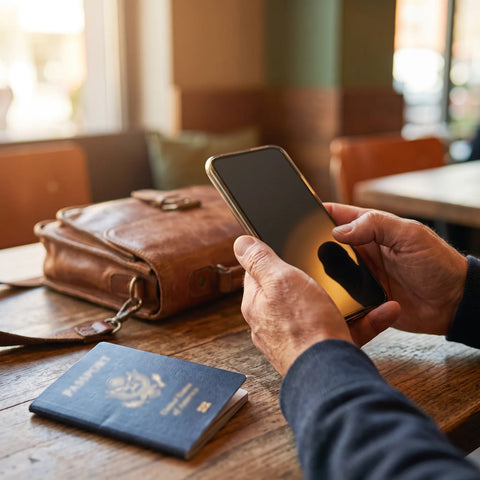
Crossing from France to Spain via the Somport and losing signal in the tunnel, arriving in a Tuscan village with your hotel reservation saved only in the cloud, or discovering in Bosnia that your "Europe" plan didn't cover that country: these are the three typical scares of an ill-prepared road trip. None of them have to happen to you.
Which eSIM is best for a European road trip?
A road trip through Europe has a peculiarity that distinguishes it from a trip to a single city: you cross borders all the time. In a two- or three-week trip, you might pass through five, eight, or ten different countries, and managing a different SIM in each one is a waste of time that no one wants in the middle of a vacation.
The reasonable solution is a multi-country European coverage eSIM. This type of plan covers the EU and, depending on the plan, countries outside the Union such as the United Kingdom, Switzerland, or Norway, with a single data profile that automatically connects to the local network. If you are still unclear on what exactly an eSIM is and how it differs from a physical SIM, we explain it without technical jargon in our guide on what a virtual eSIM is.
Before buying, look at this carefully:
- Coverage in your transit countries: verify that the plan specifically covers each country on your route, not just the "main" ones. A 30-country plan is not the same as a 33-country plan, and those 3 difference countries are often precisely the ones that fewer tourists cover in their catalogs: the Balkans, Iceland, some micro-states.
- Sufficient data: an active road trip (constant navigation, on-the-fly accommodation searches, photos uploaded to the cloud every night) consumes significantly more than a city trip.
- What happens when data runs out: some plans cut off service, others significantly reduce speed. Using GPS with reduced speed is enough, but it's good to know beforehand, not when you've already run out of data in the Black Forest.
- Plan validity: ensure the duration covers the entire trip, with some margin. A road trip rarely goes exactly as planned.
Check our Europe eSIM to see the multi-country coverage plan and verify which countries your specific route includes.
Road coverage, country by country
Not all of Europe has the same mobile coverage outside of cities. If your route passes through rural areas, mountain passes, or countries with a lower density of antennas, this is what you will encounter:
| Area | Road coverage | Weak point to consider |
|---|---|---|
| Germany, Netherlands, Belgium, Austria, Switzerland | Very good, almost continuous 4G/5G | Long alpine tunnels (Gotthard, Arlberg): no signal inside, which is normal |
| France | Good on highways, irregular in rural areas | Mountain departmental roads (Pyrenees, Massif Central) with cuts |
| Spain | Good on motorways and urban centers | Interior of Aragon, Extremadura and northern plateau with stretches without coverage |
| Italy | Excellent on motorways and in cities | Apennines and southern mountain areas, more discontinuous coverage |
| Portugal | Good on the coast | Interior of Alentejo and Trás-os-Montes, weak signal in long stretches |
| Poland, Czech Republic, Hungary | Good in general | Rural areas away from major motorways |
| Greece | Very good in Attica and ferries to large islands | Continental north (Epirus, mountain areas) more irregular |
| Romania, Bulgaria | Good in cities and main axes | Transfăgărășan and other mountain roads, intermittent signal |
| Non-EU Balkans (Bosnia, Serbia, Montenegro, Albania) | Variable | Verify before you leave if your plan includes them: not all "Europe" plans do |
A nuance often overlooked: mobile data coverage has nothing to do with your Spanish operator's roaming, nor with who manufactures your rental car. It depends solely on which antennas your eSIM is near in that specific section, just like a mobile phone with a local SIM from that country would.
How many GB do you really need?
This is the most frequently asked question before leaving, and the honest answer is "it depends on how much you download offline." With pre-downloaded maps (explained in the next section), navigation itself barely consumes data: the bulk of consumption comes from searching for accommodation on the fly, uploading photos to the cloud every night, viewing content on social networks during stops, and making video calls.
An active two- or three-week road trip, with offline maps and normal use of social networks and messaging, falls within a wide range: those who barely upload content consume little, and those who stream video or work remotely from the car multiply that consumption several times over. Before choosing the plan size, think about your normal weekly data usage at home and add a day's worth of GPS navigation: that calculation provides a more realistic reference than any generic figure. If the plan allows, it's better to run short and top up on the fly than to have an excessive amount from a huge plan.
To get the most out of every GB, we have a specific guide with practical tips: how to save data with your travel eSIM.
Google Maps and navigation without excessive data usage
Real-time GPS navigation is what consumes the most if you don't prepare for it. And it's easy to avoid:
Download offline maps in Google Maps before leaving home:
- Open Google Maps and search for the area you want to download.
- Tap the city or region name and select "Download."
- Adjust the area: you can download entire regions, such as "Germany" or "Tuscany."
- With the offline map downloaded, turn-by-turn navigation works without consuming mobile data (real-time traffic does require it).
Google Maps alternatives to carry as backup:
- Maps.me: works 100% offline with OpenStreetMap maps, very useful for rural roads and alternative routes that Google sometimes doesn't detail well.
- Waze: better for real-time traffic on busy highways, but needs active data to be useful.
- HERE WeGo: very comprehensive offline maps for Europe, a good option as a second backup app.
The strategy that works: download offline maps for all countries on your route before leaving, and save mobile data for what truly needs a connection — finding gas stations, open restaurants, accommodation availability, and live traffic on busy sections.
Single-country eSIM vs. multi-country Europe eSIM
Some travelers consider buying a local eSIM for each country on their road trip, thinking it will be cheaper. It's worth pausing to consider this, as it's not always the case:
- With per-country eSIMs you have to buy, install, and activate multiple eSIMs, and most mobile phones only allow a limited number of active eSIMs simultaneously (although you can store more installed). This forces you to change the active line at each border, and if you run out of data in one country, you cannot use the balance from another.
- With a multi-country Europe eSIM you have a single plan for the entire route, with no border formalities, and the balance shared among all countries on your itinerary. If you use more data on a specific day (arrival in a large city, a lot of movement), the rest of the trip is still available without you having to do anything.
If you've never thoroughly compared a physical travel SIM with an eSIM, the practical difference (especially on a road trip, where stopping at stores in each country would be absurd) is well explained in international chip vs. eSIM.
For routes through more than three countries, the multi-country eSIM almost always wins in convenience, even if the price per GB in some individual countries is slightly lower when purchased separately. The difference rarely outweighs the complexity of managing multiple lines while driving.
When you DON'T need a multi-country eSIM
Here it's important to be honest, because not every road trip needs the biggest plan. If your route is limited to a single country — a week-long trip through rural Spain, for example, without crossing any borders — there's no point in paying for coverage in thirty countries you won't visit: an Spain eSIM with the GB you need is sufficient.
It also doesn't pay off if your "road trip" is actually two or three days crossing a single nearby border (a weekend between San Sebastian and Biarritz, for example): first check if your usual Spanish tariff already includes roaming in the EU at no extra cost, because in that case buying an additional eSIM is overspending. And if your route combines Europe with a stretch outside, in the United States for example, you will need a separate eSIM for that part of the trip.
Myths and what almost no one tells you
Some things you only learn by traveling, or that are almost never explained in generic guides:
- The rental car's GPS is not your eSIM. If the car has an integrated navigator with its own connection, it operates independently and does not rely on your mobile. Do not confuse the two if something goes wrong: first check which of the two systems is failing.
- On ferries, no one has coverage. Ancona-Patras, Dover-Calais or any high-sea journey: no operator provides service far out at sea, whether it's an eSIM, physical SIM or good roaming. This is the time to have your maps downloaded and accept being disconnected for a while.
- Long tunnels cut off the signal even if your plan is perfect. The Gotthard, Mont Blanc or Arlberg do not have mobile coverage inside due to infrastructure design, not a failure of your operator. Google Maps offline still works there because it does not depend on data.
- Andorra and microstates are not always included in "Europe" plans, even if they are geographically surrounded by countries that are. If your route passes through Andorra, San Marino or Liechtenstein, check specifically before you leave.
- 112 works without data or an active eSIM. The European emergency number can be dialed from any mobile with coverage from any network, even without a SIM card. This is a fact worth keeping in mind on the road, not just on your phone.
- Sharing data via hotspot from the car drains battery faster than you think, especially if it's also charging the passenger's phone. Carry a car charger; don't rely solely on your phone's battery.
- Free Wi-Fi at service areas is not as reliable as it seems. If you're going to check your bank or handle any sensitive data at a stop, it's safer to use your own mobile data than open Wi-Fi at a gas station; if you still use it, it's good to know the risks involved (we cover this in detail in our guide on privacy and VPN while traveling).
Connectivity checklist for your road trip
Before you leave, review this so you don't lose connection at the worst possible time:
- ☐ eSIM purchased and installed before leaving home, with quiet Wi-Fi, not at the last minute on the shoulder.
- ☐ Confirm it covers all countries on the route, including transit countries and those outside the EU.
- ☐ Data roaming activated on your mobile: without this, the eSIM won't connect when crossing borders, even if the plan is correct. If the term sounds like Greek to you, here's a straightforward explanation: what data roaming is.
- ☐ Offline maps downloaded for all countries on the itinerary, not just the main cities.
- ☐ Accommodation reservations saved offline in the app (Booking and Airbnb allow checking reservations offline).
- ☐ Car charger or power bank: GPS and hotspot consume battery quickly.
- ☐ Mobile phone holder for the car, essential for hands-free navigation.
- ☐ Navigation Plan B: a dedicated GPS, offline maps from a second app, or physical maps for the areas without coverage we mentioned earlier.
If it's your first time installing an eSIM and you're apprehensive about the process, the complete step-by-step guide is in how to install an eSIM. And if your route crosses into countries with a wider variety of destinations (including the Balkans), check before deciding what exact coverage your plan offers in those less common countries.
Conclusion
A road trip through Europe is one of the most enjoyable travel experiences, and connectivity is not a whim: it's what allows you to find a place to sleep tonight, notify of a delay, or simply not get lost on a secondary road at eleven at night. The multi-country Europe eSIM removes all the friction of crossing borders: one plan, all countries covered, without changing lines every time you see a different sign on the road.
With offline maps downloaded and the data plan adjusted to your real route — no more, no less — you arrive in the first country with connectivity sorted out and one less thing on your list before starting the car.
Frequently asked questions about eSIM for a European road trip
Does the eSIM work when crossing the border between European countries?
Yes. Multi-country Europe eSIMs automatically switch to the local network available in each country without you having to do anything manually; the transition occurs in seconds upon entering coverage in the new country.
How many GB do I need for a multi-week road trip through Europe?
It mainly depends on how much you upload to the cloud and whether you have downloaded offline maps. With downloaded maps and normal use of social media and messaging, consumption is moderate; if you stream video or work remotely from the road, it increases significantly. Calculate your usual weekly consumption at home as a starting point.
Can I use the eSIM to share data via hotspot from the car?
Yes, you can share eSIM data as a hotspot to connect tablets, laptops, or other mobile devices. Hotspot use consumes battery quickly, so bring a car charger if you plan to use it for several hours continuously.
Is there coverage on motorways throughout Europe?
In Western Europe (Germany, France, Spain, Italy), motorway coverage is generally good. In rural areas of Eastern Europe and mountainous sections, there may be occasional outages. Offline maps are essential backup for these gaps.
Is it worth buying a different eSIM for each country on the road trip?
For most routes, no. Managing multiple eSIMs and changing the active line at each border adds complexity precisely when you're driving. A multi-country Europe eSIM is more practical, and the cost is usually reasonable compared to the sum of several local eSIMs.
Do I need to activate anything on my phone, or is installing the eSIM enough?
You need to have data roaming activated in your mobile settings for that line; if it's deactivated, the eSIM won't connect when crossing the border, even if it's correctly installed and the plan is appropriate.
What happens if I run out of data mid-route?
It depends on the specific plan: some allow you to extend data on the fly, others reduce speed when you reach the limit. It's advisable to check this before leaving so you don't get an unpleasant surprise in the wrong country, and to calculate your data volume with a margin from the start.