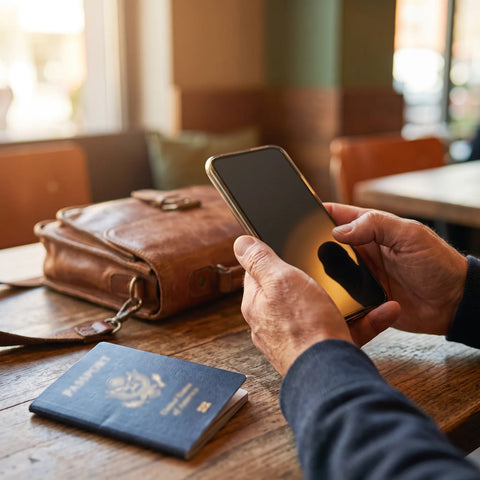
In short: for a retired person traveling in the off-season, the off-season eSIM for seniors solves the real problem of expensive roaming and lost physical cards: it's installed at home at leisure, keeps the Spanish number active for family, and provides enough data for Google Maps and video calls without bill surprises upon return.
October, November, February. The months most people avoid due to work or school are precisely the ones a retired person can take advantage of without asking anyone for permission. Fewer people at the Alhambra, a table without a reservation at the plaza's restaurant, and a climate that in many destinations is more pleasant than in the middle of August. Connectivity, however, remains the same old headache: what to do with your phone to avoid relying on your operator's roaming or searching for Wi-Fi in every coffee shop. This is where eSIM comes in, and here we will explain, straightforwardly, when it's convenient and when it's not.
Why the off-season is the best time to travel when retired
You don't need to be an economist to notice the difference: outside of school holidays and long weekends, everything relaxes. Airports have shorter queues, hotels have more room to offer better rooms for the same money, and places that are packed in July — Marrakech's market, Óbidos' viewpoint, Cartagena de Indias' boardwalk — can be enjoyed without jostling. For those whose agenda is no longer dictated by the work calendar, traveling midweek and off-season is not only more comfortable: it's usually cheaper, although the exact savings depend on each tour operator and it's best to compare prices at the time of booking rather than relying on generic figures.
The other advantage is the climate. In November, the Canary Islands still have mild temperatures, Morocco enters its best time of year (neither the suffocating summer heat nor the cold of the mountains in winter), and southern Portugal and Italy still allow walks without heavy coats. This is the window many retirees take advantage of to make the trip they had been postponing for years.
What is an eSIM and why it fits this traveler profile well
An eSIM is a SIM card that doesn't physically exist: it's a digital profile downloaded to your phone by scanning a QR code. There's no need to open the phone tray with a clip, no tiny card falling on the airport floor or getting lost at the bottom of a suitcase. For a traveler who isn't constantly fiddling with their phone, this simplicity is already a considerable advantage.
The difference with your usual Spanish operator's roaming is clear: roaming uses the same home SIM card but bills separately, often with rates that skyrocket outside the European Union. The eSIM, on the other hand, is a second data line that coexists with your usual number. The phone continues to receive calls and SMS to the Spanish number — the one saved by children and grandchildren — while browsing with the eSIM data of the country you're in. If you've never heard of what data roaming is exactly, it's worth reading before deciding: understanding the problem helps better appreciate the solution.
Pre-purchase requirement: Is your phone compatible?
Here's a detail that's often overlooked and can ruin your trip if not checked beforehand: not all phones have eSIM. Mid-range models from before 2020 and many current budget Androids don't include it. Before buying anything, go to your phone's settings and look for "add eSIM" or "mobile plan"; if that option doesn't appear, your phone is not compatible and you'll have to stick with roaming or buy a physical SIM at your destination. Checking takes a minute and avoids an unpleasant surprise at the airport, with your luggage already checked in.
Favorite off-season destinations for retirees and their connectivity needs
Not all destinations require the same. In the European Union, roaming is already included in most Spanish tariffs at no extra cost, so buying an eSIM there is almost always a waste of money. Outside the EU, the situation changes completely.
| Destination | Best off-season time | eSIM needed? | Reason |
|---|---|---|---|
| Canary Islands | November–February | No | Spanish and EU territory: your usual SIM works without roaming |
| Portugal and Italy | October–November | Usually no | Free EU roaming included in most Spanish tariffs |
| Morocco | October–November | Yes | Outside the EU: Spanish operator roaming costs skyrocket |
| Thailand and Southeast Asia | November–February | Yes | Long-haul destination, very expensive roaming outside the EU |
| Caribbean (Dominican Rep., Cuba) | November–December | Yes | Outside the EU; hotel Wi-Fi coverage unreliable for calls |
| Florida and Southern US ("snowbird" season) | December–March | Yes | Long stays: better an US eSIM than renewing roaming plans weekly |
The case of Florida deserves special mention because it's more common than it seems: every winter, a good number of European retirees — many British, German, and also Spanish retirees — spend several months in the southern United States escaping the cold, the so-called "snowbird" season. For a stay of weeks or months, continuously renewing roaming bundles is much more expensive and inconvenient than directly activating a US eSIM designed for long stays.
Another case where an eSIM offers a quality leap is an off-season Mediterranean cruise with stops outside the EU roaming zone: Morocco, Turkey, sometimes the UK. There, it's not worth buying a different eSIM for each stop of a couple of days; a multi-country Europe eSIM that covers the entire itinerary with a single active profile makes more sense.
How to install and configure your eSIM step by step, stress-free
This is when many retirees ask a child or grandchild for help, and it's perfectly fine to do so the first time. But the process, explained calmly, holds no mystery. The complete guide with screenshots is available at how to install an eSIM step by step; here's a summary designed to avoid common mistakes:
- Buy in advance, from home. Don't leave this for the last day or the airport. Do it calmly, in good light, and with home Wi-Fi, at least two or three days before flying.
- Install the profile at home, but don't activate it yet. Most eSIMs allow you to install the data profile in advance and activate it only upon landing. This is key: if you activate the eSIM too early, you start "spending" the plan's validity days even before leaving home.
- Scan the QR code with your phone's camera following the instructions received by email after purchase.
- Upon landing, activate the data plan and put your phone in airplane mode for a few seconds to recognize the new network; then deactivate it.
- Check that your Spanish number remains the primary line for calls and SMS, and that the eSIM is set as the data line. This way, your children can still call you as always.
A trick that saves trouble: before your trip, save a screenshot with the installation steps and the QR code in your phone's photo gallery. If something goes wrong and you need telephone help from a family member, it's much easier to describe what you see on screen if you have the reference handy.
How much data a traveling retiree actually needs
The most common question when choosing a plan is how many gigabytes to buy. It depends on usage, but there are fairly predictable patterns for this type of traveler:
- Google Maps and navigation: low consumption if the offline map of the area is downloaded before leaving (highly recommended in medinas, historic centers, and rural areas with irregular coverage).
- Video calls with family (WhatsApp, FaceTime): this consumes the most data day-to-day. A 20-30 minute video call already represents significant consumption if done daily.
- Photos and automatic cloud backup: this is where most people are surprised, because the phone uploads photos automatically, in the background, without you realizing it.
- Email, news, and bank app checks: low and occasional consumption.
To reduce surprises, it's advisable to review tips for saving eSIM data on a trip, especially disabling automatic photo upload while roaming and activating it only when hotel Wi-Fi is available. This is the most common reason for a data plan running out sooner than expected, and it can be solved in two taps from the photo gallery settings.
Myths and what almost no one tells you about eSIMs and retirees
There are ideas that circulate among travelers by word of mouth that should be clarified before deciding:
"eSIMs are only for young people with very expensive phones." Not true: eSIM availability depends on the phone model and year, not the user's age. Many mid-range phones from recent years already include it. The real requirement is technical, not generational.
"With EU roaming, nothing else is ever needed." Generally true, but with nuances: some Spanish tariffs limit EU roaming to a certain number of gigabytes per month or reduce speed after exceeding a certain consumption, especially in cheaper tariffs. It's advisable to check the specific conditions of your tariff before assuming that roaming will be unlimited throughout the trip.
"In a small town in Morocco or inland Portugal, coverage will be the same as in the city." Not always. In rural areas and historic centers with narrow streets and old buildings — Fez's medina is a classic example — the signal can drop significantly in covered alleys or thick stone interiors. Downloading the offline map before entering these areas is the difference between finding your way back or getting lost searching for coverage.
"If I change my data line, I lose bank SMS verification codes." No, and this reassures many people: the eSIM is used only for data, your lifelong Spanish number remains active for SMS and calls in most configurations, so online banking verification codes still reach you just as they do at home.
"Using public hotel or airport Wi-Fi is safer than using mobile data." It's quite the opposite. Open Wi-Fi networks are a known weak point for anyone wanting to snoop on the traffic of other users connected to the same network, which is especially delicate if you're checking your bank account from the hotel. For such transactions, it's advisable to review how eSIM privacy and VPN use while traveling works: using eSIM data instead of hotel Wi-Fi for sensitive operations is a simple habit that significantly reduces risk.
When NOT to buy an eSIM
And here we must be honest, even if it doesn't help sales: there are trips where buying one is throwing money away. If you're going for a weekend to Lisbon or Rome with your usual Spanish tariff, don't buy anything: EU roaming already covers you, and adding an eSIM only duplicates what you've already paid for. The same applies if the destination is the Canary Islands: it's Spanish territory, there's no roaming to pay. An eSIM makes sense when you leave your operator's free roaming zone — Morocco, America, Asia, Africa — or when you're going to spend weeks or months abroad and need a more stable solution than constantly renewing bundles.
Frequently Asked Questions
Is the eSIM complicated for an older person to set up?
The process itself doesn't require technical knowledge: buy, receive a QR code, and scan it. The first time, it's advisable to do it calmly, at home, and with family help if you feel insecure. After the second trip, most users do it themselves without a problem.
What if I have a technical problem at the destination?
PuraSIM offers support in Spanish. Additionally, if the hotel has Wi-Fi, you can always ask a family member for help via video call while resolving the issue step-by-step.
Can I call home without paying roaming using the eSIM?
Yes. WhatsApp, FaceTime, or similar applications use eSIM data to make voice and video calls without additional phone call costs. It is, by far, the most economical way to maintain daily contact with family during the trip.
How many gigabytes do I need for a two-week trip?
It depends on usage, but for map navigation, WhatsApp, and occasional email checks, a modest plan is usually sufficient if offline maps are downloaded and automatic photo upload is disabled. If you also plan to make long and frequent video calls, it's advisable to choose a plan with more allowance to avoid running out mid-trip.
Do I need an eSIM if I go to the Canary Islands or another European Union country?
Not in the Canary Islands, as it is Spanish territory. In the rest of the EU, it's also usually not necessary, because roaming is included in most Spanish tariffs; it's advisable to check the specific conditions of your tariff before leaving, in case there are data limits for roaming.
Do I lose my usual phone number when using an eSIM?
No. The eSIM adds an additional data line; your lifelong Spanish number remains the one that receives calls and SMS in the usual configuration, so your family can still reach you exactly the same way.
What if my phone is old and doesn't have an eSIM?
Then this solution is not for that phone: you need to check this beforehand in the settings by looking for "add eSIM" or "mobile plan". If that option doesn't appear, the alternatives are operator roaming or buying a physical SIM at your destination.