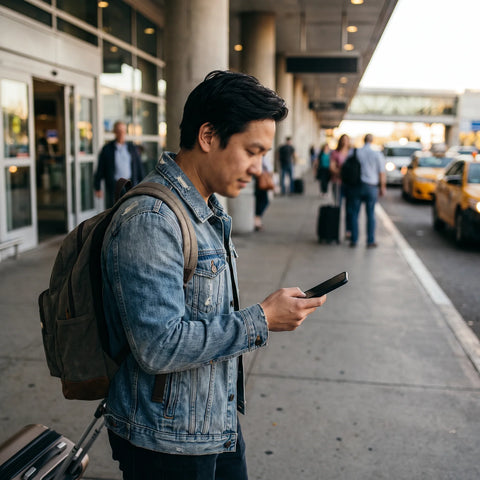
In short: an eSIM for Spaniards traveling to the United States avoids your carrier's roaming—which is expensive and has limited speed—and gives you local data from the moment you land. You buy the plan before leaving, install the profile via Wi-Fi at home, and activate the eSIM upon arrival. Your Spanish number continues to receive calls and SMS on the physical SIM, without touching it.
Why your Spanish carrier's roaming in the U.S. is expensive
If you've traveled to the United States before with your usual carrier—Movistar, Vodafone, Orange, Yoigo, or any MVNO—you probably already know what happens: roaming outside the European Union doesn't have the price limits that exist within Europe. The United States is outside that zone, so each carrier applies its own roaming rates, and in most cases, the cost skyrockets as soon as you activate mobile data the moment you set foot on American soil.
It's not just the price. Traditional roaming often comes with limitations that aren't apparent until you're already there: reduced speed to 3G after a certain consumption, data cutoff warnings halfway through the trip, and the obligation to activate a bundle before leaving even if you don't end up using it all. If you want to understand the difference in detail, we have a complete comparison in eSIM vs. roaming that breaks down point by point where each option wins.
The alternative that has gained ground in recent years is the local eSIM: a data profile that is installed on your phone and bills like an American carrier, without changing your physical card or depending on your contract in Spain. You can see the available plans for the country in eSIM United States and compare duration and GB before deciding.
| Aspect | Spanish carrier roaming | Local eSIM for U.S. |
|---|---|---|
| Activation | Automatic upon arrival, but you must contract the bundle beforehand | You install it at home via Wi-Fi and activate it when you land |
| Speed | Often limited after exceeding certain daily consumption | Local 4G/5G network without artificial reduction as long as your data bundle lasts |
| Your Spanish number | Remains active, normal calls and SMS | Remains active on the physical SIM; the eSIM only carries data |
| Cost | Carrier roaming rate, outside EU limits | Price of the data plan you choose, no surprises on the bill |
| Management during the trip | Depends on your Spanish carrier's support | You can top up data from the app or website if it runs out |
What an eSIM is and how it works in the United States
The eSIM (embedded SIM) is a digital SIM integrated into the phone itself. There is no card to insert or lose at the bottom of your suitcase: you download the carrier's profile by scanning a QR code and the phone is configured in minutes. Most modern mobile phones support several eSIMs stored at the same time, although usually only one is active for data at any given moment.
For a traveler from Spain to the United States, the process is as follows:
- You buy the data plan for the United States before leaving home.
- You receive the QR code by email and install it on your phone with Wi-Fi, calmly, days before the flight.
- You leave the eSIM installed but inactive during the trip; it doesn't start consuming data until you activate it.
- Upon landing, you activate the eSIM and select mobile data on that line.
- Your physical SIM from Spain continues to receive calls and SMS normally, with no additional cost for that.
If you have never installed an eSIM and want a step-by-step guide with screenshots, in how to install an eSIM we explain it for iPhone and Android separately. And if you are still not clear what exactly an eSIM is compared to a physical SIM, what an virtual eSIM is answers the basic questions before buying.

Is your mobile compatible? Check before buying
Not all phones support eSIMs, and the most foolish mistake is to buy the plan and then discover in Settings that your model doesn't support it. In general, they work: iPhone XS onwards, most Samsung Galaxy from S20, Google Pixel from 3, and a good portion of mid-to-high-end Xiaomi, Honor, and Motorola from recent years. The most reliable way to check is to go to Settings → Mobile Data (or Connections, depending on the manufacturer) and look for the option "Add eSIM" or "Add data plan." If it appears, your phone is compatible.
A nuance that is often overlooked: some iPhones purchased in the United States come locked to eSIM only (without a physical tray) and others, depending on the sales market, may have carrier restrictions. If your mobile comes from outside the EU or you bought it second-hand, check that it is unlocked before installing any eSIM.
How many GB do you need for your trip to the United States?
The amount of data depends on how you travel, not just how many days you are there. As an indicative reference, not an exact figure:
- Light use (occasional maps, WhatsApp, some queries): small plans are more than enough, designed for short weekend getaways.
- Moderate use (Google Maps almost all day, social media, photos, some brief video calls): this is the most common profile for a one or two-week trip through several cities.
- Intensive use (remote work, long video calls, real-time video uploads, hotspot for laptop): you need a more generous plan and it's advisable to have a way to top up data if it runs out halfway through the trip.
Google Maps navigating in real time consumes relatively little compared to what many fear, but if you are going on a road trip through several states (New York → Washington D.C. → East Coast, for example) the navigator will be on for many hours straight, so that journey weighs more than the same number of days spent in a single city. If you want to stretch the plan without running out, in how to save data on your travel eSIM there are specific tricks: lowering streaming quality, preloading offline maps and limiting automatic photo synchronization are what travelers notice most.
How to activate the eSIM before your flight, step by step
The best part of doing it in advance is that you arrive in the United States with everything ready, without depending on airport Wi-Fi or finding a phone counter as soon as you get off the plane:
- Check your mobile's compatibility as explained above.
- Choose your data plan for the United States based on the number of days and your intended use.
- Install the profile from home, with Wi-Fi, by scanning the QR code that arrives by email.
- Give the line a recognizable name (e.g., "U.S.") and configure it for data only, not for calls or SMS—those remain on your Spanish line.
- Activate it upon landing: go to Settings → Mobile Data and select the eSIM as the data line. You'll have coverage in a few seconds.
One detail often forgotten: check that "data roaming" is activated within the eSIM's own settings (it's a separate switch from your Spanish line's roaming), because if it's off, it won't connect even if you have plenty of coverage.
Coverage by zones: where the signal fails in the United States
The United States is huge, and coverage is far from uniform. In New York, Los Angeles, Miami, or Chicago, the 4G/5G signal is solid almost everywhere. The problem appears in less populated areas: national parks like Yellowstone, the Grand Canyon, or Zion have long stretches without coverage from any operator, not just yours. If your route includes driving through the deserts of Arizona, Utah, or Nevada, download the offline map of that area before leaving the last city with Wi-Fi: no eSIM will help there because there simply isn't an antenna.
Inside skyscrapers and in the basements of large cities (some hotels and shopping centers in New York, for example), the signal can also temporarily weaken, which is common with any operator, not just with eSIM data.

What almost no one tells you before traveling with an eSIM to the U.S.
Beyond the basic instructions, there are details that are only learned by traveling or by carefully reading the phone settings:
- Battery drains faster with two active lines. Having the Spanish SIM constantly searching for a network (even if it's just for calls) along with the active data eSIM consumes more battery than usual. If you're going to be out all day, bring a portable charger.
- iMessage and FaceTime can cause problems if you switch networks mid-conversation. If you notice messages getting stuck "sending" when switching from hotel Wi-Fi to eSIM data, wait a few seconds: the phone is re-registering the line, it's not an eSIM fault.
- Notify your Spanish bank of your travel dates. This has nothing to do with the eSIM, but it's one of the things that causes the most trouble: many banks block payments in the United States for security if you don't notify them beforehand.
- Wi-Fi Calling is not the same as eSIM data. If you have Wi-Fi Calling activated with your Spanish carrier, calls might go through there instead of the American network; check which line you are using if you are surprised by the cost when you return.
- When it's NOT advisable to buy a separate eSIM: if your Spanish carrier already includes free or very competitive roaming in the United States within your plan (more and more plans offer it), check the conditions first: you might not need anything else. And if the trip is a short layover at an airport with free Wi-Fi, you probably have enough with that and don't need to activate any data plan.
- If you have a layover in Europe on your way to the U.S. and the layover is long, keep in mind that an eSIM for the United States won't cover you at the European airport; for that, you need a specific plan different from the one you need for your final destination.
Privacy and streaming: what changes with mobile data in the U.S.
When you connect using local eSIM data, your traffic will have an American IP address. This has a practical consequence: apps like RTVE Play, Atresplayer, or some Spanish banking platforms may request extra verification or directly block access upon detecting that you are connecting "from outside Spain." If you need to continue watching Spanish content or access certain online banking services normally, it's advisable to combine it with a VPN; we explain this in detail in eSIM, VPN, and privacy when traveling.
eSIM versus buying a physical chip upon arrival
Another classic option is to buy a physical SIM from an American operator (AT&T, T-Mobile, Verizon) as soon as you land. This makes sense if your mobile doesn't support eSIM, but it involves queuing at the airport, filling out paperwork with your passport, and, in many cases, losing your active Spanish number while the physical SIM is inserted (unless you have a dual physical slot, which is increasingly rare). We compare both options in more detail in international chip versus eSIM, in case your phone is not compatible with eSIM and you need the physical alternative.
The underlying data is that more and more Spanish travelers are abandoning traditional roaming; if you are interested in the general picture, in statistics of Spanish roaming abroad we review how the habit of connecting outside Spain has changed in recent years.
Before returning to Spain
When your trip ends, you don't need to delete the eSIM immediately: you can leave it installed in case you return to the United States later, simply don't activate it and it won't consume anything. If you also have a getaway to another country planned for later, check the full catalog of destinations before leaving: PuraSIM has plans for more than 200 destinations, so it's easy to find coverage for your next trip without relying on roaming again.
Frequently asked questions
Can I still use my Spanish number in the United States with the eSIM activated?
Yes. The eSIM occupies an independent data line; your physical Spanish SIM continues to work in parallel for calls and SMS with your usual number. To talk to Spain without international call costs, use WhatsApp, Telegram or FaceTime via eSIM data.
When should I activate the eSIM, before leaving Spain or upon arrival in the United States?
Install it at home with Wi-Fi, but only activate it when you land in the United States. The plan's day countdown starts with the first data usage, not with the installation, so there's no rush to activate it prematurely.
Which eSIM should I buy for the United States if I am from Spain?
It depends on your itinerary: if you are only going to be in the United States, a plan specific to that country is the most suitable. If your trip combines the United States with other destinations on different dates, check the duration and GB of each leg separately before deciding, instead of trying to cover everything with a single generic plan.
Does the eSIM work uniformly throughout the entire territory of the United States?
Not exactly. In large cities, coverage is solid, but in national parks and rural areas of the west, there can be stretches without a signal from any operator. Download offline maps for these routes before losing the last Wi-Fi coverage.
Do I need to remove my physical SIM to use the eSIM in the United States?
No, there's no need. Both coexist in the same phone: the physical SIM from Spain remains for calls and SMS, and the eSIM carries only mobile data while you are there.
What happens if I run out of data halfway through my trip?
You can top up or contract an additional plan without having to reinstall anything; the eSIM is already on your phone, you just need to activate the new data balance on that same line.
Who do I contact if the eSIM doesn't connect upon arrival in the United States?
PuraSIM offers 24/7 support via email and WhatsApp. Before writing, try selecting the network manually in Settings → Mobile Data → Network and check that data roaming for that line is activated; these are the two most common reasons for not connecting immediately.