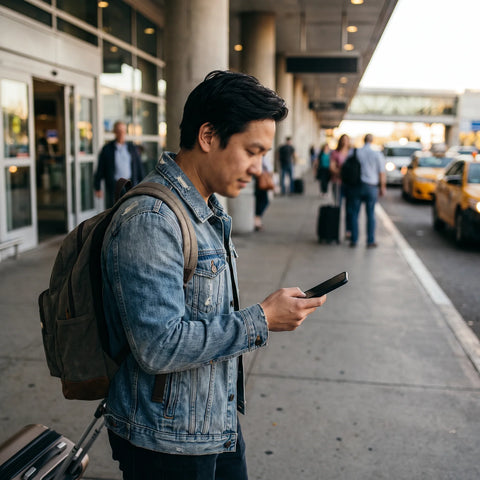
In short: If you're traveling from Brazil to Europe, an eSIM helps you avoid roaming charges from Vivo, Claro, or TIM, which bill by the MB and skyrocket as soon as you open your map at the airport. You install the plan before leaving São Paulo, Rio, or wherever you are, and land in Lisbon, Madrid, or Rome with active data, without having to search for a SIM card store or touch your Brazilian line.
What is an eSIM and why it matters to Brazilian travelers
An eSIM is a virtual chip integrated into the phone itself. There's no physical card to insert or lose at the bottom of your suitcase: you download the data profile before flying and activate it when you land. For someone leaving Guarulhos, Galeão, or Confins for Europe, this changes the usual order of things: instead of looking for a SIM card store at the airport while jet-lagged, you arrive with internet working from the moment you turn on your phone at baggage claim.
The other advantage, and the most overlooked, is that your Brazilian line remains active. PuraSIM's eSIM is installed as a second data line; your Vivo, Claro, or TIM chip remains as a voice line so your family can still call you on the same number as always, without you having to tell anyone that "you're abroad, text me on WhatsApp."
If you've never used one, it's worth first understanding the difference between eSIM and traditional roaming and what exactly data roaming is, which your Brazilian operator charges you for every time you leave the country. With that clear, the rest of the guide makes much more sense.
Coverage: which network you will use in each European country
A European eSIM plan does not create a new network: it connects you to the existing local networks in each country, the same ones Europeans use with their regular SIM card. In Portugal and Spain, this usually means good 4G/5G coverage in cities and along highways, with occasional drops in rural inland areas or mountain villages. In Italy, coverage is solid in the north and in large cities; in some southern areas and on some small Aegean or Adriatic islands, the signal can be more inconsistent.
Something that surprises Brazilians the first time: on the Paris or London subway, underground, it's common to lose data signal between stations, just like on the São Paulo subway. This is not an eSIM fault; it's tunnel physics. Download the route map before going underground and you're all set.
A plan usually covers the main destinations for Brazilian tourists (Portugal, Spain, France, Italy, Germany, Netherlands, among others) without you having to change profiles when crossing each border, which would happen if you bought a new local chip in each country.
Another detail that any Brazilian who has traveled through Europe appreciates: if your route crosses several countries by train or rental car (for example, Amsterdam - Brussels - Paris in the same week), with an eSIM you won't notice the border change. The network automatically reassigns itself to the country you are in, without notifications, without having to restart your mobile or buy anything new at each stop.
Brazilian roaming vs. eSIM: the real comparison
Brazilian operators' plans for Europe usually work with limited data packages and roaming rates that are activated daily or by consumption, and the cost quickly skyrockets if you open Google Maps, upload photos to Instagram, or make a video call. Always check your operator's current price before leaving, as it changes frequently and varies depending on the plan you have contracted in Brazil.
| Aspect | Vivo / Claro / TIM Roaming in Europe | PuraSIM Europe eSIM |
|---|---|---|
| How it's paid | By daily package or by consumption, on your Brazilian bill | One-time payment before traveling, no surprises when you return |
| Actual speed | Often limited or reduced after certain daily consumption | 4G/5G at local network speed, depending on the contracted plan |
| Coverage | Depends on your operator's roaming agreement in each country | Local network of the country you are in, no additional management |
| Your Brazilian number | Active for calls, but with per-minute surcharges | Remains as a voice line; the eSIM only carries data |
| Activation | Automatic upon landing, no control over spending | Manual, you decide when the plan starts counting |
The fundamental difference is not just the price: it's control. With roaming, you don't know how much you'll spend until the bill arrives; with an eSIM, you know exactly what you've paid before taking off. For a two or three-week trip, that removes an entire worry from your backpack.
Step-by-step activation from Brazil
- Check that your mobile supports eSIM. iPhones from XS onwards, Samsung Galaxy S20/S21 onwards, and many recent Motorola and Xiaomi models support it.
- Verify that it is unlocked. Phones purchased without a plan in Brazil usually come unlocked from the factory; those purchased with a Vivo, Claro, or TIM plan may be locked to that operator — request unlocking, it's free by law.
- Choose the data plan according to how many days you will be away and how much you use your phone daily (maps, social media, video calls add up more than you think).
- Install the profile with the QR code while you still have Wi-Fi at home, not at the airport. On iPhone: Settings → Cellular Data → Add eSIM. On Android: Settings → Networks → SIM Manager → Add eSIM.
- Set it as the data line and leave your Brazilian SIM as the primary voice line, so you don't miss calls or bank verification SMS.
- Activate it upon landing, not before. The plan starts counting from the first data usage, so installing it in Brazil won't make you lose a single day of validity.
If this is the first time you've installed an eSIM in your life, it will be useful to review how to install an eSIM step-by-step with screenshots, or first understand what an virtual eSIM is exactly if you still have doubts about the concept.
Brazilians' favorite European destinations
Brazil is one of the largest Latin American outbound tourism markets to Europe, and there are quite recognizable travel patterns:
- Portugal — The most common entry destination. Lisbon, Porto, Sintra, and the Algarve. The common language helps on the street, but the Lisbon subway, tourism apps, and car rental GPS still need data just like in any other country.
- Spain — Madrid, Barcelona, Seville, and Ibiza, often as a stop within a longer European route.
- Italy — Rome, Milan, Florence, and Venice, for gastronomy, fashion, and art. Be careful with Italian train stations: free Wi-Fi is often slow and unreliable, so it's advisable to rely on your own data to avoid missing the train.
- France — Paris remains a dream destination for many Brazilians, between museums and fashion.
- Germany, Netherlands, and Belgium — Combine cultural tourism with business trips; Frankfurt has a notable Brazilian community.
- Greece and Croatia — Increasingly present in sun and beach itineraries, especially in the European summer.
A single European eSIM plan covers all these countries without changing profiles at each border. If your route focuses only on Spain, there is also the option of a specific Spain eSIM, which is more tailored if you are not going to leave the country.
Myths and what almost no one tells you
- "Hotel Wi-Fi is enough for me." Practically false: between commutes, museum queues, and train waits, your phone spends most of the day off Wi-Fi. And airport and station Wi-Fi usually requires registration with email or phone number, which is another hassle you avoid with your own data.
- "The more people I travel with, the less data I need." The opposite: sharing maps, photos, and real-time location among several phones in the group consumes more, not less. If you travel in a group, each with their own eSIM avoids depending on one person's battery and data.
- "A physical SIM card at the airport is always cheaper." Not necessarily, and it also forces you to queue right after landing, tired from the flight, and to lose the temporary number every time you change countries if your route crosses several borders.
- "eSIM uses more battery than a regular SIM card." This is not true: battery consumption depends on data usage (video, GPS, background apps), not the type of SIM card. It's exactly the same behavior as with your physical Brazilian SIM card.
- A detail almost no one mentions: on several European high-speed trains (Spanish AVE, Italian Frecciarossa), the signal is lost in long tunnels, especially when crossing mountain ranges. Download music, destination maps, and tickets offline before boarding the train.
When you do NOT need to buy an eSIM
Not everything is advantageous for everyone, and it's worth stating clearly. If your trip is a short stopover of one or two days in a single city and you plan to stay with reliable Wi-Fi, checking itineraries in advance, it might be more cost-effective to simply use Wi-Fi and leave your mobile in airplane mode for data. If your Brazilian operator offers a very specific roaming package for those particular days and you have already contracted it, there's no point in paying twice either. The eSIM really pays off on trips of a week or more, with several countries or cities, where the savings and convenience of not depending on external Wi-Fi are noticeable day by day.
Frequently asked questions about eSIM for Brazilians in Europe
Do unlocked Brazilian phones work with eSIM in Europe?
Yes. iPhones and Samsung Galaxy phones purchased unlocked in Brazil work without problems with eSIM in any European country. Those purchased with a Vivo, Claro, or TIM plan may come locked to that operator; request unlocking, which is free in Brazil.
How much does an eSIM for Europe cost?
The price depends on the amount of data and the days of validity you choose. Check the current price and data options directly on the eSIM Europe page, as rates are updated over time.
Does the eSIM work in Portugal, being the most common entry destination?
Yes. Portugal is covered within the Europe plan, so if your flight first lands in Lisbon or Porto, you'll have active data from the very first moment.
Can I still receive calls from Brazil while using the eSIM?
Yes. The eSIM is installed as an additional data line; your Brazilian SIM remains active as a voice line, so family and contacts can call you on the same number as always.
What happens if I run out of data halfway through my trip?
You can buy an additional plan or extend data from the PuraSIM app or account itself in a matter of minutes, without needing to find a physical store.
How much battery does having the eSIM active consume?
The eSIM itself does not consume extra battery. The consumption depends on the normal data usage of the phone (maps, video, social media), just like with any physical SIM.
Do I need a different eSIM for each European country I visit?
No, if you choose a Europe plan: it covers multiple countries with the same profile, without having to activate a new one when crossing each border. You would only need a separate plan if your route goes outside the included countries.
Preparing your trip from Brazil to Europe? Check out our European eSIM plans and compare them first with international SIM card vs. eSIM or with tricks to save data during your trip. And if your next destination is within Brazil, consult our Brazil eSIM guide.