In short: an eSIM for Georgia connects you to the local mobile network (Magti, Geocell, or Beeline) from the moment you land in Tbilisi or Kutaisi, without going to a store or paying the sky-high roaming fees charged by your Spanish operator outside the European Union. It's installed before you leave home and activated with a couple of taps upon arrival.
Does an eSIM work well in Georgia?
Yes, and it surprises most first-time visitors. Georgia has a modern mobile network for what the country costs: 4G in practically all inhabited territory and 5G already deployed in Tbilisi, Batumi, and other large cities. An eSIM connects to exactly the same antennas, so your data speed is the same as a local with a Georgian contract. The difference is that you don't wait in line at any store or show your passport to anyone.
Georgia is not part of the European Union, so the "roam like at home" you might be used to in France or Italy doesn't apply here. Roaming from your Spanish plan, if you haven't deactivated it, is really expensive: a few megabytes of maps or WhatsApp with photos can skyrocket your bill without you knowing until you return home. With the Georgia eSIM, that risk disappears because you purchase data at a fixed price before you travel.
Tourism in the country has been on the rise for years, and the infrastructure has kept pace: Tbilisi and Batumi are perfectly covered, and even the mountain villages of the Caucasus have signal in inhabited areas, although it's lost as soon as you enter a valley. Many travelers enter via Istanbul, Yerevan, or directly on low-cost flights to Kutaisi, and want data working from the first stamp in their passport. That's where the eSIM stops being a luxury and simply becomes the most sensible option.

Local operators: Magti, Geocell and Beeline
The Georgian market is shared by three operators, and knowing them helps to understand why a well-designed eSIM saves you the dilemma of choosing one blindly.
| Operator | Strength | Notes |
|---|---|---|
| Magti | Best overall coverage and 5G | Often the benchmark network throughout the country |
| Geocell (Silknet) | Very strong in cities | Good performance in Tbilisi and Batumi |
| Beeline / Cellfie | Aggressive rates for the local market | Slightly weaker in rural and mountainous areas |
The real advantage of an eSIM that relies on local infrastructure is not just coverage: it's that the plan already selects the best available network in each area without you having to research rates written in Georgian or wonder if the operator you've chosen has an antenna in the village where you're sleeping tonight. You worry about your route, not your SIM.
Local SIM, eSIM or roaming: what suits you best
The physical Georgian SIM is cheap, there's no denying that. The problem isn't the price, it's everything that goes into buying it: getting to the airport or city center, finding an open store, showing your passport, waiting for activation, and manually configuring your phone. All that with your luggage in tow and during the first hours of your trip, which are the last ones you want to waste.
| Option | Advantage | Disadvantage |
|---|---|---|
| eSIM | Ready before leaving home, active in a minute | Requires a compatible phone |
| Local SIM | Low price, Georgian number if you need it | Passport registration, queues, changing physical SIM |
| Spanish roaming | Zero configuration | Outside the EU, cost quickly skyrockets |
Practical rule: if you're staying less than three weeks and prefer not to waste time on paperwork, the eSIM clearly wins. If you're setting up for months as a digital nomad and really need a Georgian number for local errands, then adding a physical SIM might be worthwhile.
To better understand why roaming outside the EU works so differently, we have a specific guide on what data roaming is and another comparing eSIM vs. roaming with practical examples. And if you're hesitating between a traditional SIM and a virtual chip, this article on international chip vs. eSIM clarifies many myths.

Coverage by zone: Tbilisi, Batumi, Kutaisi and the Caucasus
In large cities, you won't have any problems, not even in the oldest corners. In the historic center of Tbilisi, among the alleyways of Abanotubani and its sulfur baths, the signal holds up perfectly; the same goes for Rustaveli Avenue or the trendy neighborhoods around the Peace Bridge. Batumi, the Black Sea coastal city, has robust 4G and 5G throughout its boulevard and skyscraper area. And something many people don't consider when planning their trip: if you arrive via a low-cost flight to Kutaisi, the country's second-largest city and a common landing point for Wizz Air flights from Europe, coverage at the airport and city center is equally good, so you can activate your eSIM as soon as you get off the plane without waiting to reach Tbilisi.
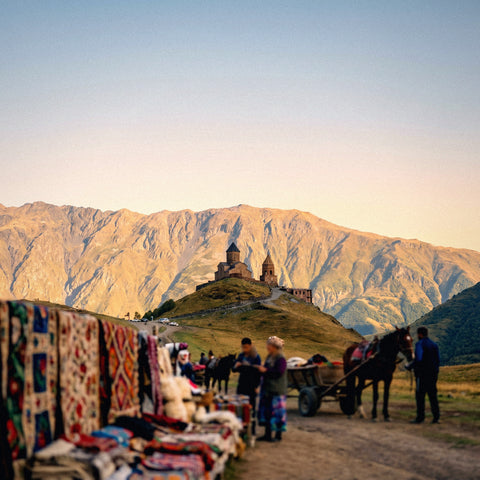
Things change in the Caucasus. On the classic route to Kazbegi (Stepantsminda) via the Georgian Military Highway, there's signal in the village itself and along much of the route, but the mountain pass known as Jvari (Cross Pass) can be blocked by snow in winter, and coverage there is patchy even in good seasons. In Svaneti, on the way to Mestia, the signal holds in the main valley but cuts out as soon as you climb towards trekking routes like the one to Ushguli, one of the highest continuously inhabited settlements in Europe: beautiful, remote, and with very limited coverage. The usual solution works here too: download offline maps before leaving the village and, if you're going on a full-day hiking route, let someone know where you're going.
In Kakheti, the wine region with over eight thousand years of tradition, coverage in villages and wineries is usually sufficient for basic needs, although in some mountain monasteries like those in the Alaverdi area, the signal weakens. And if your route includes Vardzia, the cave city carved into the rock near the Turkish border, keep in mind that it's a remote area where it's advisable to have the map already downloaded: the signal there is more of a pleasant surprise than a guarantee.
How many GB to bring depending on your itinerary
Georgia allows for very different types of trips, from a short getaway to Tbilisi to a long month working remotely from a café in Vake. As a general reference, estimate around 1 GB per day for normal use of maps, messaging, and social media, and increase that figure if you make video calls or use your phone as a hotspot.
| Trip type | Days | Recommended data |
|---|---|---|
| Tbilisi getaway | 4-5 | 5 GB |
| Classic route (Tbilisi, Kazbegi, Kakheti) | 8-10 | 10-15 GB |
| Georgia + Svaneti + Batumi | 12-15 | 15-20 GB |
| Digital nomad / long month | 30 | Unlimited or 30 GB+ |
If you're going to settle in Tbilisi for a while to work remotely, don't skimp: between video calls, uploading heavy files, and using your phone as an emergency connection if the apartment's Wi-Fi fails, consumption goes up faster than you initially calculate. If you're also going to connect to banking or work tools from café Wi-Fi networks or co-working spaces, it's worth reviewing this guide on eSIM, VPN and privacy when traveling. And to fine-tune the exact number of GB according to your habits, this other one on how to save data on a trip helps you avoid running out mid-route or overpaying for an oversized plan.
How to install and activate it step by step
The process is straightforward and done entirely from your phone, at home and calmly. The idea is to have everything ready before you leave so that at the airport—whether Tbilisi or Kutaisi—you just have to turn on your data.
- Purchase the plan and receive the QR code by email instantly.
- With Wi-Fi at home, go to your phone's Settings and scan the QR to install the profile.
- Leave the profile installed but not activated, and keep your phone as normal until the trip.
- Upon landing in Georgia, activate the eSIM data line and connect in a matter of seconds.
If it's your first time installing one, it's best to follow the complete step-by-step guide on how to install an eSIM before leaving home, without rushing and with stable Wi-Fi. Your Spanish number will continue to work normally with the physical SIM, so you'll still receive WhatsApp, calls, and bank SMS messages while browsing with the Georgian eSIM's data.
What almost no one tells you before traveling
There are a series of details that aren't found in generic guides and that make the difference between arriving calmly or spending the first day of your trip wrestling with your phone.
- Not all Android phones manage two lines equally well. Many models allow you to have both the eSIM and the physical SIM installed at the same time, but only one active for data at any given moment; if you don't change it in Settings, you could accidentally end up browsing with your expensive Spanish roaming instead of the eSIM you paid for. Check which line is marked as "mobile data" as soon as you land.
- Crossing into Armenia or Azerbaijan is not covered by your Georgia eSIM. If your route continues through Yerevan, Baku, or any neighboring country, your Georgian plan stops working as soon as you cross the border, whether at Sadakhlo, Sarpi, or Lagodekhi pass. You'll need a separate eSIM for that next country.
- The Cross Pass (Jvari) can close without warning due to snow or landslides, even outside of deep winter. If your plan is to cross to Kazbegi by car, check the road conditions on the same day and don't just rely on "there's a signal, so there's a pass."
- If you only have a technical layover at Tbilisi airport for a couple of hours without going into the city, you probably don't need to purchase anything: the airport Wi-Fi is usually sufficient for checking your boarding gate and replying to a few messages.
- If your accommodation has reliable Wi-Fi and your plan is to move around little—for example, a business stay in a central Tbilisi hotel with short taxi rides—consider whether you need a large plan or a small one just for navigating with Google Maps between meetings. There's no need to buy more GB than you'll actually use.
- eSIM QR codes cannot be rescanned infinitely. If you format your phone or change phones after installing the profile, you may need a new QR code. Save the confirmation email until your trip is over; don't delete it as soon as you install the profile.
Frequently asked questions
Does Georgia fall under European roaming?
No. Georgia is not part of the European Union, so your Spanish plan does not include data here by default and roaming, if left active, can be very expensive. That's why a local eSIM is the safest and most predictable way to have internet during your trip.
Which operator has the best coverage in Georgia?
Magti is usually the benchmark for its general coverage and 5G deployment, closely followed by Geocell/Silknet in cities. With a good eSIM, you don't have to choose: the plan relies on the network with the best available signal in each area.
Is there internet in the Caucasus mountains?
In villages and on main roads, like Kazbegi or Mestia, usually yes. In high valleys, hiking trails, and remote settlements like Ushguli, the signal easily disappears. Always download offline maps before heading into a mountain route.
How many GB do I need for a week in Georgia?
With about 8-10 GB, you have plenty of room for a week of normal use: maps, messaging, social media, and some occasional streaming. If you make many video calls or work remotely, increase to 15 GB or directly choose a higher volume plan.
Can I also use the eSIM in Armenia or Azerbaijan?
It depends on the plan. A Georgia-specific eSIM only covers Georgia; as soon as you cross the land border, it ceases to have service. If you're combining several Caucasus countries on the same route, you'll need a different eSIM for each country or look for a regional plan that includes all of them.
Does the eSIM work as soon as I land at Tbilisi or Kutaisi airport?
Yes, both airports have good coverage from local operators, so you can activate the eSIM as soon as you get off the plane, even before passing passport control.
Do I also need to carry a spare physical SIM in case the eSIM fails?
It's usually not necessary. The important thing is to install the eSIM profile at home with stable Wi-Fi, before traveling, to rule out any installation problems calmly. If your phone is somewhat old, check its compatibility beforehand to avoid last-minute surprises.
Conclusion
Georgia is one of those countries that hooks you from day one, and with roaming outside the EU that can be very expensive, the last thing you want is for your phone bill to spoil the memory of your trip. An eSIM gives you the same fast network that locals use, installs easily at home, and activates as soon as you land, whether in Tbilisi or Kutaisi. Get your eSIM for Georgia ready before you leave and dedicate your energy to what really matters: Kakhetian wine, the Caucasus mountains, and the best khinkali you'll ever taste.