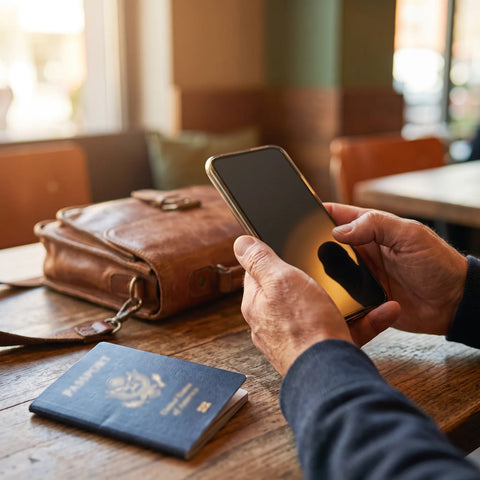
Guam is that tiny speck in the Pacific where a flight from Spain feels endless, so the last thing you want when you land is to struggle with a SIM card in a language you don't understand. With a Guam eSIM activated before you leave home, you'll arrive in Hagåtña with data working from the first minute, no airport queues or scary roaming bills.
In short: a Guam eSIM gives you mobile data as soon as you land, without expensive roaming or touching your phone's physical SIM card. You buy and install it via QR before you fly, it covers the tourist coast of Tumon and GUM airport well, and for a one or two-week trip, 5-10 GB is usually plenty.
Does an eSIM work in Guam?
Yes. Guam is a US territory in Oceania with 4G LTE networks and 5G coverage in tourist areas, so a travel eSIM works just as well as a physical SIM. You just need a compatible phone and activate the plan before you take off; when you land, the connection will pick up automatically.
The big advantage over a traditional SIM card is that you don't change anything physical: your Spanish number stays in your phone to receive bank SMS, and the eSIM only handles data. If you're not sure what exactly an eSIM is and how it works internally, we explain it calmly in what is a virtual eSIM; in short, it's a digital profile that replaces the physical card, and almost all phones manufactured since 2019 support it without problems, although it's worth confirming before buying.
Keep in mind a detail about Guam: as it's US soil, it uses the +1 (671) prefix and American type plug. Data doesn't depend on the plug, of course, but it's a reminder that here you operate within the US ecosystem, not the European one.

Coverage and local operators
Guam's market is small but well-covered on the west coast, where Tumon's hotels and the capital are concentrated. The three operators supporting the network are GTA (GTA TeleGuam), Docomo Pacific, and IT&E. A good travel eSIM relies on the operator with the best footprint to give you a stable signal without you having to choose.
Where you'll notice the difference is outside the tourist belt: the island's interior and the more rural south have areas with irregular coverage. In Tumon, Tamuning, and Antonio B. Won Pat International Airport (GUM), you'll have 4G/5G without a problem; on hidden beaches or hiking trails, the signal might drop to slower data. This is normal on an island of 540 square kilometers.
Traveler's tip: download offline maps of Guam before leaving your hotel. That way, if you venture into the south of the island and lose coverage for a while, you'll still know where you're going without using data.
If your Pacific itinerary includes more stops, you might be interested in a regional or global eSIM instead of a country-specific one. Before deciding, take a look at our comparison of international SIM vs. eSIM to see which format best fits your itinerary.
How many GB do you really need?
The million-dollar question. For a typical one or two-week trip to Guam, with map usage, messaging, some social media, and uploading beach photos, most travelers are comfortable with between 5 and 10 GB. If you plan to make long video calls or telework, increase to 15-20 GB to be safe.
To calculate without stress, think in blocks: WhatsApp and messaging use very little, Google Maps consumes a moderate amount, and what really eats up data is video streaming and video calls. If you want to get the most out of every GB without running out halfway through your trip, we have a guide with tricks to save data with an eSIM on a trip that will come in handy in Guam, where free public Wi-Fi outside hotels is scarcer than one might expect.
- Short getaway (5-7 days): 3-5 GB if you use hotel Wi-Fi at night.
- Standard trip (10-14 days): 8-12 GB for peace of mind.
- Nomad or telework: 20 GB or more, or better yet, a renewable plan.
A trick: activate your hotel Wi-Fi for large downloads and photo backups, and reserve your eSIM data for when you're out exploring. This way, a modest plan goes much further than it seems.

Plans and indicative prices
eSIM prices for Guam depend primarily on the GB and the number of days you need. As a general rule, the more gigabytes you buy at once, the lower the per-GB rate, and on a remote Pacific island like Guam, the cost may be slightly higher than in more in-demand destinations, due to pure network logistics. Always check the current price on the product page before buying; this table serves as a reference for quantities to help you plan your budget:
| Travel Profile | Suggested Data | Duration | Ideal for |
|---|---|---|---|
| Express Getaway | 3 GB | 7 days | Maps, chat, little video |
| Classic Vacation | 10 GB | 15 days | Social media, photos, browsing |
| Long Stay | 20 GB | 30 days | Telework and streaming |
Compared to how much your Spanish operator's international roaming can skyrocket outside the European Union, a data eSIM for the entire stay is usually considerably more economical; check your company's current roaming rate before traveling, as it varies greatly from one to another. And if Guam is just a stopover on a longer trip through the Pacific and Oceania, take a look at our guide to eSIM for Australia and New Zealand, two common destinations for those extending their route from Guam.
How to activate your eSIM step by step
Activating an eSIM for Guam literally takes a minute and can be done from the comfort of your home. The process is identical for iPhone and Android: you buy the plan, receive a QR code by email, scan it from your phone's settings, and you're done. The important thing is to install it before you fly, but don't activate it until you arrive so you don't waste days.
- Purchase your eSIM plan for Guam and receive the QR code in your email.
- On your phone, go to Settings > Mobile Data > Add eSIM and scan the code.
- Leave the profile installed but deactivated until you land in Guam.
- Upon arrival, activate the eSIM data and data roaming for that profile.
If you want to see the complete process with screenshots, we have a step-by-step guide on how to install an eSIM. And good news for your contacts: you continue to use WhatsApp with your usual Spanish number, because the app is anchored to your phone number, not the data you use; only where your internet connection comes from changes, not your identity in the app.
Roaming vs eSIM: the clear account
This is where the decision becomes obvious. Guam is outside the cheap roaming zone of the European Union, so your Spanish plan will charge expensive international rates. A couple of days of normal use with roaming can approach the price of an eSIM for the entire trip. The comparison isn't even fair to roaming. If you want to understand exactly what data roaming is and why the price skyrockets as soon as you leave the EU, we explain it in detail in what is data roaming.
Furthermore, with an eSIM, you control your spending in advance: you pay for a fixed plan and know exactly how much your connection will cost, with no surprises upon your return. If you want to fully understand the differences before deciding, read our in-depth comparison of eSIM vs. roaming. For most travelers to Guam, the eSIM clearly wins in price and peace of mind.
What almost no one tells you about eSIM in Guam
Guam causes more confusion than it seems because it is a US territory, but for mobile coverage purposes, it is not the United States. If you already have an eSIM for the United States intended for the mainland, do not assume that it will work here: the island relies on its own Pacific operators (GTA, Docomo Pacific, IT&E), so it is safest to buy the specific Guam plan instead of assuming one works for the other.
Another detail almost everyone misses: Guam is on the other side of the international date line, so when it's mid-afternoon in Spain, it's already morning the next day in Guam. This doesn't change anything about the connection, but it does affect when you expect bank verification SMS or flight alerts; if something takes a while to arrive, it probably already has, just with a time difference that can be confusing at first.
The island is in a typhoon zone between July and November, and that's no reason not to go, but it's good to know: a strong typhoon can temporarily knock out antennas in a specific area, something no eSIM in the world can prevent. If your trip falls during these dates, have a copy of your travel documents downloaded to your phone and not just stored in the cloud.
And an honest tip: if your stop in Guam is just a few hours without leaving the transit area of GUM airport, you probably don't need to buy anything, because the airport has plenty of free Wi-Fi to check email or notify that you've landed. Save the eSIM for when you really go out to explore the island.
Frequently asked questions
Does the Guam eSIM also work for the Mariana Islands?
Not necessarily. Guam is its own territory, and a specific eSIM for Guam covers that island. If your route includes Saipan or other Pacific islands, check that the plan includes them or look for a regional Pacific eSIM. For extensive itineraries, a global eSIM usually pays off.
Can I make phone calls with the eSIM in Guam?
Most travel eSIMs are data-only, so traditional calls are not included. The easy solution is to call via WhatsApp, FaceTime, or Google Meet using the eSIM data. It works perfectly and doesn't use up minutes from your Spanish plan.
Do I need to activate roaming in my phone settings?
Yes, but only for the eSIM profile, not for your Spanish line. It's an internal step for the phone to connect the eSIM to Guam's network; it won't charge you anything extra because the data has already been paid for in the plan you purchased.
When should I activate the eSIM, before or upon arrival?
Install it calmly at home, but only activate it when you land in Guam. Many plans start counting days from the first connection, so activating it prematurely would cause you to lose useful days. Installing and activating are two distinct steps.
Does the eSIM work at Guam airport as soon as I land?
Yes. Guam International Airport (GUM) has good coverage, so as soon as you turn on your phone after the flight and activate the profile, you'll have data to order a taxi or announce your arrival without looking for Wi-Fi.
Do I need a different eSIM if I already have one for the United States?
Yes. Although Guam is US territory, coverage is provided by local Pacific operators and not by mainland networks, so an eSIM designed for the continental US does not necessarily behave the same here. It is safest to purchase the specific plan for Guam.
Is there free Wi-Fi in Guam if I want to save data?
In Tumon hotels, yes, almost all offer reasonably stable Wi-Fi for their guests. Outside that area, open public Wi-Fi is scarce, so to get around the island, order a car, or check the map, you'll rely on eSIM data most of the time.
Conclusion
Guam is a remote and beautiful destination, but that doesn't mean being out of touch is part of the journey. With an eSIM, you arrive connected, control your spending, and avoid abusive roaming charges. Prepare your Guam eSIM before you fly and land with internet working from the first second in the Pacific.