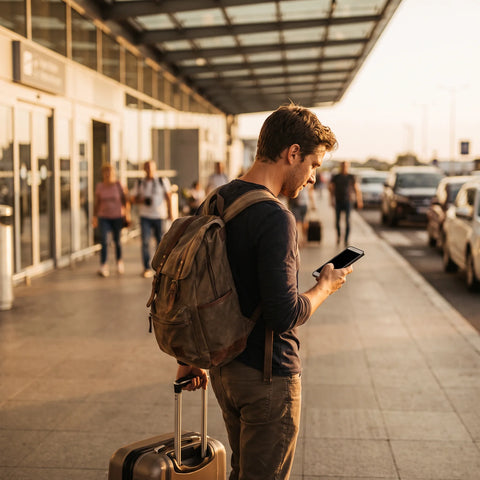
In short: the eSIM for Ho Chi Minh is actually an eSIM for all of Vietnam: you install it at home with Wi-Fi, activate it upon landing at Tan Son Nhat, and it gives you solid coverage in District 1, Ben Thanh, and the Mekong Delta. For 2-3 days in Saigon, 2-3 GB will be more than enough; in the Cu Chi tunnels and Mekong canals, the signal drops, so download maps beforehand.
Ho Chi Minh, old Saigon, is endless motorbikes, rooftops with views, and a never-stopping District 1. To cross its streets without getting lost, order a Grab, and avoid arguments with a rigged taxi meter, you need mobile data from the moment you arrive. Here's the real coverage of the city, how many GB to request depending on your travel days, and why, ultimately, an "Ho Chi Minh eSIM" is always for all of Vietnam.
What an eSIM is and why it's convenient in Saigon
An eSIM is a plastic-free SIM card: a profile that is installed by software and coexists with your home line without touching it. If you've never used one, "what is a virtual eSIM" provides a complete explanation before you continue. The advantage for a trip like this is simple: you arrive at Tan Son Nhat with data already active, without having to look for a local operator's counter or fill out forms with your passport in hand.
In Saigon, this is not a whim. The city moves by motorbike and Grab, and without GPS or a connection, you quickly get lost in the labyrinth of alleys in District 1 and District 3. With the eSIM ready before leaving home, the first thing to do upon landing is to open the Grab app, not to struggle with a telecommunications counter late at night.
Internet from Tan Son Nhat Airport (SGN)
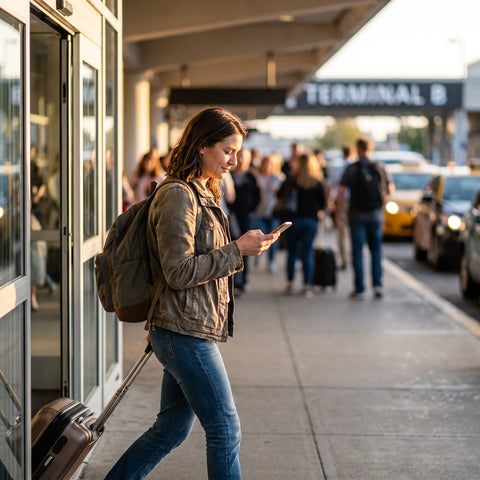
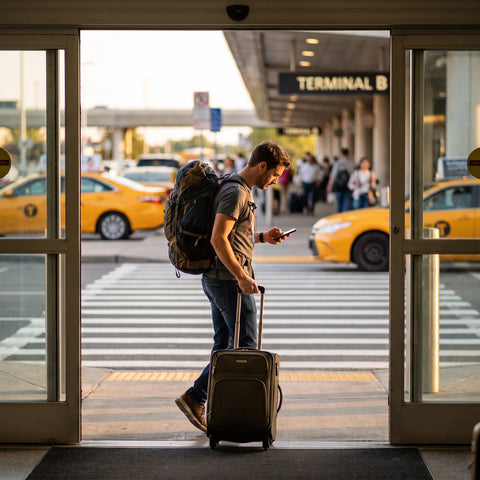
Tan Son Nhat Airport (SGN code) is next to the city, about 20-30 minutes from District 1 depending on traffic, which in Saigon is heavy almost at any time. With the eSIM installed beforehand, upon landing you only need to activate the data for that line and, in less than a minute, you will have coverage to order your transport.
That saves you the queue at the physical SIM counter, leaving your passport as a deposit for registration, and the typical surcharge of the arrivals area. A traveler's tip for Saigon: order your Grab from inside the terminal, because the pick-up point is marked by zones and that way you avoid taxi drivers who approach you at the exit offering rides at inflated prices. Having the eSIM activated before crossing the arrivals gate saves you that first unpleasant moment of the trip.
Is there an eSIM just for Ho Chi Minh?
There is no exclusive eSIM for Ho Chi Minh: you need one for Vietnam, which works equally well in Saigon, Hanoi, Da Nang, or the Mekong Delta. With a country plan, you have a single line for your entire route, without buying anything new when changing cities or reconfiguring your phone every time you get on a night bus.
Thinking of "Ho Chi Minh eSIM" only helps you calculate the GB based on the days you spend there, not to choose a different product. If your trip starts in the south and goes north, the same line will work for you from beginning to end. And if you are going to link Vietnam with Cambodia, Thailand, or Laos, it is advisable to review international chip vs. eSIM beforehand to decide if a regional plan or a country plan is better for you.
Real coverage: District 1, Mekong, and Cu Chi tunnels
In District 1, Ben Thanh, the rooftop area along the river, and the backpacker district of Pham Ngu Lao, 4G coverage is solid and more than enough for maps, Grab, translator, and social media. The entire Ho Chi Minh metropolitan area is well covered by Vietnamese operators, so you'll navigate its infernal traffic with your GPS always up to date.
On excursions to the Mekong Delta (My Tho, Ben Tre, Can Tho), coverage reaches towns and roads well, but on boat trips through narrow canals and in more rural areas, the signal drops, sometimes disappearing for a while. The honest recommendation is to download offline maps and tour information before getting on the boat, because you won't have reliable data there.
Useful tip: In the Cu Chi tunnels, a classic excursion from Saigon, coverage is weak underground, as would be expected from a network of tunnels dug for hiding. Download the tour information before going down and don't rely on having data down there.
Outside of these two specific points—Mekong canals and Cu Chi underground—you won't have any surprises: the signal in the rest of Ho Chi Minh province and on the main roads to Vung Tau or Da Lat remains stable.
How many GB to request based on your days in the city
Ho Chi Minh is usually the beginning or end of a route through Vietnam, with stays of between 2 and 5 days. To calculate the data, think about what you will really use: Grab, maps, messaging, and social networks are light; video streaming is what consumes the most, by far. This table serves as a general guide:
| Stay | Typical Use | Estimated GB |
|---|---|---|
| Saigon 2-3 days | Grab, maps, chat | 2-3 GB |
| City + Mekong (5 days) | Normal use + photos | 4-5 GB |
| Vietnam tour (2 weeks) | Intensive, some video | 10-12 GB |
| Nomad / remote work | Daily video calls | Plan with more margin or unlimited |
If you're running low on data, take advantage of Wi-Fi in cafes, hotels, and rooftops for heavy downloads (photos, apps, updates) and save the eSIM for the street, where you really need it. To adjust the calculation to your travel style, including tricks to extend your GB, you can find more details in how to save data with an eSIM on a trip. It's always better to request a little extra than to run out in the middle of an excursion day.
eSIM, physical SIM, or roaming: what's best in Vietnam
In Saigon, having data isn't just convenience, it's direct savings. With Grab, you can order a motorbike or car at a fixed price from the app and forget about the rigged taxi meter, a classic city problem that continues to cause issues for those arriving without a connection. Without internet, negotiating each ride becomes an exhausting sport, and you almost always lose.
Compared to roaming with your Spanish operator, an eSIM is usually more cost-effective: roaming outside the European Union can be quite expensive depending on your plan, whereas a Vietnam eSIM plan tailored for your stay is typically cheaper and, most importantly, more predictable, because you know beforehand how many GB you have. It's advisable to check your operator's exact conditions before you leave, as they vary greatly between companies; you can find a complete breakdown in eSIM vs. roaming and an explanation of what data roaming actually is in what is data roaming.
Compared to buying a physical SIM in Vietnam: an eSIM saves you the queue, passport registration, and losing your Spanish number while you use it, because two lines coexist on the same phone. The only real downside is that you need an eSIM-compatible and unlocked phone; if you have doubts about this, resolve them before checking your luggage, not in the queue at Tan Son Nhat.
How to install it before flying
Installation is done at home with Wi-Fi in a couple of minutes; you leave activation for landing, so you don't spend data from the Vietnamese line while still in Spain. These are the steps:
- Purchase the Vietnam eSIM and receive the QR code by email in a few minutes.
- With Wi-Fi at home, go to Settings > Mobile Data > Add eSIM and scan the QR.
- Name it "Vietnam" so you don't confuse it with your home line when you have both active.
- Upon landing at Tan Son Nhat, select that eSIM for mobile data and activate data roaming specific to that line (it's a separate switch from your Spanish line).
- You will see the local operator in the status bar: you can now open Grab and order your car.
If this is your first eSIM and you want step-by-step instructions with screenshots for your phone model, you can find the complete guide on how to install an eSIM. Your Spanish line remains active in the background to receive bank SMS, although it's advisable to deactivate its data roaming so it doesn't try to connect outside the EU and trigger an alert from your operator.
Myths and what almost no one tells you
There are a few ideas circulating about connectivity in Vietnam that are worth clarifying before they catch you by surprise in Saigon:
"Vietnam blocks Instagram and WhatsApp like China." This is not true. Vietnam does not have a firewall equivalent to China's: WhatsApp, Instagram, Facebook, and Google Maps work without restrictions with normal mobile data. You do not need a VPN to use them. Where a VPN might make sense is to protect your bank data if you ever use public Wi-Fi in a hotel or cafe; if you're interested in that point, it's covered in eSIM, VPN, and privacy on a trip.
"With the eSIM I have a Vietnamese phone number." No, and this surprises quite a few people. Travel eSIM plans are almost always data-only, without a local number. For daily use, you won't notice it: Grab, maps, and messaging work the same. But if you're going to register for local payment apps like MoMo or VNPay, which often ask for a Vietnamese number for SMS verification, you'll hit a wall there. For paying on the street in Saigon, card or cash is still the most reliable plan for a visitor.
"If I have data, I don't need to carry cash." At street food stalls, in some markets like Ben Thanh outside the more touristy areas, and with motorbike taxis that stop directly on the street (not through Grab), cash in dong is still king. The eSIM solves navigation and communication, not payments on every corner.
"The hotel can call me if something goes wrong with the reservation." Without a local number, no. If you book accommodation, always leave a WhatsApp contact or email so they can notify you of any changes; a call to your Spanish number from a Vietnamese landline almost never gets through or is very expensive for the person making it.
Typical eSIM errors in Vietnam
The most common mistake is activating the eSIM too early, even before leaving home, and starting to use data from the Vietnam plan unnecessarily. Install it at home, yes, but only activate it upon landing.
The second is not realizing that data roaming is activated per line: having the eSIM installed is not enough; you have to go into its specific settings and turn on roaming for that line, because the general switch on the phone doesn't always cover everything depending on the system.
The third is buying with the thought that "Ho Chi Minh" is a different destination from "Vietnam" and ending up with two purchases when only one was needed. And the fourth, already mentioned, is relying on having coverage in the Mekong canals or underground in Cu Chi: there, the signal does not depend on your operator, it depends on the geography.
Frequently Asked Questions
Do I have data as soon as I land at Tan Son Nhat?
Yes, if you installed the eSIM before flying. Upon landing in Saigon, you only need to activate the data for that line and its data roaming, and in less than a minute, it connects to the Vietnamese network. This way, you can order a Grab from the SGN terminal itself and avoid taxi drivers offering rides at inflated prices right outside.
Does the Ho Chi Minh eSIM work for the rest of Vietnam?
Yes, because there is no city-specific eSIM: it's an eSIM for all of Vietnam, so the same line works for you in Ho Chi Minh, Hanoi, Da Nang, or the Mekong Delta. You don't need to buy anything new or reconfigure your phone when moving between cities within the country.
Is there coverage in the Mekong Delta and the Cu Chi tunnels?
In the towns and roads of the Mekong Delta, there is reasonable coverage, but it drops on boat trips through narrow canals. In the Cu Chi tunnels, the signal is weak underground, as expected. Download maps and tour information before you go so you don't rely on having data in either of these places.
How many GB do I need for a few days in Saigon?
With Grab, maps, WhatsApp, and social media, 2 to 3 GB is enough for 2-3 days in Ho Chi Minh. If you plan to make long video calls or stream video from your phone, it's better to calculate 4-5 GB or look for a plan with more margin. Remember that sharing your connection via hotspot with another device also consumes from your plan.
Can I use WhatsApp, Instagram, and Google Maps without restrictions in Vietnam?
Yes. Unlike China, Vietnam does not block these platforms: they work with normal mobile data, and you don't need a VPN to access them. A VPN might make sense for privacy if you connect to public Wi-Fi, but not due to censorship.
Does the eSIM give me a Vietnamese phone number?
No, travel eSIM plans are data-only, without a local number. You don't need one for browsing, using Grab, or messaging, but some local payment apps like MoMo or VNPay will ask for one for SMS verification. If you plan to use them, keep this in mind before relying on them for payments.
What happens to my Spanish line while I'm using the eSIM?
It remains active on your phone to receive bank SMS or calls if someone reaches you on your usual number. It's advisable to deactivate its data roaming upon arrival in Vietnam so it doesn't try to connect outside the EU and to avoid any consumption alerts from your Spanish operator.
Conclusion
For Ho Chi Minh, the recipe is straightforward: buy the Vietnam eSIM, install it at home with Wi-Fi, and activate it upon landing at Tan Son Nhat. You'll have data from the terminal to order a Grab, solid coverage in District 1, and a single line that works for your entire trip, including the Mekong Delta. Calculate 2-3 GB for a short getaway or 4-5 GB if you add excursions, keep in mind that in the Mekong canals and underground in Cu Chi, the signal doesn't depend on your operator, and arrive in Saigon connected from the first minute, without rigged taxi meters or roaming surprises.