In short: there is no city-specific eSIM for Hanoi — you buy the Vietnam eSIM, install it before your flight, and activate your data when you land at Noi Bai. With 3 GB you’re covered for a 3–4 day trip to the Old Quarter; if you add Ha Long or Sapa, go up to 5–6 GB. You land with internet, no physical SIM queues and no roaming from your carrier.
Hanoi hits you hard the moment you step out of the taxi: the Old Quarter is a hive of motorbikes, dangling cables and streets that change name at every intersection. Without data you’ll get lost literally, not figuratively. With the eSIM for Hanoi ready before you fly you’ll have Google Maps, Grab and the translator working from the moment you clear passport control at Noi Bai airport. Here’s how to connect from the airport, what coverage you’ll really get, and how many GB to take depending on your route through northern Vietnam.
Is a city eSIM worth it for Hanoi?
The eSIM you buy for Hanoi is actually the Vietnam one: it covers the capital and the rest of the country on the same line. There’s no city-only product, so the same eSIM works in Hanoi, Ha Long Bay, Sapa or if you later fly south. Thinking in terms of a "Hanoi eSIM" only helps you work out the GB based on how many days you spend in the north.
It’s the most convenient option for a traveler: install once, activate on landing, and forget about it. If your route later goes down to Ho Chi Minh, the same line keeps working without having to manage data roaming from another carrier; it’s explained in the guide on what data roaming is. The idea is one eSIM for all of Vietnam, not one per city. And if your itinerary isn’t limited to the north, the general country reference is the Vietnam eSIM, designed exactly to cover any leg of the route regardless of where you enter or leave.

How many GB you really need
For a typical 3 to 5 day stay in Hanoi with maps, Grab, WhatsApp and social media, 3 to 5 GB is usually plenty. If you make video calls daily or watch video on your phone, bump that up or look for an unlimited plan. Video is always what drives usage, not maps or messages.
Since Hanoi is often the gateway to longer routes through the north, it’s worth thinking about the total trip, not just the city. This table gives you a guide:
| Travel plan | Usage profile | Recommended GB |
|---|---|---|
| Hanoi 3–4 days | Maps, chat, Grab | 3 GB |
| Hanoi + Ha Long/Sapa (1 week) | Normal use + photos | 5–6 GB |
| North + south (2 weeks) | Heavy, some video | 10–12 GB |
| Remote work / nomad | Daily video calls | Unlimited |
If you run short, use cafe Wi-Fi (Hanoi is full of them, especially around Hoan Kiem Lake) for the heavy stuff. To fine-tune based on your travel style, check out how to save data on a trip with eSIM. Better to have a bit of a buffer than to be stranded hunting for a phone shop or begging for Wi-Fi at a hotel that isn’t yours.
Internet from Noi Bai Airport (HAN)
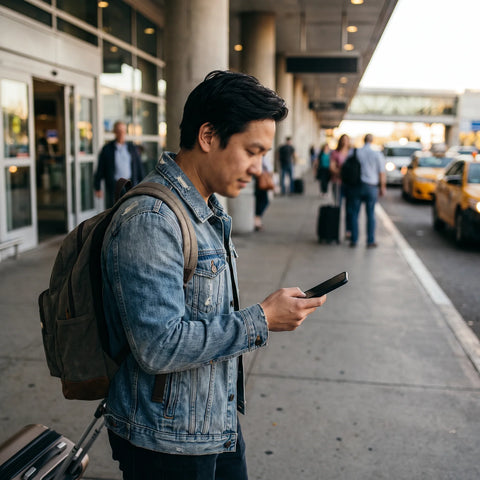
Noi Bai International Airport (code HAN) is about 45 minutes from central Hanoi, so you'll want data as soon as you land to order a Grab or find the bus. With the eSIM installed beforehand, you just switch on data for that line when you get off the plane and you'll have coverage in under a minute.
That saves you the queue at the physical SIM counter, the passport paperwork, and the airport markup. A practical tip: turn on data before you leave the baggage claim area, so you reach the arrivals gate with your ride already booked and the driver tracking you by GPS instead of you scanning license plates in the crowd. The eSIM ready before takeoff makes arriving in Hanoi smooth instead of stressful.
Tip: at Noi Bai, some drivers offer "curbside" taxis at inflated prices, especially right outside the terminal. With data, you order a Grab with a fixed fare and skip the classic airport haggle; the app shows you the price before you get in, no surprises when you arrive.

Coverage in the Old Quarter and northern excursions
In Hanoi's Old Quarter, Hoan Kiem Lake, and the French Quarter, 4G coverage is more than enough for maps, translator, and social media. Vietnamese operators provide good service across the city, so you'll navigate those chaotic streets with GPS working well, even in the narrow alleys of the 36 Streets district where each stretch sells a different product and getting lost is very easy.
On northern excursions it's different due to the terrain. In Ha Long Bay you get coverage near the coast but it's patchy out at sea, so if you're on a day cruise don't count on uploading photos live from mid-bay. In Sapa and the rice terraces there's signal in the villages but it drops on mountain trails, especially heading down into the valleys where the Hmong community lives. The rule is to download offline maps before each excursion, not when you're already without coverage and unsure which way to go. If you're torn between an eSIM and a physical SIM bought there for trips like these, this comparison clears up the differences: international chip vs eSIM.
Vietnam eSIM vs a local Viettel SIM
Many people search for "esim vietnam viettel" thinking they absolutely need the local operator. The truth is that a Vietnam eSIM uses those same national networks (Viettel among them), but without you having to go to a store, hand over your passport, or swap out your physical card.
The practical difference: with a local SIM you save money if you're staying for weeks and using a huge amount of data, but you lose time on paperwork and you're without your home number for the trip. With an eSIM you install in 5 minutes, keep your regular line for bank SMS or verification codes from your apps, and activate when you land. For a normal one- or two-week trip, the eSIM wins on convenience. If you compare it with your carrier's roaming, the cost difference is significant; you can see that at eSIM vs roaming. And if you've never used one, it's also worth understanding what exactly a virtual eSIM is before buying.
That said, there's one case where a traveler eSIM isn't the best option: if you're settling in Hanoi for several months for work or study, a local physical SIM with a monthly plan works out better, because the cost per GB drops a lot at higher sustained volumes. The traveler eSIM is designed for stays of days or a few weeks, not for a move.
Hassle-free installation and activation
Installing the eSIM takes a couple of minutes and you do it at home with Wi-Fi, before checking your bag. You only leave activation for landing:
- Buy the Vietnam eSIM and receive the QR by email almost instantly.
- With Wi-Fi, go to Settings > Mobile Data > Add eSIM and scan the code.
- Name it "Vietnam" to tell it apart from your regular line.
- When you arrive at Noi Bai, select that eSIM for data and turn on data roaming for that line.
- Check that it connected (you'll see the local carrier in the status bar) and you're browsing.
If this is your first eSIM, refer to the eSIM installation guide. Your home SIM stays in for important calls and SMS, and you can keep receiving those verification codes without relying on the Vietnamese line.
Myths and what almost no one tells you
There are a few ideas floating around about Hanoi and eSIMs that are worth clarifying before you travel, because they cause scares that are easily avoided:
- "If my phone is old, it doesn't have eSIM." Not all models support it, that's true, but most phones from recent years do. Check before buying in your phone's settings, in the mobile data section; if the option "add eSIM" appears, you're good.
- "In Vietnam you need to activate a VPN for everything." That's an exaggerated myth: for normal browsing, maps and usual social media you don't need anything special. If your work depends on accessing specific tools or you want an extra layer of privacy, then it's worth looking into; you have more detail in eSIM and VPN for traveling with privacy.
- "Buying the eSIM at the airport is cheaper." Quite the opposite: at the airport, if you find anything, it's usually more expensive and with less room to compare plans calmly. Buying it from home, in advance, is what lets you choose the GB well without the pressure of the arrivals queue.
- "With eSIM I can't share data with my travel companion." Yes you can: hotspot works just like with a physical SIM. That said, keep it in mind when calculating the GB, because sharing the connection with another person easily doubles daily usage.
- "All eSIMs for Vietnam are the same." Not exactly: they vary in speed, whether they include some calls or just data, and in coverage outside big cities. Before buying, check if the plan covers rural areas well if your route includes Sapa or Ha Giang, not just Hanoi capital.
Frequently Asked Questions
Will I have internet as soon as I land at Noi Bai?
Yes, if you installed the eSIM before flying. When you land at Noi Bai, turn on mobile data for that line and data roaming, and within a minute it will connect to the Vietnamese network. That way you can order a Grab or find the bus to the city center right from the HAN airport terminal.
Does the Hanoi eSIM also work in Ha Long and Sapa?
Yes. It's not just a Hanoi eSIM, but a whole Vietnam eSIM, so it covers Ha Long Bay, Sapa and the rest of the country. Keep in mind that in mountain areas or out at sea the signal may drop, so it's a good idea to download offline maps before each trip.
Is an eSIM better than a Viettel SIM bought there?
For a regular trip, the eSIM is more practical: you install it in 5 minutes, you don't leave your passport at any store, and you keep your home number. A local SIM can be slightly cheaper if you're staying for weeks and using a lot of data, but you waste time on paperwork and lose your home line.
How many GB will I use in 4 days in Hanoi?
With maps, Grab, WhatsApp and social media, about 3 GB is enough for 3-4 days in Hanoi. If you make long video calls or watch video on your phone, plan for 4-5 GB or look for an unlimited plan. Remember that sharing your connection via hotspot also uses up your plan.
Can I use Grab and WhatsApp with the eSIM?
Yes, no problem. Grab works great in Hanoi with the eSIM for booking a motorbike or car at a fixed price, and WhatsApp works normally for calls and messages. Both use little data unless you make long video calls, which is what eats up the most from your plan.
Do I need to activate the eSIM before leaving home or can I do it once in Vietnam?
You can install and activate it anytime, but the convenient way is to install it at home on Wi-Fi and only turn on data when you land. That way you avoid relying on airport Wi-Fi or another network's data to download it just when you're in a hurry.
What if my eSIM runs out of GB mid-trip in Vietnam?
You can top up the plan or buy another eSIM without moving from where you are, all from your phone. That's an advantage over a physical SIM, where you'd have to go back to a store; with an eSIM the process is done online from anywhere on your route.
Conclusion
For Hanoi the move is clear: buy the Vietnam eSIM, install it at home and activate it when you land at Noi Bai. You'll have data from the terminal to order your Grab, solid coverage in the Old Quarter, and a single line for your whole route through the north, including Ha Long or Sapa. Plan for 3 GB for a short trip or 5-6 GB for a week with excursions. Step off the plane connected and skip the queues and markups.