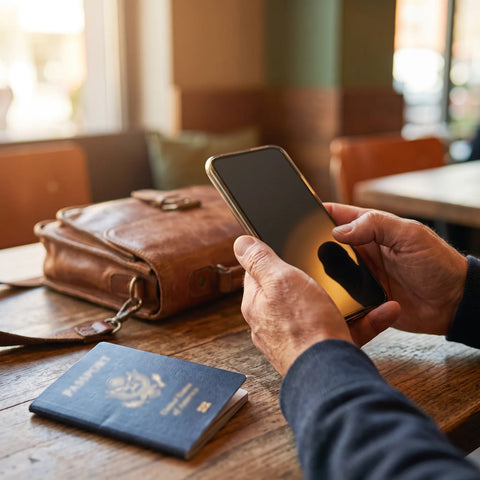
In short: An eSIM for Oslo gives you your own internet connection as soon as you land at Gardermoen, with no roaming, no physical SIM card, and no queues. You install it at home before you leave, activate the data upon arrival, and connect to the Norwegian network (Telenor or Telia) in a minute. For a city break, 1 to 3 GB will be more than enough.
Oslo is expensive for almost everything, so the last thing you want is to add a roaming bill to your six-euro coffee. With an eSIM for Oslo installed before departure, you’ll leave Gardermoen Airport already connected, with Google Maps open and your Flytoget ticket handy. You land with internet, no roaming, no stress. In this guide, you'll see what coverage to expect in the Norwegian capital, how many GB to bring for a weekend, and why a city eSIM is approached differently from one for the whole country.
Do I need an eSIM for Oslo?
The short answer: almost certainly yes, unless your plan covers Norway at no extra cost. And beware, because many people assume it does and get an unpleasant surprise. Norway is not part of the European Union, although it is part of the Schengen area and the European Economic Area. This means that the "roaming like at home" rates you enjoy within the EU don't always apply there, and some operators charge a daily extra for using your data in Norwegian territory.
Translated into practice: without an eSIM, you either pay roaming at operator prices or spend your trip begging for Wi-Fi. An eSIM for Oslo gives you your own data from the moment you step into the terminal, without depending on anyone and without nasty surprises on your next month's bill. For a city break, it's the most convenient option and, in such an expensive country, also the most sensible for your wallet.
Before buying anything, do a two-minute check: look at the roaming conditions of your contract and see if Norway appears in the included zone. If it's not included, or if it charges per day, the eSIM pays for itself from the first day. The underlying idea is simple: without coverage included in your plan, every megabyte you spend there is paid at roaming prices.
Internet from Gardermoen Airport
Oslo Airport (Gardermoen, code OSL) has free Wi-Fi, but ideally, you shouldn't rely on it as soon as you land. The airport network usually requires registration, gets saturated at peak times, and doesn't accompany you when you board the train to the city center. With the eSIM already installed, you activate the data as soon as you touch down and leave the terminal connected.
At Gardermoen, that's more useful than it seems. The airport is about 50 kilometers from the city center, so almost everyone takes the Flytoget (the express train) or a cheaper regional Vy train. Both run on a schedule, and buying your ticket from your phone, checking the platform, and opening the map as you walk saves you the classic "I can't connect and my train is leaving" hassle. With data from the first step, you coordinate your transfer without wasting time.
The golden trick: install the eSIM profile at home, using your usual Wi-Fi, and leave data activation until you land. Installing the profile doesn't consume data; it simply loads the configuration onto your phone. So, when you arrive in Oslo, all you have to do is turn on the line and wait a minute for it to connect to the network. No scanning QR codes in the middle of the terminal with luggage in tow.
Coverage in Oslo: operators and 5G
Good news for travelers: Norway has one of the best mobile networks in Europe, and Oslo is exceptionally well covered. The two main operators are Telenor and Telia, both with widespread 4G and 5G throughout the capital. In the city center, on the subway (the T-bane), in the museums on the Bygdøy peninsula, or in the Aker Brygge harbor area, you'll have quality signal without thinking about it.
A travel eSIM that relies on Telenor or Telia offers you the same coverage without needing to contract anything locally or visit a store. Urban network coverage is not an issue in Oslo. The only place where it's advisable to lower expectations is outside the city: if you escape to the fjords, go up to Holmenkollen on a foggy day, or hike in the mountains, the signal may falter in specific areas. For that, the usual solution is to have maps downloaded offline.
| Area of Oslo | Typical Coverage | Tip |
|---|---|---|
| City Center and Aker Brygge | Excellent 4G/5G | Browse without limits |
| T-bane Metro | Good on most sections | Save your ticket offline |
| Bygdøy Museums | Solid 4G/5G | Upload photos without issue |
| Holmenkollen and hills | Good, with weak spots | Download the map beforehand |
| Fjords and mountains | Variable | Offline maps and routes |
How many GB for a getaway to Oslo
A city break consumes little data if you take advantage of hotel Wi-Fi at night for large downloads. For a long weekend in Oslo, with maps, messaging, social media, and some occasional searches, between 1 and 3 GB is usually sufficient. If you use a translator a lot, upload many stories, or make video calls home, step up a level to be safe.
This table gives you a realistic reference based on the number of days and your consumption rate:
| Duration in Oslo | Light use | Medium use | Heavy use |
|---|---|---|---|
| Weekend (2-3 days) | 1 GB | 2-3 GB | 4-5 GB |
| Getaway (4-5 days) | 2 GB | 4-5 GB | 7-8 GB |
| Full week | 3 GB | 6-8 GB | 10 GB or more |
As you can see, you don't need a huge plan to get around a city. The key is that in Oslo, Wi-Fi is everywhere, so much of the heavy consumption (updating apps, backing up photos, watching long videos) can be left for when you're connected at your accommodation. If you have doubts about your specific profile, the guide on how much data you need for travel helps you fine-tune the calculation without overdoing it or falling short.
Oslo city vs. all of Norway: which eSIM to choose
This is the decision that truly matters. If your trip is limited to Oslo and its surroundings (the Oslo Fjord, Holmenkollen, a day trip), a small-GB eSIM is more than enough: urban consumption is contained. But if the plan is more ambitious (going to Bergen, exploring the western fjords, taking a road trip through the interior), data consumption skyrockets. Navigation maps on the road, without Wi-Fi and with the screen always on, consume much more than people estimate.
The important thing to understand: there is no "Oslo only" eSIM. The product is the same in both cases, an eSIM for Norway that works just as well in the capital as in the rest of the country. The only thing that changes is the amount of GB depending on your route. Few if you stay in the city, a more generous plan if you are going to travel across the country.
What if your itinerary crosses borders? If you're going from Oslo to Stockholm, Copenhagen, or any other Nordic capital, don't buy an eSIM per country: a regional plan is more suitable. We elaborate on this in the guide to eSIM for Scandinavia, and if you're traveling through more countries on the continent, an eSIM for Europe might be more cost-effective than adding individual plans. For example, many combine Oslo with a stop in neighboring Sweden or Denmark; in that case, a plan covering several countries prevents you from adding individual eSIMs at each border.
How to activate your eSIM upon arrival
The process is quick and doesn't require technical knowledge. Here are the steps, in order:
- Buy the eSIM before your trip and receive the QR code by email, comfortably at home and with your Wi-Fi.
- Install the profile by scanning the QR from your phone settings. This doesn't consume data yet; it just prepares the eSIM.
- Upon landing in Oslo, activate the eSIM data line and turn on data roaming for that specific profile.
- Wait a minute for it to connect to Telenor or Telia, and you'll be browsing right inside the Gardermoen terminal.
If it's your first time with this technology, the guide on how to install an eSIM details it step by step with screenshots. And remember the usual recommendation: install at home and activate data only upon arrival, so you don't consume data prematurely or get surprises with the validity date.
Common myths and mistakes (what almost no one tells you)
There are a couple of misconceptions circulating about eSIMs and Norway that should be debunked before you travel. These are the most common pitfalls:
"Since it's Europe, I have free roaming." As we've already said, this is the number one mistake: Norway is not the EU. Check your contract instead of taking it for granted. If you rely on it and it's not included, the bill will remind you when you return.
"I'll buy the eSIM when I arrive, using the airport internet." Bad idea. Buying and configuring the eSIM at the terminal, tired and with luggage, relying on Wi-Fi that might not even work well, is precisely the opposite of what you want. Buy and install it at home; arriving and activating takes a matter of seconds.
"I need tons of data just in case." For a city with as much Wi-Fi as Oslo, that's throwing money away. It's better to start with a modest plan and, if you run short, top up. Almost all travel eSIMs allow you to extend the GBs without changing your profile.
And now, the small tricks that make a difference and rarely appear in guides:
- Download the Oslo map offline before you leave. The T-bane and tram can be navigated perfectly without spending a single megabyte.
- Take advantage of Wi-Fi at museums, cafes, and your hotel for app updates and photo backups, which is where consumption skyrockets the most.
- Save your Flytoget and public transport tickets in your phone's wallet, so you don't have to load them using data every time you pass through a turnstile.
- Disable automatic video playback on social media. It's the silent hole through which most data leaks without you noticing.
- Download the language in your translator in advance. In Norway, almost everyone speaks impeccable English, but for signs and menus, it's good to have it offline.
With these gestures, a small plan will last you more than enough for your entire getaway. If you want to squeeze every GB, you have more ideas in the guide on how to save data with your eSIM, and if you're concerned about general expenses in such an expensive country, review how to avoid roaming so you don't get any surprises when you return.
eSIM vs. operator roaming: the quick comparison
To see it at a glance, here's the difference between relying on your Spanish operator's roaming in Norway and carrying a travel eSIM:
| Aspect | Operator Roaming | eSIM for Oslo |
|---|---|---|
| Cost in Norway | May apply daily extra; check current price with your operator | Fixed price per data plan |
| Cost control | Risk of bill surprise | You know what you're paying beforehand |
| Activation | Automatic, but without control | You decide when data starts |
| Physical SIM card | Uses your usual SIM | Digital, coexists with your usual number |
| Coverage | Your operator's agreement | Telenor or Telia, top-level network |
If you want a thorough analysis of both options, with their real pros and cons, you can find it in the comparison of eSIM versus roaming.
Frequently asked questions
Do I have free roaming in Oslo if I'm from the EU?
Not necessarily. Norway is in Schengen but not in the European Union, so European "roaming like at home" rates don't always cover it and an extra daily charge may apply. Check your contract conditions: if it doesn't include Norway at no cost, an eSIM for Oslo will be cheaper and more predictable from day one.
Does the eSIM work as soon as I land at Gardermoen?
Yes, provided you installed it before traveling. Upon landing, you just need to activate the data line and roaming for that profile, and within a minute, you'll connect to the Norwegian network (Telenor or Telia). This way, you leave the terminal already connected to buy your Flytoget ticket and open the map without relying on airport Wi-Fi.
How many GB do I need for a weekend in Oslo?
For a weekend with normal use (maps, messaging, and social media), 1 to 3 GB is usually sufficient, especially if you take advantage of hotel Wi-Fi at night. If you make many video calls or upload a lot of videos, calculate a bit more. An eSIM with a top-up option allows you to extend without hassle if you run short mid-trip.
Does the Oslo eSIM work for the rest of Norway?
Yes. There is no "Oslo only" eSIM: you buy an eSIM for Norway that works in the capital and throughout the country. You only choose the GBs according to your route: a few if you stay in Oslo, more if you go to Bergen or explore the fjords, where navigation maps consume much more than one expects.
Is there good coverage on the Oslo metro and city center?
Yes. Norway has one of Europe's best networks, and Oslo is well-covered with 4G and 5G. In the T-bane, museums, and harbor, you'll have quality signal. Coverage might weaken outside the city, in the mountains or fjords, so it's advisable to download maps offline in case you lose signal in some sections.
Can I keep my WhatsApp number with the eSIM?
Yes. The eSIM provides travel data and coexists with your usual number on your phone, so your WhatsApp continues to work with your usual number via the eSIM's connection. You don't lose your chats or change accounts; you just browse with Norwegian data instead of roaming.
What happens if I run out of data in Oslo?
You won't be stranded: most travel eSIMs allow you to top up the same profile without reinstalling anything. You can extend the GBs from your phone as soon as you have Wi-Fi or some credit. Even so, with data-saving tricks (offline maps, Wi-Fi for large downloads), it's rare to exhaust a well-sized plan on a city break.
Conclusion
Oslo is expensive, but getting connected doesn't have to be. With an eSIM installed before departure, you'll leave Gardermoen browsing, move around the city with top-level coverage, and a small plan will be more than enough for a getaway. Adjust the GBs depending on whether you stay in the capital or venture to the fjords, forget about roaming, and coordinate the Flytoget from minute one. Arrive in Norway with your data ready and enjoy Oslo without watching the meter or fearing the bill.