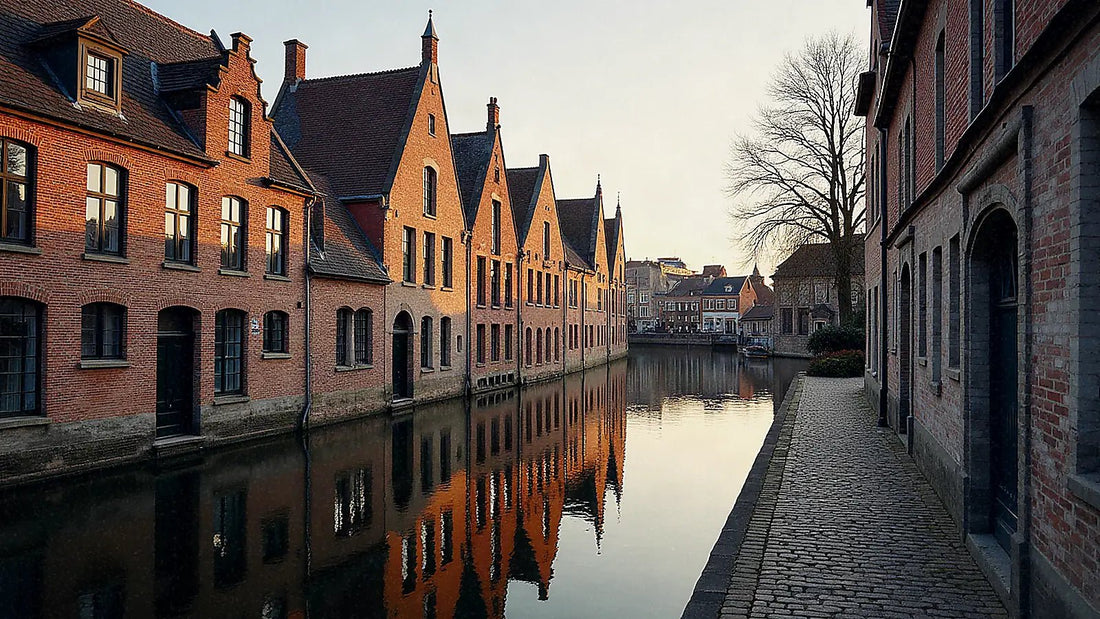
Bruges is Belgium's medieval gem: canals, a belfry, and a fairy-tale atmosphere that fills your phone with photos. To share them instantly, navigate its alleys with a map in hand, and avoid relying on cafe Wi-Fi, an eSIM is the most convenient solution. Here, we'll tell you exactly what an eSIM for Bruges covers, from the airport you arrive at to how many gigabytes you need for a getaway.
In summary: Bruges doesn't have its own eSIM; you need a Europe eSIM, which covers Belgium and provides internet as soon as you land in Brussels. For a weekend trip, 1-3 GB is enough; if your route continues to the Netherlands or France, the same eSIM will work without any changes.
Does an eSIM work for Bruges?
Yes. Bruges doesn't have its "own" eSIM: as a Belgian city, a Belgium eSIM works, covering the entire city and the rest of the country. You install it before you leave, you land and you're already browsing, without looking for stores or relying on the Wi-Fi of historical center cafes.
The important distinction is this: when you search for "Bruges eSIM," you actually need data coverage in Belgium, because eSIMs work by country or region, not by city. Our Europe eSIM includes Belgium—Bruges, Brussels, Ghent, and Antwerp—with the same digital card, so if your getaway combines several Belgian cities, you don't have to change anything. And since Belgium is a gateway to the Netherlands and France, it's also worth considering whether your route stays within or crosses borders: with a European regional eSIM, moving from one country to another makes no difference on your phone.
Tip for your getaway: Bruges can be explored entirely on foot in one or two days. With a map loaded on your phone and data always available, you won't waste time looking for Wi-Fi to locate the next canal or belfry.

How to get there: airports and first steps
Bruges does not have its own airport, so most travelers arrive via Brussels: Brussels-Zaventem Airport (BRU) or Brussels-South Charleroi Airport (CRL), which many low-cost airlines use. From both, there are direct or connecting trains to Bruges station in just over an hour.
This is where the eSIM shines: as soon as you step off the plane and turn on your phone, you have internet to buy train tickets, check schedules, and let people know you've arrived, without looking for airport Wi-Fi or queuing at a SIM card store. If your flight lands in Brussels and you stay there for a day before going to Bruges, the same Belgium eSIM covers both cities. Have data roaming activated on the eSIM line when you land and choose it as your data line; if you have doubts, review how to install the eSIM before you leave.
Coverage throughout the city and canals
The historic center of Bruges—Grote Markt, the Belfry, the Lake of Love (Minnewater), and the canals—has very good 4G/5G coverage. Being a compact and very touristy city, the signal is stable in the areas you will visit: you will browse without problems, taking photos, uploading stories, or following a walking tour on your phone.
A good Belgium eSIM relies on leading local operators, so you'll connect to the best available antenna without configuring anything. On boat trips through the canals or inside very thick stone buildings, the signal may drop temporarily, which is normal in any European old town. A trick: download the offline map of Bruges before you go, so you can navigate even if you enter a church with meter-thick walls. If your getaway continues to another country, you don't need anything extra: the same Europe eSIM maintains the connection without searching for new Wi-Fi at each border, unlike traditional roaming, which charges differently depending on the country you are in.

How many gigabytes for a getaway
For a weekend getaway to Bruges, you don't need a huge plan. Typical usage—maps, photos, social media, and some messaging—uses less than people think, especially if you take advantage of hotel Wi-Fi at night.
| Duration | Usage | Estimated Data |
|---|---|---|
| 1-2 days | Maps, photos, social media | 1-3 GB |
| 3-4 days | Medium usage + some video | 3-5 GB |
| Week (all of Belgium) | Several cities | 5-10 GB |
Since Bruges has Wi-Fi in most hotels, restaurants, and museums, you can save your eSIM data for outdoors: maps, finding places to eat, and sharing photos instantly. If you want to make your gigabytes last without running out by mid-afternoon, here are some tricks to save data on your eSIM that work just as well in Bruges as in any European city: disable automatic app updates, reduce the upload quality of photos, and close apps that continue to consume data in the background even if you're not looking at them.
Europe eSIM: is it valid for your entire route?
For Bruges—alone or combined with another Belgian city—the Europe eSIM is the simplest option: a single digital card, a single QR code, and coverage in Belgium from minute one. And here's the well-reasoned advice, not the easy sales pitch: if your trip is a short weekend and your Spanish plan already includes free roaming within the European Union, first consider whether you really need to buy anything. For a two-day trip to Bruges with a generous plan, adding an eSIM might be overspending.
Where the Europe eSIM makes a difference is when your route grows: Bruges plus Brussels plus Amsterdam plus Paris on the same trip, or when your Spanish operator overcharges when exceeding a certain data volume in roaming—something that happens more often than it seems with the tightest plans. In that case, the Europe eSIM gives you an independent data margin, without surprises on your bill when you return home. If you are still in doubt between this option and buying something upon arrival, the eSIM wins in activation speed and not having to look for a store as soon as you land.
Install it before traveling
The best time to prepare your eSIM is at home, with Wi-Fi and no rush, a few days before you fly. Installing the profile requires a connection, so doing it beforehand saves you the stress of configuring it at the airport with saturated Wi-Fi.
The process is quick: you buy the eSIM, receive a QR code by email, scan it from Settings, and give it a name to distinguish it from your Spanish SIM. Upon landing in Brussels, you activate data roaming on that line, choose it for mobile data, and you're already browsing on your way to Bruges. With the Europe eSIM ready before you leave, your getaway starts with internet from minute one, without queues or surprises. If it's your first time with a digital card, the step-by-step installation guide will resolve any doubts in no time.
Myths about the eSIM that you can avoid in Bruges
There are ideas circulating about eSIMs that, on a short trip like a getaway to Bruges, can make you waste time or overspend. Here are a few, by name:
"It's better to buy a physical SIM when I arrive." There are operator stores in Brussels-Zaventem, yes, but they usually have queues during peak flight hours and close earlier than you might think. With an eSIM, you already have active data before leaving the baggage claim area, without queuing or showing your passport at a counter. If you are still undecided between the two options, the comparison of physical chip versus eSIM resolves the most common doubts.
"The free Wi-Fi in downtown cafes is enough." It's true that Bruges' historic center is full of cafes with Wi-Fi, but it usually requires you to register with your email or make a purchase, and you won't stop every ten minutes to check the map on your way to the Lake of Love. Furthermore, connecting to unencrypted open networks in a highly touristy area has its risks: if you're going to rely heavily on public Wi-Fi, it's worth understanding what a VPN does on a trip and when it's worth activating it.
"With my Spanish plan's roaming, I'm all set; nothing else is needed." It depends on the plan, and this is where it's really worth being clear: many plans include roaming in the EU, but with a data limit that runs out quickly if you record video of the carillon or Minnewater in high quality. If your plan has little margin or roaming is expensive, an eSIM pays off. But if your operator already gives you several gigabytes in the EU and you're only going to be there for two days, spend your money on Belgian chocolate rather than data you won't need.
What almost no one tells you: the Bruges belfry has a weak signal as you climb the 366 steps—the narrow opening of the tower blocks coverage past a certain height—so download the photos you want to share before you start climbing, not halfway up. And if you visit the Beguinage (Begijnhof) at sunset, when the large gates of the enclosure have already closed, you'll notice that the signal drops a bit due to the thickness of the walls; nothing that can't be fixed by going out to the street next door, by the canal.
Frequently asked questions
Is there a specific eSIM for Bruges?
There isn't an eSIM just for Bruges, because eSIMs work by country or region. For Bruges, you need a Belgium eSIM, which covers the entire city and also Brussels, Ghent, and Antwerp. With a single digital card, you'll have internet access anywhere on your Belgian getaway.
Which airport do I arrive at for Bruges?
Bruges does not have its own airport. Most travelers arrive via Brussels: Brussels-Zaventem Airport or Charleroi Airport, which is widely used by low-cost airlines. From both, there's a train to Bruges station in just over an hour. The Belgium eSIM provides data as soon as you land.
How many gigabytes do I need for a weekend in Bruges?
For one or two days of normal use (maps, photos, and social media), 1-3 GB is usually enough, especially if you use the hotel's Wi-Fi at night. If you stay longer or visit several Belgian cities, estimate between 3 and 10 GB depending on how much video you consume.
Will the same eSIM work if I'm also going to Amsterdam or Paris?
Yes, if you use the Europe eSIM: it covers Belgium and its neighboring countries with the same profile, so crossing into the Netherlands or France won't leave you without data or force you to install anything new. This is precisely the advantage over an eSIM that would only cover one country.
Will I have good coverage in the historic center and canals?
Yes. Bruges' city center has very good 4G/5G coverage because it's a compact and touristy area. You'll browse without problems in Grote Markt, at the belfry, or along the canals. The signal may only drop temporarily inside very thick stone buildings or near the top of the Belfry; for that, download the offline map before you go.
Can I install the eSIM directly at Brussels airport?
Technically yes, if the airport has free Wi-Fi, but it's not ideal: installing an eSIM profile requires a stable connection, and the Wi-Fi at a crowded airport can fail just when you need it most. It's better to install it at home, calmly, and when you land, you just have to activate it from your phone settings.
Do I need to remove my physical SIM to use the eSIM in Bruges?
No. eSIM-compatible phones hold both lines simultaneously: your Spanish physical SIM and the eSIM data profile for Europe. You just need to choose which one uses mobile data from the settings, so you keep receiving calls and SMS on your usual number while browsing with the eSIM.
Conclusion
To visit Bruges with data from the moment you arrive, a Europe eSIM is the most convenient option: it covers the entire city, works as soon as you land in Brussels, and saves you from relying on cafe Wi-Fi. If your route crosses to Amsterdam or Paris, the same digital card will accompany you without any changes. Prepare your Europe eSIM before you leave and enjoy the canals with your phone always connected.