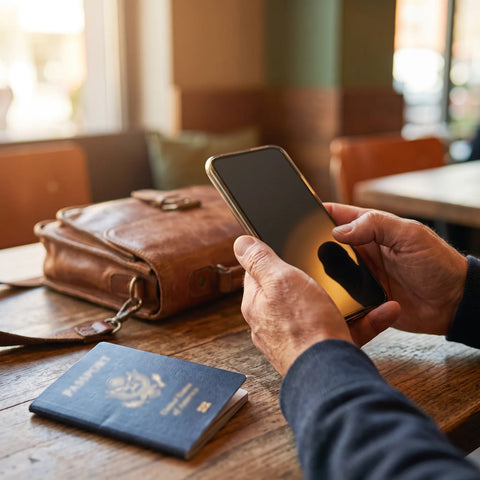
In short: an eSIM for Crete gives you internet as soon as you land in Heraklion or Chania, with solid coverage across the entire north coast and tourist areas. It's not a separate product: it's covered by a plan that includes Greece. If your Spanish plan already includes free EU roaming, you might not need to buy anything; if not, activate it before you fly and you're all set.
What is an eSIM and why is it useful in Crete
An eSIM is a digital SIM card: it's installed by scanning a QR code, no plastic or store visits needed, and coexists with your usual Spanish line. For Crete, this means you arrive with your usual number active for calls and WhatsApp, and a second data line that uses the Greek network for browsing, all on the same mobile. If you've never used one, it's worth understanding first what a virtual eSIM is and how it differs from the traditional physical SIM.
Crete is administratively part of Greece and also part of the Greek mobile network: there is no "Cretan" operator distinct from the rest of the country. That's why any data plan covering Greece works the same in Heraklion as in Chania, Rethymno, or Agios Nikolaos. There is no need for a specific "eSIM Crete" product: searching for it is a waste of time comparing something that, in practice, is the same as buying Greek coverage.
Do you really need to buy one? EU roaming explained
Here, we have to be honest, even if it doesn't suit us to sell. Spain is in the European Union and so is Greece, so since 2017, the "roam like at home" regulation applies: if your Spanish plan includes mobile data, in Crete you use your Spanish data allowance at no extra cost, within your operator's fair use policies. This means that for many travelers, their phone already works as soon as they land, without touching anything.
When DOES an eSIM for Crete make sense then? In several specific cases: if your plan is an old one or a low-cost one that doesn't include EU roaming (there are very affordable plans that exclude it, check the conditions before traveling); if you have few GB in your Spanish allowance and you're afraid of running out of data halfway through your trip while driving around the island; if you prefer not to touch your main line for cost control or because you're traveling with a prepaid card; or if you're chaining Crete with countries outside the EU where roaming is indeed expensive. For a three-day long weekend with a normal Spanish plan, you probably don't need to buy anything. For two weeks exploring the island by car with little data coverage on your plan, it does pay off.
That said, many people prefer an eSIM even if they have EU roaming included: it leaves your Spanish data allowance intact for when you return, and avoids surprises if your operator applies fair use limits on roaming (some low-cost operators do have them, although they don't always communicate it clearly). If you want to fully understand the difference between relying on your operator's roaming or having your own eSIM, we have a dedicated comparison: eSIM versus roaming. And if you're interested in the technical detail of how data roaming works in general (not just in the EU), we explain it in what data roaming is.
Internet from Heraklion or Chania airport
Most flights to Crete from Spain land at Heraklion Airport (HER), the largest on the island, or Chania Airport (CHQ), smaller and more common for seasonal flights. At both, the free terminal Wi-Fi is often slow and requires email registration, just when you want to quickly get your rental car or taxi.
If you have an eSIM, the trick is to install it before you fly, at home and with Wi-Fi, and leave the data line deactivated until you land. This way you avoid wrestling with the QR code with poor coverage in the terminal or with your phone in airplane mode. Once you land, activate "data roaming" for that eSIM line (this is the step almost everyone forgets) and you'll already have a map to get to your hotel, you can order an Uber or Beat (it works in Heraklion and Chania) and let people know you've arrived without relying on anyone.
Real tip: the most common mistake is not coverage, it's settings. The eSIM is installed but the data line is still off, or the phone is still using the Spanish line for data by priority. Check in Settings which line has mobile data activated before leaving the terminal.
Real coverage across the island
Along the north coast, where most travelers move, 4G/5G coverage is solid: Heraklion, Chania, Rethymno, Agios Nikolaos, and Hersonissos all have good coverage, as do the large, car-accessible beaches. This is the most visited part of Crete and also the best covered.
Where the signal weakens is in the mountainous interior and the more isolated south. If you hike the Samaria Gorge, a classic hiking trail on the island, you'll have long stretches without coverage between the ravines: it's a protected mountain area, not for antennas. The same goes for the Lasithi plateau and secondary roads leading south. And if you go to Balos or Elafonisi beaches, which are much photographed and have final access by dirt track or boat, the signal may cut out at the very end. None of this is a fault with your eSIM: it's the topography of a mountainous island, and it would happen with any line, Spanish or Greek.
The solution isn't technical, it's about foresight: download an offline map of Crete (Google Maps and Maps.me allow it) before leaving the area with coverage, and have your itinerary for those stretches clear beforehand. If your route is also going to take you through more than one country this summer, you'll want to see how to save data with your travel eSIM, with tips that apply equally in Crete as on any island with shadow zones.
How many GB for your getaway
For a normal trip to Crete, with maps for driving, WhatsApp, social media, and a few reservations, estimate around 1 GB for every 3-4 days of moderate use. If you're going to share a lot of videos, make video calls, or use Instagram/TikTok frequently, that figure will go up quite a bit. One detail people underestimate: you'll use your phone as a car GPS for your rental car almost every day, and that consumes more than it seems, especially with the screen on and real-time navigation on winding roads.
| Trip Duration | Light Use (maps, chat) | High Use (video, social media) |
|---|---|---|
| Weekend (3 days) | 1 GB | 3 GB |
| Week (7 days) | 3 GB | 5-8 GB |
| 10-14 days | 5 GB | 10 GB or unlimited |
If your trip isn't just to Crete and you're going to combine it with other islands or countries on the continent, it's not worth buying a plan for each destination: a plan that covers several European countries, such as the Europe eSIM, will sort out your entire route with a single installation and without having to worry about changing lines when crossing borders or boarding a ferry.
How to activate it step-by-step
The process is short and doesn't vary much from one provider to another: you buy the plan, you receive a QR code by email, you scan it from Settings > Mobile Data > Add eSIM (on iPhone) or the equivalent SIM menu on Android, and confirm. On a compatible phone, from start to finish it takes a couple of minutes, most of it waiting for the phone to validate the profile.
Do it at home, with Wi-Fi, a few days before you fly; not in the security line. Almost all phones from the last five years support eSIM, but if it's your first time using one and you want the full step-by-step with screenshots, you can find it in how to install an eSIM. And if you're wondering whether to choose the traditional physical SIM or the digital one, here we compare international chip vs. eSIM so you can decide based on criteria, not habit.
Myths and what almost no one tells you
Myth 1: "Crete needs its own eSIM." No. We've already said it above, but it's worth repeating because it's the most common and most mistaken search: any Greek plan covers the entire island, without distinction.
Myth 2: "If I have an eSIM, I don't need Wi-Fi anywhere." Partially false. In rural areas with thick stone houses, typical of the island's interior, the signal inside the accommodation can be worse than outside; still ask about Wi-Fi for heavy tasks (uploading video, updating apps).
Myth 3: "More GB is always better." Not if you're going to rely on the accommodation's Wi-Fi for heavy tasks and only use data for light ones. Buying too much isn't a serious mistake, but it's money you didn't need to spend; adjust to the table above according to your actual travel pace, not the worst-case scenario.
One detail almost no one mentions: if you rent a car in Heraklion or Chania, some rental companies offer their own paid GPS. With an eSIM and Google Maps or Maps.me downloaded, that add-on is almost never necessary, so you can confidently decline it and save that line item on the contract. Another practical detail: if you're traveling and want to control which apps access your connection on networks you don't control (hotels, open Wi-Fi cafes), a VPN is a reasonable extra layer of privacy; we explain it in eSIM and VPN for private travel.
Frequently asked questions
Do I need a specific eSIM for Crete?
No. Crete is part of Greece and shares a network with the rest of the country, so it's covered by any plan that includes Greece. There is no need for a "Crete-only" product.
What if my Spanish plan already includes EU roaming?
Then you probably already have internet in Crete without buying anything, within your operator's fair use policy. An eSIM makes sense if your plan doesn't include EU roaming, you have few GB in your Spanish allowance, or you prefer not to touch your main line during the trip.
Will I have coverage on southern beaches like Elafonisi or Balos?
On the access roads and the beach itself, coverage can be patchy, especially on the final dirt track stretch or if you arrive by boat. Download an offline map before leaving the area with a signal.
How many GB should I take for a week in Crete?
For moderate use with maps, chat, and some social media, about 3 GB is usually enough. If you share a lot of video or make video calls, it's better to go for 5-8 GB. Driving around the island using your phone as a GPS daily consumes more than people estimate.
Will it work as soon as I land at the airport?
Yes, if you installed the eSIM before you flew. Upon landing in Heraklion or Chania, you just need to activate mobile data for that line, without relying on the terminal's Wi-Fi or email registrations.
Will there be coverage in the Samaria Gorge or the Lasithi Plateau?
In mountain stretches and gorges like Samaria, it's normal to lose signal for a good part of the route; it's a protected area without antennas, not a fault with your line. In Lasithi, coverage is more irregular than on the coast. Bring a downloaded map.
Does the same plan work if I also visit Athens or Santorini?
Yes, if the plan covers Greece in general and not just a specific area. And if your route crosses into other European countries, a regional plan like the Europe eSIM saves you from buying a new one every time you cross a border.
Conclusion
To get around Crete without relying on hotel Wi-Fi or airport queues, what you need is a data plan that covers Greece, not a specific product for the island. If your Spanish plan already gives you EU roaming, you might have enough with what you've got; if not, or if you prefer to be safe with separate GB for driving, maps, and social media, activate the eSIM before you fly and land already connected in Heraklion or Chania.