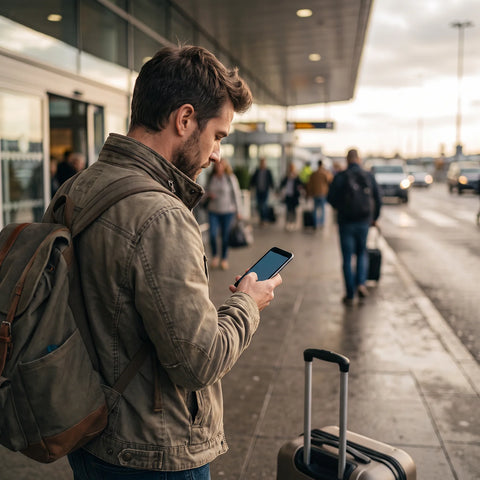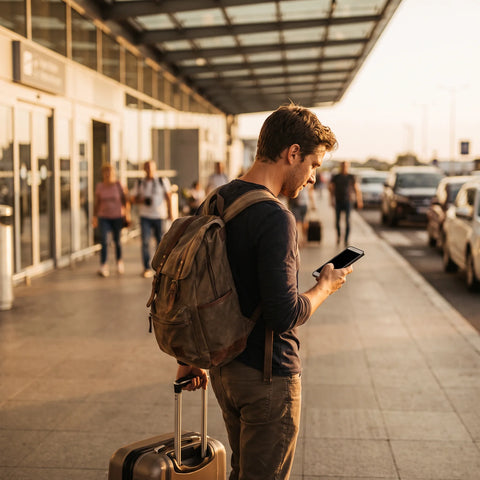
In short: the eSIM for Geneva gives you mobile data as soon as you land at Cointrin, without having to look for a physical card or rely on expensive Swiss roaming (outside the EU). You install it before you fly, activate it upon arrival, and in seconds you have maps, messaging, and transport working. For a normal weekend, 2-3 GB will be more than enough.
What is an eSIM for Geneva and why you need it
An eSIM for Geneva is a data profile that is installed on your mobile digitally, without a physical card, and that you activate when you set foot on Swiss soil. You install it at home with WiFi, leave it on standby during the flight, and upon landing at Geneva-Cointrin airport, you turn it on: in a matter of seconds you have Swiss internet without having visited any phone store or queued at the airport.
It's the kind of solution that makes the most sense for the profile that visits Geneva most often: the short getaway. Business meetings in the international district or near the UN, a three-day weekend by Lake Geneva, or a stopover on the way to Chamonix or the Alps. In all these cases, it's important to be operational from minute one, because Geneva is one of the most expensive cities in Europe to rely on cafe or restaurant WiFi. With the eSIM for Switzerland, you arrive with your own data, you know exactly how much you're going to spend because it works on a prepaid basis, and you don't depend on the hotel having a good signal in the room. If your trip goes beyond the city and you want to see it at a country level, the complete guide is at eSIM for Switzerland.

Coverage in the city and surroundings
Geneva has one of the most robust mobile networks in Europe. In the city center, at Cornavin station, on the lakeside promenade next to the Jet d'Eau, in the Pâquis district, and throughout the international organizations area, there is ample 4G and 5G for browsing, making video calls, or uploading photos without interruptions, even at peak times with a crowded platform.
Coverage is maintained if you take a day trip to the surroundings, although it's worth keeping in mind in mountain areas. If you go up Salève by cable car or approach Chamonix, the signal becomes irregular as you gain altitude and enter forest areas, which happens with any operator, not just with the eSIM. This table summarizes what to expect depending on where you are.
| Area | Expected Coverage | Typical Use |
|---|---|---|
| Center and Lake Geneva | Excellent 5G | Maps, social media, video calls |
| Cointrin Airport | Very good 4G/5G | Activate upon landing, order taxi |
| Trains to Lausanne or Montreux | Stable 4G | Work or streaming on the go |
| Palexpo and convention area | Very good 4G/5G | Video calls, email, agenda |
| Mountain excursions (Salève, Chamonix) | Variable, drops with altitude | Download offline maps beforehand |
Tip: The train from Cointrin to the city center takes seven minutes and is free if you pick up the transport card from the airport itself (it's in the baggage claim area, before exiting to the street). Take advantage of that journey to activate the eSIM while seated, without rushing, as you arrive in the city instead of doing it standing in the taxi queue.
How many GB you need for a getaway to Geneva
As most visits to Geneva are short, you don't need a large plan. These figures provide guidance based on the number of days and usage, and help you avoid paying for GB you won't use. Keep in mind that hotel WiFi will cover a good part of your night-time consumption, so mobile data usage will be concentrated outdoors, on the journey from the airport, and in odd moments between meetings or walks.
- 1-2 GB: a weekend with light use of maps, messaging, and some social media.
- 3-5 GB: four or five days with photos, constant browsing, and occasional streaming on the train.
- 8-10 GB: business trip with daily video calls, or if you're going to share data via hotspot with your laptop.
A real example: if you're attending a conference at Palexpo for three days and only use maps, email, and WhatsApp, 2 GB will be more than enough. If, on the other hand, you upload stories every afternoon from the lake, search for restaurants with Google Maps constantly, and watch some videos on the train back to the hotel, aim for 4 or 5 GB to be comfortable without checking your data usage. If your Swiss itinerary is longer and involves several cities, it's better to calculate with the guide on how to save data on an eSIM trip, which has specific tricks to stretch your GB without sacrificing anything important.

Why Switzerland is not like the EU
This is the point that catches many people who travel to Geneva for the first time. Switzerland is not part of the European Union or its free roaming zone, although it is completely surrounded by EU countries and uses the euro in many tourist shops. This means that your Spanish "roaming like at home" tariff does not apply here, and using your usual data without checking beforehand can skyrocket the cost without you realizing it until the bill arrives.
This is where the eSIM makes a difference compared to traditional roaming outside the EU: instead of a pay-as-you-go tariff that spirals out of control, you pay in advance for the GB you want and know from the outset how much your connection will cost for the entire trip. Before flying, it's a good idea to understand exactly what you're being charged extra for, and for that, it helps to review what data roaming is and calmly compare the two scenarios in eSIM vs roaming.
Border city: beware of France
Geneva is literally next to France, and that has practical consequences for your connection. The airport itself has a French exit (the so-called "secteur France"), many budget hotels are in Annemasse or Ferney-Voltaire, a stone's throw from the border, and you only need to cross a street in certain neighborhoods for your phone to switch countries without you even realizing it.
This can lead to an annoying situation: your Swiss eSIM connects to a nearby French antenna and, if your plan is only for Switzerland, you run out of data just when you least expect it, for example, walking through Pâquis near the border or staying across the border to save money on your hotel. To avoid this, you have two practical options. If you're going to move between Geneva and its French side, choose a plan that covers both countries or directly a multi-country European eSIM like eSIM for Europe. And on your mobile, disable automatic network selection and manually set it to a Swiss operator while you're in the city, thus avoiding an involuntary jump to a French network that your plan doesn't cover.
Myths and what almost no one tells you
There are beliefs about traveling to Geneva with data that should be debunked before leaving home, because some make you spend too much and others leave you without coverage at the worst possible moment.
"If I have a good plan in Spain, it will also cover me in Switzerland." This is not the case by default: Switzerland is outside the EU roaming zone, and most Spanish plans treat it as the rest of the world, with much worse conditions than within the Union. Before assuming you're covered, check your operator's specific conditions for Switzerland, not for Europe in general.
"Hotel and airport WiFi is enough." It works until you go outside. In Geneva, you'll spend more time than you think moving between the lake, the international area, and some points of interest outside the center, and public WiFi disappears there. If your plan is a full day trip without returning to the hotel until night, you need your own data so you don't depend on cafes.
"All eSIMs for a country cover exactly the same thing." No: some are strictly limited to Swiss borders, and others include border areas or neighboring countries within the same plan. Given how close Geneva is to France, this difference matters more here than in almost any other European destination, so always check what exact coverage the plan provides before buying, not just the country name.
When NOT to buy an eSIM for Geneva. If you're only going to be in the city for a few hours on a layover without leaving the airport, Cointrin's WiFi is free and usually enough to check your boarding gate or notify of your arrival; there's no need to spend on mobile data for that. And if your Spanish operator does include Switzerland at no extra cost in your usual plan—this happens with some premium plans, although it's not common—check the exact conditions before buying something you already have included.
What almost no one tells you: if you're flying with cabin baggage only and arrive with your phone already in airplane mode from takeoff, activate the eSIM in your seat on the plane, as soon as the seatbelt sign turns off, before getting up. That way, when you step into the terminal, the Swiss network is already connected, and you save yourself those first few minutes of disorientation trying to find the exit sign with your phone having no data.
How to activate your eSIM in 1 minute
The process is quick and doesn't require technical knowledge. The idea is to have everything installed at home with WiFi and activate data only when you arrive in Geneva, so you don't use up the plan's validity ahead of time.
- Confirm that your mobile supports eSIM before purchasing (most mid-range and high-end phones from recent years do).
- Purchase the Switzerland plan and receive the QR instantly via email.
- Scan the QR and install the profile at home, with WiFi, so you don't use hotel data or depend on coverage at that moment.
- Upon landing at Cointrin, or even before getting up from your seat, activate eSIM data and data roaming in your mobile settings.
- Wait a few seconds for it to connect to the Swiss network, and you're online, without looking for a counter or queuing.
If it's your first time with this technology, the guide on how to install an eSIM will walk you through it step by step, and if you also want to understand the fundamental difference with a physical card, check out international chip vs eSIM before deciding.
Frequently asked questions
Do I need a separate eSIM for Geneva, or can I use the one for Switzerland?
The one for Switzerland is fine. Geneva is a Swiss city, so any eSIM plan for Switzerland covers the city, Cointrin airport, and its surroundings within the country. There is no "Geneva-only" eSIM: by purchasing the country plan, you get coverage throughout its Swiss geography.
Does my eSIM work at Geneva airport as soon as I land?
Yes. Cointrin has excellent 4G and 5G coverage, so as soon as you activate your eSIM data, you'll connect to the Swiss network in seconds. You can order a taxi, check the train to the city center, or let people know you've arrived without needing to look for WiFi.
Does the Swiss eSIM also work on the French side of Geneva?
A Switzerland-only plan will not provide data if your mobile connects to a French antenna, which is common in border areas like Annemasse or Ferney-Voltaire. If you plan to move around the French side of the city, choose a plan that also covers France or directly a multi-country European eSIM.
Why is roaming in Geneva so expensive with my Spanish plan?
Because Switzerland is not in the European Union or its free roaming zone. Your "roaming like at home" plan does not apply here, and many operators treat the country as the rest of the world, with costs that quickly skyrocket if you don't check beforehand. A prepaid eSIM avoids this surprise with a fixed, upfront cost.
Can I keep WhatsApp with my Spanish number using the eSIM?
Yes. The eSIM gives you data, and WhatsApp continues to work with your usual number because it's linked to the account, not the physical card. You can chat and make video calls normally using the eSIM data in Geneva, without changing anything in the app.
Can I buy the eSIM on the same day as my flight?
Yes, that's one of the advantages over a physical chip: you receive it instantly via email and install it whenever you want, even at your origin airport if you have WiFi before boarding. However, it's better to install it with time and not leave it until the last minute in case you have any technical questions.
Does my phone lose dual SIM capability when using an eSIM in Geneva?
No, that's precisely the advantage: the eSIM works in parallel with your physical Spanish SIM, so you can have both active. You keep the physical SIM for calls and SMS with your usual number, and the eSIM handles mobile data while you're in Switzerland.
Conclusion
A getaway to Geneva requires you to be connected from the airport without risking expensive roaming in a country outside the EU. Choose the GB according to your actual days out, keep in mind the border with France if you're going to move around that area, and activate the plan before flying so you don't waste a minute in the terminal. Leave Cointrin already online with PuraSim's Switzerland eSIM.