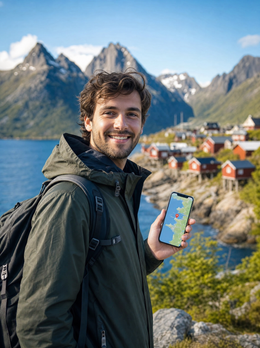
In short: an eSIM for Scandinavia connects you instantly in Norway, Sweden, Denmark, Finland, and Iceland with a single plan and without changing cards at every border. The key is roaming: Norway and Iceland are outside the EU, so without an eSIM, the risk of a surprise bill is real. Install it at home and land with data already active.
Traveling through the Nordic countries and running out of data just when you're looking for fjords or the Northern Lights is a classic. An eSIM for Scandinavia gives you internet as soon as you land in Norway, Sweden, Denmark, Finland, or Iceland, without expensive roaming and without changing cards at every border. Here we tell you what it covers, how many GB to take, and the roaming details that almost no one checks.
Does one eSIM work for all of Scandinavia?
Yes. The most convenient option is a regional Europe eSIM that covers all five Nordic countries with a single plan and price. You buy online, install the profile before you leave, and browse in Norway, Sweden, Denmark, Finland, and Iceland without buying a different eSIM for each country. It's the most practical for a multi-country itinerary.
The alternative is an eSIM per country, which makes sense if you are going to a single destination, for example only to Norway or only to Iceland. But if your plan is Copenhagen, Stockholm, and then the Norwegian fjords, a regional eSIM avoids installing and paying three times. You can see it all together in the Europe eSIM.
The reason a European eSIM works in Scandinavia is that it covers both EU countries and Norway and Iceland, which are not members but are part of the European roaming area. This mix is precisely where the detail we see in the next section lies.
If you're wondering whether to choose a physical international chip or an eSIM for this route, the eSIM wins in convenience for a multi-country itinerary: no need to search for a store or change physical cards every time you cross into Sweden or Denmark. You have the complete comparison in international chip vs. eSIM if you're still not sure. And if this is the first time you've heard of this system, it's worth knowing that an eSIM is nothing more than a digital profile: here we explain what a virtual eSIM is and how to install it without a physical card.

The roaming trick: beware of Norway and Iceland
Here's the mistake that causes bills to skyrocket: Norway and Iceland are not in the European Union. With many Spanish tariffs, "free EU roaming" doesn't apply there, and you can be charged very high rates per MB. Sweden, Denmark, and Finland are in the EU, but it's enough to cross into Norway for roaming costs to soar if you haven't managed it.
That's why an eSIM is so useful in this area: you pay a fixed price known in advance, and it doesn't matter if you're in an EU country or not. There are no surprises on your mobile bill when you return. If you usually rely on your operator's roaming, check beforehand which countries have free roaming on your tariff and see if Norway and Iceland are included (they almost never are).
Quick rule: in Scandinavia, treat anything that isn't Sweden, Denmark, or Finland as "outside the EU" for roaming. With a data eSIM, this distinction no longer matters.
The difference between relying on roaming or carrying an eSIM is very noticeable on a route that mixes EU and non-EU countries. For full details, see the comparison of eSIM vs. roaming.
If the term "data roaming" sounds like fine print in your contract, it's worth understanding it well before you go: it's exactly what your operator charges you for using data outside Spain, and it changes depending on whether the country is in the EU or not. We explain it in detail in what data roaming is. With a local or regional eSIM, that calculation disappears: you pay for the plan you bought, and that's it.
Coverage country by country
Mobile coverage in Scandinavia is among the best in Europe in cities and main roads, becoming irregular in mountain areas, isolated fjords, or the interior of Lapland. An eSIM relies on local operators in each country, so you'll have good signal where they do.
| Country | In the EU? | General coverage |
|---|---|---|
| Norway | No | Very good in cities, weak in remote fjords |
| Sweden | Yes | Excellent in the south and cities |
| Denmark | Yes | Excellent, small and connected country |
| Finland | Yes | Very good, irregular in Lapland |
| Iceland | No | Good on the Ring Road, scarce inland |
As you can see, all five have good general coverage, but Norway and Iceland add the nuance of roaming and remote areas. Plan offline map downloads if you're going to remote routes.

How many GB do you need?
For a typical one-to-two-week trip to Scandinavia, most people use between 5 and 10 GB. If you use your phone a lot for maps, photos, social media, and some video, aim for the higher end. If you only check routes and messaging, less will be sufficient. These are indicative references by profile:
- Light traveler (maps, WhatsApp, some social media): 3-5 GB per week.
- Medium traveler (photos to the cloud, occasional streaming): 5-8 GB per week.
- Intensive use (video, tethering, remote work): 10 GB or more per week.
Keep in mind that on fjord and aurora routes, you'll upload many photos and videos, so it's usually better to err on the side of caution. If in doubt, calculate with a margin over your usual data consumption, and remember that you can always top up without getting stuck.
If you're tight on GB, there are real tricks to extend them: disable automatic app updates, lower the upload quality of photos to social media while traveling, and download music or maps via hotel Wi-Fi instead of on the road. You have the complete list in how to save data with an eSIM on a trip, and if you prefer not to risk it, the regional Europe eSIM lets you add GB on the go without leaving your hotel to find a store.
How to activate it on your trip
Installation is the same as any eSIM and takes 1 minute with Wi-Fi. The key is to do it at home before you leave: download the profile, and when you land, you just need to activate the data. No need to search for a store in a Nordic airport at eleven at night.
The basic process is as follows:
- Buy the regional Europe eSIM and receive the QR or automatic installation.
- Install it at home with Wi-Fi before you leave for your trip.
- Upon arrival in Scandinavia, activate the eSIM data and deactivate roaming on your main SIM.
- Check that you have a signal and you're already browsing.
If this is your first time with this technology, it's good to read what a virtual eSIM is to know what to expect. Also check that your phone is compatible; almost all recent iPhones and high-end Androids are.
Tips for cold weather and remote routes
Scandinavia has two enemies for mobile phones: extreme cold and distances. Cold drains the battery at full speed, so always carry an external battery, especially if you're chasing auroras at night. And on fjord routes, Lapland, or inland Iceland, there will be stretches without coverage, no matter how good your eSIM is.
A couple of recommendations that make a difference:
- Download offline maps from Google Maps or Maps.me before leaving an area with coverage.
- Keep your phone in an inside pocket so that the cold doesn't turn it off.
- Inform someone of your route if you are going to isolated areas: the eSIM provides data, not magical coverage where there are no antennas.
With these habits, the eSIM will solve your internet needs for the vast majority of your trip, which is where you really need it: cities, roads, airports, and towns. For remote stretches, the solution is not the eSIM, it's offline preparation.
Myths and what almost no one tells you about eSIMs in Scandinavia
Before buying, it's worth debunking a couple of circulating ideas that lead to overpaying or running out of coverage where you shouldn't.
- "With a Europe eSIM, I'll have coverage everywhere in the Nordic region": not entirely. Svalbard, the Norwegian archipelago near the North Pole, and the Faroe Islands (Danish territory) are usually outside standard "Europe" plans because they are not part of the usual roaming area. If your route includes either of these, check before buying if the plan explicitly covers them.
- "If I see coverage bars, the speed will be good": in Scandinavia, not always. On routes like the Bergen train or the inland road in Lapland, there are stretches with emergency coverage that's enough for a WhatsApp message but not for loading a map. Download routes offline before venturing into areas of dense forest or mountains.
- "The airport eSIM is the cheapest": almost never. It's bought online days in advance from home, without queues or last-minute rush, so you arrive connected from passport control.
- "If I use the hotel Wi-Fi, I don't need anything else": Nordic hotel Wi-Fi is usually good, but accessing banking or email on an unsecured shared network is not a good idea. For sensitive transactions, it's better to use your own data or review this guide on VPN and privacy while traveling.
And the detail almost no one tells you: in the Sami reindeer herding areas of northern Norway, Sweden, and Finland, lack of coverage is not an eSIM failure; there are simply no antennas. It's an uninhabited area by design, not due to poor infrastructure. If you're going there, let someone know your route and bring plenty of battery.
Frequently asked questions
Does a Europe eSIM work in Norway and Iceland?
Yes. Although Norway and Iceland are not in the EU, they are part of the European roaming area, and regional Europe eSIMs usually cover them. What's more, the eSIM is especially useful there, because your operator's "free EU roaming" doesn't always apply in these two countries.
Can I use a single eSIM for multiple Nordic countries?
Yes, and it is highly recommended if your route includes several. A regional Europe eSIM covers Norway, Sweden, Denmark, Finland, and Iceland with a single plan. This avoids installing and paying for an eSIM per country, which is more expensive and cumbersome on a trip that crosses borders.
How many GB should I take for two weeks in Scandinavia?
For two weeks, a range of 8 to 15 GB covers most people for maps, photos, social media, and some video. If you share your connection or work remotely, increase to 15-20 GB. On aurora and fjord trips, you'll upload many photos, so it's better to overestimate than run short.
Does the eSIM work in the fjords and Lapland?
It works where there is coverage from local operators, which is good in cities and main roads. In remote fjords, inland Iceland, or deep areas of Lapland, there may be no signal from any network. Download offline maps before entering these areas.
Do I need a different eSIM for Iceland?
Not if you have a regional Europe eSIM that includes it. A specific eSIM for Iceland would only make sense if it is your only destination. As it is a country outside the EU, check that your plan covers it; with a good European eSIM, it is usually included.
Do I need my phone unlocked to use an eSIM in Scandinavia?
Yes, it must be unlocked from your original operator to install a different eSIM profile. If you bought it with a contract or financed, check with your operator that it does not have a network lock before installing anything; if it is locked, the eSIM will not activate even if the purchase was made correctly.
What do I do if I run out of data halfway through my trip in Scandinavia?
You can top up or add GB without moving, as long as you have Wi-Fi or another connection to complete the purchase. That's why it's wise to calculate with a margin from the beginning: it's more convenient to buy too much before you leave than to run out of data on a Saturday in a small village in Lapland.
Conclusion
Scandinavia is a destination where an eSIM shines: it saves you the shock of roaming in Norway and Iceland and gives you internet in five countries with a single plan. Bring plenty of GB for photos, install the profile before you leave, and prepare offline maps for remote routes. With that, you can browse the fjords and auroras without thinking about the bill or changing cards.