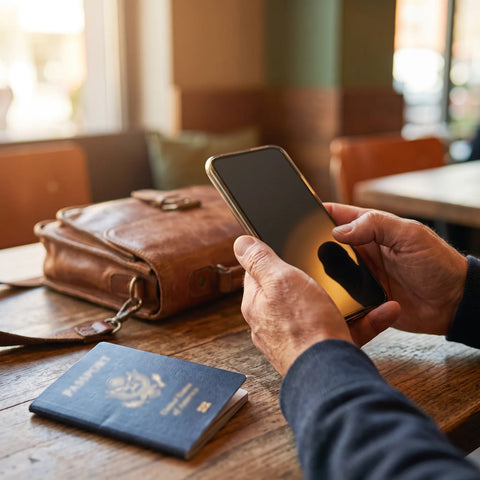
In short: an eSIM for Laos gives you data as soon as you land in Vientiane, with no passport or local SIM queues needed. 4G is more than enough in cities and tourist routes; in the Mekong, mountains, and rural villages, there will be stretches without signal, so download maps beforehand. 8-10 GB will cover a standard two-week trip.
Laos is one of those destinations where connectivity is doubly appreciated: for booking a minivan to Vang Vieng, confirming the slow boat down the Mekong, or translating a menu in Luang Prabang. An eSIM for Laos activated before you arrive gives you data as soon as you land at Vientiane airport, without wasting time looking for a SIM store or negotiating prices in a language you don't speak. If you've never used one, our guide on what a virtual eSIM is clarifies the concept in two minutes. Here you can see what real coverage is like, how many GB to bring, and why it's more worthwhile for most people than a local SIM.
Is an eSIM for Laos worth it?
Yes, especially for convenience and to avoid surprises. An eSIM for Laos connects you to local networks as soon as you land, with no airport formalities or passport needed to register a SIM. You install it at home with Wi-Fi and arrive with internet, which in a country where English isn't always helpful is worth its weight in gold.
Laos is not the most digitized country in Southeast Asia, but cities and tourist routes have enough 4G for a traveler's needs: maps, messaging, translating, and booking transport. The classic alternative is to buy a local physical SIM, but that involves queuing, showing your passport, and risking settings in Lao. With an eSIM, you save all that, and if you're traveling through several countries in the area, you won't even have to change cards. Plus, you avoid roaming from your Spanish operator, which skyrockets outside the EU.

eSIM vs. Local SIM: Unitel, Lao Telecom, and ETL
In Laos, the main operators are Unitel, Lao Telecom, and ETL. A local SIM is usually cheap for data, but it requires passport registration, Lao menus, and in-person top-ups. The eSIM relies on these same networks via roaming agreements, so you get equivalent coverage without any of the hassle.
If you also want to compare the eSIM with the option of a physical international chip bought before you leave, you can find the complete analysis in international chip vs. eSIM. This comparison helps you decide with a clear head:
| Aspect | Local SIM (Unitel/ETL) | PuraSIM eSIM |
|---|---|---|
| Passport registration | Mandatory | Not required |
| Available before travel | No, must be purchased there | Yes, install it at home |
| Configuration language | Lao / basic English | In Spanish, guided |
| Works in multiple countries | Laos only | Regional Asia plans |
| Top-ups | At physical stores | Online in 1 minute |
Practical tip: if Laos is your only long stop and you have plenty of time, a local SIM might be slightly cheaper per GB. But if you value arriving connected and not having to show your passport, an eSIM is definitely worth it.
Coverage by area: from the Mekong to the mountains
Coverage in Laos is good in cities and patchy in rural or mountainous areas. Vientiane, Luang Prabang, Vang Vieng, and Pakse have stable 4G, more than enough for travel. On the slow boat on the Mekong, during treks in the north, or in remote villages, the signal drops or disappears: this is normal and should be expected.
Here's what to expect depending on where you're traveling:
- Vientiane: Solid 4G throughout the capital, perfect for bookings and navigation.
- Luang Prabang: Good coverage in the historic center and temples; a bit weaker at Kuang Si Falls.
- Vang Vieng: Decent signal in the town; patchy during tubing and cave tours.
- Mekong and rural north: Stretches with no coverage; download maps and offline translations before you go.
The recommendation is clear: always have your routes downloaded on Google Maps and an offline translator, because there will be dead zones between stages. You'll regain signal without a problem at tourist stops.

How many GB to bring based on your route
For a typical trip to Laos of one to two weeks, 5 to 10 GB will more than suffice for most people. Usage here is lighter than in a city destination: lots of maps, messaging, and translating, little streaming. If you're going to upload a lot of photos and videos or work remotely, upgrade your plan.
- Disconnected backpacker (1-2 weeks): 5 GB, relying on guesthouse Wi-Fi.
- Standard traveler (10-14 days): 8-10 GB for daily maps, social media, and bookings.
- Content creator or digital nomad: 15 GB or more, or top-up online.
Remember that you'll spend much of your time in Laos in places with free Wi-Fi (cafes, accommodations), so your data goes further than it seems. If you're running low on GB or want to maximize your plan, the guide on tricks to save data with your eSIM has settings that make a difference on a long trip (disable automatic updates, download maps beforehand, and lower the quality of photos you upload to social media).
Laos as part of a Southeast Asia itinerary
Almost no one travels only to Laos: it's common to combine it with neighboring countries on a multi-week backpacking trip through Southeast Asia. If this is your case, before buying anything, carefully check which countries are included in the plan's coverage: a single-country plan is not the same as one that covers the entire region, and the price and GB vary greatly depending on what you choose.
If your route continues beyond Southeast Asia to other parts of Asia—Seoul or Busan, for example, increasingly common in long continental itineraries—take a look at the eSIM for South Korea guide to plan that stage in advance. And if you're concerned about security when connecting to Wi-Fi in guesthouses and hostels along the way, it's advisable to add a travel VPN to your eSIM, especially if you're going to check your bank or email from public networks shared with other travelers.
How to activate it step-by-step
Activating an eSIM for Laos takes minutes and can be done entirely from home. You buy the plan, instantly receive the installation code, add it to your phone's settings, and decide when it starts counting. When you arrive in Vientiane, you'll just need to activate data roaming for that line, and you're good to go.
The step-by-step is simple:
- Confirm your phone is eSIM-compatible before purchasing.
- Choose your Laos or Asia plan and receive the code in 1 minute.
- Install it with Wi-Fi at home following the guide on how to install an eSIM.
- Upon landing, activate data roaming for that line and start browsing.
Before buying, check your phone settings (Settings > Mobile Data > Add eSIM, or similar depending on the model) to ensure it supports this technology: almost all smartphones from recent years do, but it's best to check calmly at home, not in an airport queue. And if something doesn't connect upon arrival, Spanish-speaking support is available at any time to resolve it before it ruins your day.
What almost no one tells you about eSIMs in Laos
Beyond the basics, there are small details that make the difference between arriving in Vientiane relaxed or struggling with your phone on the first day:
- Vientiane airport Wi-Fi doesn't always save you. Many times it asks for SMS verification to a local number that, obviously, you don't have. If your eSIM is already installed and you just need to activate data roaming for that line, you avoid that absurd loop as soon as you get off the plane.
- At the land border from Thailand (Friendship Bridge), it takes a while for your phone to drop the Thai network. It's normal to see "no service" or a flashing roaming icon for a few minutes while it switches operators; don't restart your phone every two minutes, give it time.
- The rainy season (approx. June to October) affects signal in mountainous areas. 4G towers in the north, around Nong Khiaw or Luang Namtha, lose some range during heavy storms. It's not an eSIM fault; it's the topography and weather working against you.
- The "free" Wi-Fi at some guesthouses along the Mekong is worse than your mobile data. In small river towns, it works via satellite and gets saturated in the afternoon when all guests connect at once. Often, it's faster to use your eSIM than to fight with that shared network.
- Google Maps offline doesn't always include rural dirt tracks. For treks in the north or motorbike routes off-road, combine it with Maps.me or similar as a backup: it covers paths that the official map misses.
- Do not activate data roaming for that line until you land. If you activate it before takeoff, some phones try to connect to networks of countries you fly over, and you might accidentally use data or generate confusing roaming alerts.
Frequently asked questions
Does eSIM work well in Laos outside of cities?
In Vientiane, Luang Prabang, Vang Vieng, and Pakse, it works very well with 4G. In rural areas, mountains, and on the slow boat on the Mekong, the signal drops or disappears, just like with any local SIM. Download offline maps and translations for those stretches.
Is it better to buy a local SIM at Vientiane airport?
A local SIM might be slightly cheaper per GB, but it requires passport registration, queues, and menus in Lao. An eSIM is installed at home, you arrive connected, and you don't give away your data. For most travelers, the convenience of an eSIM outweighs the alternatives.
How many GB do I need for two weeks in Laos?
Between 8 and 10 GB will cover two weeks of standard travel: daily maps, messaging, translating, and some social media. Since you'll use guesthouse and cafe Wi-Fi a lot, your data will go further. If you upload many videos, choose 15 GB or top-up on the go.
Can I use the same eSIM if I continue to Thailand or Vietnam?
If you choose a regional Asia plan, yes: the same line works in Laos, Thailand, Cambodia, and Vietnam without changing cards at each border. If you buy a Laos-only plan, it won't cover neighboring countries. For backpacking routes, the regional plan is the best option.
Do I need a passport to use an eSIM in Laos?
No. Unlike a local physical SIM, which requires passport registration, an eSIM does not require any identity formalities. You buy online, install the code, and activate data upon arrival. It's one of its big advantages over traditional cards.
Can I run out of data midway through my trip and top up from Laos?
Yes. If you find yourself running low on GB in Luang Prabang or Vang Vieng, you can buy another plan or top up online as soon as you have Wi-Fi, without needing to find a physical store. This is one of the advantages over a local SIM, where depending on a point of sale can be a problem if you're in a small area.
Does the eSIM work as soon as I land at Vientiane airport?
Yes, provided you've installed it beforehand with Wi-Fi at home. When you get off the plane, you just need to activate data roaming for that line in your phone's settings, and within seconds you'll have coverage from the local network without going to any counter.
Conclusion
Laos is much more enjoyable when you arrive connected: no queues for a local SIM, no need to show your passport, and with data to get around Vientiane, Luang Prabang, and the Mekong. 8-10 GB will cover a standard trip, and if you're combining neighboring countries, it's a good idea to check the plan's coverage carefully before buying. Install your Laos eSIM in 1 minute and focus on the slow boat, not on finding Wi-Fi.