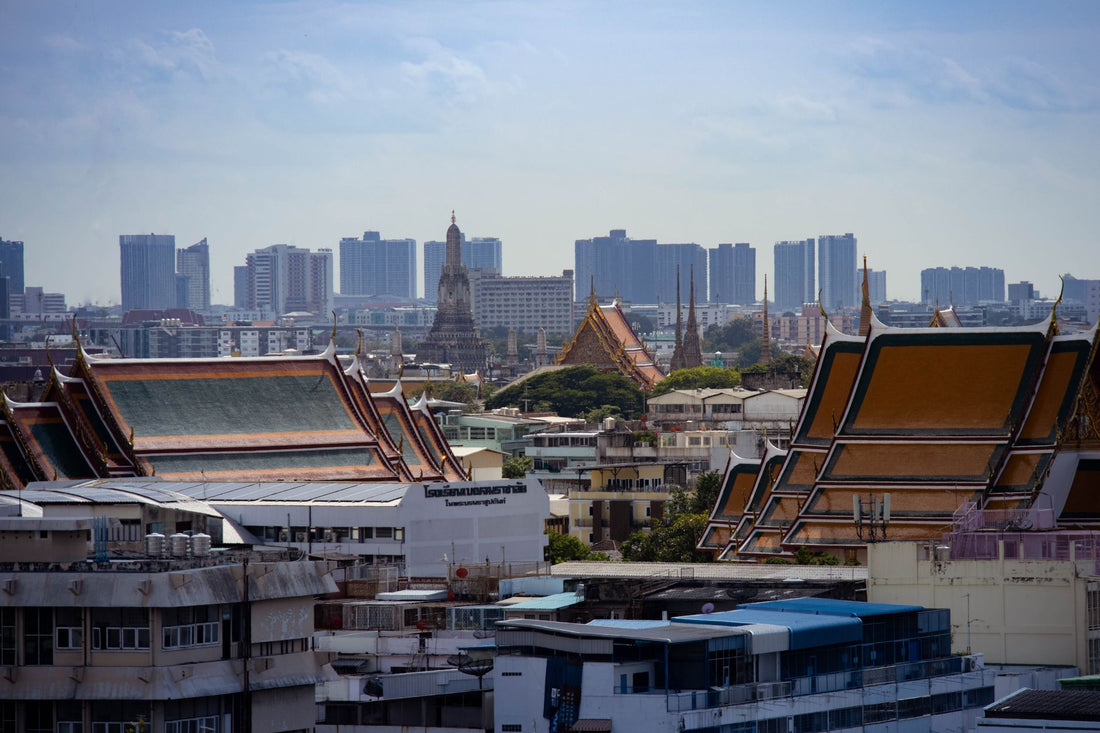
Thailand is one of the most visited destinations in the world, and it's not hard to see why: golden temples, dream beaches in Phuket, the inexhaustible energy of Bangkok, and the cultural tranquility of Chiang Mai form a combination rarely found elsewhere. But to enjoy all of this to the fullest, you need to be connected: checking real-time maps, booking transportation, finding restaurants, and sharing those moments on social media are activities that depend entirely on reliable mobile data.
The classic problem for Spanish-speaking travelers is roaming. Using your usual SIM in Thailand can skyrocket your bill to unthinkable levels: some European and Latin American operators charge several euros or dollars for each megabyte outside their coverage area. The smart alternative is a local data eSIM, which allows you to have a Thai SIM card on your phone without needing to physically change anything.
In this guide, we tell you everything you need to know before your trip: how good the coverage is in the main cities, how many GB are enough for your itinerary, how to activate your eSIM without complications, and some practical tips that you'll only learn once you've been there.

1. Internet in Thailand: what to expect
Thailand has a surprisingly robust telecommunications infrastructure for a Southeast Asian country. Its three major operators—AIS, DTAC (now merged with True Move H), and True Move H—compete intensely, which translates into low prices for locals and very broad coverage in tourist areas.
The 4G LTE network is available in practically all cities and tourist areas of the country. In Bangkok, you'll find excellent coverage on the subway (BTS Skytrain and MRT), in shopping malls, hotels, and public spaces. 5G is already available in some areas of central Bangkok, although for travelers with data eSIMs, 4G is more than sufficient for everyday use.
Average 4G download speeds are around 30-50 Mbps in urban areas, enough for high-quality video calls, uninterrupted music or podcast streaming, and smooth Google Maps usage. In more rural areas between cities, speeds may drop to 10-20 Mbps, but the connection remains stable.
An important fact for travelers: almost all hotels, hostels, and restaurants in Thailand offer free WiFi, but the quality varies greatly. Relying only on hotel WiFi to plan your days can be frustrating when you need it most—like when you're in a tuk-tuk looking for directions to the Temple of the Emerald Buddha. Having your own data connection is the only way to ensure you're always connected.
Thailand's extreme heat—especially between March and May, when temperatures exceed 38°C—significantly accelerates mobile battery consumption. Remember to have your phone charged when you arrive at Suvarnabhumi Airport so you can activate your eSIM and connect without delays. Carrying a compact power bank can be the best investment of your trip.
2. How many GB do you need? City guide
This is the question we get asked most often: how much data do I need for my trip to Thailand? The answer depends on your travel style, but we have a fairly accurate estimate based on the typical usage of Spanish-speaking travelers.
For a 10-day trip combining Bangkok, Phuket, and Chiang Mai, our recommendation is a plan between 8 and 12 GB. This is what an average traveler consumes per day:
- Google Maps in real-time: 20-30 MB per hour of active navigation
- Social media (Instagram, TikTok, Facebook): 100-300 MB per hour depending on usage
- WhatsApp with photos and videos: 50-150 MB per day
- Video calls (FaceTime, Zoom, WhatsApp): 250-500 MB per hour
- Web searches, bookings, Tripadvisor: 20-50 MB per day
- Spotify or streaming podcasts: 40-70 MB per hour
A traveler who uses their mobile moderately—navigation, social media, messaging, and an occasional video call—consumes approximately 600 MB to 1 GB per day. In 10 days, that's between 6 and 10 GB. That's why we recommend an 8-12 GB plan: you have enough leeway without going overboard.
If you're someone who uploads real-time stories, live streams your trip, or works remotely during vacation, consider the 12 GB plan or more. If, on the other hand, you use hotel WiFi a lot and your mobile only for maps and messages, the 8 GB plan will be more than enough.
In Bangkok, consumption is usually higher because you're constantly navigating between attractions, looking for restaurants on Google Maps, and sharing photos. In Phuket and Chiang Mai, the pace is more relaxed and consumption drops a bit, although on the beaches or at the Chiang Mai night market, social media usage skyrockets.

3. Bangkok: connected in the city of temples
Bangkok is one of Asia's most dynamic cities and one that offers the best connectivity to travelers. With over 10 million inhabitants and being one of the most visited tourist destinations in the world, the mobile infrastructure of the Thai capital is top-notch.
4G coverage in Bangkok is practically universal throughout the urban area. From Suvarnabhumi Airport to the Sukhumvit district, passing through the Chao Phraya River and the floating markets, you will have a constant signal. The BTS Skytrain and MRT subway offer coverage even in tunnels, which is not the case in many European cities.
The main tourist attractions where you will most need data in Bangkok:
- Temple of the Emerald Buddha (Wat Phra Kaew) and Royal Palace: You will need your mobile to check the complex map and schedules. Admission costs 500 baht (approximately 13 euros) and the place is huge.
- Wat Arun Temple: On the banks of the Chao Phraya River. Tuk-tuks don't always know exactly where to drop you off, so Google Maps is essential.
- Chatuchak Market: With over 8,000 stalls, it's easy to get lost. A stable connection will help you navigate and share your location with your group.
- Khao San Road: The quintessential backpacker area. Excellent signal, although during peak hours the network can be saturated.
Transportation in Bangkok also depends on your connection. Apps like Grab (the Thai equivalent of Uber) are essential for getting around economically and safely. Without data, you will have to negotiate prices with local taxi drivers, which can be complicated if you don't speak Thai. With an active eSIM, ordering a Grab from anywhere in the city takes seconds.
A practical tip: if you have a connecting flight or arrive late at night, activate your eSIM before leaving your home country. Upon landing at Suvarnabhumi, Bangkok's airport, you will have an immediate connection to notify whoever is waiting for you or order your first Grab directly to the hotel.
4. Phuket and Chiang Mai: coverage outside the capital
While Bangkok is the most common entry point, many travelers dedicate most of their itinerary to Phuket and Chiang Mai, which have very different profiles in terms of both tourist experience and mobile coverage.
Phuket: tropical paradise with good signal
Phuket is Thailand's largest island and one of its most popular tourist destinations. 4G coverage in the main tourist areas—Patong Beach, Kata, Karon, and the Phuket Town area—is excellent. However, in some more remote beaches or on the cliffs of the northern part of the island, the signal may be weaker.
The most important thing in Phuket is to have data to organize boat excursions to nearby islands like Phi Phi or James Bond Island. Many agencies operate through apps and WhatsApp, and booking in advance from the hotel is much easier (and cheaper) than booking at the pier.
Chiang Mai: the jewel of the north
Chiang Mai, the cultural capital of northern Thailand, has surprisingly good 4G coverage in both the walled city and modern neighborhoods. Warorot night market, historic temples like Wat Chedi Luang, and trendy cafes in the Nimman neighborhood offer stable signal at all times.
Where coverage becomes more variable is on excursions to the northern mountains and tribal villages, especially in the Doi Inthanon area or near the Myanmar border. In these areas, you may experience moments without signal, so we recommend downloading Google Maps offline maps before you leave.
The plane journey between Bangkok and Chiang Mai or Phuket is very affordable (Air Asia and Bangkok Airways have flights from 30-50 euros), so most travelers move between cities by plane. Upon arrival at each regional airport, your eSIM will remain active and connected without any additional action required.
5. How to activate your eSIM for Thailand step by step
One of the great advantages of eSIMs over traditional physical SIMs is that you can install and configure them before leaving home. You don't need to queue at the airport, you don't risk losing a tiny physical card, and you don't have to keep your usual SIM in a safe place during your trip.
The activation process for a PuraSIM eSIM for Thailand is as follows:
- Purchase your plan at purasim.com: Choose the 8 or 12 GB plan for Thailand. In less than 5 minutes, you will receive an email with your activation QR code.
- Install the eSIM on your phone (before traveling): On iPhone, go to Settings > Cellular > Add Data Plan and scan the QR. On Android, the process varies depending on the manufacturer, but it's usually in Settings > Network & Internet > SIM > Add eSIM.
- Set up the eSIM but DO NOT activate it yet: Once installed, turn off data for the eSIM in the settings. Keep it ready but paused until you arrive in Thailand. This prevents you from accidentally consuming data before your trip.
- Upon arrival in Thailand (Suvarnabhumi Airport or any other): Activate the PuraSIM eSIM data in your phone's settings. Make sure your phone is charged for this step—Thailand's extreme heat drains battery quickly, especially in summer.
- Make sure the eSIM is the primary data line: On dual SIM phones, verify that the PuraSIM eSIM is set as the active data line, not your usual SIM.
If you have any problems during installation, the PuraSIM support team is available via WhatsApp and chat on our website. Most issues are resolved in less than 10 minutes.
An important detail: make sure your phone is not carrier-locked. Phones purchased with a contract from some operators may be locked to only use SIM cards from that operator. If in doubt, contact your current operator before purchasing the eSIM.
The PuraSIM eSIM works with local Thai networks (mainly AIS and True Move H), which offer 4G LTE coverage in all tourist areas of the country. Once connected, you can use WhatsApp, Google Maps, Instagram, and any app in the same way you do at home, without bill surprises.
Frequently asked questions
How many GB do I need for 10 days in Thailand?
For a 10-day itinerary combining Bangkok, Phuket, and Chiang Mai with normal mobile use (maps, social media, messaging, and occasional video calls), we recommend between 8 and 12 GB. If you constantly upload content to social media or work remotely, opt for the 12 GB plan. If your usage is more moderate and you take advantage of hotel WiFi, the 8 GB plan will be sufficient.
Does the eSIM work on Thai islands like Koh Samui or Phi Phi?
Yes, the PuraSIM eSIM works on the main tourist islands of Thailand, including Koh Samui, Koh Phangan, Koh Tao, Phi Phi, and the islands near Phuket. Coverage in beach areas and tourist towns is good, although in very remote beaches or in the interior of smaller islands it may be weaker or non-existent.
Can I install the eSIM on my Android phone?
Yes, most Android smartphones released since 2020 are eSIM compatible: Samsung Galaxy S21 and later, Google Pixel 3 and later, Motorola Edge series, and many others. To check if your phone is compatible, go to Settings > About phone and look for the eSIM or IMEI2 option. If you have doubts, write to us and we will confirm compatibility.
Do I have to pay additional roaming fees when traveling between Bangkok, Phuket, and Chiang Mai?
No. Your PuraSIM eSIM for Thailand works throughout the country, including domestic flights and transfers. It doesn't matter if you travel from Bangkok to Phuket by plane or from Chiang Mai to Bangkok by night train: the connection remains the same with no additional costs.
What happens if I run out of data before my trip ends?
If you use up all your GB before the end of your trip, you can purchase an additional plan from the PuraSIM platform. You can also connect to hotel and cafe WiFi for activities that don't require mobility, and save your mobile data for when you're out exploring the city.
Activate your eSIM before you leave and arrive connected from the moment you land at Suvarnabhumi Airport.
See eSIM plans →