
In brief: An eSIM for Madagascar works across the entire island wherever the Telma, Orange, or Airtel networks reach: whether in Antananarivo, the coast, or tourist circuit towns, with normal outages on remote tracks and parks. You install it before flying, activate it upon landing in Ivato, and avoid queues, expensive roaming, and losing your Spanish number.
Madagascar is unlike any other destination: it's an island the size of France with roads that take a full day to cover three hundred kilometers, generators that provide electricity for only a few hours, and nature that compensates for every bump on the RN7. Arriving with data already sorted, without relying on finding an open Telma store in Antananarivo, changes the trip. Here's the real coverage, operators, how many GB you need, and how to get everything ready before leaving home.
Does an eSIM work in Madagascar?
Yes, as long as your mobile phone is compatible and unlocked. The eSIM connects to a local operator's network (usually Telma or Orange) as soon as you activate data, so you have internet from Ivato airport without searching for a sales stand or queuing with the rest of the flight. It's installed with a QR code and coexists with your physical Spanish SIM: you keep your number for calls and WhatsApp, and use the eSIM only for browsing.
To check if your phone supports eSIM, dial *#06# and see if an EID number appears. Most mobile phones from the last five or six years have it, but if you have doubts, it's best to resolve them before paying anything: we explain it in detail in what is a virtual eSIM.
Madagascar is a destination of extreme nature—baobabs, lemurs, reefs—where having the map, translator, and accommodation reservations handy makes the difference between a smooth day and one spent wasting time looking for Wi-Fi in a hotel with barely any fixed network coverage.
Real coverage on the island
Coverage is solid in Antananarivo, Nosy Be, Toamasina, and Antsirabe, with 4G that holds up well for maps, messaging, and uploading photos. The problem isn't the cities: it's everything in between. Madagascar is the size of France and has only one main road in good condition—the RN7, which connects the capital with Tulear, passing through Antsirabe, Ambositra, Ranomafana, and Isalo; on the winding sections between these towns, the signal comes and goes, and there are hours at a time with no signal.
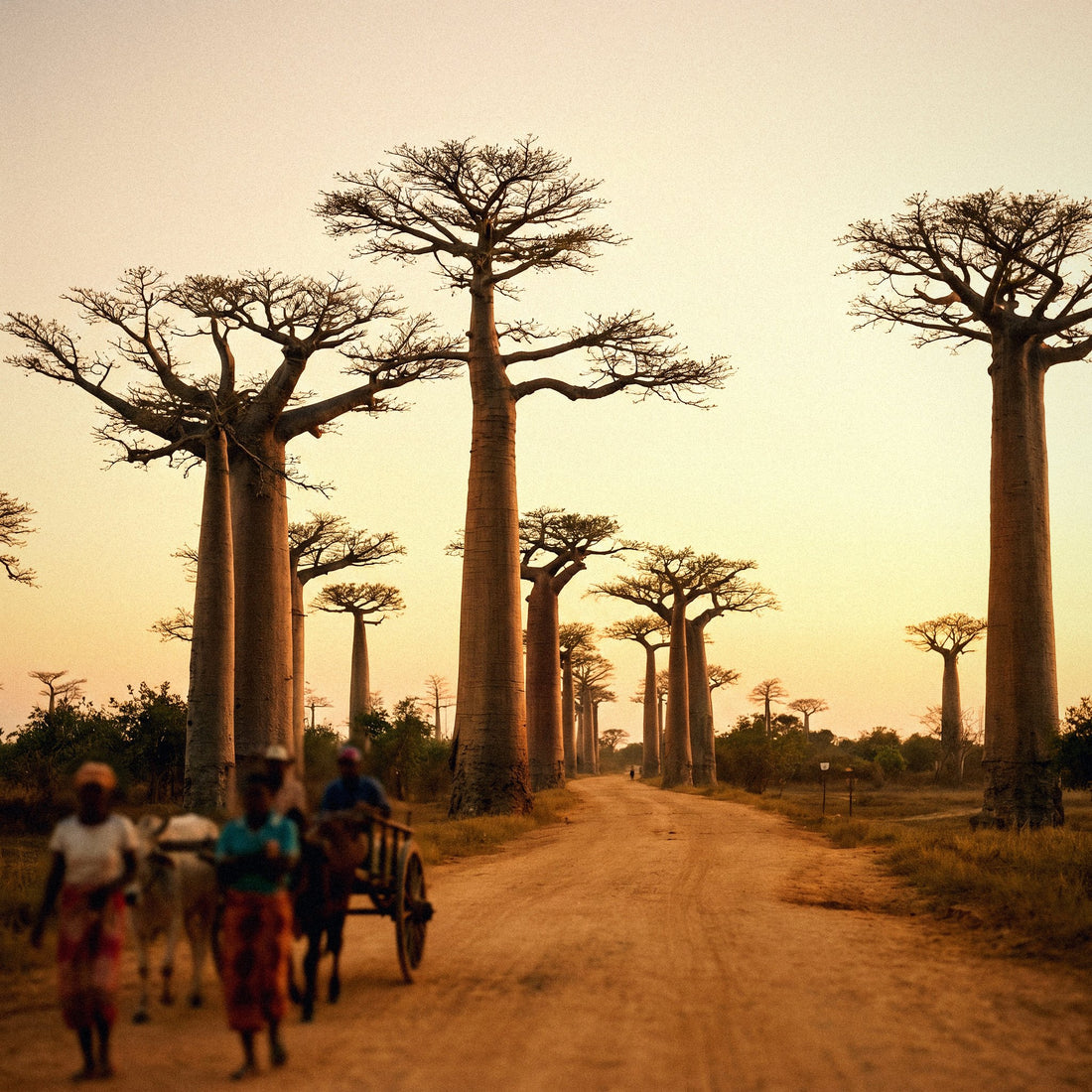
If your route includes Isalo National Park, the Avenue of the Baobabs near Morondava, or the Ranomafana rainforest, you will have data in the base village but not inside the park itself: local guides don't rely on coverage to take you to see lemurs, so you won't need it on the trail, though you will before and after to confirm that night's hotel.
Traveler's tip: download offline maps of your entire route and accommodation bookings before leaving Antananarivo. On a normal journey along the RN7, you will spend long stretches without stable coverage, and the taxi-brousse won't stop for you to update the GPS.
In the north, Diego Suarez and Amber Mountain have better signal than you'd expect for the remoteness of the area, thanks to tourism. In Île Sainte-Marie, very popular between July and September for humpback whale watching, coverage is concentrated in the town and drops significantly on the southern beaches of the island. For an overview of the continent as a whole, you can check our general guide to eSIM for Comoros if your itinerary includes that neighboring archipelago, which is very common as a stopover or combined with northern Madagascar.

Local operators: Telma, Orange, and Airtel
Three mobile networks operate in Madagascar, and a good eSIM connects to the one with the best signal in each area without you having to manually choose:
| Operator | Strength | Where it performs best |
|---|---|---|
| Telma | Largest fiber and 4G deployment in the country | Antananarivo, east coast, major cities |
| Orange Madagascar | Good presence in tourist areas | Nosy Be, Antananarivo, main road axes |
| Airtel Madagascar | Competitive coverage inland | Rural areas and highland villages |
The difference from buying a physical Telma or Orange SIM upon arrival is that you don't need to register your passport at a store, figure out how to top up in French or Malagasy, or rely on the counter accepting your foreign card. The eSIM comes with data already loaded before you leave home, so your connection is sorted without stepping foot in a store in the country.
How many GB you need for your trip
For a nature trip like Madagascar, consumption is usually moderate: offline maps with some active GPS, WhatsApp, occasional social media, and uploading photos at night at the hotel. This table provides guidance based on the type of traveler:
| Travel Profile | Typical Use | Estimated Data |
|---|---|---|
| 1-week getaway (Antananarivo + Nosy Be) | Maps, messaging, basic social media | 3-5 GB |
| 2-week circuit on the RN7 | Daily navigation, photos, some video | 8-10 GB |
| Month of nature and trekking | Continuous use + sharing connection with the group | 15-20 GB |
An important nuance for Madagascar in particular: when spending so many hours without coverage on the road, your actual consumption almost always falls below what you estimate before leaving. If you usually run short or have too much data halfway through your trip, in how to save data on a trip, you'll find specific tricks to stretch your GB without giving up anything essential.
How to activate your eSIM step by step
Activating the eSIM is the easiest part of the entire trip, and it's best to do it in Spain, with your home Wi-Fi, not in the check-in queue:
- Buy the eSIM and receive the QR code instantly by email.
- With Wi-Fi, go to Settings > Mobile Data > Add eSIM and scan the QR.
- Label the line as "Travel" so you don't confuse it with your main SIM.
- Upon landing in Ivato, activate data and, if your phone prompts, roaming for that specific line.
Install it before flying but do not activate it until you arrive in Madagascar: that way, your plan's day counter starts when you really need it. If this is your first time with this type of card, the complete process with screenshots is in how to install an eSIM.
eSIM vs. local SIM and roaming
You have three ways to get internet in Madagascar, and not all of them are equally worthwhile. Roaming from your Spanish operator skyrockets outside the European Union, so unless you activate a specific bonus from your company for a single day, it's not a reasonable option for two or three weeks of travel. A local SIM is cheap but requires registering your passport at a store, changing your physical card, and losing your number while it's in use. The eSIM combines the best of both: a fixed price before you leave and zero paperwork upon arrival.
- Roaming: convenient but expensive outside the EU; only makes sense for a rare emergency.
- Local SIM: economical but with paperwork, queues, and no support in your language if something goes wrong.
- Travel eSIM: you install it beforehand, keep your Spanish number, and know what you'll pay in advance.
If you want the full side-by-side comparison with examples, we break it down in eSIM vs. roaming and in international chip vs. eSIM.
What almost no one tells you
There are details about Madagascar that aren't mentioned in general eSIM guides but do change your real-world experience:
- Electricity matters more than coverage. Many lodges and roadside hotels operate with generators for a few hours a day, usually at dusk. If your battery dies in the afternoon, even if you have coverage, you won't be able to charge your phone until night: carry a fully charged power bank every morning; it's more critical than having extra GB.
- The taxi-brousse won't wait for your GPS. If you're traveling by shared road transport, the driver won't stop because your navigation has cut out. Have your route and drop-off point written down or in a screenshot, not just on the live map.
- When NOT to buy an eSIM. If your trip is just a one-day layover in Antananarivo en route to another destination, or you're on an all-inclusive package where the hotel provides decent Wi-Fi and you barely leave the premises, you probably have enough with the accommodation's Wi-Fi and don't need to spend on mobile data for such little use.
- Save the QR code on paper or captured too. If you lose the email or run out of battery just upon arrival, having the QR saved as an image (not just in the email) saves you the problem of not being able to activate anything when you land.
- Be careful with hotel Wi-Fi for online banking. Many hotel Wi-Fi networks in Madagascar are open and shared by dozens of guests. For checking your bank or making payments, it's better to use your eSIM data than that shared network; if you also want an extra layer of privacy on public networks, we explain it in eSIM and VPN for private travel.
If you continue your journey after Madagascar
Many itineraries to Madagascar include a long layover at a European airport, or the traveler continues to another country before returning to Spain. If you're going to spend hours or a couple of days with a transit connection through Europe, you don't need anything new for Madagascar itself, but you might be interested in having that part of the journey sorted separately: check out the eSIM for Europe if your return includes a long layover or a few additional days on the continent before heading home.
Frequently asked questions
Does the eSIM work throughout Madagascar?
It works wherever the Telma, Orange, or Airtel networks reach: cities, towns, and main roads with 4G or 3G. In very remote national parks and inland tracks, the signal may disappear, just as it would for any local Malagasy SIM, so it's not a limitation exclusive to the eSIM.
How much does an eSIM for Madagascar cost?
The price depends on the GB and days you contract; check the current price on the product page before purchasing. What you can compare is the concept: it's a fixed price you know in advance, compared to international roaming, whose cost can skyrocket without you realizing it until the bill arrives.
Can I still use WhatsApp with my Spanish number?
Yes. The eSIM provides you with data, but your number and your apps—WhatsApp, Telegram, banking—continue to function with your usual identity. You keep your physical SIM for calls and SMS and use the eSIM only for internet browsing.
Do I need to register my passport as with a local SIM?
No. One of the advantages of a travel eSIM is that there's no registration or paperwork. You buy online, receive the QR by email, and activate it upon arrival. This saves you the queue and identification process that Telma or Orange stores within the country require.
When should I activate the eSIM, before leaving or upon landing?
Install it in Spain with Wi-Fi, but only activate data upon landing in Ivato. This way, your plan's day counter starts when you truly need it and you don't lose travel days while still on the plane or during a layover.
Is there Wi-Fi at Antananarivo airport in case something goes wrong?
There is Wi-Fi in the terminal, but it's erratic, and you shouldn't rely on it to solve an unforeseen problem right after landing, with the immigration queue behind you. That's why it's worth having the eSIM already installed and checked before leaving Spain, and activating it the moment you turn on your phone on the tarmac.
Can I use two eSIMs or one eSIM and my physical SIM at the same time in Madagascar?
Most modern mobile phones allow you to have your physical Spanish SIM and the data eSIM active at the same time, each with its own function: calls and SMS on one hand, mobile data on the other. Before traveling, check that your model supports simultaneous dual active lines, as this varies by manufacturer.
Conclusion
Madagascar rewards the traveler who arrives well-prepared: maps downloaded, accommodations saved, and data sorted before boarding the plane. With this foundation, irregular coverage on tracks and in parks ceases to be a problem and simply becomes part of the landscape. An eSIM for Madagascar gives you reliable internet in Antananarivo, the coast, and major roads, without overpaying or losing your Spanish number. You install it before flying and activate it upon arrival, in a minute, to dedicate the rest of your trip to the baobabs, not to finding coverage.